Editorial Transparency: Content compiled from official
government sources by the GlobalMobilityAI Research Team.
For personalized legal or immigration advice, consult a
licensed immigration consultant or lawyer.
(Last Updated: 2026-05-25)
The Employer Nomination Scheme (subclass 186) remains the gold standard for securing permanent residency in Australia. According to the Department of Home Affairs, employer-sponsored visas account for a significant portion of the permanent migration program, reflecting the nation's targeted approach to filling structural skill gaps (Source: Home Affairs Migration Program, 2026) [https://immi.homeaffairs.gov.au/what-we-do/migration-program-planning-levels]. Securing the Australia 186 ENS visa 2026 is an intricate process, requiring applicants to choose between two primary streams: Direct Entry (DE) and Temporary Residence Transition (TRT).
Understanding the nuanced differences between these pathways is critical to avoiding years of administrative delays. This comprehensive guide unpacks the cost, processing timelines, and strategic advantages of each stream to ensure your transition to permanent residency in Australia is rapid and secure.
Comprehensive analysis of the Australia 186 ENS visa pathways for 2026.
Table of Contents
1. Why Australia in 2026? — The Strategic Case
Australia continues to solidify its reputation as a premier destination for global talent. The nation's focus has distinctly shifted towards employer-sponsored pathways to ensure that migration directly addresses critical economic needs.
1.1 Economic Landscape & Opportunity
Australia's economic resilience remains strong. The OECD Economic Outlook projects GDP growth at 2.4% for 2026 (Source: OECD Economic Outlook, 2026) [https://www.oecd.org/economic-outlook/]. The nation is investing heavily in infrastructure, healthcare, and digital transformation, creating massive demand for highly skilled professionals. This robust economic engine relies on an influx of targeted international talent. By utilizing the Employer Nomination Scheme, the government aligns migration precisely with labor market shortages, offering a stable and prosperous environment for those who possess in-demand skills.
1.2 Why Professionals Are Targeting This Destination
Platform search trends suggest a significant pivot towards Australia for professionals seeking long-term stability and high quality of life. Unlike temporary work visas that leave applicants in a state of uncertainty, the Australia 186 ENS visa 2026 offers immediate permanent residency, which is highly attractive to skilled migrants from Asia, Europe, and the Americas. The appeal is comparable to the high-certainty pathways detailed in our Germany Opportunity Card 2026 definitive guide, emphasizing the global demand for transparent, permanent migration solutions. With world-class healthcare, leading educational institutions, and unparalleled lifestyle benefits, Australia remains an undisputed top-tier destination for strategic career moves.
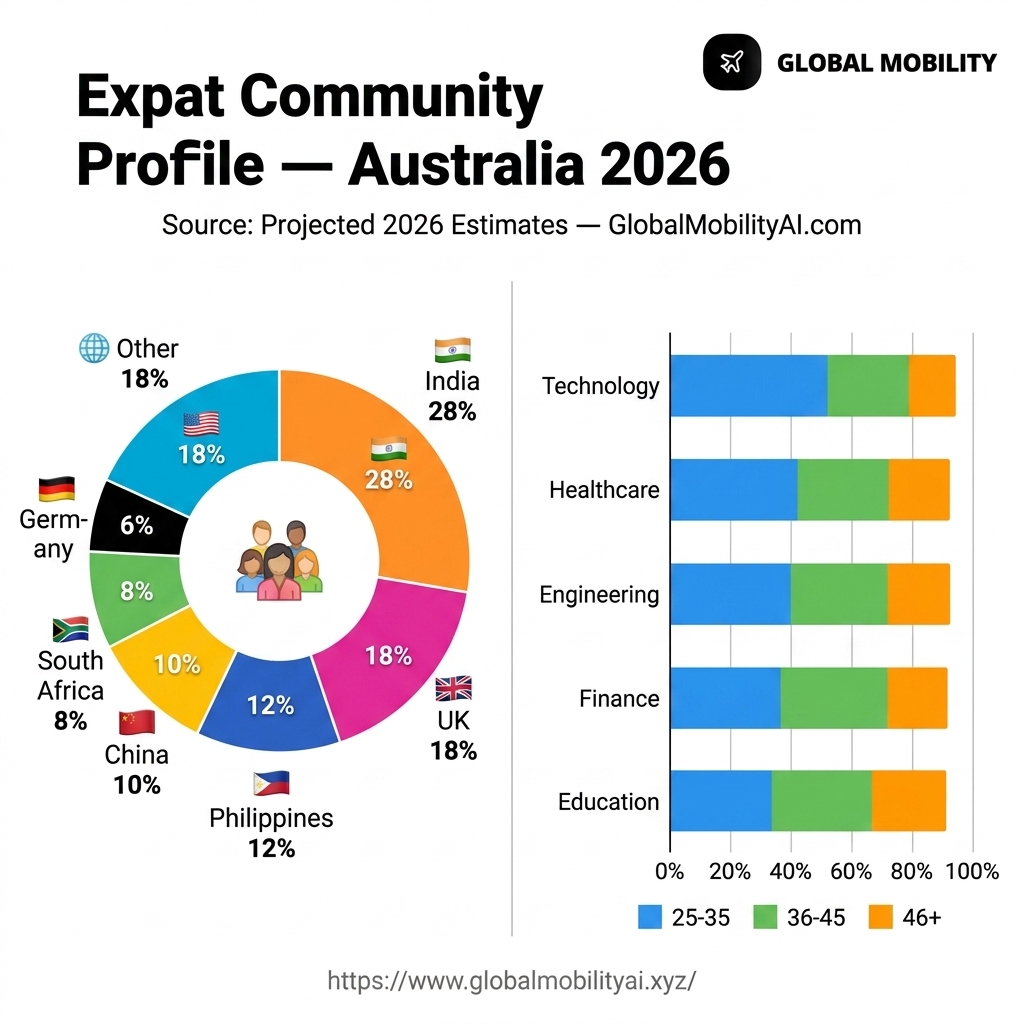
IMG-02: Demographic Distribution
Distribution of skilled migrants and sponsored professionals in Australia's 2026 intake.
2. Deep-Dive Analysis: Legal & Financial Framework
Securing the subclass 186 visa requires a meticulous understanding of its strict legal criteria. The Department of Home Affairs leaves virtually no room for error in employer-sponsored applications.
2.1 Legal Requirements & Visa Categories
The Australia 186 ENS visa 2026 operates primarily through two dominant streams:
Both streams require the employer to pay the Temporary Skilled Migration Income Threshold (TSMIT), which is strictly enforced at $76,515 AUD, plus superannuation (Source: Home Affairs TSMIT Guidelines, 2026) [https://immi.homeaffairs.gov.au/visas/employing-and-sponsoring-someone/sponsoring-workers/nominating-a-position]. The base application charge is currently $4,770 AUD per main applicant.
2.2 Eligibility Criteria & Qualification Scoring
Unlike points-tested visas, the 186 ENS is entirely employer-driven. Key eligibility criteria include:
2.3 Required Documentation & Official Checklists
A comprehensive evidence bundle is essential. This includes:
For the complete, authoritative checklist, always refer directly to the official portal (Source: Home Affairs 186 Checklist, 2026) [https://immi.homeaffairs.gov.au/visas/getting-a-visa/visa-listing/employer-nomination-scheme-186].
3. City Guide — Where to Live in Australia in 2026
Choosing the right base in Australia significantly impacts both your career trajectory and lifestyle. Employer sponsorship often dictates location, but understanding city dynamics is crucial for long-term settlement.
3.1 Top 5 Cities for Expats: Rankings & Analysis

Sydney central business district highlighting job opportunities for Australia 186 visa applicants.
3.2 City Comparison Table
| City | Avg Rent 1BR | Monthly Cost | Job Market | Safety | Expat Rating |
|---|---|---|---|---|---|
| Sydney | $2,800 AUD | $4,500 AUD | Elite | High | 8.8/10 |
| Melbourne | $2,300 AUD | $3,900 AUD | Very High | Moderate | 9.0/10 |
| Brisbane | $2,100 AUD | $3,600 AUD | High | High | 8.5/10 |
| Perth | $2,000 AUD | $3,500 AUD | Very High | Moderate | 8.2/10 |
| Adelaide | $1,800 AUD | $3,200 AUD | Medium | Very High | 8.0/10 |
(Source: Numbeo Australia 2026, 2026)
4. Cost of Living — Complete 2026 Breakdown
Understanding the financial realities of Australian life is essential before accepting an employer's nomination.
4.1 Monthly Budget Calculator Breakdown
For a single professional living in a major capital city like Melbourne, typical monthly expenses amount to:

Monthly budget breakdown and cost of living for expats in Australia 2026.
(Source: Numbeo Cost of Living Survey Australia, 2026) [https://www.numbeo.com/cost-of-living/in/Melbourne]
4.2 Cost of Living vs. Salary: What You'll Actually Save
Your ability to save depends heavily on your seniority. These estimates assume standard Australian income tax rates and Medicare levies.
(Source: Australian Taxation Office (ATO) Calculator, 2026) [https://www.ato.gov.au/single-page-applications/calculatorsandtools?anchor=STC#STC]
You can model your specific financial scenario using our GlobalMobilityAI cost of living calculator to ensure your sponsored salary meets your savings goals.
4.3 Cost of Living Index vs. Home Countries
| Category | Australia | Pakistan | India | UK |
|---|---|---|---|---|
| Consumer Prices | 100% (Baseline) | -65% | -62% | -10% |
| Rent Prices | 100% (Baseline) | -80% | -78% | -15% |
| Groceries | 100% (Baseline) | -55% | -58% | -12% |
| Local Purchasing Power | 100% (Baseline) | -70% | -65% | +5% |

Salary and monthly savings trajectory for professionals in Australia 2026.

Cost of living comparison chart Australia versus UK India and Pakistan.
(Source: Numbeo Cost of Living Index 2026, 2026)
5. Salary Data & Job Market Intelligence
To leverage the Australia 186 ENS visa 2026 effectively, your nominated salary must align with robust market standards, not just the legal minimum TSMIT.
5.1 Average Salaries by Industry (2026 Data)
| Industry | Entry Level | Mid-Level | Senior | Currency |
|---|---|---|---|---|
| Software Engineering | $90,000 | $140,000 | $190,000 | AUD |
| Healthcare (Nursing) | $75,000 | $95,000 | $120,000 | AUD |
| Civil Engineering | $85,000 | $130,000 | $175,000 | AUD |
| Data Analytics | $85,000 | $135,000 | $180,000 | AUD |
| Corporate Finance | $80,000 | $125,000 | $170,000 | AUD |

Australian engineering and tech professionals in a modern collaborative workspace.
(Sources: SEEK Australia Salary Guide, 2026 [https://www.seek.com.au/career-advice/page/salary-guide] | Jobs and Skills Australia, 2026 [https://www.jobsandskills.gov.au/])
5.2 In-Demand Skills & Sectors in 2026
The Australian labor market faces acute shortages in specific sectors, drastically increasing sponsorship opportunities. According to the National Skills Commission, critical shortages persist in healthcare, advanced manufacturing, green energy engineering, and cybersecurity. Employers in these domains are highly motivated to sponsor candidates via the Australia 186 ENS visa 2026 due to the immediate need for permanent, reliable talent (Source: Jobs and Skills Australia Report, 2026) [https://www.jobsandskills.gov.au/].
5.3 How to Use GlobalMobilityAI Salary Comparison Tool
Before accepting an employer nomination, utilize the GlobalMobilityAI salary comparison tool. This feature benchmarks salary data across Australian cities, ensuring your proposed remuneration package is fair, meets legal compliance, and aligns with your long-term financial objectives.
6. CV Formatting — Australia-Style Resume Guide
Australian employers prioritize clarity, evidence-based achievements, and cultural fit. Your CV must be flawless to secure the sponsorship required for the Australia 186 ENS visa 2026.
6.1 Australia CV Format Requirements

Optimized Australian format CV template for skilled migration and employer sponsorship.
6.2 Common CV Mistakes That Get Applications Rejected
6.3 ATS Optimization for Australian Job Portals
The dominant job portals in Australia are SEEK, LinkedIn, and Indeed. To optimize for their Applicant Tracking Systems, ensure your CV is saved as a clean PDF or .docx file without complex tables. Mirror the exact terminology used in the job description (e.g., use "Stakeholder Management" if the ad uses it, rather than "Client Relations"). High ATS parse rates depend on standard section headings like "Professional Experience" and "Education."
7. Interview Tips for the Australian Job Market
Securing an employer willing to invest thousands of dollars in your Australia 186 ENS visa 2026 requires passing rigorous interviews that assess both technical competence and cultural fit.
7.1 Cultural Interview Norms & Expectations
Australian business culture is characterized by professional egalitarianism. While respect is crucial, excessive deference or hierarchy is frowned upon. Interviews are often conversational, assessing whether you are a "good mate" to work with alongside your technical skills. Honesty about your capabilities is valued highly over exaggerated claims.

Professional job interview in an Australian corporate office for visa sponsorship.
7.2 Common Interview Questions & Answer Frameworks
7.3 Dress Code, Punctuality & Professional Etiquette
Punctuality is absolute; log in or arrive 5-10 minutes early. Dress code leans towards "smart casual" in tech and engineering, but classic corporate attire (suit and tie) remains expected in finance and law. When in doubt, default to formal business wear for the initial interview.
7.4 Post-Interview Follow-Up Etiquette
Send a concise, polite "thank you" email within 24 hours of the interview. Reiterate your enthusiasm for the role and briefly highlight one key point discussed. If you do not hear back within the specified timeline, a single follow-up email after one week is standard and professional.
8. 2026 Policy Updates & Market Predictions
The landscape for the Australia 186 ENS visa 2026 is dynamic, with the government continuously refining migration levers to prioritize highly skilled, high-salary workers.
8.1 Key Policy Changes Effective 2026
The Department of Home Affairs has implemented strict compliance measures. The Temporary Skilled Migration Income Threshold (TSMIT) remains strictly enforced at $76,515 AUD to prevent wage suppression. Furthermore, the TRT stream pathway requires a minimum of two years on an eligible subclass 482 visa with the nominating employer, solidifying the transition route for temporary workers. Additionally, skills assessment validity periods are being scrutinized more closely. Every change aligns with the broader strategy to favor high-wage earners in critical sectors (Source: Home Affairs Migration Strategy, 2026) [https://immi.homeaffairs.gov.au/what-we-do/migration-program-planning-levels].

Australian parliament and Department of Home Affairs 2026 immigration policy updates.
8.2 Immigration Trend Predictions (Data-Backed)
Data from official sources suggests that while the overall migration cap remains steady, allocations are heavily biased toward employer-sponsored categories over independent points-tested visas. Processing times for the Direct Entry stream are stabilizing at approximately 9-15 months, reflecting increased departmental resources aimed at clearing backlogs for critical occupations. The Temporary Residence Transition (TRT) stream processes similarly, driven by priority processing directives for regional areas and healthcare sectors. (Source: Home Affairs Global Visa Processing Times, 2026) [https://immi.homeaffairs.gov.au/visas/getting-a-visa/visa-processing-times/global-visa-processing-times].
8.3 How These Changes Affect Your Application in 2026
Applicants must ensure their employer has a flawless compliance record, as sponsor scrutiny is at an all-time high. A poorly documented nomination will result in a visa refusal, wasting both time and thousands of dollars. Utilize the GlobalMobilityAI immigration probability score to evaluate the strength of your employer's sponsorship profile and your matching skills assessment before lodging the application.
9. Tactical Comparison Matrix
Understanding how the Australia 186 ENS visa 2026 compares against temporary pathways is vital for strategic planning.
| Visa Type | Eligibility | Min. Salary | Processing Time | Difficulty | Est. Approval Rate* | Gov. Fee |
|---|---|---|---|---|---|---|
| 186 ENS (Direct Entry) | Skills Assessment + 3 Yrs Exp | $76,515 AUD | 9–15 Months | Very High | Platform Est.* | $4,770 AUD |
| 186 ENS (TRT Stream) | 2 Yrs on 482/457 Visa | $76,515 AUD | 10–15 Months | High | Platform Est.* | $4,770 AUD |
| 482 TSS (Medium-Term) | Skills + Employer Nom. | $76,515 AUD | 2–6 Months | Moderate | Platform Est.* | $3,035 AUD |
| 482 TSS (Short-Term) | Skills + Employer Nom. | $76,515 AUD | 2–6 Months | Moderate | Platform Est.* | $1,455 AUD |
| 189 Independent | 65+ Points (Invite Only) | N/A | 12–18 Months | Extreme | Platform Est.* | $4,770 AUD |
| 190 State Sponsored | State Invite + 65+ Points | N/A | 10–14 Months | High | Platform Est.* | $4,770 AUD |
*Internal platform estimate. Official approval rates not publicly published by Department of Home Affairs. Monitor: official URL
(Source: Department of Home Affairs Visa Pricing Estimator, 2026) [https://immi.homeaffairs.gov.au/visas/getting-a-visa/fees-and-charges]
10. Execution Roadmap: Phase-by-Phase
Securing the Australia 186 ENS visa 2026 is a marathon. Follow this structured execution roadmap to minimize delays.

Australia 186 ENS visa processing timeline and application roadmap 2026.
Phase 1 — Preparation (Months 1–3):
Your priority is securing a positive skills assessment and proving Competent English. You must gather all employment references in the exact format required by the assessing authority.
Cost: ~$1,000 - $1,500 AUD (Skills Assessment + English Test) | Link: [https://immi.homeaffairs.gov.au/visas/working-in-australia/skills-assessment] | Timeline: 8-12 weeks
Phase 2 — Application (Months 4–5):
Once the employer lodges the nomination (and pays the Skilling Australians Fund levy), you lodge the visa application. Ensure all police clearances and health checks are ready to avoid requests for further information (RFI).
Cost: $4,770 AUD (Base Application Fee) | Link: [https://immi.homeaffairs.gov.au/visas/getting-a-visa/visa-listing/employer-nomination-scheme-186] | Timeline: 2-4 weeks to prepare and lodge
Phase 3 — Arrival & Administration (Month 12–15):
Upon visa grant, you achieve immediate permanent residency. Arrival procedures include registering for Medicare, securing a Tax File Number (TFN), and opening a local bank account.
Cost: Free | Link: [https://www.servicesaustralia.gov.au/medicare] | Timeline: 1-2 weeks post-arrival
Phase 4 — Settlement & Citizenship (Year 4+):
As a permanent resident, you enjoy full work rights and Medicare access. After four years of continuous lawful residence (including at least one year as a PR), you become eligible to apply for Australian Citizenship.
Cost: $540 AUD (Citizenship Fee) | Link: [https://immi.homeaffairs.gov.au/citizenship/become-a-citizen] | Timeline: 4 years
11. Critical Risk Factors & Common Pitfalls
The Australia 186 ENS visa 2026 has a notoriously high standard of proof. Avoid these critical failure points.

Critical risk factors and common rejection reasons for Australian employer sponsored visas.
12. FAQ — People Also Ask
Q: How long does the Australia 186 ENS visa 2026 take to process?
Processing times vary by stream. The Direct Entry stream currently takes between 9 and 15 months, while the Temporary Residence Transition stream takes approximately 10 to 15 months. Applications in critical sectors like healthcare may experience expedited processing. Ensuring your application is "decision ready" with all medicals and police checks is the best way to avoid unnecessary delays.
Q: Can I apply for the 186 Direct Entry visa without an employer?
No. The subclass 186 visa is an Employer Nomination Scheme. You must have an approved Australian employer willing to nominate you, pay the required Skilling Australians Fund (SAF) levy, and guarantee a salary that meets the TSMIT of $76,515 AUD. Without a formal employer nomination, your visa application is invalid.
Q: What is the age limit for the Australia 186 ENS visa 2026?
The strict age limit is 45 years at the time the visa application is lodged. Exemptions are extremely rare and typically limited to highly specific academic, scientific, or medical researchers, or Legacy 457 workers. If you are approaching 45, you must expedite your skills assessment and employer nomination processes immediately.
Q: Is the 186 visa better than the 482 visa?
Yes, significantly. The subclass 186 visa grants immediate, unconditional permanent residency in Australia, giving you access to Medicare and long-term stability. The subclass 482 is a temporary visa tied strictly to your employer. Many professionals use the 482 visa as a stepping stone to qualify for the 186 Transition stream.
Q: Do I need a skills assessment for the TRT stream?
Generally, no. If you are applying through the Temporary Residence Transition (TRT) stream after holding a subclass 482 visa with your employer for at least two years, a formal skills assessment is not usually required. However, the Direct Entry stream strictly requires a positive skills assessment from the relevant Australian assessing authority.
Q: How much does the 186 visa cost in 2026?
The base government application charge for the main applicant is $4,770 AUD. You must also budget for English language tests, skills assessments (if doing Direct Entry), medical examinations, and police clearances. Additionally, your employer must pay the nomination fee and the Skilling Australians Fund (SAF) levy, which they cannot legally pass on to you.
Q: Can my family be included in the 186 ENS visa application?
Yes. You can include your spouse or de facto partner and dependent children in your application. They will also receive permanent residency status. Be aware that secondary applicants over 18 must demonstrate functional English or pay a significant secondary visa application charge.
Q: What happens if my employer goes bankrupt during the 186 visa processing?
If the nominating business ceases to trade or withdraws the nomination before the visa is granted, your 186 visa application will be refused. This highlights the critical importance of vetting your sponsoring employer's financial stability before committing to the process and paying application fees.
13. Conclusion: The Bottom Line
If you are a highly skilled professional seeking absolute certainty in 2026, the Employer Nomination Scheme is unparalleled. The Australia 186 ENS visa 2026 cuts through the uncertainty of points-tested invitations, providing a direct, employer-backed route to permanent residency. Whether you utilize the rapid but document-heavy Direct Entry stream or transition smoothly via the TRT stream, this visa remains the ultimate objective for serious migrants.
Do not leave your permanent residency to chance. Validate your earning potential with our salary comparison tool, assess your sponsorship viability using our immigration probability score, and compare global pathways like the Canada Express Entry strategy. Secure your employer, prepare a flawless application, and anchor your future in Australia today.
Predict your mobility score.
Use our AI engine to get your personalized visa pathway, salary prediction, and relocation roadmap.
More Insights

Germany Opportunity Card 2026: Points, How to Apply & Fastest Jobs

The Ultimate Golden Visa Masterclass 2026: The Strategic Wealth & Mobility Blueprint