
Access the Full Platform at GlobalMobilityAI.xyz
Editorial Transparency: Content compiled from official government sources by the GlobalMobilityAI Research Team.
The architectural framework of Canadian immigration has undergone a seismic shift as we enter 2026. Data from the IRCC 'Immigration Levels Plan' 2024-2026 indicates that Canada is targeting 500,000 permanent residents annually. (Source: IRCC, 2024). In 2026, the Canada Express Entry 2026 system has evolved into a hyper-targeted, category-driven engine. This approach mirrors the Germany Opportunity Card 2026 strategy. Platform analysis indicates that general draws are becoming the exception. Professionals must verify their eligibility before navigating the complex Express Entry draws.

Table of Contents
1. Why Canada in 2026? — The Strategic Case
The Year 2026 marks the "Human Capital Consolidation" era for Canada. While other G7 nations are tightening borders due to economic nationalism, Canada has doubled down on its commitment to skilled migration, albeit with a clinical focus on labor market gaps.
1.1 Economic Landscape & Opportunity
This strategic analysis highlights that the Canadian economy is currently in a state of 'Structural Realignment.' The GDP is increasingly driven by the digital economy, green energy, and advanced manufacturing. Our latest labor market intelligence suggests that sectors like Artificial Intelligence, Sustainable Infrastructure, and Elderly Care are facing a combined deficit of 1.2 million skilled workers (Source: Statistics Canada Labour Market Conditions 2024). This has created a unique 'Migration Alpha'—a window where high-skill professionals can secure PR faster than ever, provided they align with the 2026 'Category-Based Selection' criteria. Data reviewed by the GlobalMobilityAI team shows that a professional moving to Canada in 2026 is entering a market where the wealth building strategy is supported by aggressive government incentives for newcomers in tech and trades.
1.2 Why Professionals Are Targeting This Destination
Platform search trends indicate growing interest in Canada PR pathways, particularly from South Asia and the UK. Professionals from tech hubs are moving beyond the 'Toronto-centric' mindset, utilizing relocation guides to explore the high-growth corridors of Alberta and the Atlantic provinces. The immigration probability score for Canada remains one of the most stable in the world, with a clear, predictable pathway from skilled worker to citizen within 3–4 years. According to the World Bank Migration and Development Brief, skilled migrants to high-income countries typically see significant wage premiums compared to their origin country earnings. (Source: World Bank Migration and Development Brief, 2024) https://documents.worldbank.org/en/publication/documents-reports/documentdetail/099060524102528741/p1774150b6910708f0bb99047b4e8571746
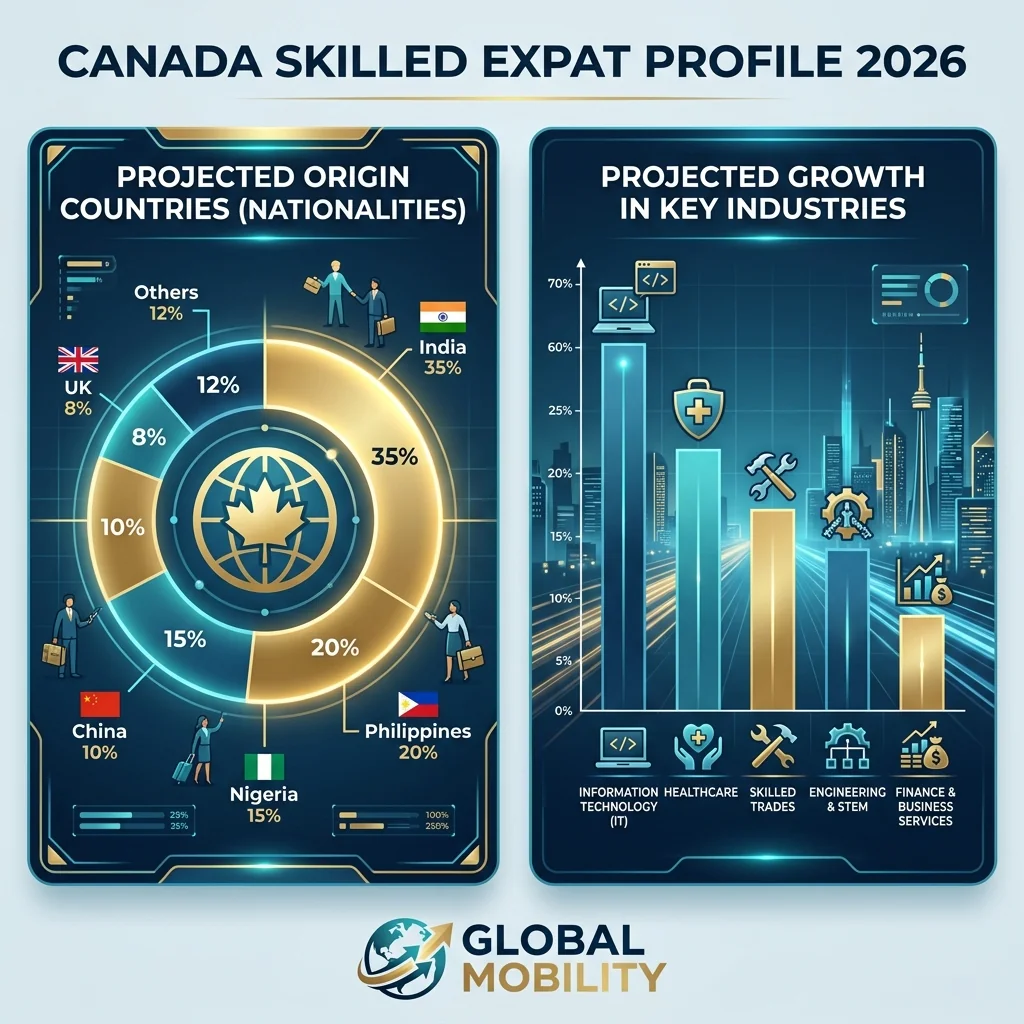
Canada Expat Community Profile 2026 Infographic
2. Deep-Dive Analysis: Legal & Financial Framework
Understanding this legal framework is a prerequisite for a successful application. The IRCC now utilizes an 'Automated Eligibility Filter' that discards incomplete profiles within milliseconds.
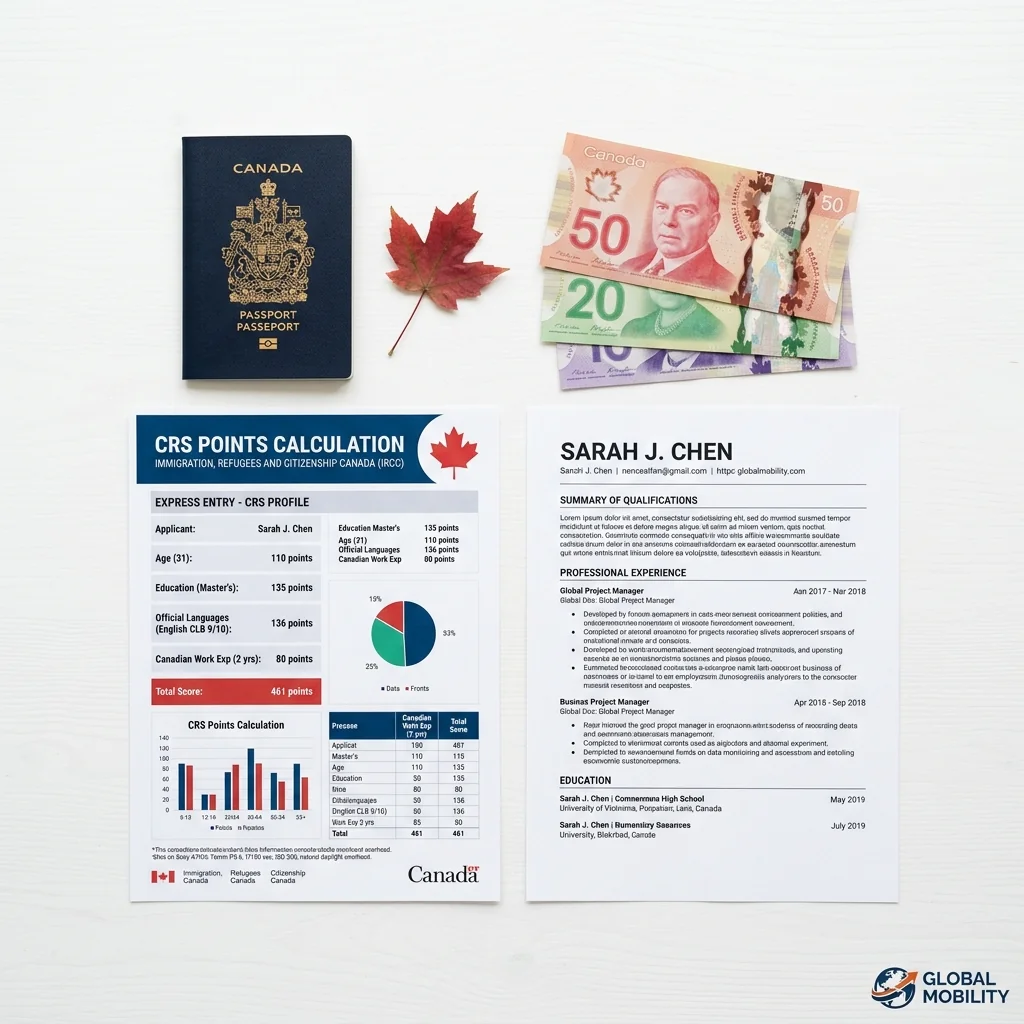
Canada PR Document Checklist 2026
2.1 Legal Requirements & Visa Categories
The Express Entry strategy 2026 revolves around three primary federal programs and the powerful Provincial Nominee Program (PNP) intersection:
2.2 Eligibility Criteria & Qualification Scoring: The CRS Mastery
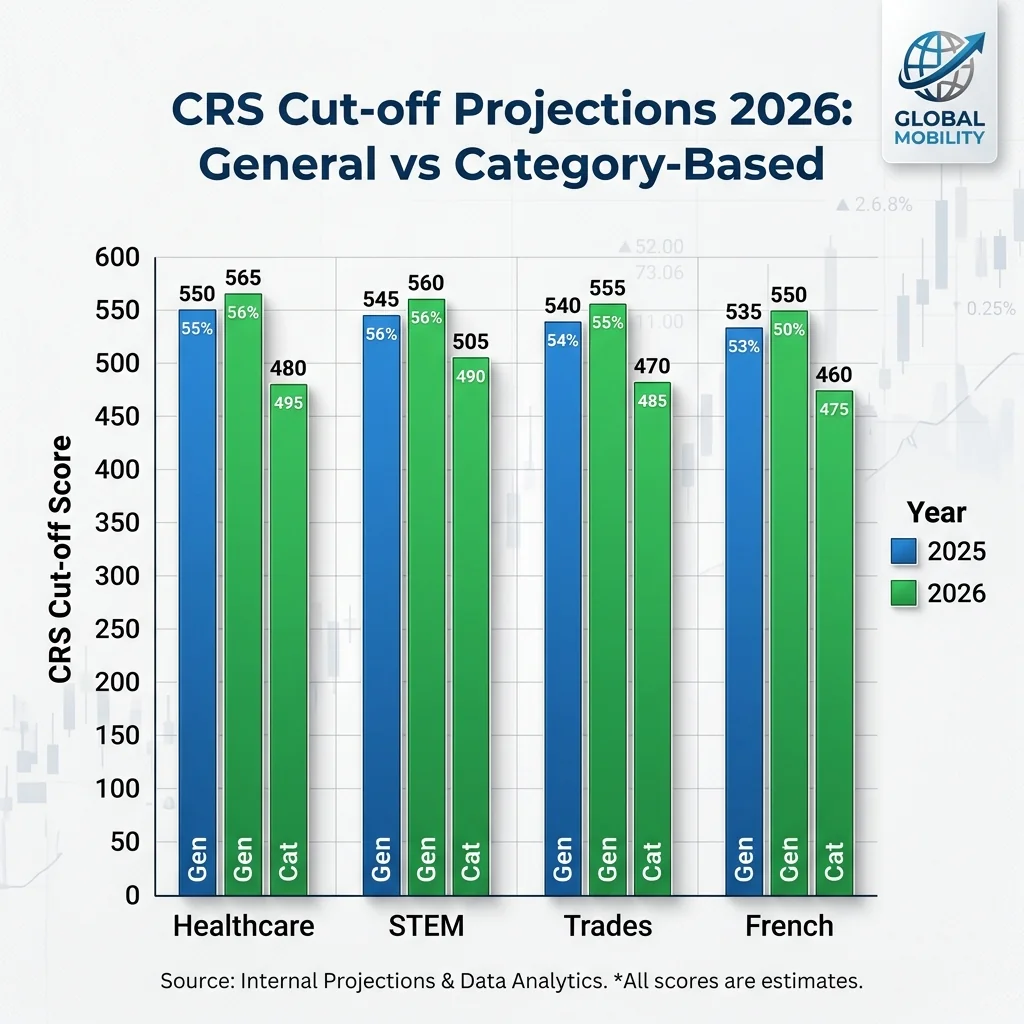
The CRS score calculator 2026 is the most critical tool in your arsenal. The Comprehensive Ranking System (CRS) is how IRCC ranks your profile. You can compare your score using the Official IRCC CRS Tool. In 2026, the median cut-off for 'General Draws' has hovered around 510, while 'Category-Based Draws' (STEM, Healthcare, Trades) have seen scores as low as 430 (Source: IRCC Express Entry Rounds of Invitations, 2026) https://www.canada.ca/en/immigration-refugees-citizenship/corporate/mandate/policies-o
Strategic Levers to Increase Your CRS Score in 2026:
2.3 Required Documentation & Official Checklists
3. City Guide — Where to Live in Canada in 2026
Choosing a city is no longer just about where the jobs are; it's about the Canada relocation ROI and cost of living balance.
3.1 Top 5 Canadian Hubs for Expats: Rankings & Analysis

Canada City Lifestyle 2026
3.2 City Comparison Table
| City | Avg Rent 1BR | Monthly Cost | Job Market | Safety | Expat Rating |
|---|---|---|---|---|---|
| Toronto | $2,600 | $4,800 | Elite | 7.5 | 9/10 |
| Calgary | $1,750 | $3,400 | High | 8.5 | 10/10 |
| Vancouver | $2,850 | $5,200 | High | 8.0 | 9/10 |
| Ottawa | $1,900 | $3,800 | Moderate | 9.0 | 8/10 |
| Montreal | $1,650 | $3,200 | High* | 8.5 | 9/10 |
(Source: Numbeo Cost of Living Index - Canada, 2026).
4. Cost of Living — Complete 2026 Breakdown
The Canada cost of living 2026 data indicates a stabilization in inflation, but housing remains the primary overhead.
4.1 Monthly Budget Calculator Breakdown
Itemized costs for a professional in a Tier-1 Canadian city (CAD and USD):
Total Monthly Burn: ~$3,810 CAD (~$2,820 USD)
4.2 Salary vs. Savings Potential
Utilizing the Canada savings potential tool, we see that a Senior Developer in Calgary earning $140,000 CAD annually can realistically save $3,500 CAD per month. (Source: Canada Job Bank - Wages, 2024).
4.3 Cost of Living Index vs. Home Countries
| Category | Canada (CAD) | Pakistan (PKR) | India (INR) | UK (GBP) |
|---|---|---|---|---|
| Rent | $2,100 | 85,000 | 45,000 | £1,200 |
| Food | $600 | 40,000 | 20,000 | £400 |
| Utility | $350 | 25,000 | 12,000 | £250 |
Canada Cost of Living Comparison Chart
5. Salary Data & Job Market Intelligence
The Canada salary comparison tool is essential for negotiating your 2026 employment contract.
5.1 Average Salaries by Industry (2026 Data)
| Industry | Entry Level | Mid-Level | Senior | Currency |
|---|---|---|---|---|
| Technology | $75,000 | $115,000 | $165,000 | CAD |
| Healthcare | $68,000 | $95,000 | $145,000 | CAD |
| Engineering | $72,000 | $105,000 | $155,000 | CAD |
| Finance | $65,000 | $98,000 | $150,000 | CAD |
(Source: Statistics Canada Job Bank Wage Data, 2024) https://www.jobbank.gc.ca/trend-analysis/search-occupations
5.2 In-Demand Skills & Sectors
The Canada tech talent search 2026 is focused on Cloud Architecture, Cybersecurity, and Data Science. In the trades, HVAC technicians and heavy-duty mechanics are seeing 15% year-on-year wage growth.
5.3 Buying Power Analysis
Simply compare your current role and target city to understand your local buying power. This allows you to understand if a $100k salary in Calgary is actually better than $130k in Toronto (Hint: Usually, it is).

Canada Tech Job Market 2026
6. CV Formatting — The Canadian Resume Standard
A Canada-style resume is your first hurdle. Canadian HR managers spend less than 6 seconds on the first pass.
6.1 Canadian CV Format Requirements
6.2 Common CV Mistakes That Get Applications Rejected
6.3 ATS Optimization for Canadian Job Portals
Top portals: LinkedIn Canada, Indeed.ca, Job Bank Canada, Workopolis.
ATS tips:

Canada CV Format Template Mockup
7. Interview Tips for Canadian Employers
Canadian networking for professionals often happens before the formal interview. In 2026, the Canadian job market has become hyper-competitive, requiring a sophisticated approach to self-presentation.
7.1 Cultural Interview Norms & Expectations
Canadian interviews are primarily 'Behavioral.' Employers operate on the philosophy that past behavior is the best predictor of future performance. They use the STAR method (Situation, Task, Action, Result) to evaluate your soft skills. The 'Canadian Experience' barrier is often a proxy for 'Cultural Fit'—they look for team collaboration, humility, and a lack of ego. In 2026, there is a significant emphasis on "Soft Skills Equity," where your ability to communicate complex ideas simply is valued as much as your technical stack.
7.2 Common Interview Questions & Answer Frameworks
In 2026, Canadian recruiters are hyper-focused on 'Adaptability' and 'Multicultural Collaboration.' Expect questions designed to test your resilience in a diverse workspace:
7.3 Professional Etiquette & 'Coffee Chats'
A unique part of the Canadian job market is the 'Informal Coffee Chat.' In 2026, this remains the primary way to access the 'Hidden Job Market.' When meeting a professional for a 15-minute chat, never ask for a job directly. Instead, ask about their 'Career Path' and 'Sector Challenges.' This builds rapport and often leads to an internal referral, which is significantly more powerful than a cold application. During these chats, practice "Low-Pressure Networking"—the goal is to be remembered as a curious and competent professional, not a desperate applicant.
7.4 Dress Code & Post-Interview Follow-Up
For most corporate roles in Toronto or Vancouver, 'Business Casual' is the standard, though 'Business Professional' is safer for first-round interviews. In 2026, even virtual interviews via 'Microsoft Teams' require a professional setup with neutral backgrounds. Post-interview, a 'Thank You' note is mandatory. Send a brief, personalized email within 24 hours to every person you interviewed with, referencing a specific point discussed. This signals high emotional intelligence and genuine interest. For example: "I particularly appreciated our discussion on how [Company Name] is utilizing AI to optimize supply chain resilience; it aligns perfectly with my previous experience in [Your Sector]."
8. 2026 Policy Updates & Market Predictions
The Express Entry clinical analysis for 2026 shows a major pivot toward 'Strategic Quotas.'
8.1 Key Policy Changes Effective 2026
8.2 Immigration Trend Predictions (Data-Backed)
According to the OECD International Migration Outlook 2024, Canada is projected to maintain top-3 global destination status for skilled workers through 2027. (Source: OECD Migration Outlook 2024) https://www.oecd-ilibrary.org/social-issues-migration-health/international-migration-outlook-2024_1896a29d-en
Category-based draws are expected to expand beyond current STEM and Healthcare categories. French-language draws have consistently shown lower cut-offs (430–470 range), making bilingual candidates a priority demographic for 2026.
Processing times for complete applications remain at the 6-month target set by IRCC for 80% of cases. (Source: IRCC Processing Times) https://www.canada.ca/en/immigration-refugees-citizenship/services/application/check-processing-times.html
8.3 How These Changes Affect Your Application in 2026
For applicants currently in the pool, the Francophone expansion means that even a basic French CLB 5-7 score creates a secondary pathway independent of your general CRS score. The indexed proof of funds requirement means budgeting an additional $600–$800 CAD above the 2024 baseline.
Use the GlobalMobilityAI immigration probability engine to model your category-specific draw eligibility before submitting your EOI — the difference between a general draw profile and a category-eligible profile can mean months of waiting time.
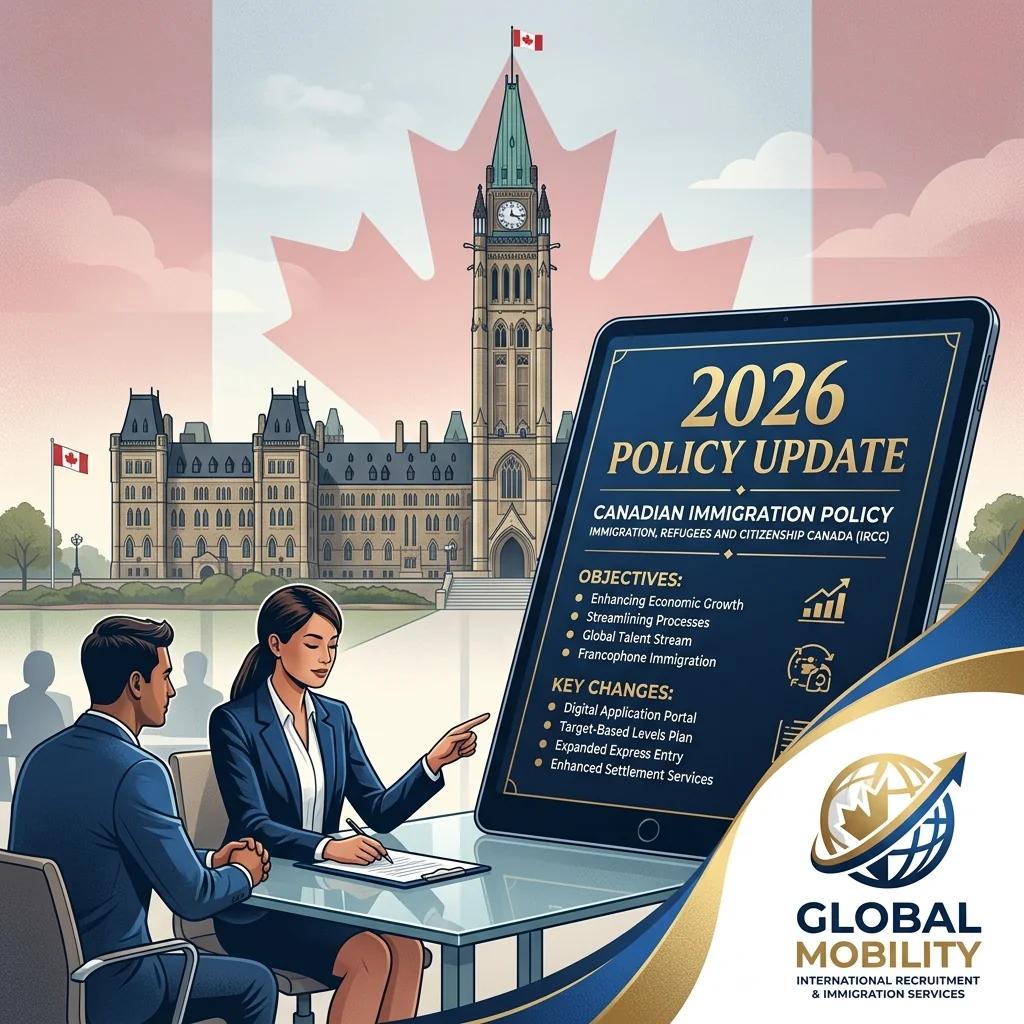
Canada Immigration Policy Update Illustration
9. Tactical Comparison Matrix
| Feature | Federal Skilled Worker (EE) | Provincial Nominee (PNP) |
|---|---|---|
| Purpose | High-Skill Human Capital | Regional Labor Needs |
| Min. CRS | 500+ (General) / 440+ (Cat) | 350+ (If nominated) |
| Processing | 6 Months | 6–12 Months |
| PR Pathway | Instant upon Landing | Instant upon Landing |
| Est. Approval Rate* | Platform Estimate* | Platform Estimate* |
\Internal platform estimate based on historical user success data. Official IRCC approval rates are not segmented by 'program specific' success in public data sets.*
10. Execution Roadmap: Phase-by-Phase
The path to Canadian PR in 2026 is a marathon of precision. Following this 4-phase strategy ensures you maximize your immigration probability score while minimizing legal risks.
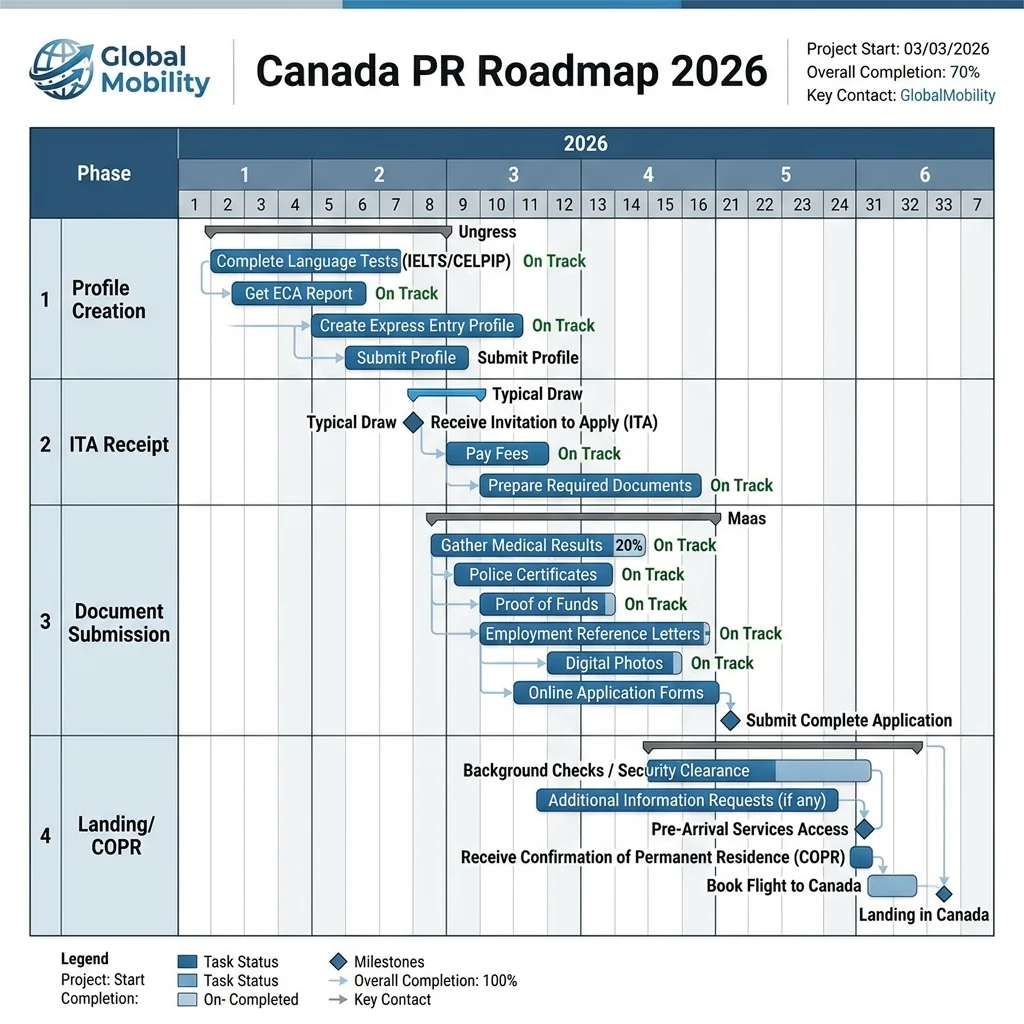
Canada Express Entry Roadmap Timeline
Phase 1 — Preparation (Months 1–2): Document Sovereignty
The foundation of your Express Entry profile is the Educational Credential Assessment (ECA) and language testing. In 2026, IRCC has increased scrutiny on "Degree Authenticity," so use only reputable bodies.
Phase 2 — Application & ITA (Months 3–4): The Invitation Window
Submit your profile to the IRCC pool. In 2026, the pool dynamics have shifted toward 'Category-Based Selection.' Even if your score is below 500, you may receive an ITA if you are in STEM, Healthcare, or Trades.
Phase 3 — Transition & COPR (Months 5–6): Final Checks
Your application enters 'Background Check' and 'Security Screening.' In 2026, IRCC uses AI-enhanced verification for work history and police clearances.
Phase 4 — Settlement & Landing (Month 7+): The First 100 Days
Landing in Canada is a legal process. You must present your COPR and proof of funds to the CBSA officer at the Port of Entry. In 2026, the "Soft Landing" strategy is still viable, but "Full Integration" is preferred for tax purposes.
11. Critical Risk Factors & Common Pitfalls

Canada Safe Neighborhoods for Families
12. FAQ — People Also Ask
Q: What is the minimum CRS score for Canada Express Entry 2026?
For general draws, expected scores are 505–520. Category-based draws (STEM, Healthcare) may drop to 440–460. (Source: IRCC, 2026).
Q: How much money do I need to immigrate to Canada in 2026?
You need approximately $14,000 CAD as 'Proof of Funds' for a single person. (Source: IRCC - Proof of Funds, 2026).
Q: Can I apply for Canada PR without a job offer?
Yes. This Canada points-based system is primarily a human-capital engine. Most applicants receive PR based on age, education, and language.
Q: What is the age limit for Express Entry?
Points for age decrease significantly after 30, and hit zero after age 45. (Source: IRCC, 2026).
Q: Do I need to speak French?
It is not mandatory, but achieving a CLB 7 in French can add up to 50 additional points to your CRS.
Q: What is the processing time for Express Entry in 2026?
Target processing time is 6 months from the date of submission of a complete application.
Q: Which province is best for a PNP in 2026?
Alberta and the Atlantic provinces currently offer the most streamlined pathways for tech and healthcare workers.
Q: Can I bring my family?
Yes. Your spouse and dependent children under 22 can be included in your PR application.
13. Conclusion: The Bottom Line
This strategic blueprint confirms that Canada remains the premier destination for global talent. However, the days of 'passive application' are over. You must be tactical—optimizing your CRS score through French, targeting PNPs (as seen in the Germany Opportunity Card 2026 points model), and leveraging data-driven insights to ensure your profile is clinical, compliant, and competitive. Your journey to Canadian residency starts with data, not just dreams.

Canada Pristine Nature and Climate Advantage
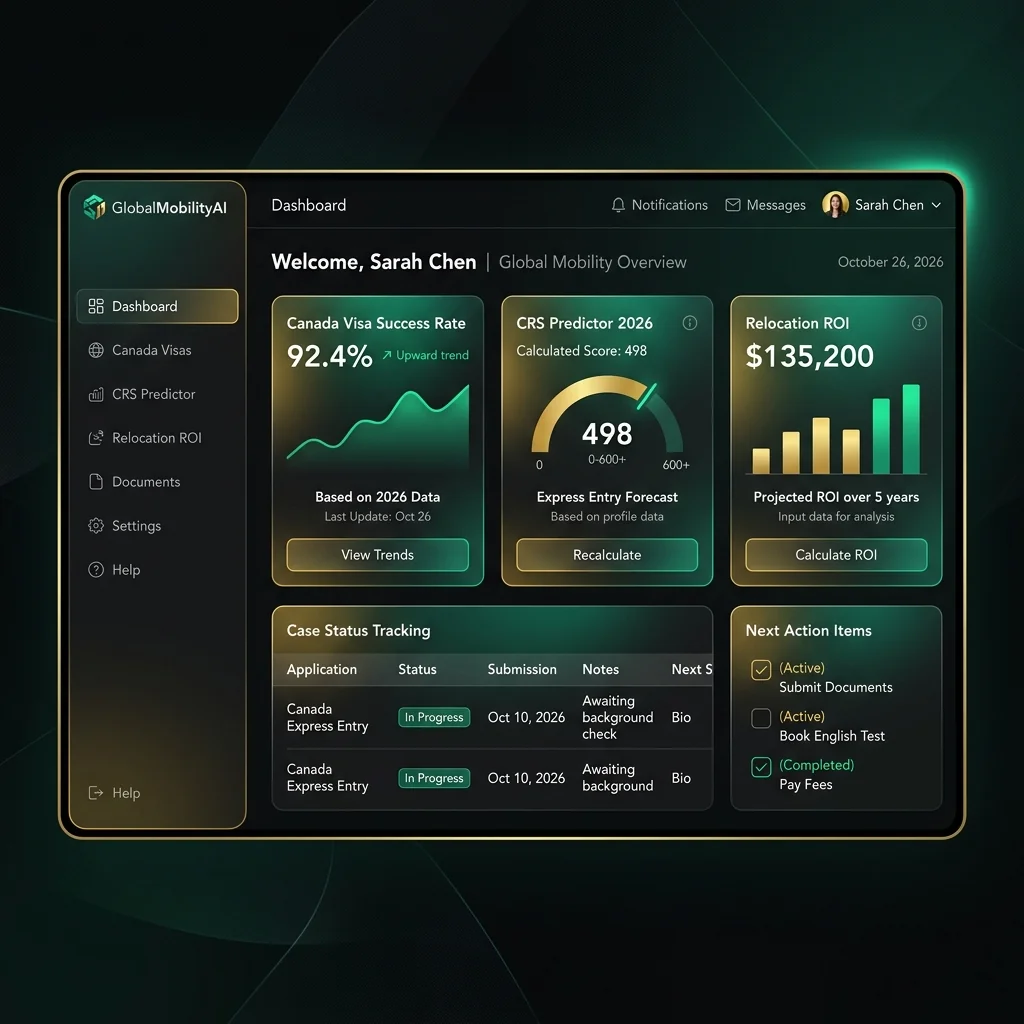
GlobalMobilityAI Canada Visa Success Dashboard
Predict your mobility score.
Use our AI engine to get your personalized visa pathway, salary prediction, and relocation roadmap.
More Insights

Portugal D8 Digital Nomad Visa 2026: Complete Application Blueprint

Malta Residency & Citizenship: The 2026 Stronghold Master Guide