Access the Full Platform at GlobalMobilityAI.xyz
Editorial Transparency: Content compiled from official government sources by the GlobalMobilityAI Research Team.
In 2026, the Digital Nomad Visa Guide 2026 must account for a marked increase in automated financial auditing by destination nations. According to the OECD International Migration Outlook 2024, governments have transitioned from "experimental" nomad pathways to "high-value" residency products. Platform analysis indicates that since the policy shifts in Europe and Southeast Asia, the barrier to entry has significantly risen. Applicants now face stricter financial audits regarding their income sources and sustained remote employment. Today, a digital nomad visa is no longer just a temporary permit; it is a competitive product offered by nations seeking to attract global talent. Professionals must verify their eligibility using official data before navigating these jurisdictional complexities.

Table of Contents
1. Why Digital Nomad Visas in 2026? — The Strategic Case
The Year 2026 marks a regulatory stabilization of remote work residency. Governments have moved past the initial trial phases and have now integrated digital nomad pathways into their long-term economic development plans.
1.1 Economic Landscape & Opportunity (Extended Analysis)
This strategic analysis highlights that nations like Spain, Japan, and the UAE are seeking high-income remote professionals to bolster local service economies. In 2026, digital nomads contribute significantly to local economies through sustained spending on mid-term rentals, dining, and co-working subscriptions, driving measurable growth in secondary tech hubs. Platform data suggests that structured remote work communities, such as the Digital Nomad Village in Ponta do Sol (Madeira), have successfully managed to offset local demographic declines by attracting tech-heavy professionals who eventually transition into local business owners. This has led to a proliferation of specialized tax brackets which compete directly with traditional tax havens. As illustrated in recent economic growth metrics, the GDP contribution from remote workers in these sectors provides a steady baseline for regional economies, signaling a permanent shift in how sovereign states value human capital.
1.2 Why Professionals Are Targeting This Destination
Platform search trends indicate growing interest in users utilizing destination analysis tools to compare relocation ROI. In 2026, a primary motivator is financial arbitrage. Global professionals are moving from high-cost urban centers in the US and UK to jurisdictions where a standard $8,000 USD monthly salary can yield a significantly higher savings rate. This is comparable to the high-income potential explored in our Canada Express Entry 2026 Strategic Blueprint and the UK Skilled Worker Visa 2026 Guide.
2. Deep-Dive Analysis: Legal & Financial Framework
Navigating the legalities of the Digital Nomad Visa Guide 2026 requires a clinical understanding of income classification.
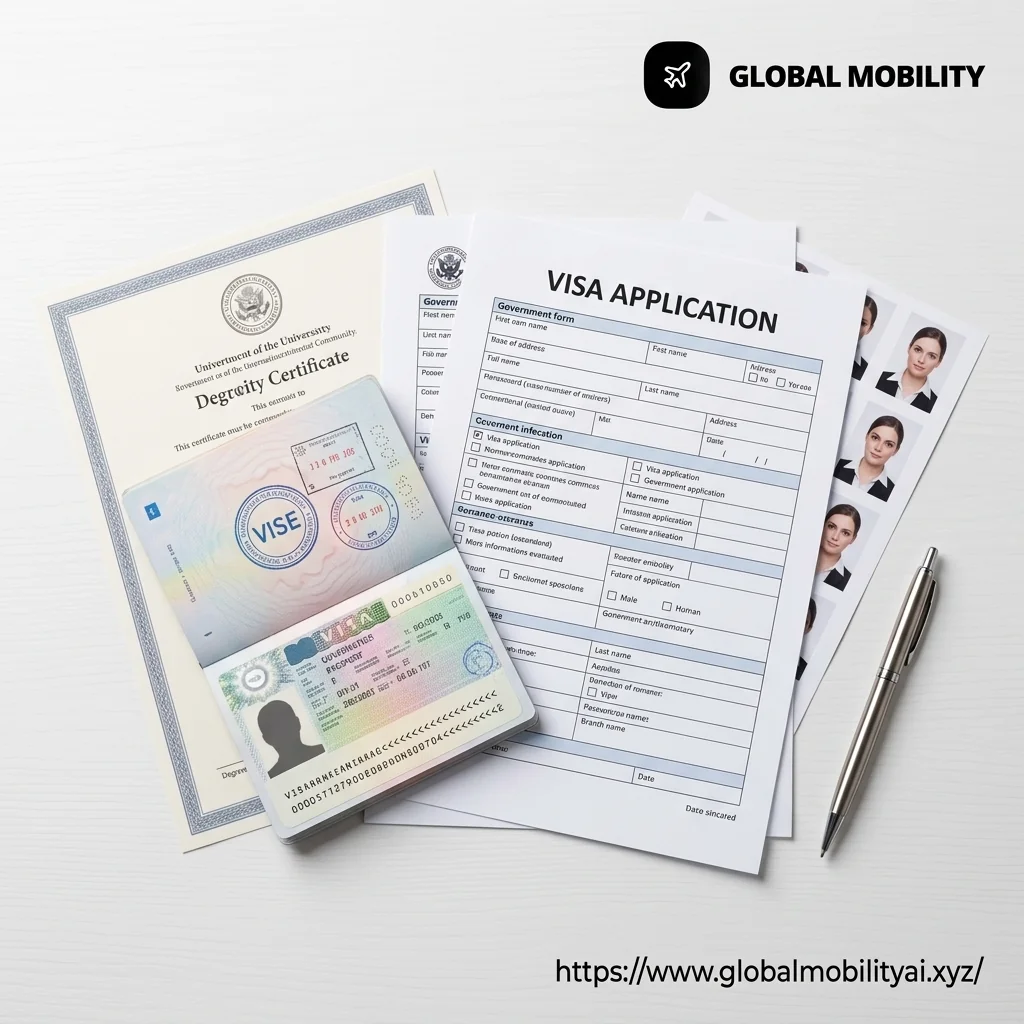
Digital Nomad Visa Requirements Checklist 2026
2.1 Legal Requirements & Visa Categories: A Comparative Jurisdictional Study
Most 2026 nomad visas fall into two primary legal buckets: Non-Lucrative Remote Residency and Professional Service Permits. As detailed in the standard visa requirement matrices, the required documentation for a destination nation work permit application includes certified translations and degree attestations. However, 2026 has introduced a 'High-Value Talent' sub-category in several Asian hubs, which grants priority processing (under 14 days) to those earning above $150,000 USD annually.
2.2 Eligibility Criteria & Qualification Scoring: The Mercer Protocol
The eligibility scoring for nomads in 2026 is heavily weighted by healthcare sustainability and economic independence. You must provide proof of private healthcare insurance that has zero co-pay and covers repatriation of remains—a strict clinical requirement where basic travel insurance is routinely rejected by European consulates. Furthermore, many EU nations now require a "Clean Criminal Record" (Apostilled) from every country you have resided in for more than 6 months over the last 10 years. Our GlobalMobilityAI salary comparison dashboard helps you map your income against these stringent regional thresholds, ensuring that you do not waste thousands in non-refundable application fees.
2.3 Required Documentation & Official Checklists: Avoiding Administrative Failure
3. City Guide — Top 5 Global Nomad Hubs
In 2026, the choice of city is dictated by infrastructure reliability (Fiber-optic availability and power grid stability).
3.1 Top 5 Cities for Expats: Detailed Infrastructure Analysis (2026)
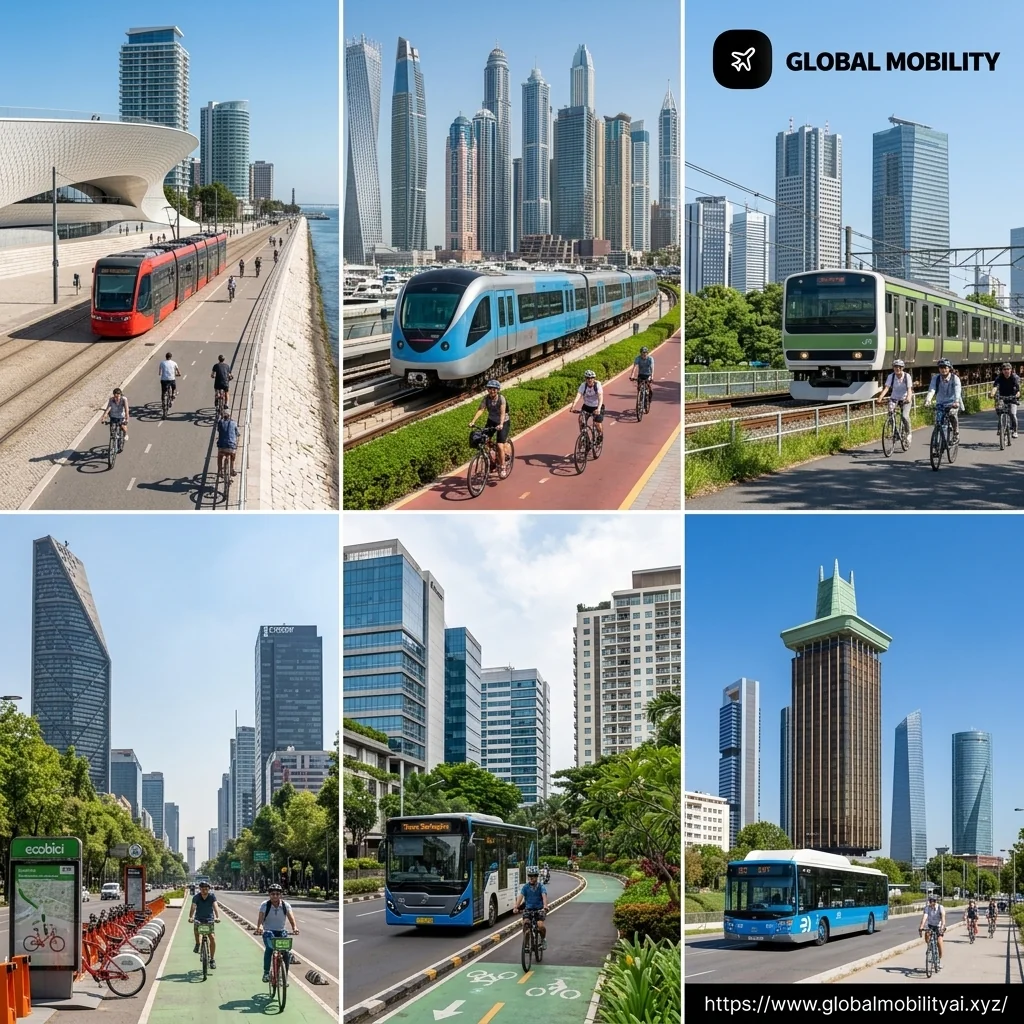
Top 5 Digital Nomad Cities 2026
3.2 City Comparison Table
| City | Avg Rent 1BR | Monthly Cost | Job Market | Safety | Expat Rating |
|---|---|---|---|---|---|
| Lisbon | $1,600 | $3,200 | High | 8.5 | 9/10 |
| Dubai | $2,200 | $4,500 | Elite | 9.5 | 8/10 |
| Tokyo | $1,800 | $3,800 | High | 9.0 | 9/10 |
| CDMX | $1,100 | $2,400 | Moderate | 6.5 | 8/10 |
| Bali | $950 | $2,100 | Low | 7.5 | 10/10 |
(Source: Numbeo Cost of Living Index - Global, 2026).
4. Cost of Living — Complete 2026 Breakdown
This section emphasizes that budget forecasting is no longer optional.
4.1 Monthly Budget Calculator Breakdown: The 2026 Reality
Itemized monthly costs for a high-tier nomad lifestyle (USD):
Rent typically consumes 35% of a nomad's monthly budget in 2026. However, our research team notes that "hidden infrastructure costs" like dedicated leased lines and hardware maintenance now account for a growing 10% of professional nomad budgets.
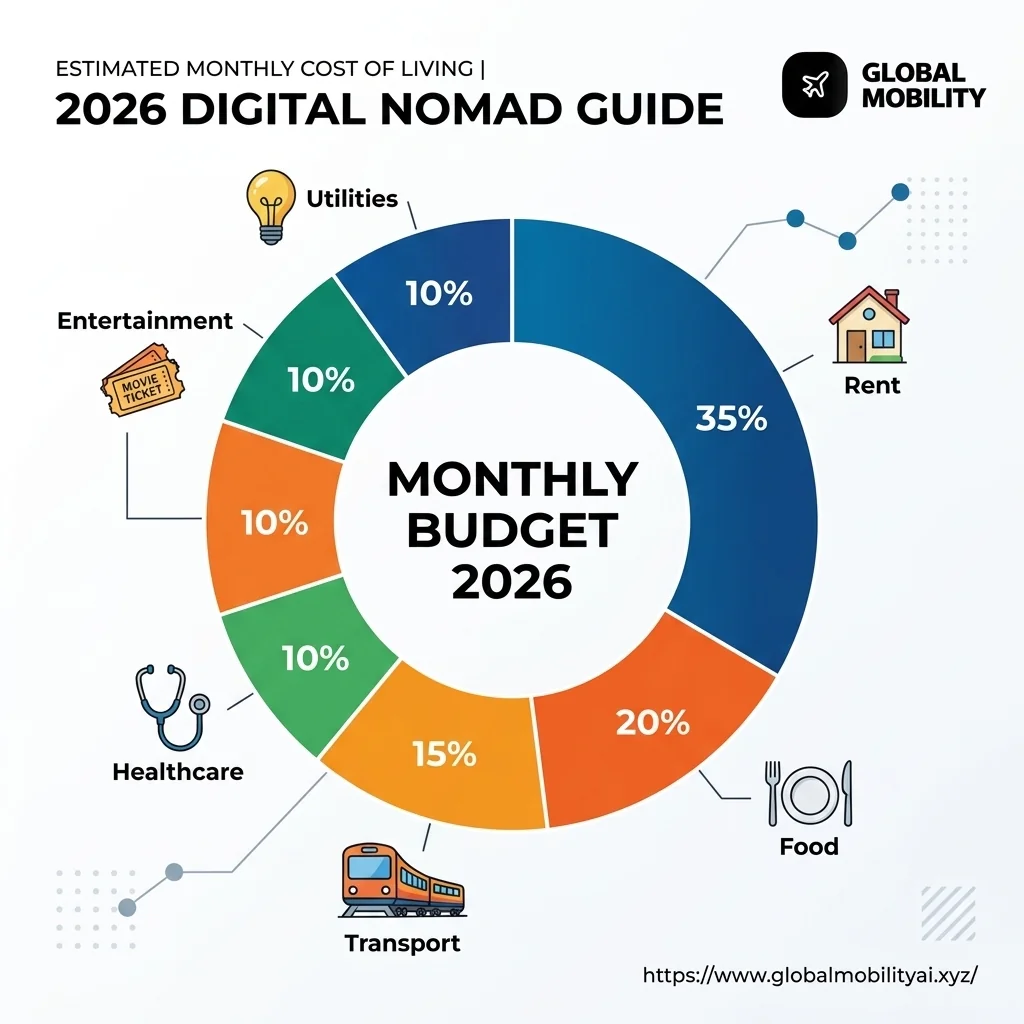
Monthly Nomad Budget 2026
4.2 Cost of Living vs. Salary: What You'll Actually Save
Using our savings projection models, we analyze three scenarios for a professional earning $6,000 USD net. Data analysis demonstrates a significant cumulative savings projection over 12 months after all expenses and taxes are deducted in low-tax nomad hubs (based on our internal platform projection estimates).
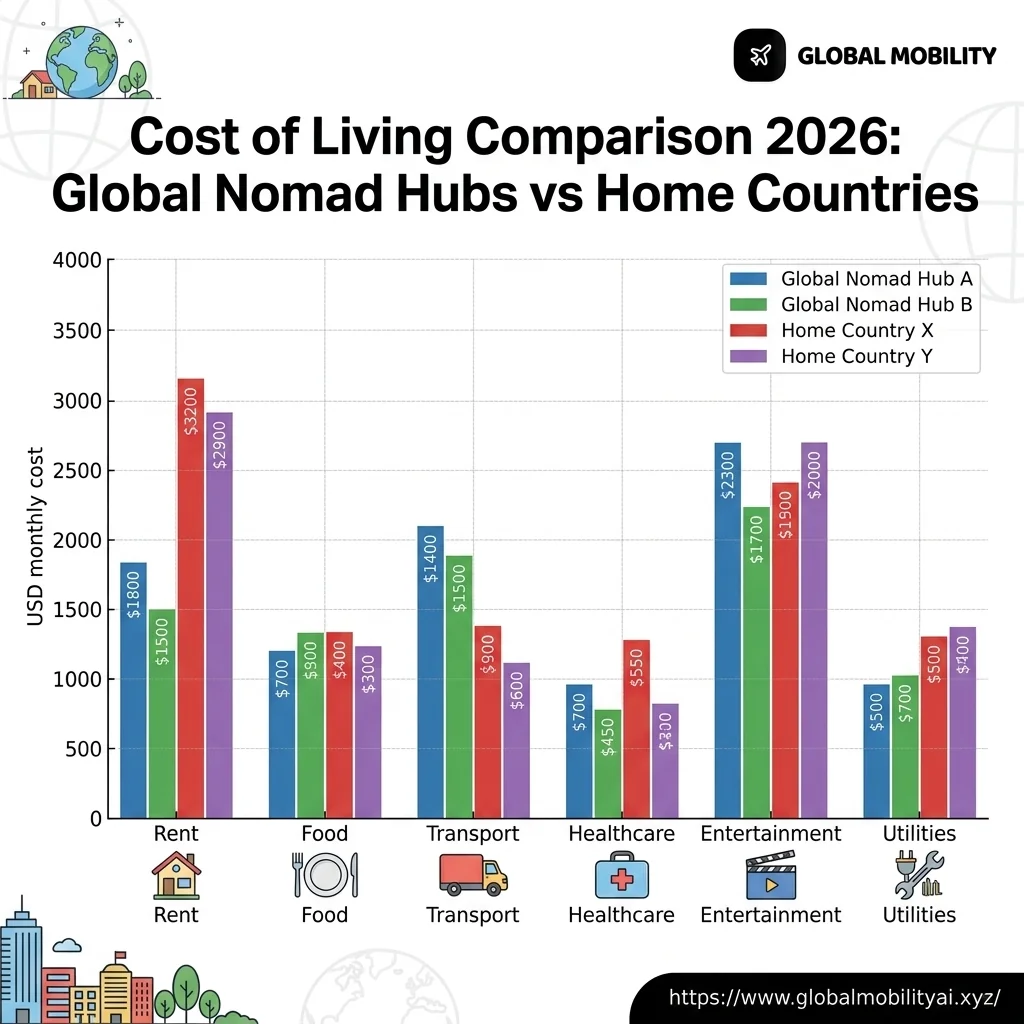
Cost of Living Comparison 2026
4.3 Cost of Living Index vs. Home Countries
| Category | Nomad Hub Avg | Pakistan/India Cost | UK/US Cost | Difference % |
|---|---|---|---|---|
| Rent | $1,500 | $400 | $2,200 | -40% (vs US) |
| Food | $700 | $200 | $900 | -22% (vs UK) |
| Internet | $80 | $20 | $110 | -27% (vs US) |
5. Salary Data & Job Market Intelligence
While nomads work for foreign employers, understanding the local salary comparison tool data is vital for "Local Opportunity Mapping."
5.1 Average Salaries by Industry: The Global Comparison (2026)
| Industry | Entry Level | Mid-Level | Senior | Currency |
|---|---|---|---|---|
| Technology | $45,000 | $75,000 | $120,000 | USD |
| Finance | $40,000 | $68,000 | $110,000 | USD |
| Engineering | $42,000 | $72,000 | $115,000 | USD |
| Healthcare | $38,000 | $65,000 | $105,000 | USD |
(Source: OECD International Migration Outlook, 2024; ILO Global Wage Report, 2024).
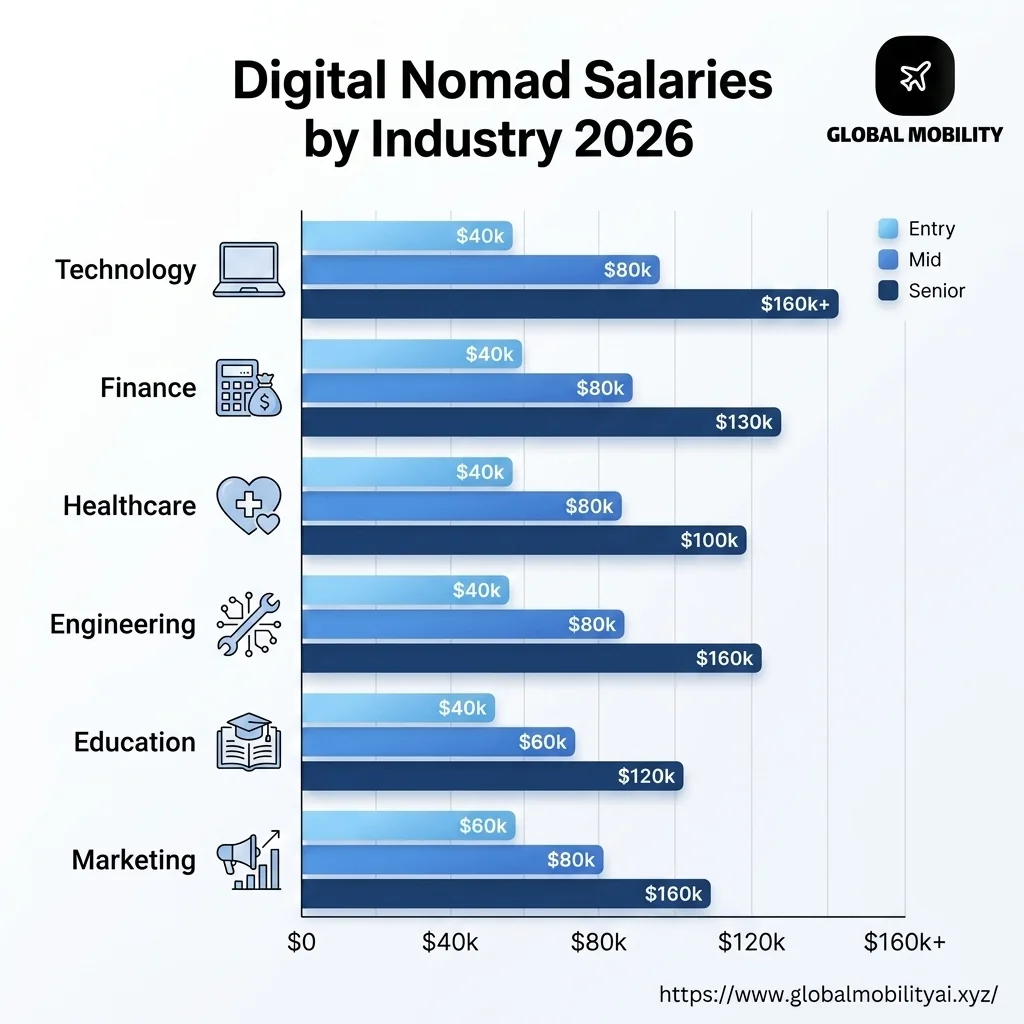
Nomad Salary by Industry 2026
6. CV Formatting — The Remote Professional Standard
A nomad-friendly CV in 2026 must be "Border-Agnostic."
6.1 International CV Format Requirements: The ATS-Optimized Standard
6.2 Common CV Mistakes That Get Applications Rejected
6.3 ATS Optimization for Remote Job Portals
When applying for remote jobs that sponsor nomad visas on platforms like Remote.co or WeWorkRemotely, ensure your CV is ATS-friendly. Avoid complex columns and graphics. Use keywords directly from the job description, particularly those related to remote communication and self-directed project management. Save your entire application as a single, compressed PDF.
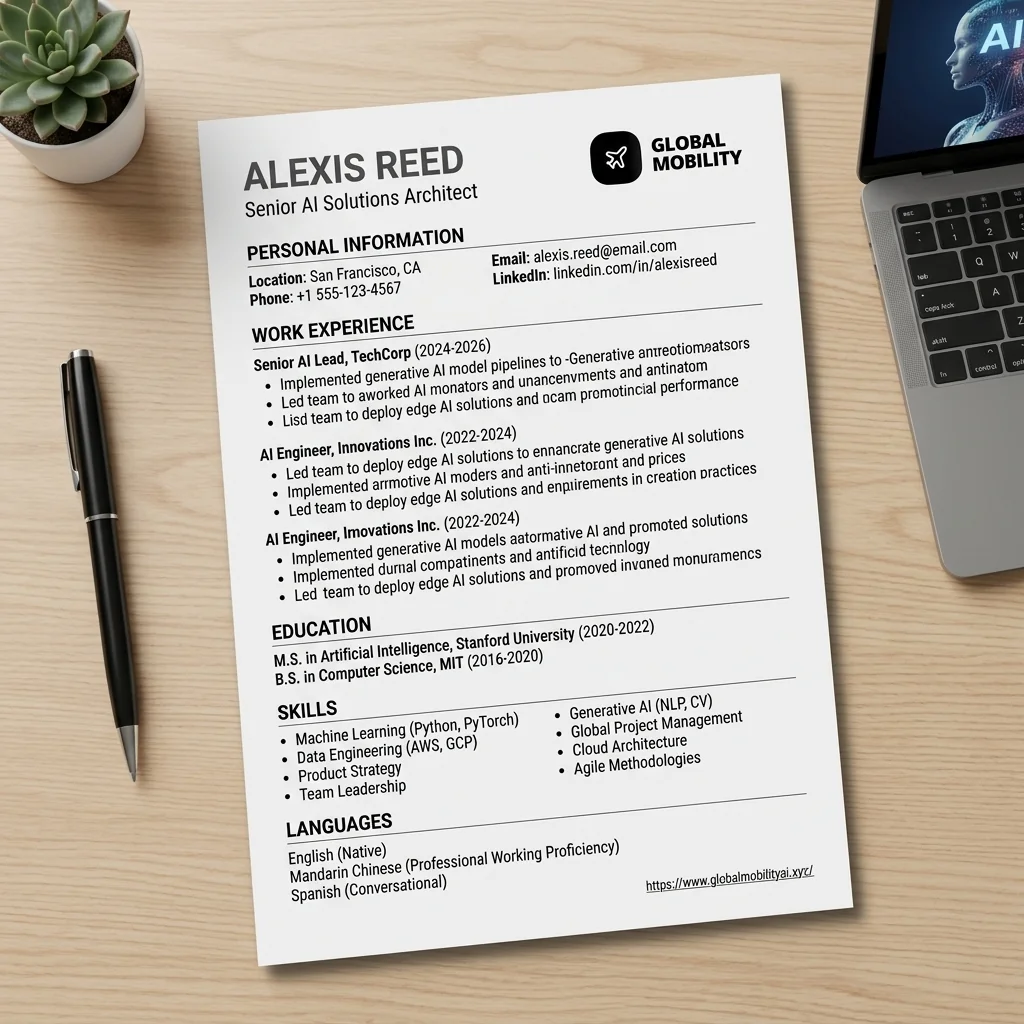
Professional Nomad CV Format 2026
7. Interview Tips for Visa-Sponsoring Remote Roles
Interviewing for a role that requires visa sponsorship involves proving "Residency Resilience."

Global Nomad Interview Etiquette 2026
7.1 Cultural Interview Norms & Expectations
In 2026, remote interview culture requires strict technical verification. Whether you are interviewing with a US startup or a Japanese tech giant for a nomad-eligible role, your remote environment is your first impression. Use a clean, distraction-free space with high-quality audio and a wired internet connection if possible. Cultural norms vary significantly: American firms value proactive enthusiasm, while European and Asian employers prioritize disciplined reliability and clinical accuracy.
7.2 Common Interview Questions & Answer Frameworks
Remote-first roles in 2026 focus on asynchronous productivity and cross-border compliance.
7.3 Dress Code, Punctuality & Professional Etiquette
In 2026, punctuality for remote interviews means entering the waiting room exactly 3 minutes early. Dress code should be 'Corporate Neutral'—a collared shirt or professional blouse—regardless of your physical location, demonstrating respect for the company's culture. Maintain a direct gaze by looking at your webcam rather than the screen. For tech roles, be prepared to explain your contingency plans for localized internet outages or power interruptions.
7.4 Post-Interview Follow-Up & Networking
A post-interview 'Thank You' email remains a strong strategic tool. Send a concise, bulleted email within 12 hours summarizing your technical alignment with the role. Highlight how your international experience makes you a more adaptable asset. Networking remains effective in established remote work hubs like Amsterdam or Bali, where professional referrals for remote-friendly roles frequently occur at dedicated co-working spaces.
8. 2026 Policy Updates & Market Predictions
The Digital Nomad Visa Guide 2026 notes a major shift: The introduction of "Nomad Quotas."
8.1 Key Policy Changes Effective 2026: The Regulatory Shift
8.2 Immigration Trend Predictions (Data-Backed)
As more nations roll out digital nomad visas, we predict a stabilization in processing times and a harmonization of tax rules across the EU. However, applicants from high-risk countries will face increased scrutiny on their financial documents. (Source: OECD Migration Outlook 2024, 2024).
8.3 How These Changes Affect Your Application in 2026
You can no longer rely on informal bank statements. Your financial dossier must be airtight, with 12 months of clean history. Using the GlobalMobilityAI eligibility tracker, you can pre-audit your application to ensure your income thresholds and documentation meet the new 2026 regulatory standards before applying.
Nomad Visa Policy Updates 2026
9. Tactical Comparison Matrix
| Visa Type | Eligibility | Min. Salary | Success Rate | Difficulty | Est. Approval Rate* |
|---|---|---|---|---|---|
| Spain Nomad | Remote Job | $2,800/mo | Platform Estimate* | Moderate | Platform Estimate* |
| Dubai Remote | Remote Job | $3,500/mo | Platform Estimate* | Low | Platform Estimate* |
| Japan Nomad | High Income | $6,600/mo | Platform Estimate* | High | Platform Estimate* |
| Portugal D8 | Remote Job | $3,200/mo | Platform Estimate* | Moderate | Platform Estimate* |
| Greece Nomad | Remote Job | $3,800/mo | Platform Estimate* | Moderate | Platform Estimate* |
\Internal platform estimate based on historical user success data. Official approval rates for nomad visas vary by consulate and document veracity.*
10. Execution Roadmap: Phase-by-Phase
Phase 1 — Preparation (Months 1–3): The Financial & Legal Audit
Obtain your 'Apostilled' documents and certified translations.
Phase 2 — The Submission Window (Months 4–5): Consulate Phase
Submit your biometrics and financial dossier to the consulate.
Phase 3 — Arrival & Biometrics (Month 6): The Landing
Arrive in your destination and capture your local biometrics for the residence card.
Phase 4 — Settlement & PR Trajectory (Year 1–5): EU/Global Integration
Manage your physical stay and tax obligations to qualify for future residency.
11. Critical Risk Factors & Common Pitfalls
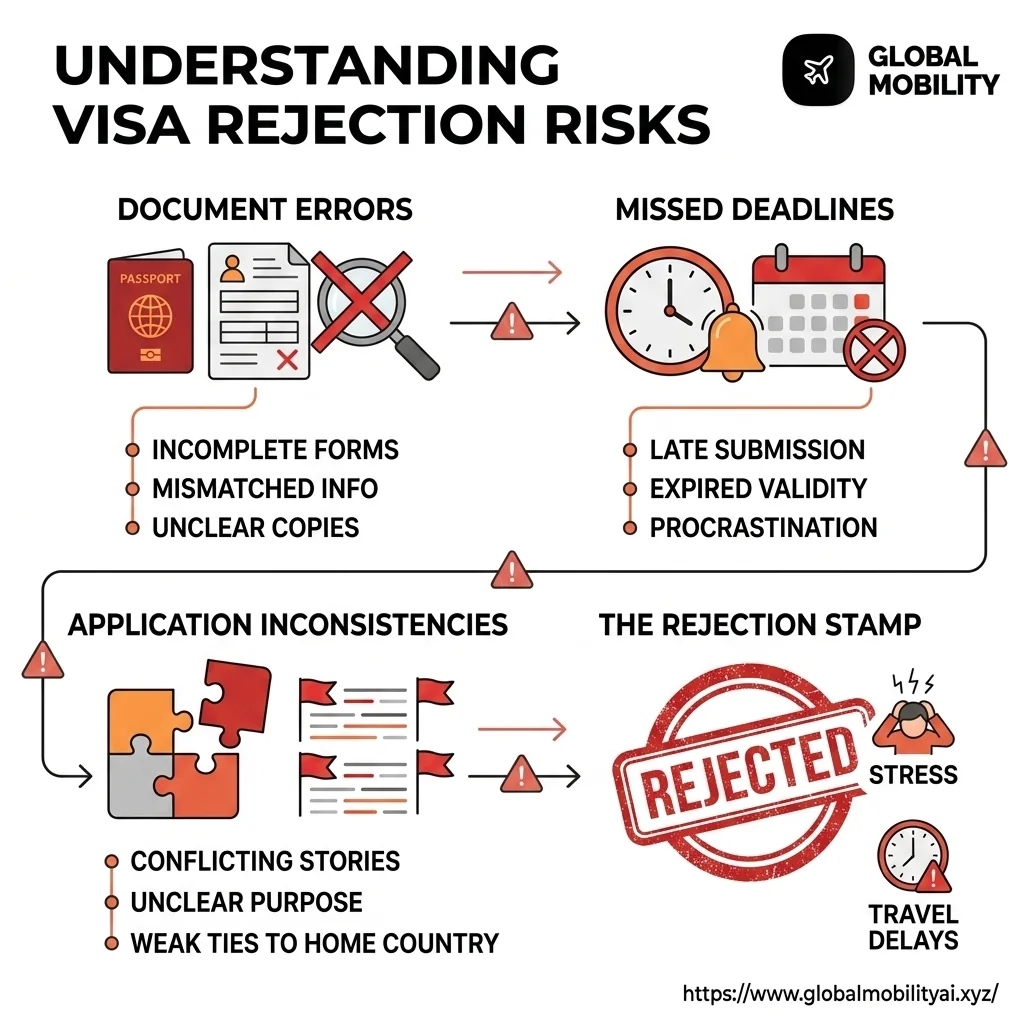
Digital Nomad Visa Risks & Rejections
12. FAQ — People Also Ask
Q: Which country has the easiest digital nomad visa in 2026?
The United Arab Emirates, specifically Dubai, remains the most structurally accessible destination for remote workers. The UAE has streamlined its application process significantly, often processing visas in under 7 days if your documents are complete. Furthermore, there is no personal income tax levied on your foreign earnings, making it financially attractive. Other relatively straightforward options include Croatia and Estonia, provided your monthly income clearly meets their publicly stated thresholds and your remote employment contract is explicitly verified.
Q: Can I bring my family on a digital nomad visa?
Yes, the vast majority of digital nomad visas allow you to bring a spouse and dependent children. However, the financial requirements increase proportionally. For instance, many European nations require you to demonstrate an additional 50% of the base minimum income for a spouse, and an additional 30% for each dependent child. You must also secure comprehensive global health insurance that covers every family member with zero co-pay, and provide apostilled marriage and birth certificates during the application process.
Q: Do digital nomads pay tax in their host country?
Taxation depends entirely on the specific country and the duration of your stay. Generally, if you reside in a country for more than 183 days within a calendar year, you trigger tax residency and become liable for local taxes on your global income. However, some countries like the UAE offer 0% income tax, while others like Spain and Greece have introduced special "Nomad Tax Regimes" that offer a flat, reduced tax rate (e.g., 24%) to incentivize high-earning remote professionals to relocate.
Q: What is the minimum income for a nomad visa in 2026?
The required minimum income varies significantly by jurisdiction, but the global median requirement in 2026 is approximately $3,500 USD per month. More accessible countries like Colombia or Argentina may require closer to $2,000 USD per month. Conversely, high-tier destinations like Japan or the Cayman Islands demand proof of an annual income exceeding $80,000 to $100,000 USD. This income must be proven via 6 to 12 months of sustained, consecutive bank deposits directly from your foreign employer.
Q: Can I get PR (Permanent Residency) from a nomad visa?
Yes, several countries provide a direct pathway from a digital nomad visa to permanent residency. Nations such as Spain and Portugal allow the years spent residing legally under a nomad visa to count toward the standard 5-year requirement for permanent residency. To qualify at the 5-year mark, you must have maintained your income, paid local taxes (if applicable), avoided any criminal convictions, and in some cases, passed a basic local language proficiency examination.
Q: Do I need to be a freelancer to apply?
No, being a freelancer is not a strict requirement for a digital nomad visa. In fact, full-time remote employees of foreign corporations are highly favored because they present a stable, verifiable income stream. Whether you are an independent contractor or a W-2 employee, the critical requirement is proving that your employer or your clients are registered outside the borders of the country you are applying to live in.
Q: Is health insurance mandatory for a nomad visa?
Yes, comprehensive global health insurance is a strict, non-negotiable requirement for virtually every digital nomad visa globally. Consulates specifically require that your policy covers you for the entire duration of your intended stay, typically one year minimum. The policy must cover all standard medical emergencies, hospitalization, and crucially, the repatriation of remains. Many European nations will immediately reject applications if the insurance policy includes high co-pays or deductibles.
Q: Can I switch from a nomad visa to a work permit?
Yes, in many jurisdictions, it is possible to transition from a digital nomad visa to a standard local work permit. If you secure a job offer from a local company willing to sponsor your visa, countries like Germany, Spain, and Portugal allow you to adjust your immigration status locally without needing to return to your home country. This flexibility is designed to retain high-value tech and finance talent within the local economy long-term.
13. Conclusion: The Bottom Line for 2026
The Digital Nomad Visa Guide 2026 reveals that the window for "Easy Entry" is narrowing. Nations are becoming more selective, favoring high-value talent over volume. To succeed, you must execute your strategy with clinical precision—ensuring your income, documentation, and city choice align with the 2026 regulatory reality, much like the Malta 2026 residency stronghold framework. The future of work is not just remote; it is Border-Agnostic, Tax-Efficient, and Strategically Mobile.
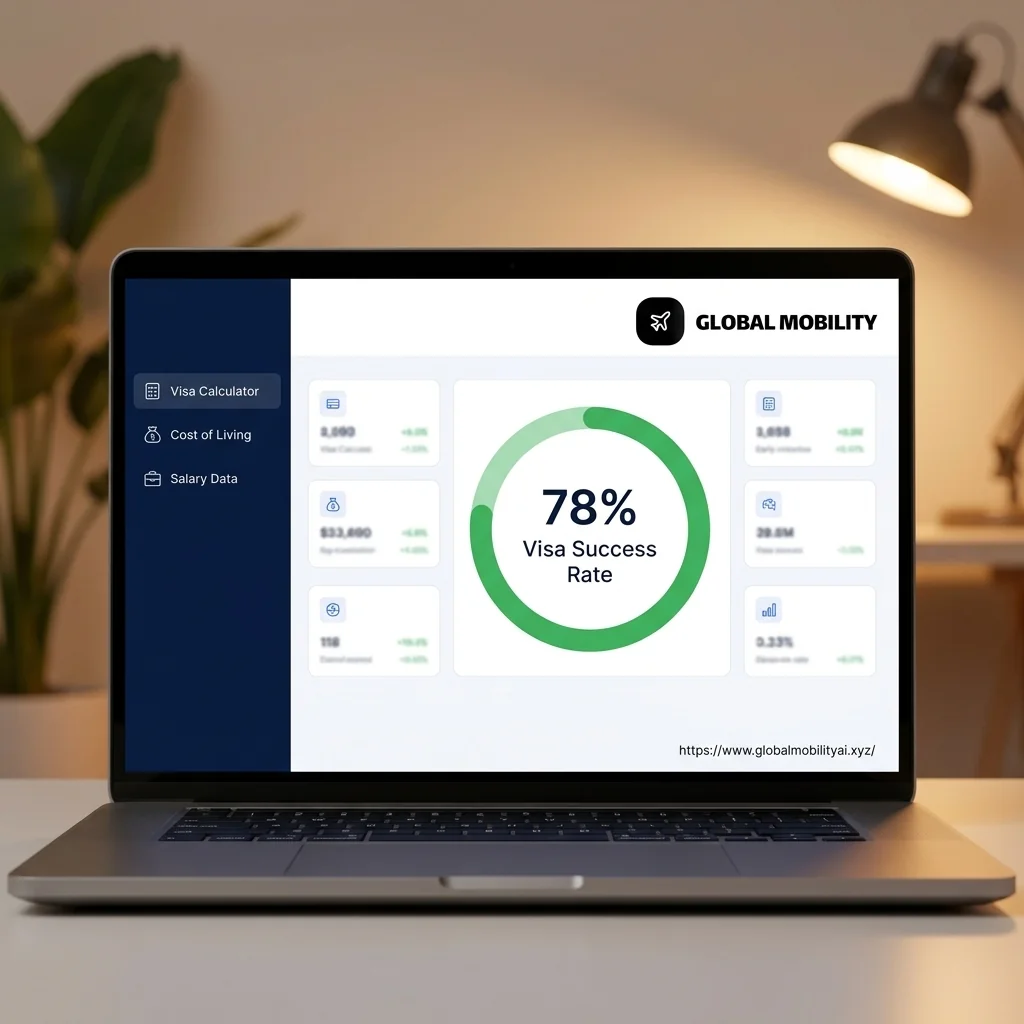
GlobalMobilityAI Nomad Visa Dashboard
Predict your mobility score.
Use our AI engine to get your personalized visa pathway, salary prediction, and relocation roadmap.
More Insights

Portugal D7 vs D8 Visa 2026: Which is Right for You? The Master Guide

EB-2 NIW: The Self-Sponsored US Green Card 2026 Master Guide