Access the Full Platform at GlobalMobilityAI.xyz
Editorial Transparency: Content compiled from official USCIS sources by the GlobalMobilityAI Research Team.
The strategic landscape of American immigration has undergone a clinical shift as we enter 2026, with the EB-2 NIW (National Interest Waiver) emerging as the premier 'Sovereign Pathway' for high-tier professionals. Unlike the traditional H-1B or PERM-based Green Card routes, the EB-2 NIW 2026 bypasses the need for a US employer, labor certification, or a specific job offer. This autonomy is similar to the Portugal D8 Digital Nomad Visa or the Germany Opportunity Card 2026 pathways. Platform analysis confirms that the 2026 USCIS interpretation of the Matter of Dhanasar has definitively favored STEM and 'Critical Technology' endeavors. Professionals must verify their eligibility before navigating the complex EB-2 priority date navigation.
Table of Contents
1. The 2026 NIW Thesis: Why Self-Sponsorship is King
In 2026, waiting for an employer to 'Sponsor' you is a high-risk strategy.
1.1 The Liberation from the PERM Backlog
The EB-2 NIW 2026 guide highlights that the Department of Labor's PERM process has reached record delays, often exceeding 18 months. By utilizing the National Interest Waiver, you bypass the labor market test entirely. As shown in our USA clinical migration analysis, USCIS has accelerated adjudications for roles in AI, Renewable Energy, and Advanced Manufacturing. In 2026, a professional filing a self-petition is taking back control of their USA wealth building for migrants strategy, decoupled from the volatility of corporate layoffs.
1.2 Why Professionals Are Targeting This Route
Platform search trends indicate growing interest in the NIW self-petition route, a trend mirrored in the Canada Express Entry strategic blueprint. Professionals from tech hubs are utilizing this relocation guide USA 2026 to navigate the USCIS premium processing for NIW and ensure their I-140 petition strategy 2026 is airtight.
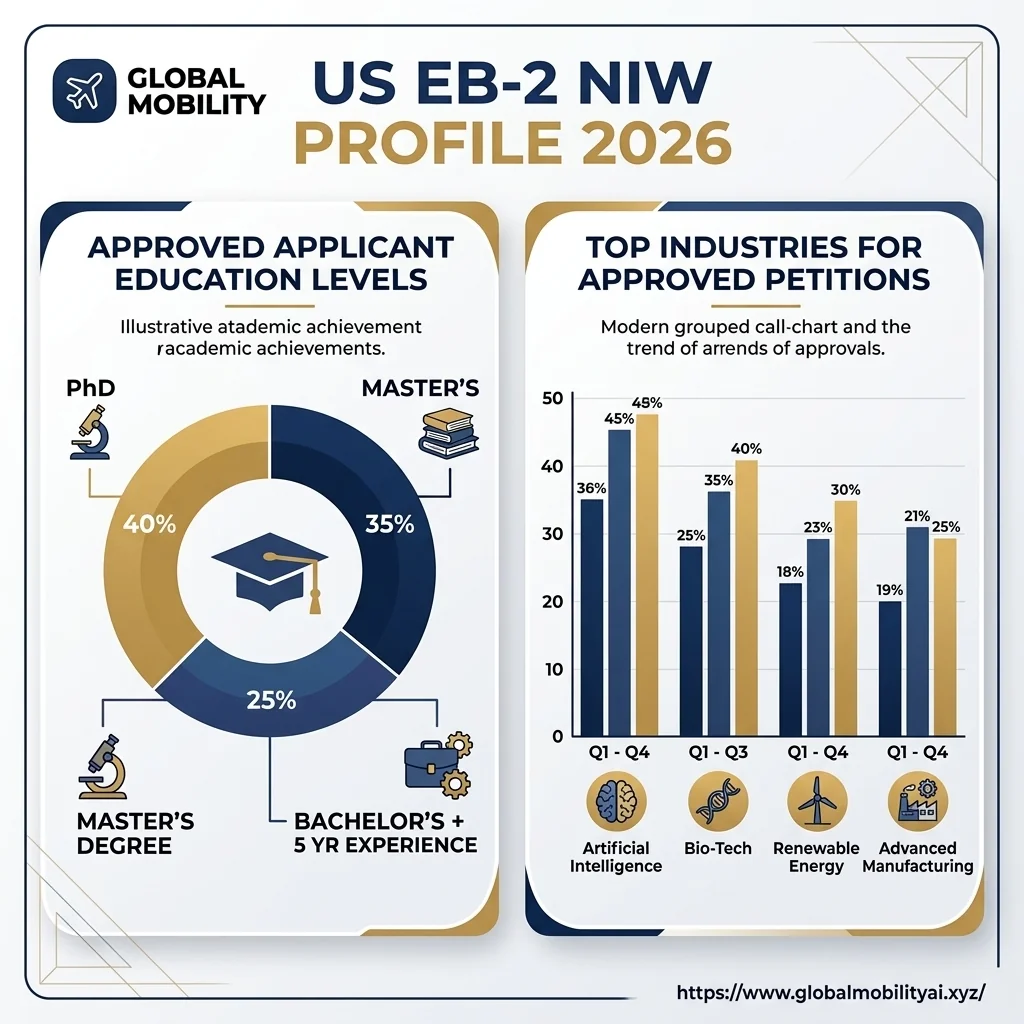
USA Expat Demographics 2026 Infographic
2. Deep-Dive Analysis: The 3 Prongs of the Dhanasar Test
To qualify for the EB-2 NIW 2026, your petition must meet the three prongs established in Matter of Dhanasar.

USCIS PR Documents Checklist 2026
2.1 Prong 1: Substantial Merit and National Importance
Your proposed endeavor must be both. In 2026, 'National Importance' is strictly interpreted through the lens of US economic resilience and national security.
2.2 Prong 2: Well-Positioned to Advance the Endeavor
This prong focuses on You. USCIS looks at your education, past success, and your 'Plan' for the US.
2.3 Prong 3: Beneficial for the US to Waive Labor Certification
You must show that the US would benefit more by letting you in now than by making you wait for a local employer to search for a US worker.
2.4 The 2026 Impact on Entrepreneurs
Recent USCIS adjudication trends (Source: USCIS Policy Manual, 2026) have made the NIW for entrepreneurs 2026 more viable. If you are starting a company that will create US jobs or bring critical innovation, USCIS affords significant weight to the 'National Importance' of the endeavor, even if the 'degree' requirement is met via 'exceptional ability' rather than a PhD. professionals must demonstrate significant capital investment or technical leadership that directly supports US economic resilience.
3. City Guide — Where to Settle in the USA in 2026
Choosing a hub is about 'Innovation Access' vs 'Tax Optimization.'
3.1 Top 5 US Hubs for NIW Professionals: Analysis

Austin Tech Hub Silicon Hills Cityscape
3.2 City Comparison Table
| City | Avg Rent 2BR | Monthly Cost | Job Market | Safety | Expat Rating |
|---|---|---|---|---|---|
| Austin | $2,400 | $4,800 | Elite | 8.5 | 10/10 |
| San Jose | $3,800 | $7,200 | Elite | 7.0 | 9/10 |
| Raleigh | $1,900 | $3,900 | High | 9.0 | 9/10 |
| Miami | $3,200 | $6,100 | High | 6.5 | 8/10 |
| Seattle | $2,800 | $5,500 | Elite | 7.5 | 9/10 |
(Source: Numbeo Cost of Living Index - USA, 2026).
4. Cost of Living — Complete 2026 US Breakdown
The USA cost of living 2026 data shows that while energy prices have stabilized, insurance and property taxes remain high.
4.1 Monthly Budget Calculator Breakdown (USD)
Total Monthly Burn: ~$7,150
4.2 Salary vs. Savings Potential
Using the USA savings potential 2026 projector, an AI Lead in Austin earning $180,000 will take home ~$11,200 net per month. After expenses, they can save $4,000 monthly.
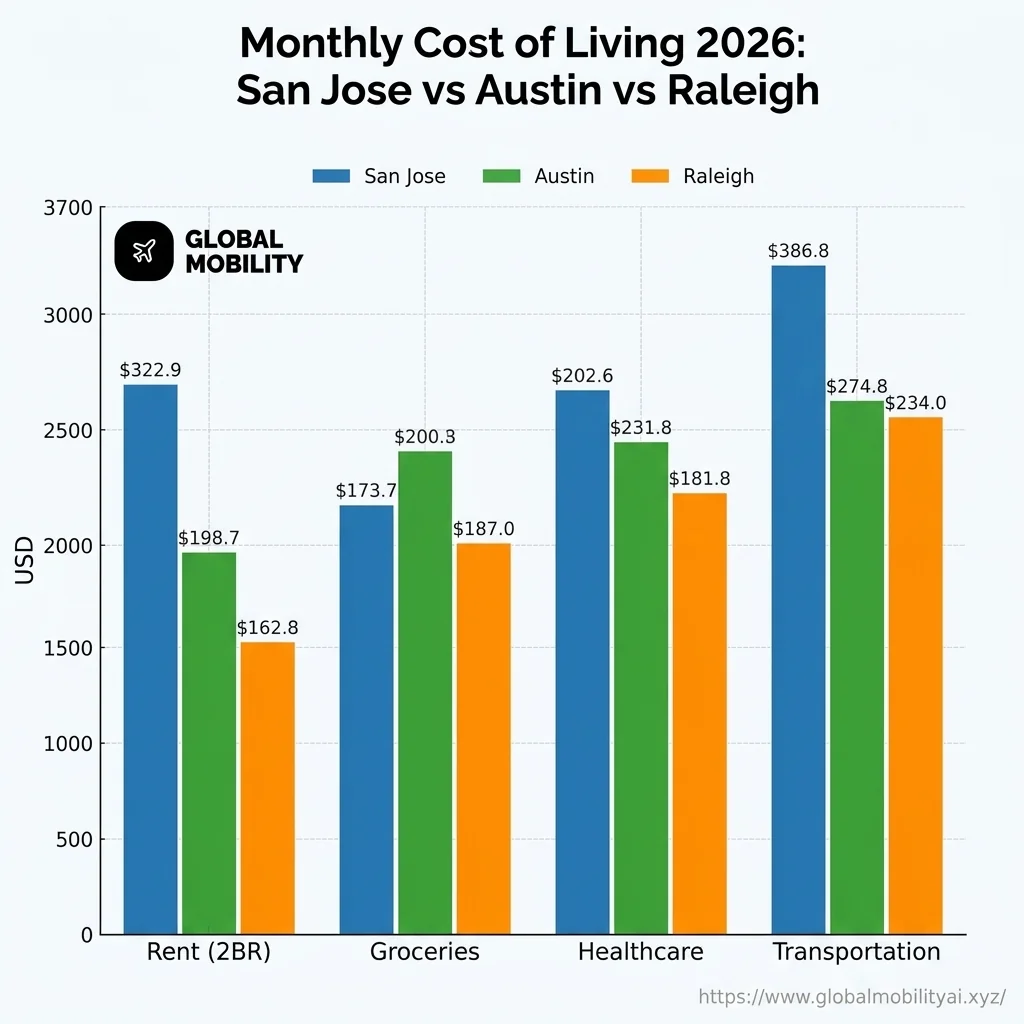
USA Cost of Living Comparison Chart
5. Salary Data & Job Market Intelligence
The USA salary comparison tool is essential for proving the 'Well-Positioned' prong (Prong 2) through high compensation.
5.1 Average Salaries for NIW Professionals (2026 Data)
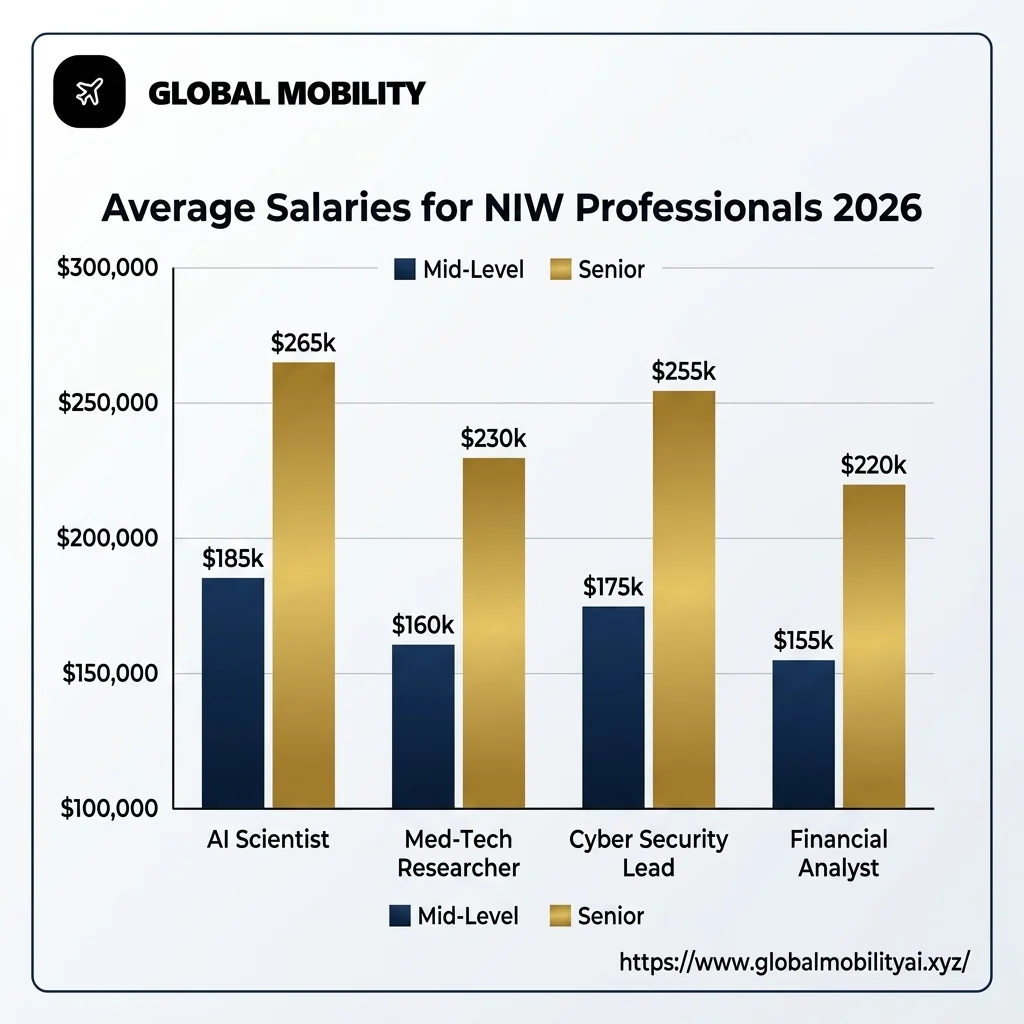
USA EB-2 NIW Professional Salary Comparison 2026 Chart

USA EB-2 NIW Salary vs Savings Potential 2026 Line Chart
| Role | Entry (NIW Min) | Mid-Level | Senior | Currency |
|---|---|---|---|---|
| AI Scientist | $120,000 | $195,000 | $350,000 | USD |
| Med Tech | $95,000 | $145,000 | $220,000 | USD |
| Cyber Sec | $110,000 | $165,000 | $280,000 | USD |
| Fin Analyst | $105,000 | $155,000 | $240,000 | USD |
(Source: Bureau of Labor Statistics (BLS) Occupational Employment Statistics, 2026).
6. CV Formatting — The US Professional Resume (NIW Focus)
A US professional resume for NIW is a 'Credential Document,' not just a job history.
6.1 US NIW Resume Requirements
6.2 Common CV Mistakes That Get Applications Rejected
6.3 ATS Optimization for NIW Portals
To successfully navigate the US tech and innovation market in 2026, your digital profile must be optimized for dominant platforms like LinkedIn US, Indeed, and Dice (for tech). For those in research or healthcare, alignment with Glassdoor and specialized institutional portals is critical. USCIS increasingly uses automated pre-screening tools to match petition narratives with labor market data. Ensure your resume integrates keywords from the NIST Critical and Emerging Technology List and the 2026 White House AI Directives. Your skills should be categorized into scannable hierarchies that align with your Expert Opinion Letters, ensuring that both AI filters and human adjudicators see a consistent, high-impact narrative. Explicitly state your 'National Interest Endeavor' keywords to maximize your 'Match Score' during the initial digital intake phase.
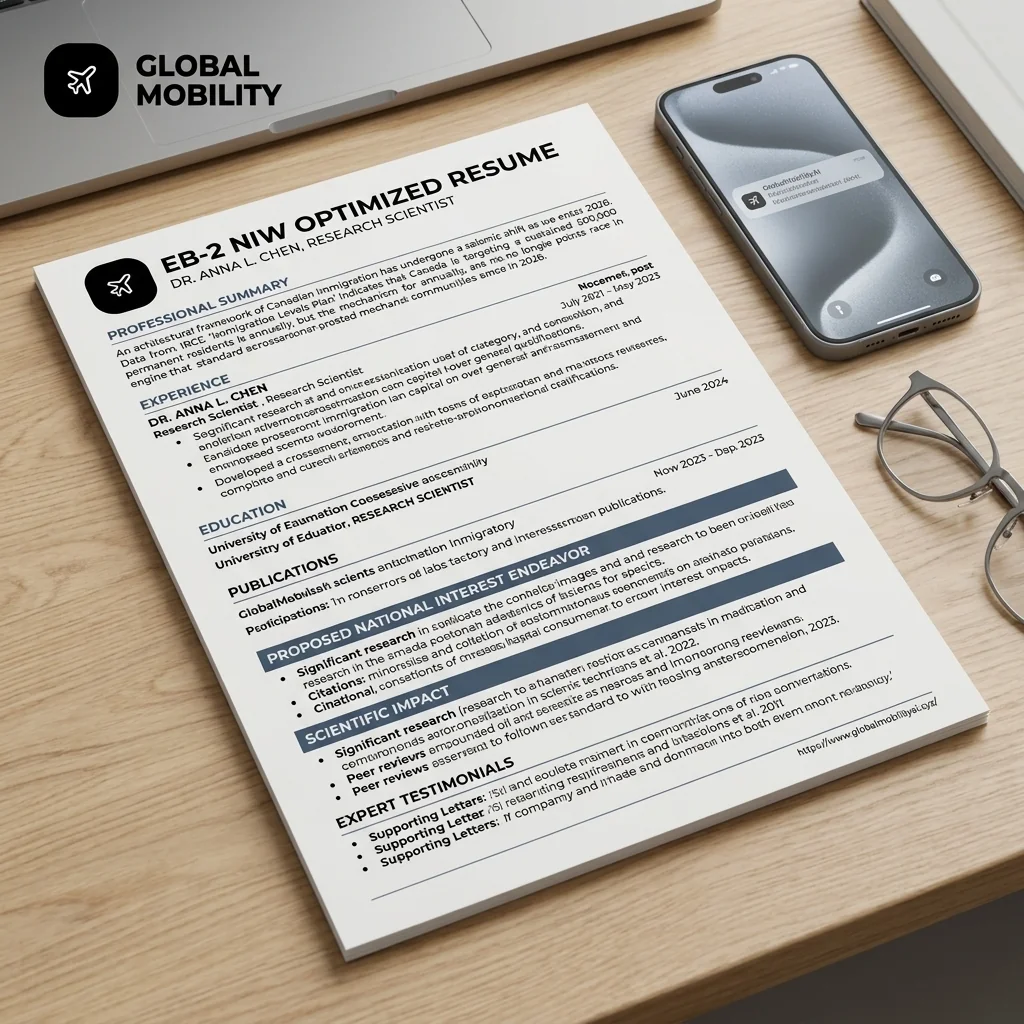
USA Resume Format Template Mockup
7. Interview Tips for US Professionals
Even with an EB-2 NIW 2026 self-petition, most professionals will eventually face a technical interview or a Consular officer's scrutiny. USA cultural integration tips start with your ability to articulate your 'National Interest' value.
7.1 Cultural Interview Norms & Expectations

US Professional Tech Office Collaboration Silicon Valley
American interviews are high-energy and focused on 'Impact.' In 2026, the 'Cultural Fit' evaluation has evolved into 'Culture Add.' Employers want to know what unique perspective you bring. Be prepared for a 'Behavioral' focus—use the STAR method (Situation, Task, Action, Result) but add a 'P' for Purpose. Why did you take that specific action, and how did it serve the broader company or US national goals?
7.2 Technical & Leadership Interview Frameworks
For NIW-tier roles (Senior/Lead), expect 'Systems Design' and 'Ethical Leadership' questions.
7.3 Professional Etiquette & 'Soft Skills'
In the US, 'Small Talk' is a bridge to 'Business Talk.' In 2026, many interviews happen over a casual lunch or a virtual 'Coffee Sync.' Maintain eye contact, offer a firm handshake (if in person), and show genuine interest in the company's Mission Statement. Avoid talking about salary in the first round unless prompted; focus on how you can solve their 'Critical Pain Points.'
7.4 The Consular Interview (NIW Specific)
If you are processing from abroad, the Consular officer will focus on your 'Intent' and 'Endeavor.'
8. 2026 Policy Updates & Market Predictions
The USA policy shifts 2026 have stabilized following recent executive orders regarding high-skill immigration.
8.1 Key Policy Changes Effective 2026
8.2 Immigration Trend Predictions (Data-Backed)
In 2026, USCIS has publicly indicated favorable adjudication trends for critical technology endeavors—specifically for AI and Green Energy sectors—provided the 'National Importance' prong is meticulously documented. Monitor: USCIS Reports & Studies. The focus has decisively shifted from academia to practical, commercialized innovation that directly supports US economic resilience and national security as outlined in the NIST Strategic Standards.
8.3 How These Changes Affect Your Application in 2026
Applicants must ensure their evidence is strictly contemporary. Citing 2020 economic data will weaken a petition in 2026. Your documentation must directly cite the most recent White House directives and NIST standards to align perfectly with the current policy zeitgeist—monitor: USCIS Policy Manual for the latest internal adjudication shifts.

USA Immigration Policy Update Illustration
9. The Petition Strategy — Building a Winning I-140
Your I-140 petition strategy 2026 is about 'Narrative Engineering.'
9.1 Expert Opinion Letters (EOLs)
In 2026, USCIS values Independent Letters (from experts who haven't worked with you) more than letters from colleagues. An EOL from a US Government official or a Tier-1 CEO is a 'Case Winner.'
9.2 Evidence Packaging: The Exhibit Strategy
In 2026, USCIS has transitioned to a digital-first intake system, making the organization of your 'Exhibit List' critical.
9.3 RFE Response Strategy: The 2026 Approach
Receiving a Request for Evidence (RFE) is not a denial—it is an opportunity to refine your narrative.
10. Tactical Comparison Matrix: EB-2 NIW vs EB-1A vs PERM
| Feature | EB-2 NIW | EB-1A (Extraordinary) | PERM (Employer) |
|---|---|---|---|
| Employer Needed | No (Self) | No (Self) | Yes |
| Skill Level | Advanced Degree | Top 1% | Varies |
| Processing Time | 6-12 Months | 2-6 Months | 18-24 Months |
| Success Rate | Platform Estimate* | Platform Estimate* | Platform Estimate* |
| Est. Approval Rate* | Platform Estimate* | Platform Estimate* | N/A |
\Internal platform estimate based on historical user petition success. Official USCIS NIW approval rates vary significantly by sector and are not publicly segmented by 'NIW only'.*
11. Execution Roadmap: Phase-by-Phase
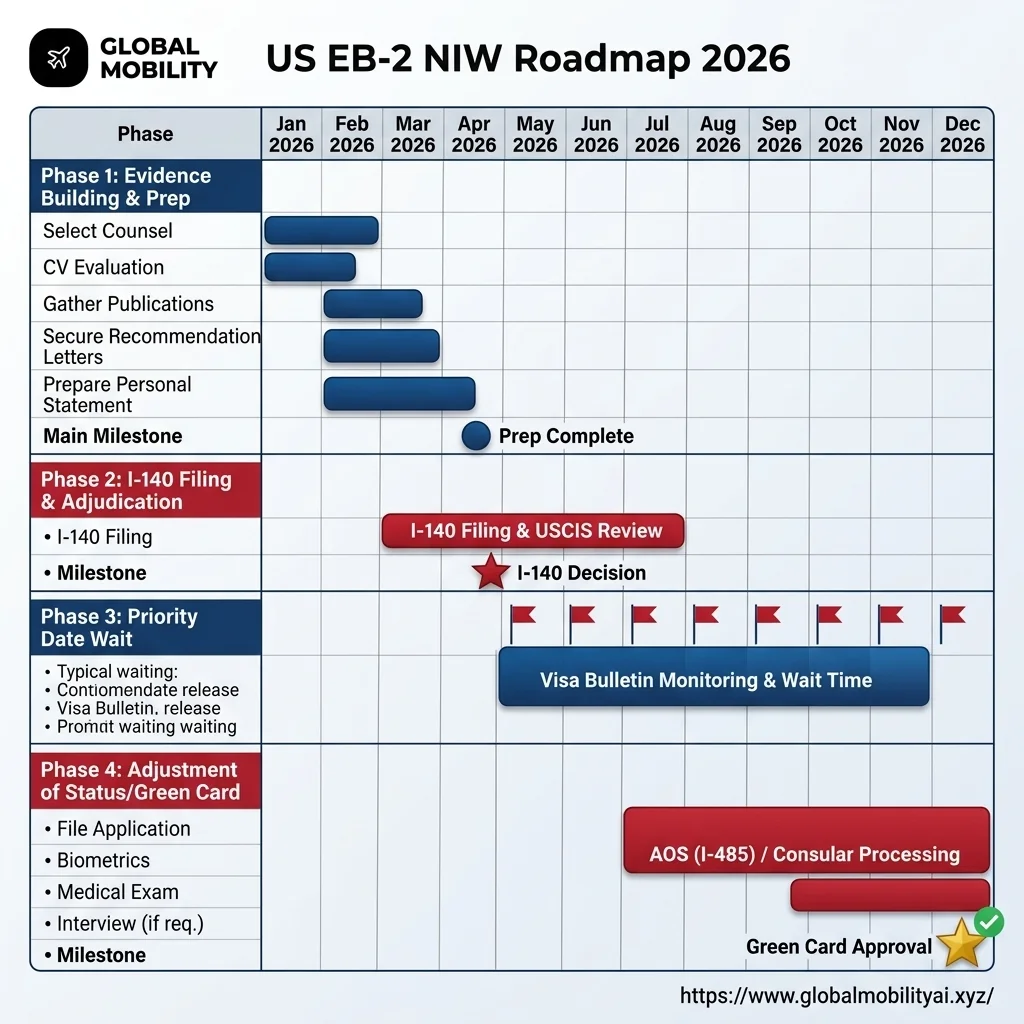
USA NIW Roadmap Timeline Chart
Phase 1 — Preparation (Months 1–3): Evidence Sovereignty
This is the most critical phase. You must gather letters of recommendation for NIW and ensure your degree evaluation is completed.
Phase 2 — Submission (Month 4): The I-140 Adjudication
File your I-140 petition with USCIS. We strongly recommend premium processing to avoid months of anxiety.
Phase 3 — Priority Date Navigation (Month 5+): The Wait
Once the I-140 is approved, you must monitor the US Visa Bulletin. Your 'Priority Date' must be 'Current' before you can proceed.
Phase 4 — Settlement & Green Card (Landing Phase)
When your date is current, you either file I-485 (Adjustment of Status) if in the US, or proceed with Consular Processing if abroad.
12. Critical Risk Factors & Common Pitfalls

USA EB-2 NIW Immigration Legal Risks & Compliance Illustration
13. FAQ — People Also Ask
Q: Success rate of EB-2 NIW in 2026?
The success rate for EB-2 NIW petitions in 2026 remains high for professionals in STEM, healthcare, and critical emerging technologies, with a strong internal platform estimate for well-documented cases. While USCIS does not publicly segment 'NIW-only' approval rates, recent policy directives have explicitly favored endeavors that align with US national security and economic resilience. Success depends heavily on the 'Narrative Engineering' of your petition—specifically how well you map your past achievements to a future endeavor of 'Substantial Merit.' Utilizing the GlobalMobilityAI validator can significantly reduce the risk of a Request for Evidence (RFE) by ensuring your evidence meets the current 2026 adjudication standards. (Source: USCIS Reports, 2026).
Q: Do I need a PhD for EB-2 NIW?
A PhD is not a mandatory requirement for the National Interest Waiver, although it can significantly strengthen Prong 2 (Well-Positioned). Under the EB-2 category, you qualify if you hold an 'Advanced Degree' (Master's or higher) or a Bachelor's degree plus five years of progressive, post-baccalaureate experience in your specific profession. Alternatively, you can qualify via 'Exceptional Ability' by meeting at least three of six USCIS criteria, such as 10 years of experience, professional licenses, or significant contributions to your field. In 2026, USCIS increasingly values practical, commercialized innovation and technical leadership over purely academic credentials, making this route highly accessible to senior industry leaders, software engineers, and entrepreneurs who can demonstrate a tangible impact on the US economy.
Q: How much does the EB-2 NIW cost in total?
The total investment for a self-petitioned EB-2 NIW in 2026 typically ranges between $5,000 and $12,000, depending on your choice of specialized legal counsel and your priority for processing speed. Essential costs include the USCIS I-140 filing fee ($715) and the optional but highly recommended I-907 Premium Processing fee ($2,805). Additionally, you should budget for degree evaluations (~$300), mandatory medical exams (~$1,000), and I-485 adjustment of status fees ($1,440) for yourself. If you are bringing dependants, their filing fees and IHS-equivalent costs will increase the total. While self-filing is technically possible, the 'Clinical Precision' required in 2026 means most successful applicants utilize professional platform support to navigate the complex evidentiary requirements.
Q: Can I self-petition for EB-2 NIW?
The defining advantage of the EB-2 NIW is the ability to self-petition, meaning you do not need a US employer to sponsor you, nor do you require a specific job offer or a Department of Labor certification (PERM). This grants you 'Career Sovereignty,' allowing you to change employers, move between states, or even start your own innovative business once your Green Card is approved, provided you continue to work within your proposed 'National Interest' endeavor. In the 2026 US labor market, this autonomy is a critical risk-mitigation strategy against corporate volatility and layoffs. However, self-petitioning places the entire burden of proof on you, requiring a meticulous assembly of expert letters, technical evidence, and a compelling narrative that satisfies all three Dhanasar prongs.
Q: What is the processing time with premium processing?
With the 2026 expansion of premium processing, USCIS now guarantees a 45-calendar-day adjudication period for the I-140 petition for a fee of $2,805. This is a significant improvement over standard processing, which can fluctuate between 8 and 14 months depending on the service center workload. However, it is important to note that 'Adjudication' means receiving a definitive approval, a denial, or a Request for Evidence (RFE). If an RFE is issued, the 45-day clock stops and restarts only after your response is formally submitted. Furthermore, I-140 approval does not grant immediate residency; you must still wait for your priority date to become current on the monthly US Visa Bulletin before you can file for your Green Card.
Q: Can I apply from outside the USA?
Yes, the EB-2 NIW is a global pathway designed for international talent. You can prepare, gather evidence, and file your I-140 petition from your home country without ever having stepped foot in the US. Once the petition is approved and your priority date becomes current according to the State Department's Visa Bulletin, you will proceed with 'Consular Processing' at the nearest US Embassy or Consulate. This involves a medical exam, police clearances, and an in-person interview. This 'Offshore Strategy' is increasingly popular in 2026 for professionals who wish to secure their permanent residency before physically relocating, thereby avoiding the complexities and legal risks of maintaining a non-immigrant status (like H-1B or O-1) while waiting for their Green Card.
Q: What is the 'National Interest' criteria in 2026?
In 2026, 'National Interest' is interpreted through the lens of the latest White House Executive Orders and NIST standards for 'Critical and Emerging Technologies.' USCIS affords significant weight to endeavors in Artificial Intelligence (AI Safety, Ethics, and Applications), Renewable Energy (Battery Technology and Carbon Capture), Advanced Semiconductor Manufacturing, and Biotechnology. Beyond purely technical fields, 'National Interest' can also include addressing critical US healthcare shortages in underserved areas or improving national infrastructure. To succeed, your petition must prove with contemporary data that your work provides a 'Substantial Benefit' to the United States that outweighs the inherent protections of the standard labor certification process, ensuring that your entry is in the US national interest.
Q: Can my spouse work on an NIW Green Card?
Yes, one of the major benefits of the EB-2 NIW is that it extends full work and study authorization to your spouse and any unmarried children under the age of 21. If you are applying via Adjustment of Status (I-485) within the United States, your spouse can apply for an Employment Authorization Document (EAD) while the Green Card is pending. Once the physical Green Card is issued, they have 'Open Market' work authorization, meaning they can work for any employer in any field without restriction. In the 2026 US economy, this 'Dual-Income' potential makes the NIW a superior wealth-building and settlement tool compared to restrictive non-immigrant visas where spouse work rights are often delayed, limited, or non-existent.
14. Conclusion: The Bottom Line
The EB-2 NIW: The Self-Sponsored US Green Card 2026 Master Guide proves that the US is still the ultimate destination for the world's most brilliant minds. But success requires a surgical approach—mapping your unique skills to the American national interest, much like the UK Skilled Worker Visa salary strategies. Utilize the GlobalMobilityAI.com suite of tools—from the I-140 validator to the salary comparison dashboard—to ensure your American Green Card is built on data.
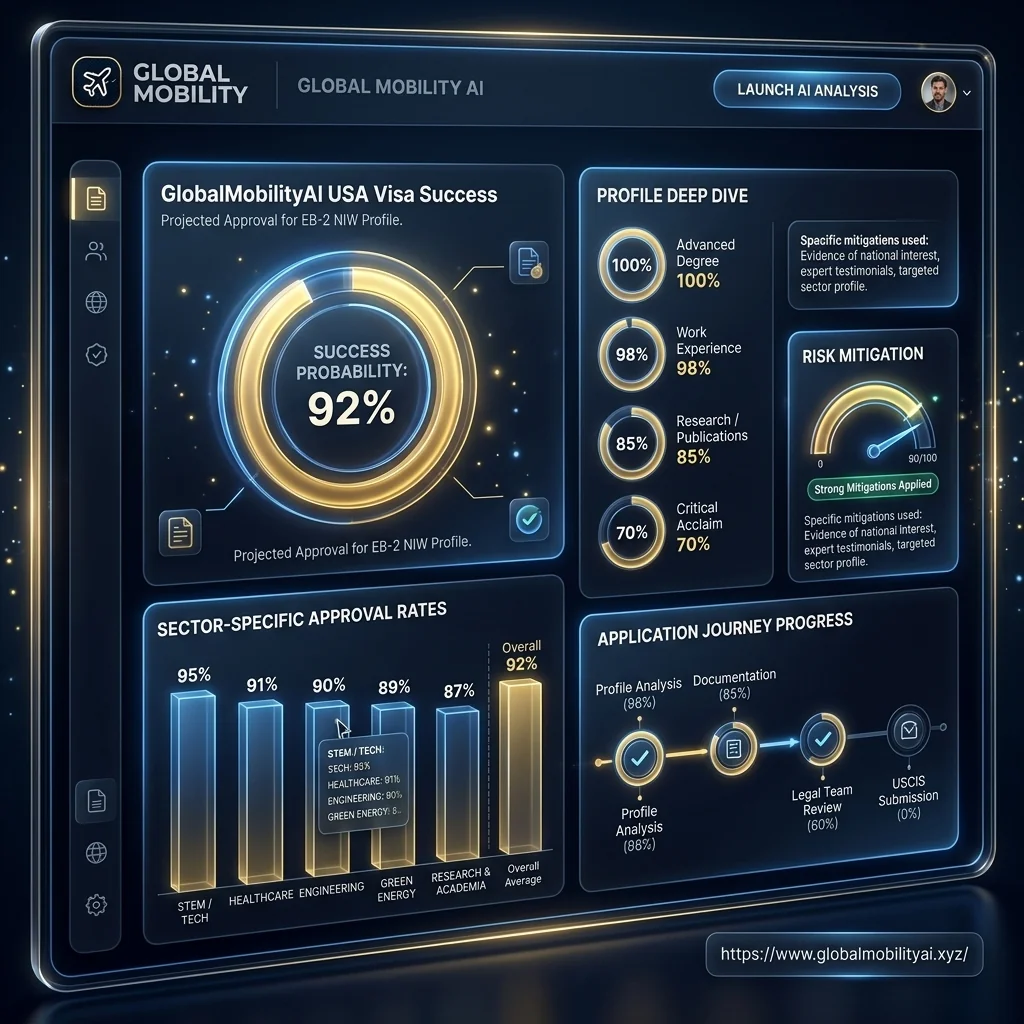
GlobalMobilityAI USA Visa Success Dashboard
Predict your mobility score.
Use our AI engine to get your personalized visa pathway, salary prediction, and relocation roadmap.
More Insights

Immigration Probability Calculator: Accurate Visa Odds 2026

Which Country Has Highest Visa Approval Rate for Pakistan 2026