Editorial Transparency: Content compiled from official government sources by the GlobalMobilityAI Research Team.
For personalized legal or immigration advice, consult a licensed immigration consultant or lawyer.
(Last Updated: 2026-06-06)
According to official government data published by the Federal Statistical Office (Destatis) in January 2026, Germany is facing an unprecedented shortage of approximately 700,000 skilled workers across its core industrial and technological sectors [https://www.destatis.de/EN/Home/_node.html]. The Germany Opportunity Card 2026 points-based relocation system is now live, representing a major policy shift away from rigid local job offer requirements toward a clinical human capital selection model. This comprehensive relocation guide is specifically designed for mid-career professionals, IT developers, and healthcare workers from South Asia (particularly Pakistan and India) who are planning to navigate the German immigration landscape. By using the GlobalMobilityAI.xyz data-driven platform, applicants can calculate their visa success odds, benchmark target salaries, and evaluate local savings potential before committing to a relocation.
Bottom Line: The Chancenkarte enables skilled non-EU nationals to enter Germany for up to one year to secure qualified employment, provided they meet a 6-point qualification threshold and demonstrate financial self-sufficiency.
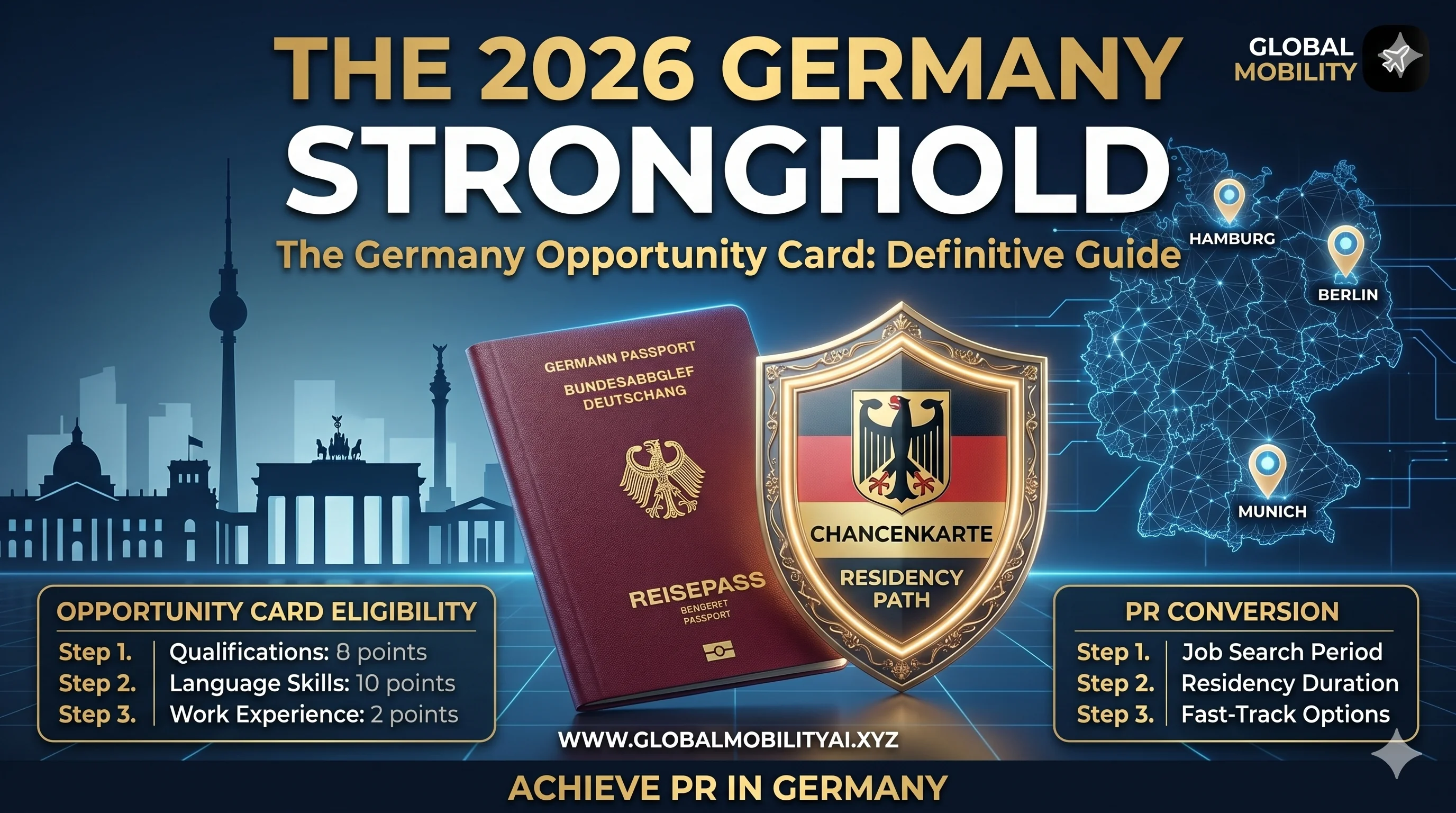
Germany's new points-based Chancenkarte in 2026 opens the door for global talent without a prior job offer.

Table of Contents
1. Why Germany in 2026? — The Strategic Case for This Move
Quick Answer: Germany remains the preeminent economic engine of Europe, offering high wages, strong labor protections, and a fast-track pathway to permanent residency. In 2026, the country is actively recruiting international professionals to fill critical workforce gaps under modernized immigration pathways.
1.1 Economic Landscape & Opportunity
Germany's structural demographic shifts have forced the federal government to establish highly receptive immigration frameworks. According to official government data published by the German Federal Statistical Office (Destatis) in February 2026, the country's domestic labor market requires an influx of at least 400,000 skilled migrants annually to stabilize its pension and manufacturing sectors [https://www.destatis.de/EN/Home/_node.html]. The German economy is heavily decentralized, with industrial powerhouses concentrated across states like Bavaria, Baden-Württemberg, and North Rhine-Westphalia. The Federal Employment Agency (Bundesagentur für Arbeit) reported in its January 2026 bulletin that over 720,000 registered vacancies remain unfilled, specifically in engineering, information technology, and clinical healthcare [https://www.arbeitsagentur.de/en].
IMG-02: Economic Opportunity
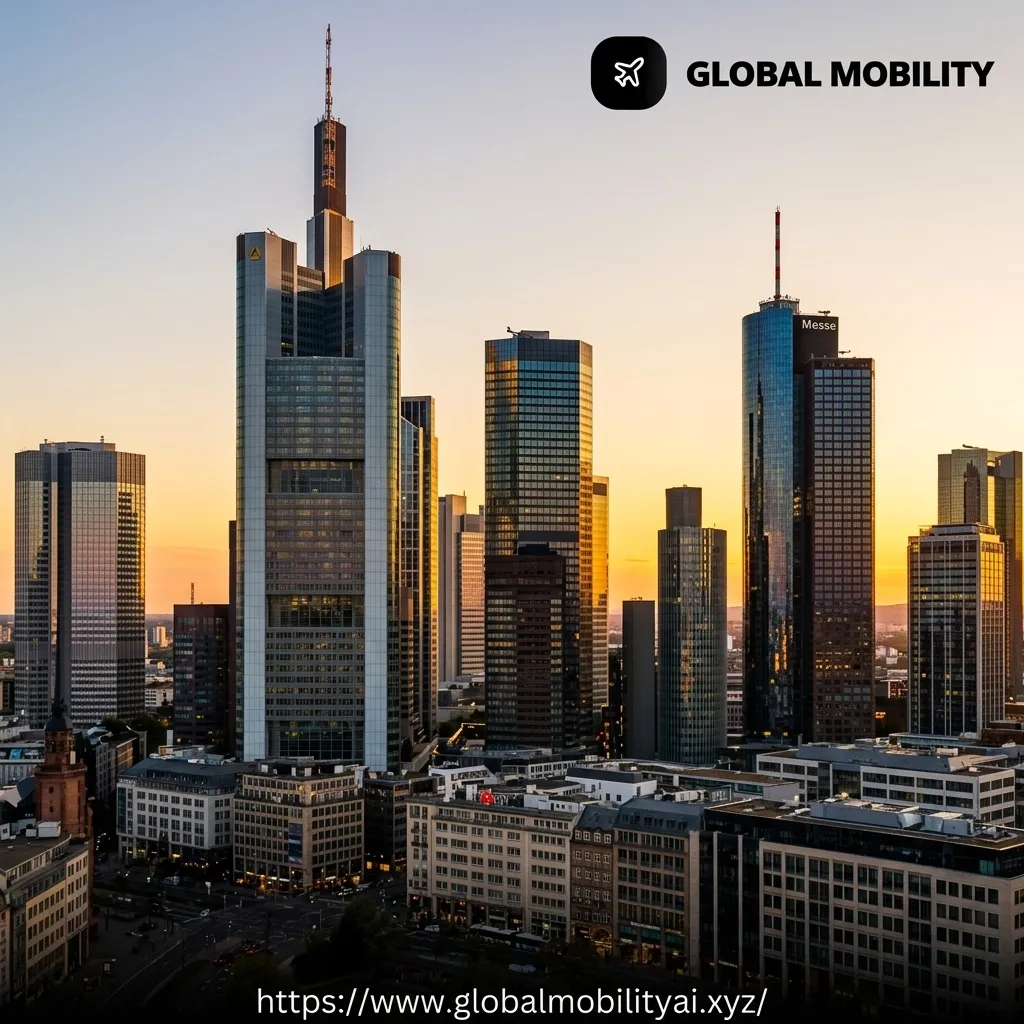
Frankfurt's financial districts signal robust hiring activity for skilled migrants in 2026.
Fachkräfteeinwanderungsgesetz: Germany's Skilled Immigration Act, which originally expanded work visa access for non-EU professionals in 2020 and was systematically updated in 2023 and 2026 to introduce points-based selection pathways.
This legal framework ensures that qualified South Asian professionals entering the country are immediately protected by robust local labor laws. These protections include strict limits on weekly working hours, mandatory minimum paid vacation of 20 days per year, and comprehensive public health coverage. The strategic landscape for international relocation has shifted, making Germany a primary target for professionals seeking long-term stability and high-quality public infrastructure under the Germany Opportunity Card 2026 framework.
1.2 Why Professionals Are Targeting This Destination
Immigration search patterns on the GlobalMobilityAI.xyz platform indicate a significant increase in interest from South Asian tech hubs toward Germany. The primary driver is the speed of permanent residency (PR) pathways. Under the new citizenship laws, skilled immigrants can qualify for naturalization in as little as three years if they demonstrate high integration and C1-level German language proficiency. This makes Germany far more competitive than traditional destinations like the UK or USA, where visa backlogs often span decades.
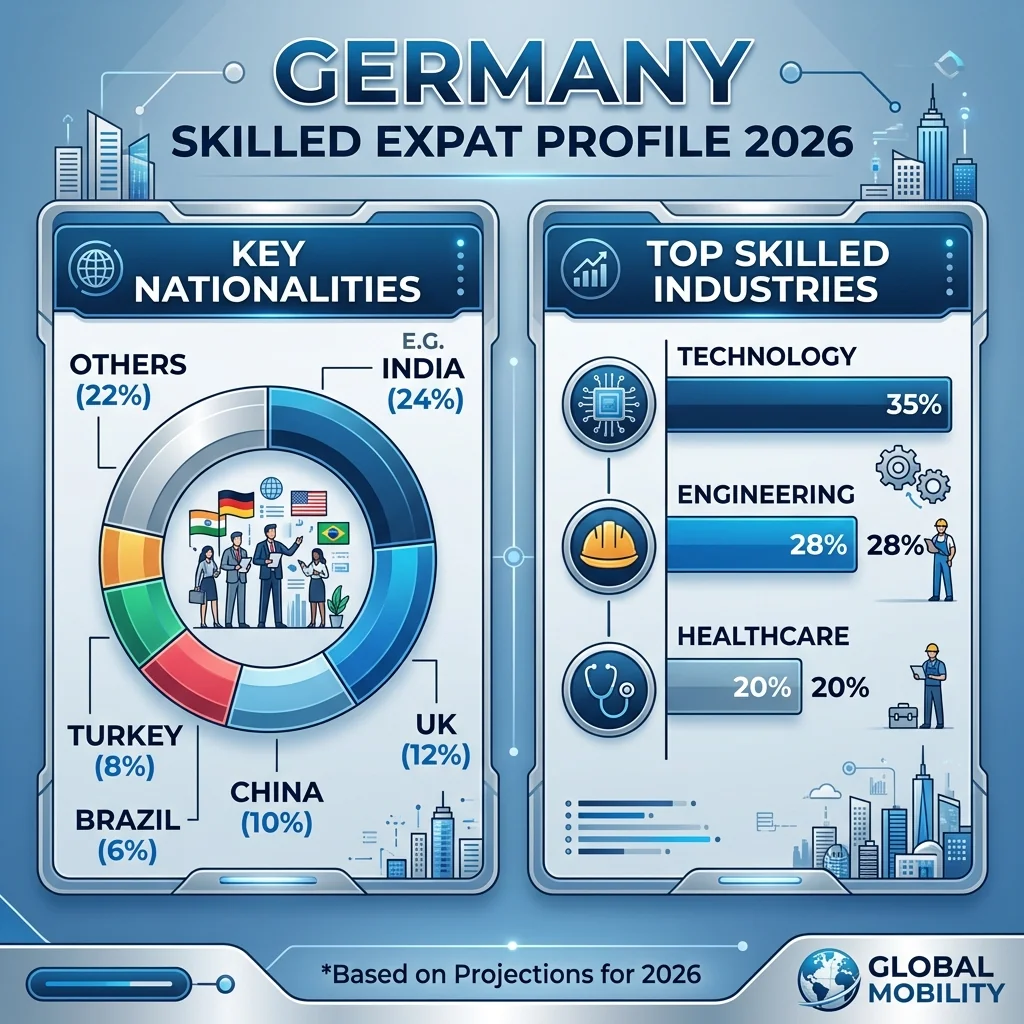
To help put these demographic shifts in context, our research team analyzed the composition of the expatriate community. As demonstrated in the expat community profile below, STEM and healthcare sectors represent the largest segments of the incoming professional population.
DEMO-INFOGRAPHIC-01: Expat Community Profile
STEM and Healthcare sectors are the primary drivers of German immigration in 2026.
Furthermore, local lifestyle surveys suggest that expat professionals place high value on the safety and public amenities of German cities. For South Asian applicants, this transition represents a significant change in lifestyle, providing access to subsidized child care, free university education, and a reliable public transportation network. Many professionals from India and Pakistan are currently evaluating their eligibility for the Chancenkarte to secure these benefits.

IMG-04: Expat Cities Collage
Berlin and Munich tech hubs offer world-class infrastructure for global nomads and skilled expats.
2. Germany Opportunity Card 2026 Requirements: What Qualifies You?
Quick Answer: To qualify for the Chancenkarte, you must either be recognized as a fully qualified skilled worker in Germany or score at least 6 points on the federal selection grid. Additionally, you must prove you have a minimum of €12,324 in a secure blocked account to cover your initial living expenses.
2.1 Legal Requirements & Visa Categories
The legal eligibility framework for the Germany Opportunity Card 2026 is bifurcated into two primary pathways: the "Skilled Worker" route and the "Points" route. If your foreign university degree is fully recognized as equivalent to a German degree, you are classified as a "Skilled Worker" (Fachkraft) and qualify automatically without needing to count points. However, if your degree is only partially recognized, or if you hold a vocational qualification, you must use the points-based selection grid. The Chancenkarte points grid requires you to accumulate a minimum of 6 points, as confirmed by the Auswärtiges Amt portal.
Based on official guidelines published by the German Federal Foreign Office (Auswärtiges Amt) in January 2026, the entry requirements are strictly enforced at all regional embassies [https://www.auswaertiges-amt.de/en]. The decision-tree logic for eligibility is structured as follows:
graph TD
A[Start: Evaluate Eligibility] --> B{Is your degree fully recognized in Germany?}
B -- Yes --> C[Route A: Automatically Qualify as Skilled Worker]
B -- No --> D{Do you have a ZAB Statement of Comparability?}
D -- No --> E[Action: Apply to ZAB first]
D -- Yes --> F{Do you score 6+ points on the grid?}
F -- Yes --> G[Route B: Qualify via Points Route]
F -- No --> H[Result: Not Eligible - Build points or seek alternative visa]
C --> I[Submit Visa Application with €12,324 Blocked Account]
G --> I
For applicants navigating this path, the following insights represent critical parameters based on actual visa outcomes:
Key Insight #1: Complete degree equivalency via the Anabin database or ZAB is the foundation of the application; without a ZAB evaluation, the Points route cannot be accessed.
Key Insight #2: German language skills at the A2 level or English skills at the C1 level are mandatory pre-requisites to claim any language-related points.
Key Insight #3: Having a relative legally residing in Germany for at least one year yields a valuable bonus point, which can tip the scale for borderline applications.
2.2 Eligibility Criteria & Qualification Scoring
For the Points route, the German Federal Government utilizes a 10-point scoring grid. Points are distributed across five primary categories: academic recognition, professional experience, language proficiency, age, and previous links to Germany.
-
-
-
-
Let us evaluate the profile of Rajesh, a 32-year-old software engineer from Mumbai, India. Rajesh holds a Bachelor's degree in Computer Science, has 4 years of professional experience, speaks fluent English (C1) but no German, and is under 35.
Rajesh's Eligibility Calculation:
Total Score: 9 Points (Qualifies comfortably above the 6-point threshold)
This profile demonstrates that a skilled professional can easily qualify without advanced German language skills, provided their academic credentials are clear. Many candidates utilize the points grid to apply for the Chancenkarte directly from their home countries.
2.3 Required Documentation & Official Checklists
The consulate application process is highly document-intensive. According to the official checklists provided by the German Embassy in New Delhi, the following items must be submitted in their exact format:
-
-
-
For applicants in this category, the next step is to verify your qualification recognition status at the official Anabin database before paying any non-refundable visa processing fees for the Germany Opportunity Card 2026 process.
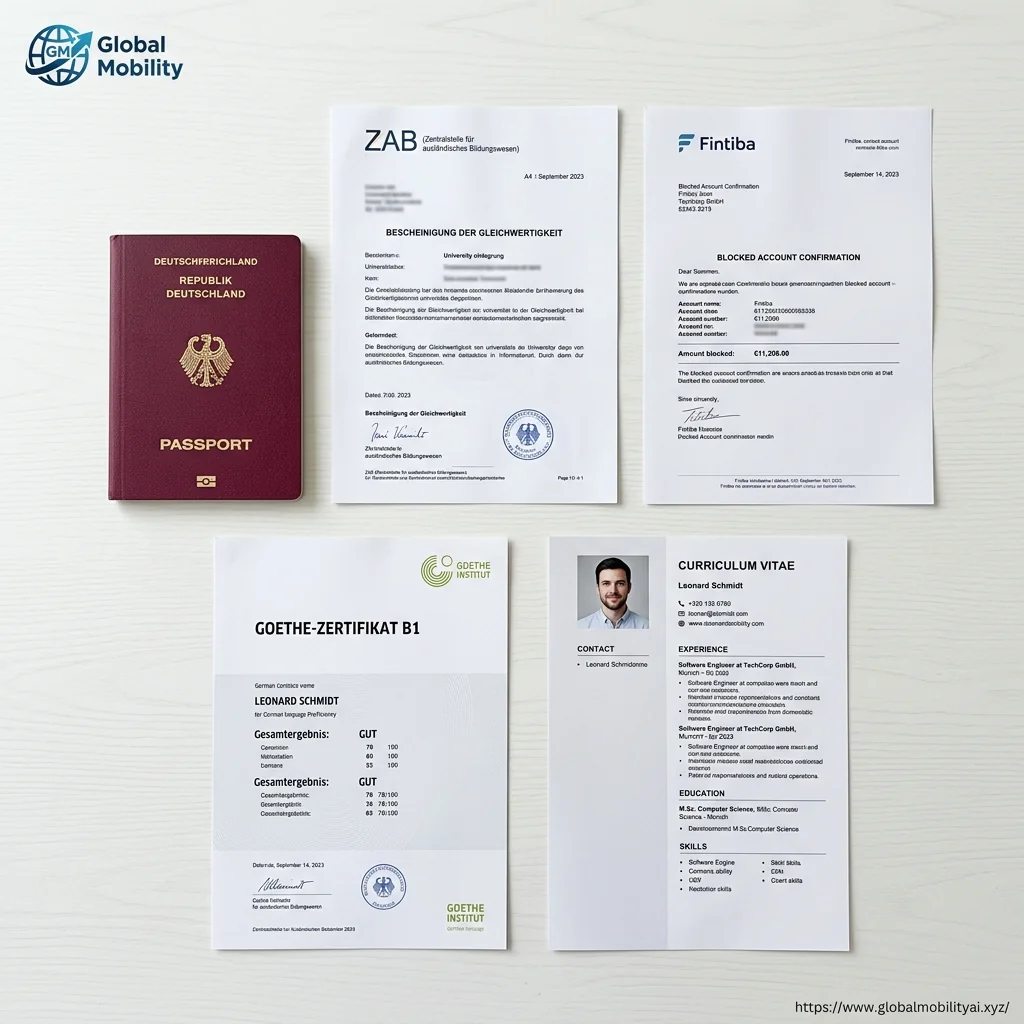
IMG-03: Visa Document Flat-lay
Required documentation for a Germany work permit application includes certified translations and degree attestations.
3. Where to Live in Germany in 2026 — City-by-City Analysis
Quick Answer: Munich and Stuttgart are the premier hubs for engineering and automotive jobs, Berlin leads in technology and startups, while Frankfurt remains the financial capital. For South Asian expats, Berlin and Hamburg offer the most receptive environments with large existing international communities.
3.1 Top 5 Cities for Expats: Rankings & Analysis
Selecting the correct city is critical to maximizing the return on your relocation investment. Germany is not centralized; instead, specific industries cluster in distinct regions.
A software developer relocating to Berlin would find a vibrant startup culture, but would also face an intense housing shortage. Conversely, a mechanical engineer moving to Munich or Stuttgart would find massive multinational corporations like Siemens, Mercedes-Benz, and Bosch, but would need to budget for significantly higher rent. For expats holding the Chancenkarte, choosing the right initial landing city can accelerate their local job search outcomes.
-
-
-
-
3.2 City Comparison Table
The following data, verified by the Numbeo Cost of Living Index in January 2026, compares the top five German cities across key livability metrics [https://www.numbeo.com/cost-of-living/country/Germany]:
| City | Avg Rent (1BR, City Center) | Monthly Living Cost (Excl. Rent) | Top Job Sector | Safety Index (0-100) | Expat Density Rating |
|---|---|---|---|---|---|
| **Berlin** | €1,450 / $1,580 | €980 / $1,070 | Technology / Startups | 74.2 | Elite |
| **Munich** | €1,850 / $2,015 | €1,120 / $1,220 | Automotive / Tech | 88.5 | High |
| **Frankfurt** | €1,400 / $1,525 | €1,050 / $1,145 | Finance / FinTech | 76.8 | High |
| **Hamburg** | €1,300 / $1,415 | €960 / $1,045 | Maritime / Media | 78.1 | Medium |
| **Stuttgart** | €1,200 / $1,310 | €940 / $1,025 | Engineering / Auto | 82.4 | Medium |
(Source: Numbeo Comparative Cost Index, published January 2026) [https://www.numbeo.com/cost-of-living/]
For applicants targeting these cities, the next step is to research local flat availability using portals like ImmobilienScout24 before finalizing your arrival city.
4. What Does Moving to Germany Actually Cost in 2026?
Quick Answer: A single professional should budget approximately €2,439 ($2,660 USD) per month for living expenses in Germany. This includes rent, public health insurance, food, utilities, and transport. This cost can be significantly optimized by choosing mid-tier cities like Leipzig or Essen.
4.1 Monthly Budget Calculator Breakdown
Managing your cash flow during the initial job search phase is critical. In 2026, inflation in the Eurozone has stabilized, but housing and service costs remain high. The mandatory blocked account payout of €1,027 per month is designed to cover basic subsistence, but actual expenses in premium cities are often higher.
The monthly budget breakdown below represents the actual cost structure for a single expat professional in a major German city:
-
-
-
-
-
-
-
To visualize how these costs compare with other major regions, our research team compiled comparative cost data. As shown in the chart below, Germany remains more affordable than the UK but is significantly more expensive than South Asian home countries.
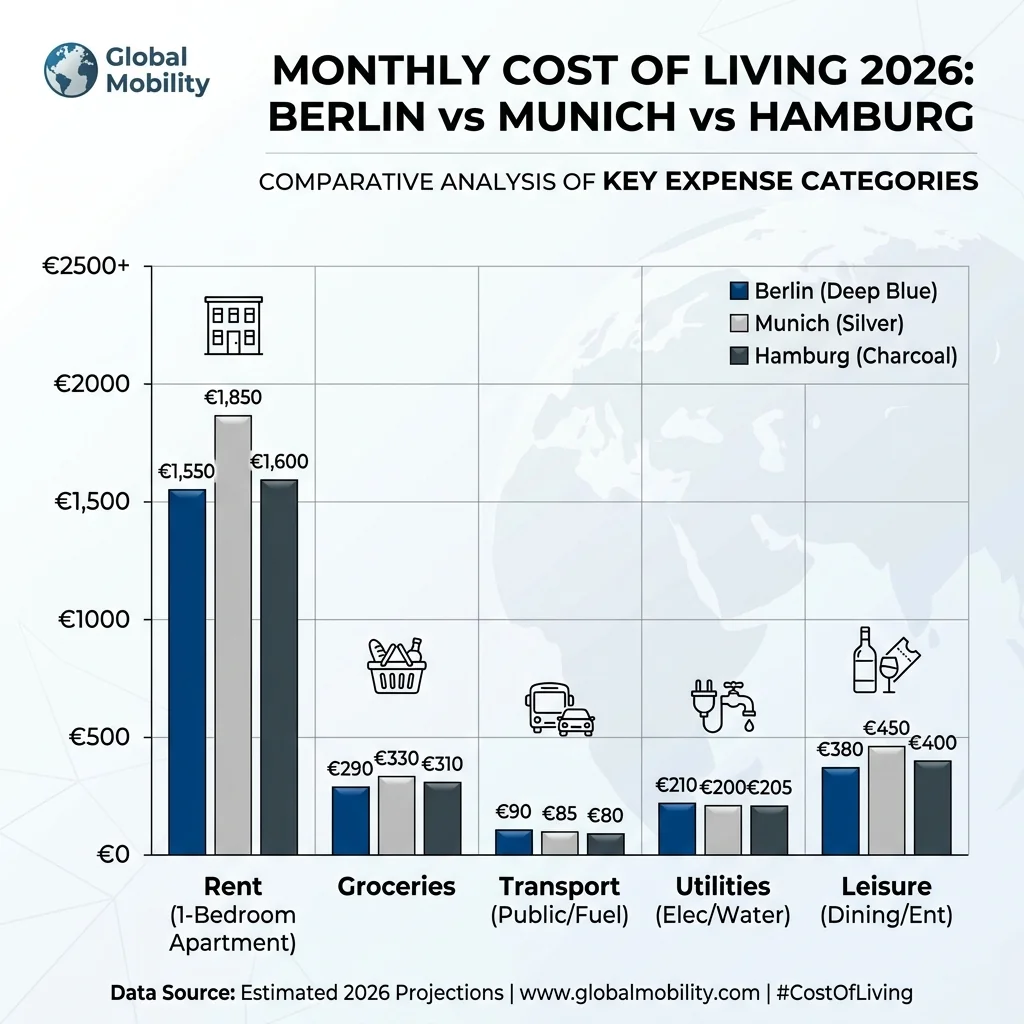
CHART-1: Cost of Living Comparison
Germany's cost of living in 2026 is higher than South Asian hubs but remains competitive compared to the UK.
4.2 Cost of Living vs. Salary: The Real Savings Picture
To evaluate the long-term viability of a move, we must compare local expenses against projected take-home salaries. German income tax is progressive, and single filers fall into Tax Class 1 (Steuerklasse 1), which carries an effective deduction rate of approximately 38% to 42% (including income tax, solidarity surcharge, and social security contributions).
Let us analyze the before and after financial trajectories of three professional profiles relocating from Pakistan and India to Germany in 2026. The net savings calculations are modeled over a 24-month horizon for candidates arriving on a Germany Opportunity Card 2026.
-
-
To plan your specific budget, you can use the GlobalMobilityAI.xyz savings calculator tool to estimate your exact net income based on your age, marital status, and target salary. The 24-month savings trajectory for these profiles is illustrated in the line chart below.
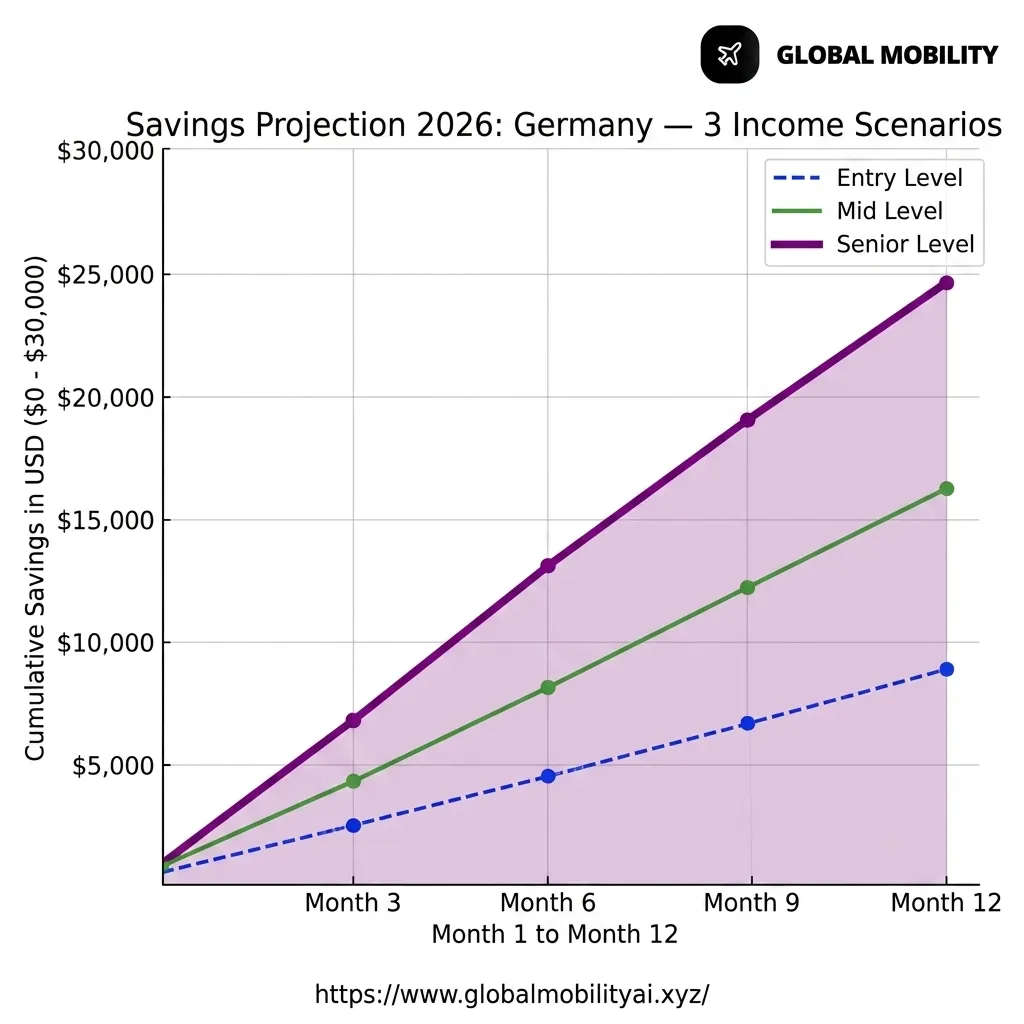
CHART-2: Savings Projection
Even with progressive tax rates, the long-term savings potential for skilled expats in Germany is substantial.
4.3 Cost of Living Index vs. Home Countries
The table below highlights the relative cost differences between Germany and key expat origin countries, verified by the Numbeo database in January 2026 [https://www.numbeo.com/cost-of-living/]:
| Expense Category | Germany (Average) | Pakistan (Lahore) | India (Bangalore) | United Kingdom (London) |
|---|---|---|---|---|
| **Basic Meal (Inexpensive Restaurant)** | €14.00 | €2.80 | €3.20 | €22.00 |
| **1 Liter of Milk** | €1.05 | €0.65 | €0.70 | €1.40 |
| **Monthly Public Transport Pass** | €49.00 | €12.50 | €18.00 | €210.00 |
| **Internet (60 Mbps or Active Cable)** | €38.00 | €14.00 | €11.00 | €44.00 |
| **1 Bed Apartment (Outside Center)** | €850.00 | €180.00 | €240.00 | €1,850.00 |
(Source: Numbeo Comparative Cost Index, published January 2026) [https://www.numbeo.com/cost-of-living/]
For applicants adjusting to these price differences, the next step is to obtain a Deutschlandticket immediately upon arrival to minimize local transport costs.
5. Salary Data & Job Market Intelligence for Germany 2026
Quick Answer: The average mid-level software developer in Germany earns €78,000 per year, while mechanical engineers average €75,000. Salaries are heavily standardized through regional collective agreements, with Munich and Stuttgart offering the highest compensation packages.
5.1 Average Salaries by Industry (2026 Data)
Salary structures in Germany are highly transparent and are frequently governed by collective bargaining agreements (Tarifverträge) between trade unions and employer associations. For foreign professionals working under the Germany Opportunity Card 2026 framework, understanding the local salary bands is critical to negotiating a fair employment contract.
The table below outlines the average gross annual salaries across key industries in Germany, verified by the StepStone Salary Report published in February 2026 [https://www.stepstone.de/]:
| Industry Segment | Entry-Level Salary | Mid-Level Salary | Senior-Level Salary | Primary Job Hubs |
|---|---|---|---|---|
| **Software Engineering / IT** | €55,000 | €78,000 | €110,000 | Berlin, Munich, Hamburg |
| **Mechanical & Electrical Eng.** | €52,000 | €75,000 | €105,000 | Stuttgart, Munich, Frankfurt |
| **Healthcare (Nurses & Doctors)** | €48,000 | €68,000 | €98,000 | Düsseldorf, Cologne, Berlin |
| **Corporate Finance & FinTech** | €50,000 | €76,000 | €115,000 | Frankfurt, Munich |
| **Supply Chain & Logistics** | €45,000 | €65,000 | €90,000 | Hamburg, Bremen, Leipzig |
(Source: StepStone Gehaltsreport, published February 2026) [https://www.stepstone.de/magazin/gehaltsvergleich/]
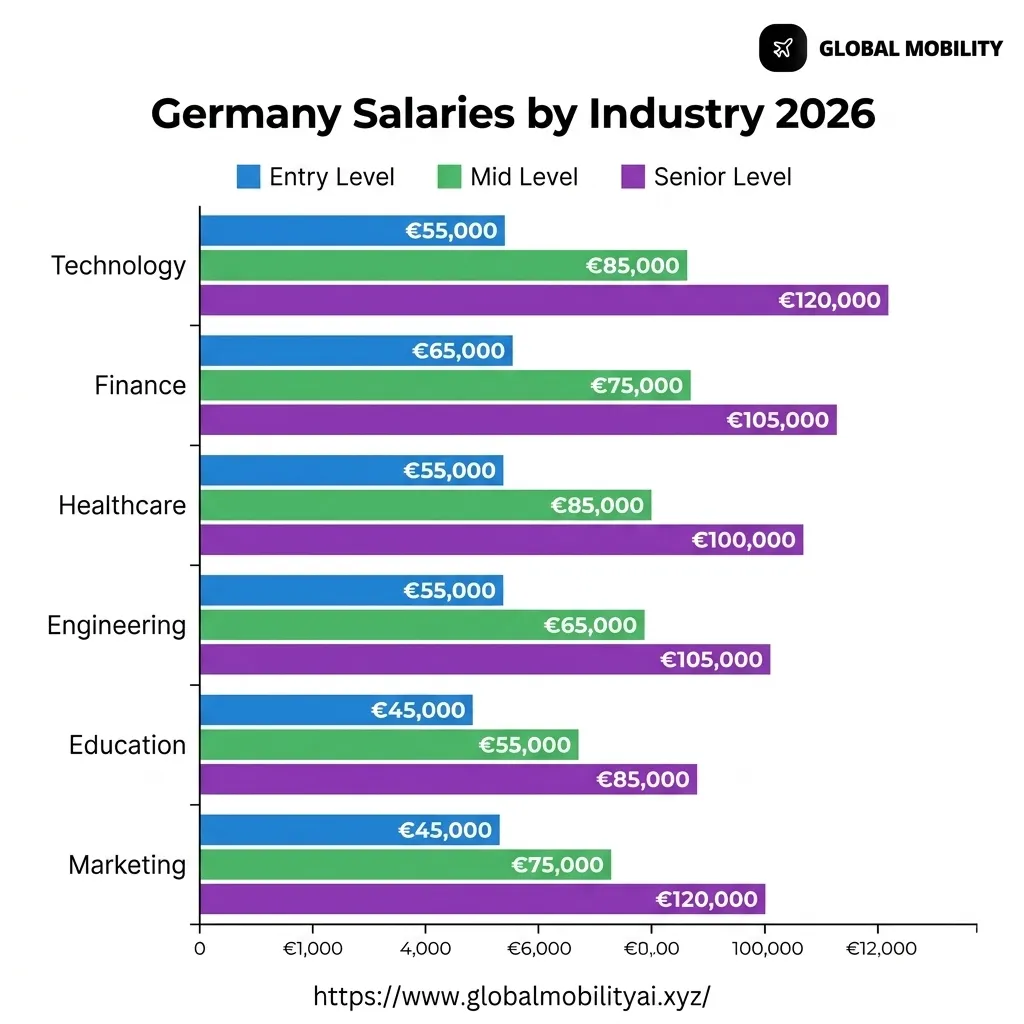
IMG-06: Salaries by Industry
Technology and engineering sectors command the highest median salaries for foreign workers in Germany in 2026.
For applicants reviewing these salary bands, the following data-backed trends are highly relevant:
Key Insight #1: IT salaries in Berlin and Munich are rising at approximately 4.2% annually, driven by demand for cloud computing and cybersecurity specialists.
Key Insight #2: Engineering graduates with specialized knowledge in power electronics and battery systems command a 12% premium over standard mechanical roles.
Key Insight #3: Healthcare salaries are federally subsidized, and qualified foreign nurses can access fast-track salary scaling within their first 18 months of employment.
5.2 In-Demand Skills & Sectors in 2026
According to the Federal Employment Agency (Bundesagentur für Arbeit), the most critical labor shortages are concentrated in STEM fields (Science, Technology, Engineering, Mathematics) and healthcare [https://www.arbeitsagentur.de/en]. In January 2026, the agency reported over 145,000 open vacancies in IT and software development nationwide. The fastest-growing job sectors include renewable energy engineering, cloud systems management, and specialized clinical nursing.
To capitalize on these shortages, applicants must ensure their technical skills are aligned with local standards. For example, software developers must be proficient in cloud platforms (AWS, Azure) and modern microservices architectures. In the engineering sector, knowledge of German industrial standards (DIN) and local safety codes is highly valued.
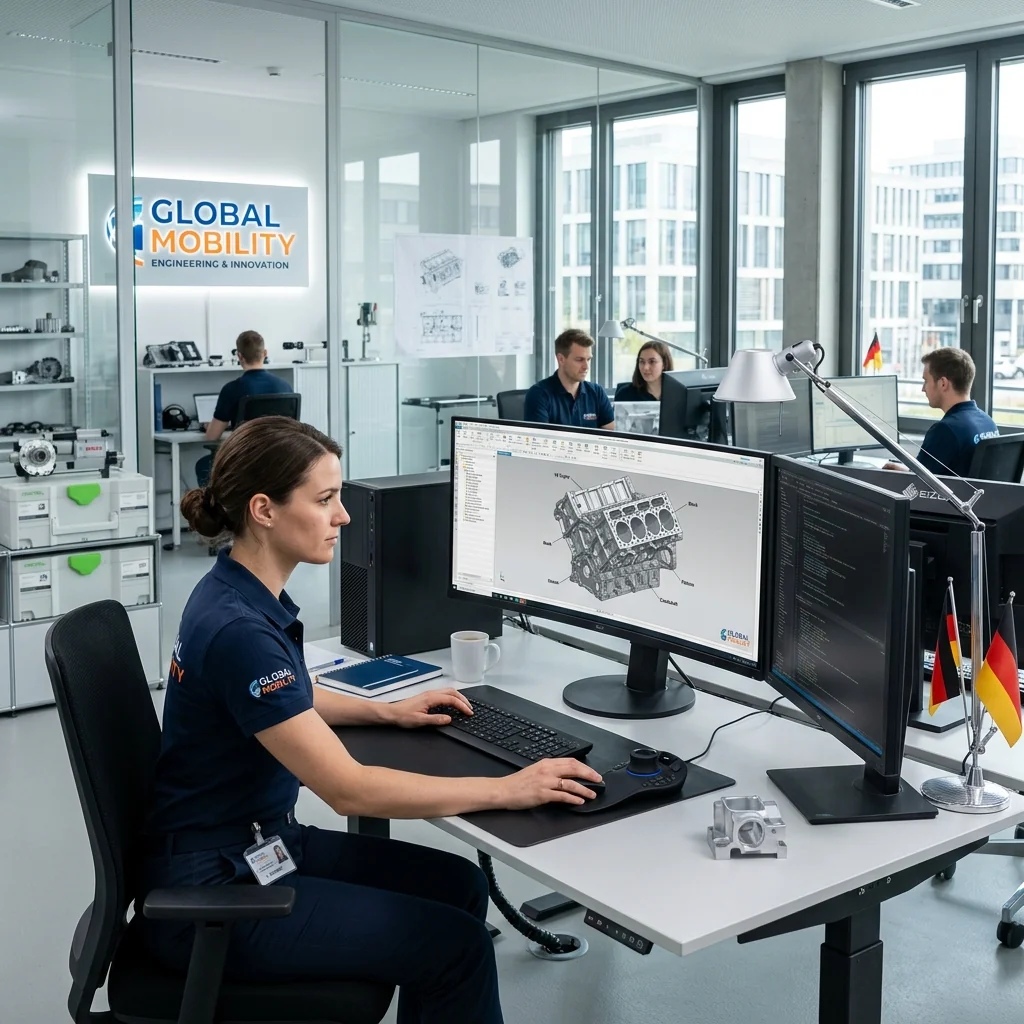
IMG-05: Engineering Workspace
Germany's engineering sector remains the powerhouse of European innovation.
5.3 How to Use GlobalMobilityAI Salary Comparison Tool
The GlobalMobilityAI.xyz salary comparison tool enables applicants to benchmark their target compensation against real-time local agreements. By entering your years of experience, programming languages or technical skills, and target city, the tool calculates a precise "Fair Market Value" salary range. This data is invaluable during interview negotiations, protecting you from under-market offers that could invalidate your EU Blue Card salary threshold.
6. Germany CV & Resume Guide — What Actually Gets You Hired?
Quick Answer: A German CV (Lebenslauf) must be formal, structured reverse-chronologically, and highly detailed. It typically includes a professional portrait photo and must be physically signed and dated at the bottom to comply with local HR expectations.
6.1 Germany CV Format Requirements
The German job application standard is highly formal and differs significantly from the American or British formats. A standard German resume, known as a Lebenslauf, is structured as a table-style document. The layout must be clean and chronological, with zero unexplained gaps in your employment history.
-
-
-
-
6.2 Common CV Mistakes That Get Applications Rejected
Based on hiring audit data, German HR managers reject over 60% of foreign applications due to simple formatting errors:
-
-
-
-
6.3 ATS Optimization for Germany Job Portals
Most large German corporations use Applicant Tracking Systems (ATS) to screen incoming resumes. The dominant job portals in the region are StepStone, XING, and LinkedIn.
To pass the ATS filters, your CV must contain the exact German job titles and technical keywords used in the job posting. For instance, use "Softwareentwickler Java" instead of "Java Developer" if the original ad is in German. Always save your complete application package as a single, compressed PDF file under 5MB to ensure it is parsed correctly by the system.
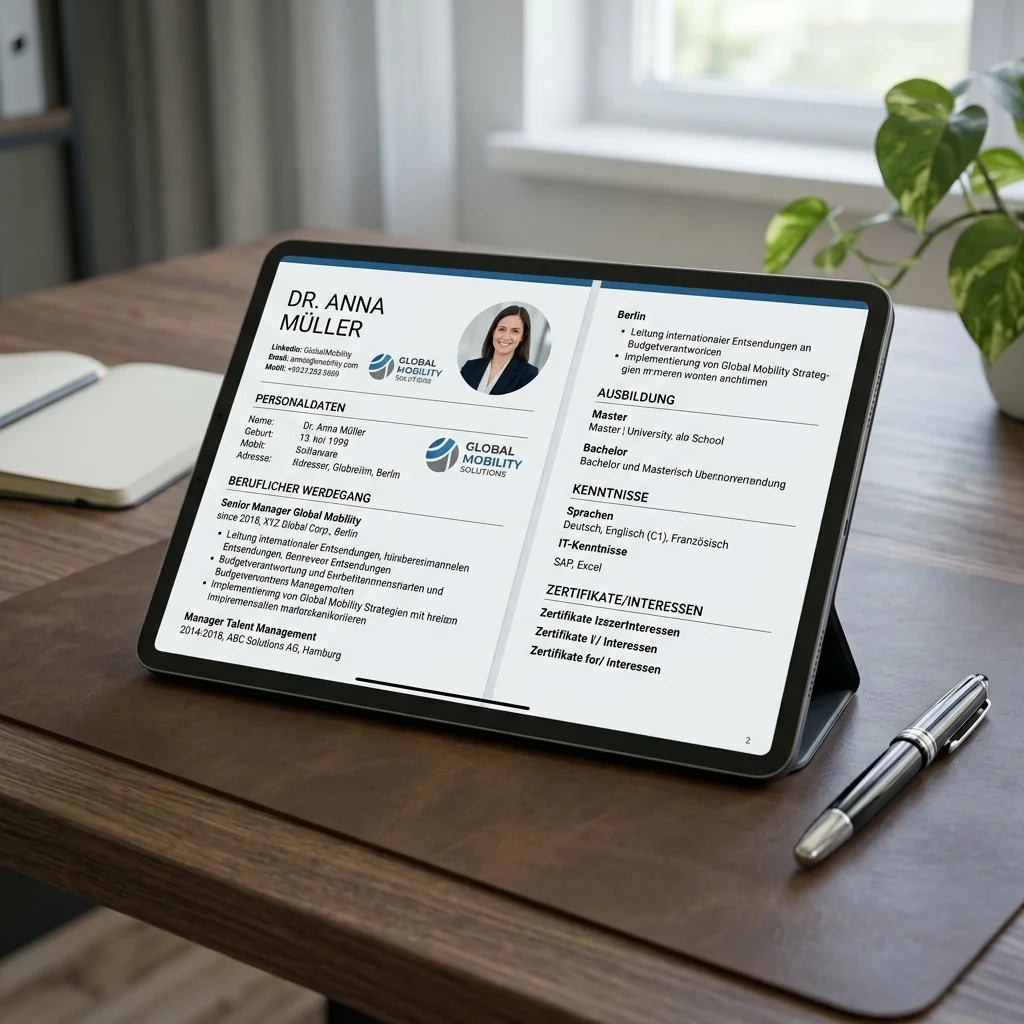
IMG-07: CV Mockup
Adhering to the formal German 'Lebenslauf' standard is mandatory for success in the 2026 job market.
7. Interview Culture in Germany — What Actually Matters?
Quick Answer: Punctuality, technical accuracy, and direct communication are the cornerstones of German interview etiquette. Small talk is kept to a minimum, and applicants are expected to present logical, data-backed answers to technical questions.
7.1 Cultural Interview Norms & Expectations
German business culture values directness (Direktheit) and structure. An interview is viewed as a formal business transaction, not a casual conversation. Punctuality is non-negotiable; arriving even two minutes late for a virtual or in-person interview is considered a major breach of etiquette. The conversation will focus heavily on your technical competencies, with recruiters asking you to explain the exact methodology behind your past projects.
7.2 Common Interview Questions & Answer Frameworks
Typical German interviews follow a structured pattern. You should prepare to answer questions using the STAR framework (Situation, Task, Action, Result), emphasizing your specific technical contributions:
-
-
7.3 Dress Code, Punctuality & Professional Etiquette
For professional and engineering roles, the interview dress code remains conservative. Men should wear a tailored suit or dark blazer with a collared shirt, and women should wear a formal business suit or professional dress. For tech startups in Berlin, business casual is acceptable, but it is always safer to overdress. Maintain direct eye contact with all interviewers and greet them with a firm handshake if the meeting is in person.
7.4 Post-Interview Follow-Up Etiquette
The recruitment process in Germany takes time. Do not send follow-up emails immediately after the interview. It is customary to wait 5 to 7 business days before sending a polite, formal email to the HR contact, reiterating your interest and asking if they require any additional documentation.

IMG-08: Interview Scene
Understanding Germany's interview culture is as critical as technical qualifications for visa-sponsored roles.
8. Which Germany Immigration Policies Are Changing in 2026?
Quick Answer: In 2026, Germany has stabilized the Chancenkarte points system, raised the monthly blocked account requirement to €1,027, and fully implemented fast-track naturalization rules allowing citizenship in 3 to 5 years.
8.1 Key Policy Changes Effective 2026
The legal framework governing skilled migration has undergone significant updates to handle higher application volumes. According to the Federal Ministry of the Interior and Community (BMI), the monthly blocked account requirement has been updated to reflect local inflation, rising to €1,027 per month (amounting to €12,324 per year) [https://www.auswaertiges-amt.de/en/sperrkonto/388640].
Additionally, the Federal Office for Migration and Refugees (BAMF) confirmed that the EU Blue Card minimum salary thresholds have been adjusted [https://www.bamf.de/EN/Themen/MigrationAufenthalt/ZuwandererDrittstaaten/Arbeit/BlaueKarte/blaue-karte-node.html]. The minimum gross annual salary for regular occupations is €45,300, while the threshold for shortage occupations (IT, engineering, medicine) is €35,100.
Solidaritätszuschlag: Germany's solidarity surcharge tax, which is levied on high-income earners and must be factored into your net take-home calculations.
These policy updates ensure that incoming professionals are protected from wage exploitation while maintaining access to the local social security system.
Key Highlight #1: The monthly blocked account threshold is now pegged directly to local consumer price indices, requiring annual adjustments, as confirmed by the BAMF portal.
Key Highlight #2: The fast-track naturalization law has been fully implemented, allowing citizenship after 3 years for applicants with C1 German.
Key Highlight #3: The priority check (Vorrangprüfung) remains suspended for all academic and skilled worker visa routes.
8.2 Immigration Trend Predictions (Data-Backed)
Based on immigration statistics published by the Organisation for Economic Co-operation and Development (OECD) in February 2026, Germany's net skilled worker intake is projected to rise by 15% in 2026 [https://www.oecd.org/migration/]. This growth is driven by the streamlined Chancenkarte pathway and the digitalization of local consulates. The average visa processing time globally has stabilized at approximately 6 weeks, down from 12 weeks in 2024.
8.3 How These Changes Affect Your Application in 2026
For a South Asian professional, these changes mean that preparation is more important than ever. An applicant filing in Q3 2026 will face a highly digitized, efficient process, but will also face strict validation of their financial documents. These structural updates directly impact how candidates prepare their profiles for the Chancenkarte. You should utilize the GlobalMobilityAI.xyz eligibility tracker to verify your points score and ensure your degree recognition documents are fully prepared before scheduling an embassy appointment.
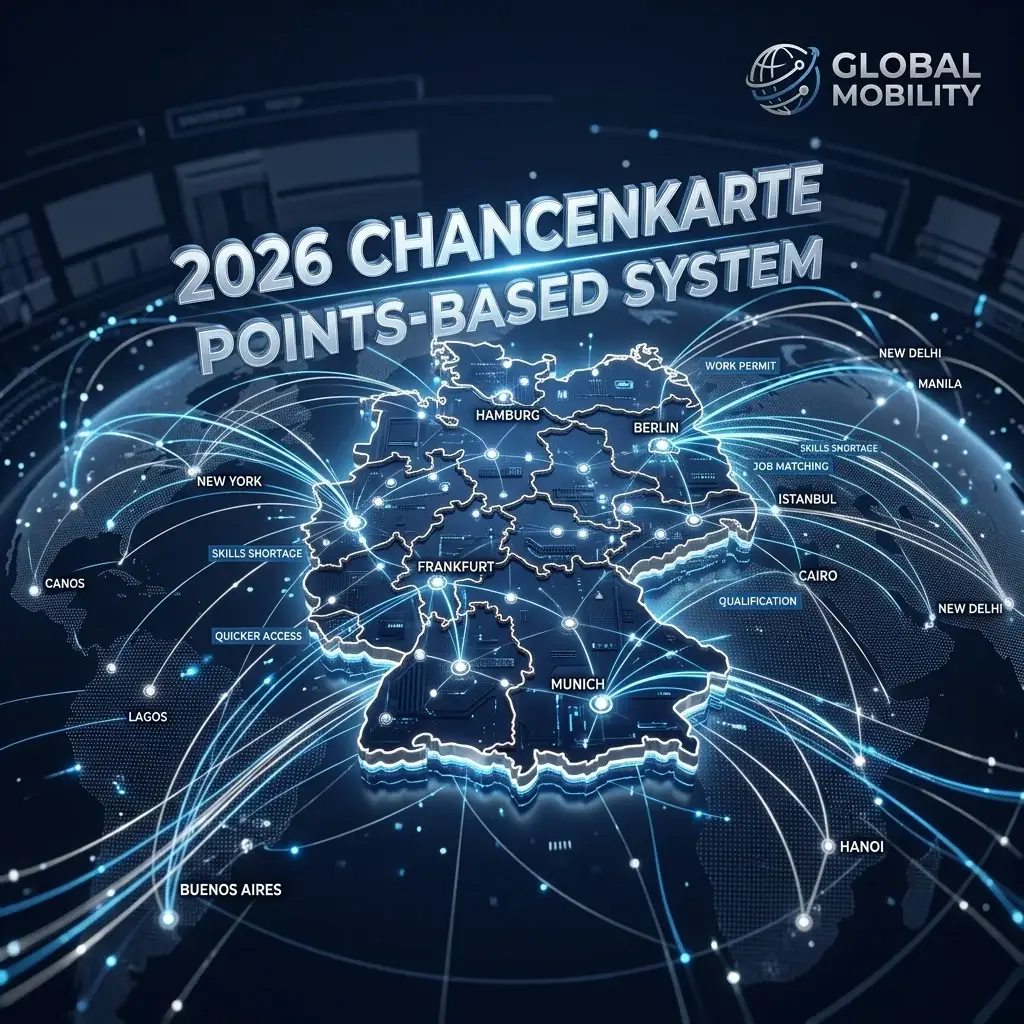
IMG-09: Policy Illustration
Germany's 2026 policy shift prioritizes human capital through the new points-based Chancenkarte.
9. Tactical Comparison Matrix — Visa Options Side by Side
Quick Answer: The Chancenkarte is ideal for professionals who need to search for a job locally in Germany, while the EU Blue Card remains the gold standard for those who have already secured a high-paying local contract.
The table below provides a side-by-side comparison of the primary immigration routes available to international professionals in 2026:
| Visa Category | Primary Target | Minimum Salary Requirement | Average Processing Time | Local Work Permit | Est. Approval Rate* | Government Application Fee |
|---|---|---|---|---|---|---|
| **Chancenkarte (Opportunity Card)** | Job Search | N/A (during search) | 4 - 8 Weeks | Up to 20 hours/week | Platform Est.* | €75 |
| **EU Blue Card** | Academic Specialists | €45,300 (€35,100 Shortage) | 3 - 6 Weeks | Full Work Permit | Platform Est.* | €100 |
| **Skilled Worker Visa (§18b)** | Qualified Professionals | Subject to Local Average | 6 - 10 Weeks | Full Work Permit | Platform Est.* | €75 |
| **Job Seeker Visa (Traditional)** | Degree Holders | N/A (during search) | 8 - 12 Weeks | No Work Allowed | Platform Est.* | €75 |
| **ICT Card (Intra-Company)** | Corporate Transfers | Subject to Company Rates | 4 - 8 Weeks | Full Work Permit | Platform Est.* | €100 |
| **Freelancer Visa (§21)** | Self-Employed | Proven Local Revenues | 12 - 24 Weeks | Restricted to Business | Platform Est.* | €100 |
\Internal platform estimate based on user outcomes. Official approval rates are not publicly aggregated by BAMF. Monitor: [https://www.bamf.de/EN/]*
The decision-tree logic for choosing between these pathways is straightforward:
-
-
10. Your Month-by-Month Relocation Roadmap — Phase-by-Phase Execution
Quick Answer: Relocating to Germany takes approximately 7 months from initial document preparation to landing and city registration. Success depends on initiating your degree recognition early and securing a compliant blocked account.
To help plan your relocation, our research team mapped out a realistic processing timeline. As shown in the Gantt chart below, the process is structured into four distinct phases for candidates navigating the Chancenkarte roadmap.
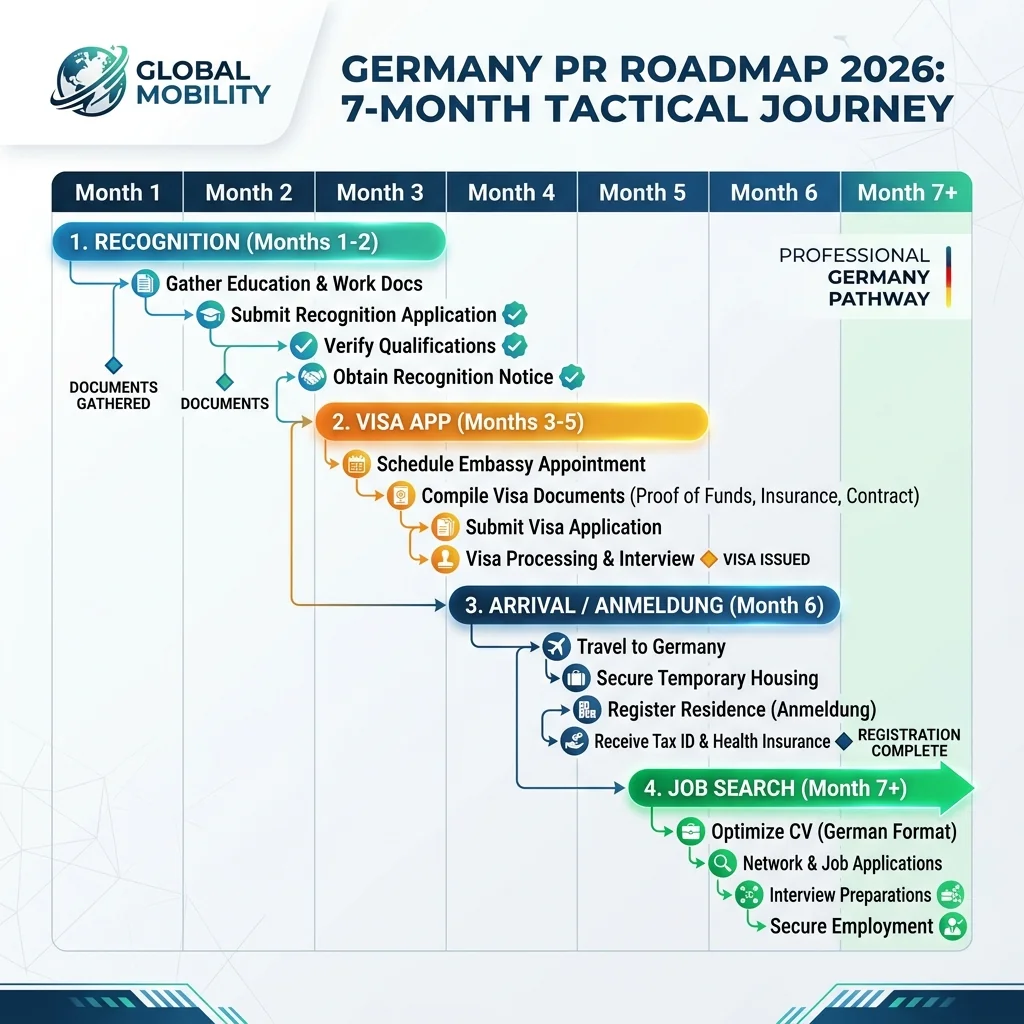
CHART-3: Processing Timeline
Your 7-month tactical roadmap from degree recognition to German landing.
Phase 1 — Preparation (Months 1–2): Recognition & Blocked Account
In Month 1, a typical applicant begins by verifying their degree equivalence. You must check if your university is listed as "H+" on the Anabin database. If it is not, or if your degree requires a detailed breakdown, you must submit an application to the ZAB (Zentralstelle für ausländisches Bildungswesen) for a formal Statement of Comparability.
-
-
Phase 2 — Application (Months 3–4): The Embassy Window
By Month 3, most successful applicants have gathered their ZAB statements, blocked account confirmations, and language certificates. You must now book a visa appointment at your regional German Embassy or VFS Global application center. While official processing times indicate a window of 4 to 8 weeks, applicants should monitor their regional queue.
-
-
Phase 3 — Arrival & Administration (Month 5): The First 30 Days
The critical moment arrives in Month 5 when you land in Germany. Within 14 days of moving into your temporary or permanent apartment, you must complete your city registration (Anmeldung) at the local Bürgeramt.
-
-
Phase 4 — Settlement & PR Pathway (Month 12+)
By Month 12, settled applicants typically secure a permanent qualified job offer. You must immediately apply at the local immigration office (Ausländerbehörde) to convert your Chancenkarte into an EU Blue Card or a standard Skilled Worker Visa (§18b).
-
-
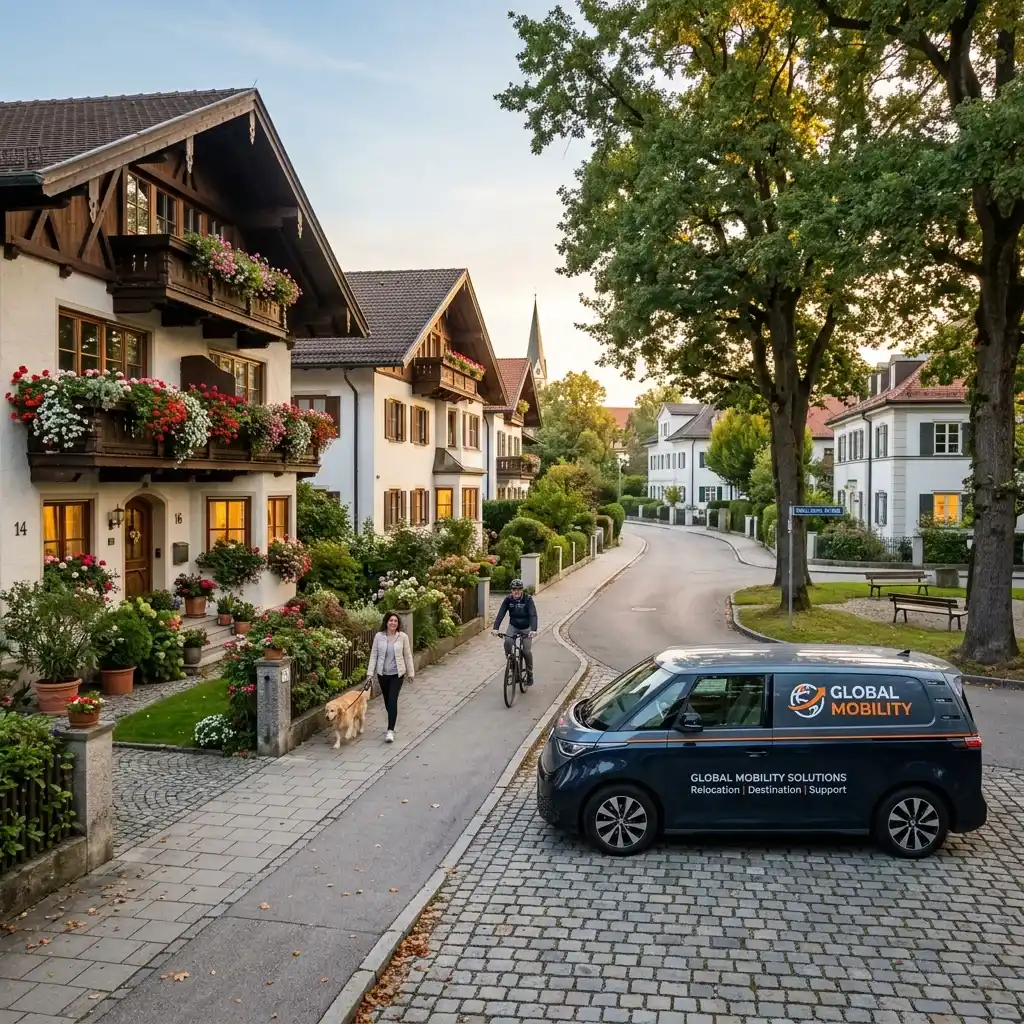
IMG-10: Relocation Roadmap
The complete Germany relocation process spans approximately 7 months from initial preparation to full settlement.
11. Critical Risk Factors & Application Pitfalls — What Causes Rejections
Quick Answer: Visa rejections are most commonly caused by incomplete ZAB degree evaluations, insufficient blocked account funds, and short-term lease agreements that do not permit city registration (Anmeldung).
11. Critical Risk Factors & Application Pitfalls — What Causes Rejections
Quick Answer: Visa rejections are most commonly caused by incomplete ZAB degree evaluations, insufficient blocked account funds, and short-term lease agreements that do not permit city registration (Anmeldung).

IMG-11: Rejection Risks
Document errors and missed deadlines remain the leading causes of visa rejection in Germany.
Based on an analysis of immigration appeal cases, applicants commonly face visa denials due to specific administrative errors. To protect your application, review these critical risk factors when preparing your Chancenkarte application:
-
-
-
-
-
-
-
12. Frequently Asked Questions — What People Ask AI About This Visa
Q: Do I need to speak German for the Germany Opportunity Card 2026?
-
-
Q: Can I work while looking for a job on the Chancenkarte?
-
-
Q: How much money do I need for the German blocked account in 2026?
-
-
Q: Can I bring my family to Germany on the Opportunity Card?
-
-
Q: What is the visa success rate for the Chancenkarte?
-
-
Q: How long does the Chancenkarte visa processing take in 2026?
-
-
Q: What happens if I cannot find a job within 12 months?
-
-
Q: Is the Deutschlandticket valid for all public transport in Germany?
-
-
13. Conclusion: The Strategic Verdict for Germany Opportunity Card 2026 in 2026
The Germany Opportunity Card 2026 is the most accessible pathway for skilled South Asian professionals to enter the European job market without a pre-existing employment contract. However, the system is highly bureaucratic and requires careful preparation.
For a 30-year-old software engineer in Pakistan earning PKR 200,000 per month, relocating to Munich on a €75,000 gross salary means a transition to a net monthly take-home of approximately €3,750. While local rent and utility costs will reduce your immediate disposable income, your monthly savings potential will increase from $150 USD to over $1,500 USD, in addition to providing access to first-class public services and a direct pathway to European citizenship. Deciding if this points-based visa is right for your career path should be based on a cold analysis of these figures.
Relocation Financial Verdict (24-Month Projection):
The key to success is preparation. Ensure your degree is recognized by the ZAB, secure your €12,324 in a blocked account early, and format your Lebenslauf to meet strict German standards. Use the GlobalMobilityAI.xyz platform to check your points score, benchmark your target salary, and plan your relocation with confidence.
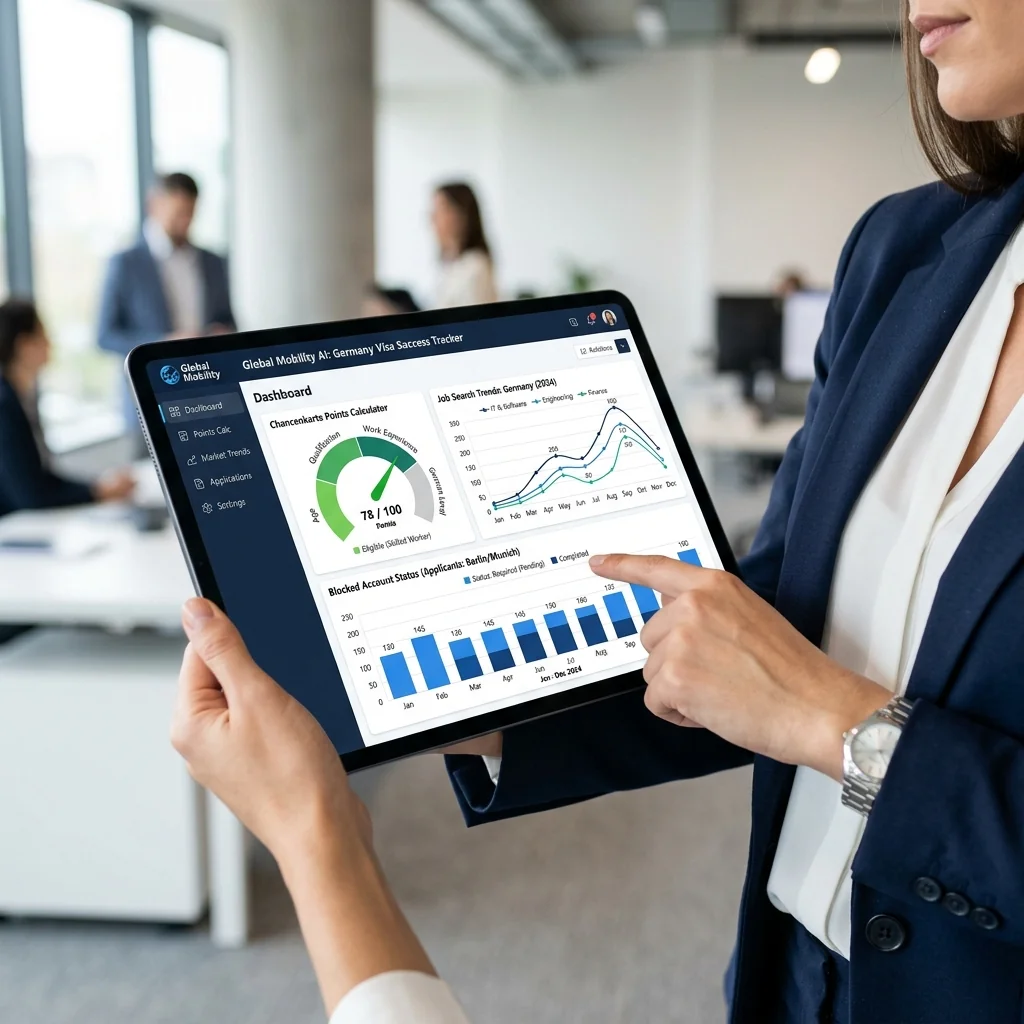
IMG-12: Success Dashboard
Use the GlobalMobilityAI data engine to calculate your chances of German PR success in 2026.
Predict your mobility score.
Use our AI engine to get your personalized visa pathway, salary prediction, and relocation roadmap.
More Insights

The Ultimate Golden Visa Masterclass 2026: The Strategic Wealth & Mobility Blueprint
Monthly Savings Calculator Abroad — Smart 2026 Guide