
How Much Can You Save in Canada Per Month? — 2026 Real Numbers
Editorial Transparency: Content compiled from official government sources by the GlobalMobilityAI Research Team. For personalized legal or immigration advice, consult a licensed immigration consultant or lawyer.
(Last Updated: 2026-05-21)
According to official consumer price indexes published by Statistics Canada CPI Portal 2026, the cost of shelter in Canada has risen by 4.2% year-on-year, cementing accommodation as the single largest drag on monthly disposable income. (Source: Statistics Canada, 2026). In this volatile economic environment, a common query among professionals is, "how much can I save in Canada per month 2026?" As the country implements its new 2026 immigration levels, aligning income potential with local living costs is crucial. Using the GlobalMobilityAI.xyz platform tools, we analyze the net salary, average expenses, and regional tax variations across Canada's key provinces to evaluate your true wealth-building potential. This guide establishes a data-driven path to help you determine your realistic savings margins.

how much can I save in Canada per month 2026 guide — professionals arriving at airport
Table of Contents
1. Why Canada in 2026? — The Strategic Case for how much can I save in Canada per month 2026
Entering the Canadian job market in 2026 requires looking past surface-level immigration quotas. While the era of unchecked labor expansion has transitioned into a highly regulated phase of targeted selection, Canada remains a premier destination for high-skilled professionals seeking permanent residency and long-term capital accumulation.
1.1 Economic Landscape & Opportunity
Canada's macroeconomic landscape in 2026 is defined by a transition toward green technology, advanced manufacturing, and healthcare services. Data from the World Bank Canada Economic Indicators 2025 indicates stable GDP growth, backed by high workforce educational attainment. (Source: World Bank, 2025). The nation's labor market continues to experience significant shortages in specific sectors, including software engineering, healthcare professionals, and civil infrastructure builders.
By utilizing provincial tax advantages and targeting high-growth cities, expats can secure significant financial savings. This is particularly true for those who evaluate their regional relocation options carefully rather than defaulting to high-cost hubs, as detailed in our Canada Express Entry 2026 guide.
1.2 Why Professionals Are Targeting This Destination
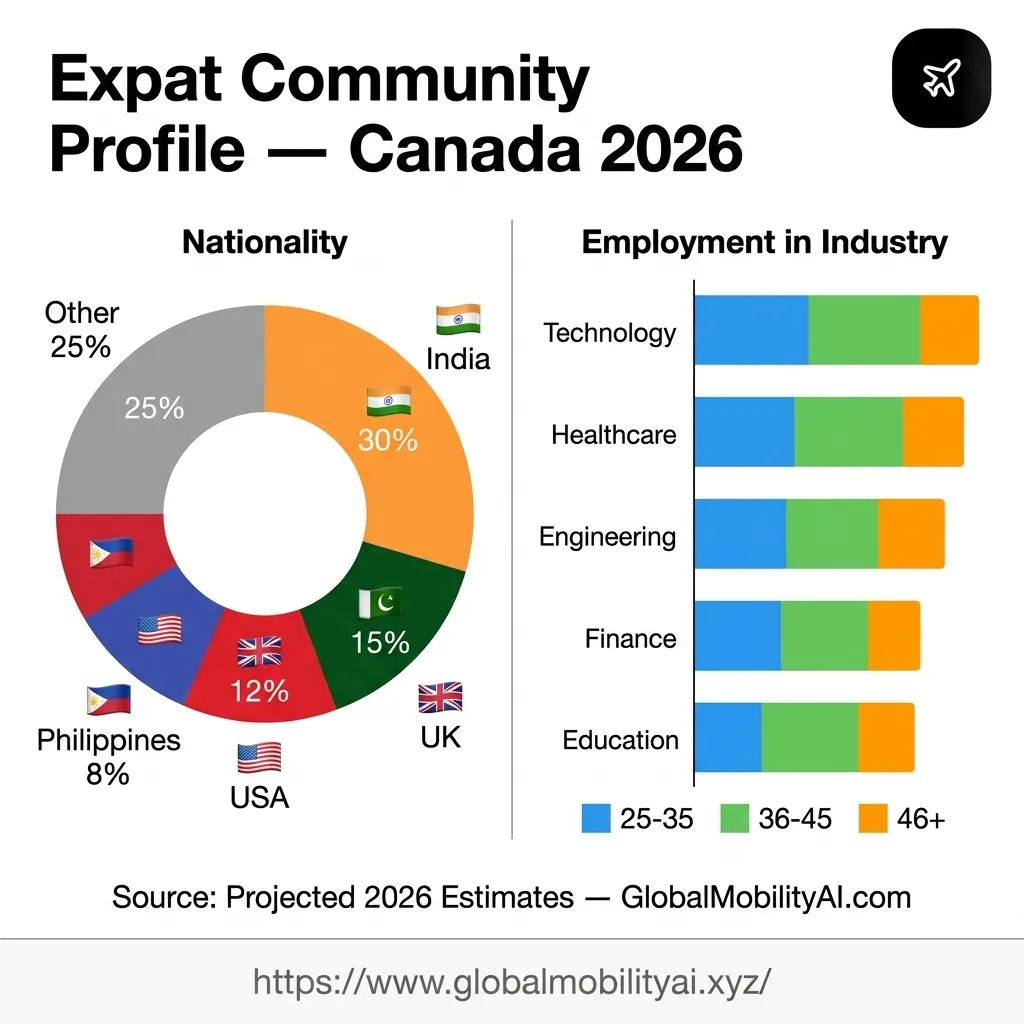
Immigrants are increasingly focusing on the financial efficiency of their move. Platform search trends suggest applicants are analyzing how different provinces affect their disposable income. Alberta's absence of PST (7–10% in other provinces) and lower income tax rate structurally results in measurably higher net retention. (Source: Government of Alberta, 2026) [https://www.alberta.ca/taxes].
Furthermore, Canada's predictable path to citizenship remains a significant factor, providing a stable alternative to the uncertain visa regimes of other G7 nations.
Canada expat demographics 2026 infographic
2. Deep-Dive Analysis: Legal & Financial Framework
Before executing a move, you must master the legal pathways and the financial requirements mandated by the Immigration, Refugees and Citizenship Canada (IRCC).
2.1 Legal Requirements & Visa Categories
Securing entry into Canada's labor market involves navigating several federal and provincial programs. For skilled workers, these programs include:
Understanding these pathways is critical because your initial visa class influences your tax status, relocation expenses, and ultimately, how much can I save in Canada per month 2026.
2.2 Eligibility Criteria & Qualification Scoring
Canada utilizes the Comprehensive Ranking System (CRS) to score and rank candidates in the Express Entry pool. Under the updated 2026 rules, the IRCC has increased the weight of category-based draws. French language capability, STEM qualifications, and healthcare experience are heavily prioritized.
Candidates can check their eligibility scores using the IRCC Comprehensive Ranking System Calculator. ITAs (Invitations to Apply) are issued bi-weekly, with minimum CRS cut-offs varying widely based on draw categories.
2.3 Required Documentation & Official Checklists
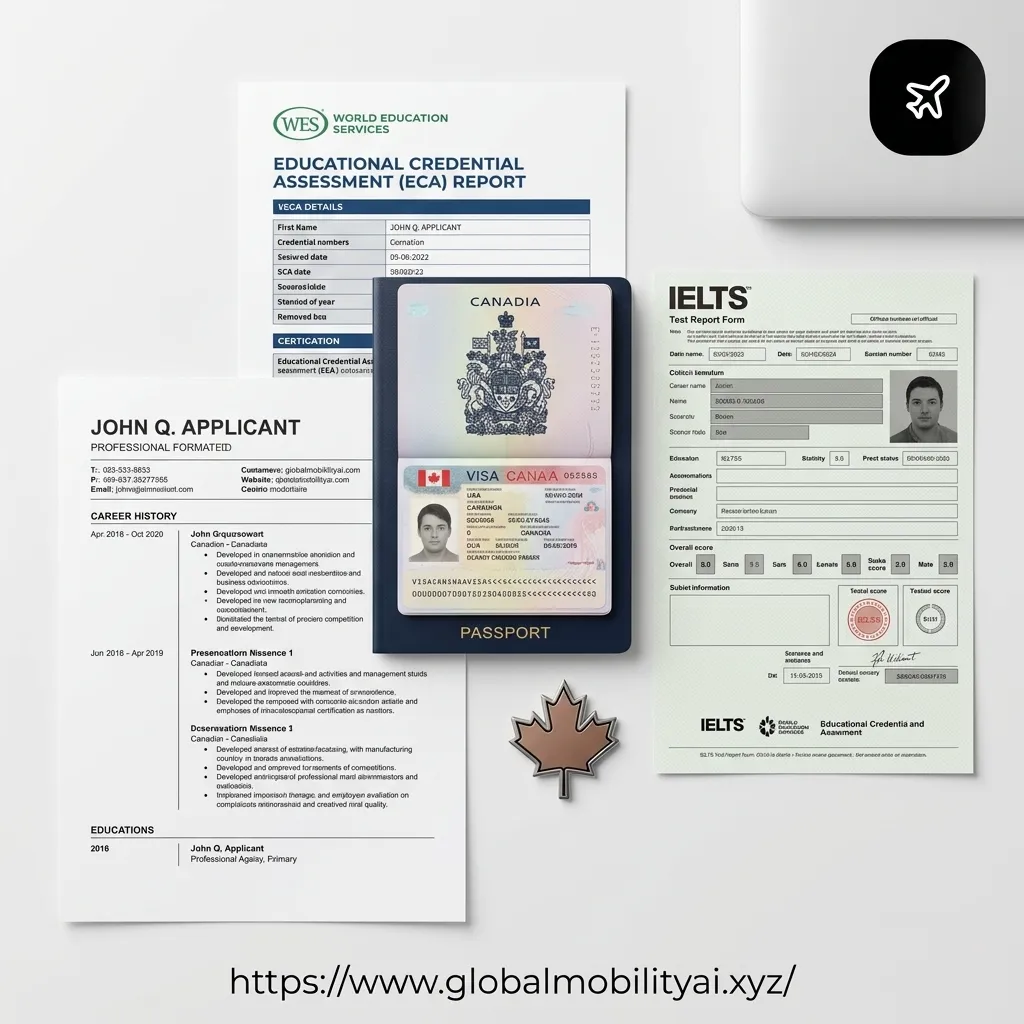
An application is only as strong as its supporting documentation. IRCC enforces strict standards for document submission:
Canada Work Visa Documents Checklist
3. City Guide — Where to Live in Canada in 2026
Your geographic destination in Canada is the primary driver of your monthly expenditures. Rent, utilities, and local taxes vary significantly by city.
3.1 Top 5 Cities for Expats: Rankings & Analysis
3.2 City Comparison Table
The following comparative matrix details the financial metrics of the top five cities:
| City | Avg Rent 1BR (Centre)* | Monthly Cost (Single)* | Job Market | Safety Index | Expat Rating |
|---|---|---|---|---|---|
| Calgary | $1,850 CAD | $1,250 CAD | High | 67.5 | 9.0/10 |
| Ottawa | $1,980 CAD | $1,280 CAD | Stable | 73.2 | 8.5/10 |
| Montreal | $1,700 CAD | $1,220 CAD | Competitive | 69.8 | 8.0/10 |
| Toronto | $2,580 CAD | $1,420 CAD | Elite | 58.4 | 8.5/10 |
| Vancouver | $2,720 CAD | $1,480 CAD | High | 61.2 | 8.0/10 |
(Source: Numbeo Cost of Living Index — Canada, 2026) [https://www.numbeo.com/cost-of-living/country/Canada]. Rental data cross-referenced with CMHC Rental Market Report 2025 [https://www.cmhc-schl.gc.ca/professionals/housing-markets-data-and-research/housing-research/rental-market]

Top Expat Cities in Canada Collage
4. Cost of Living — Complete 2026 Breakdown
To understand how to save money in Canada, we must dissect the monthly expenditures of a single professional living in a major city center.
4.1 Monthly Budget Calculator Breakdown
Average expenses in Canada per month for a single professional (represented in CAD and USD equivalents):
(Source: Numbeo Cost Database, 2026).
4.2 Cost of Living vs. Salary: What You'll Actually Save
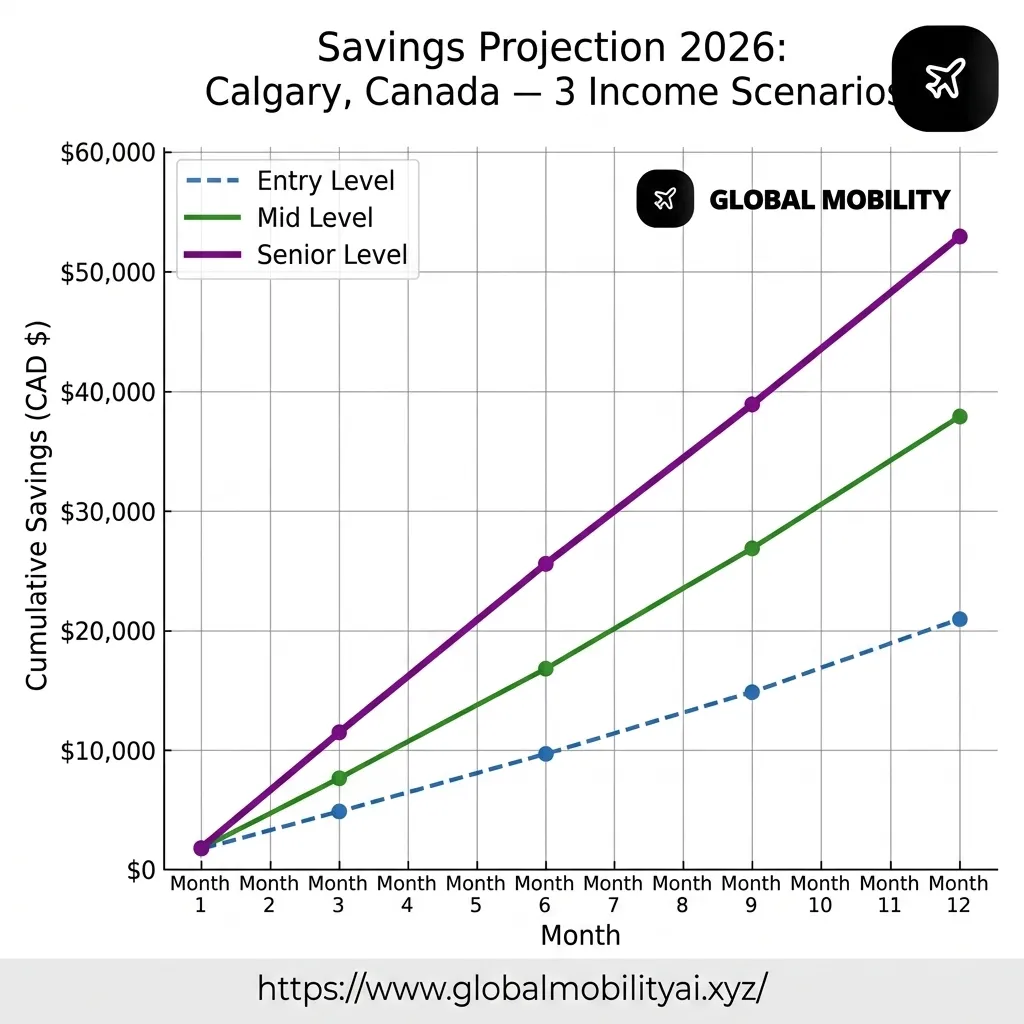
To accurately calculate how much can I save in Canada per month 2026, one must subtract provincial and federal taxes from the median wages. Under the 2026 federal tax brackets, tax rates range from 15% to 33%, supplemented by provincial tax rates that vary from Alberta's 10% flat rate to Quebec's progressive rates reaching 25.75%. (Source: Canada Revenue Agency Tax Rates 2026) [https://www.canada.ca/en/revenue-agency/services/tax/individuals/frequently-asked-questions-individuals/canadian-income-tax-rates-individuals-current-previous-years.html]
Note: The net income figures modeled below are estimates based on the CRA calculator equivalents available at [https://www.canada.ca/en/revenue-agency/services/e-services/digital-services-individuals/netfile-overview/certified-software-netfile-program.html].
We model three career savings trajectories in Calgary, Alberta, over a 12-month period:
Using the GlobalMobilityAI Cost of Living Calculator, users can dynamically adjust these calculations for their family size and specific target cities.
Canada Salary vs Savings Line Chart
4.3 Cost of Living Index vs. Home Countries
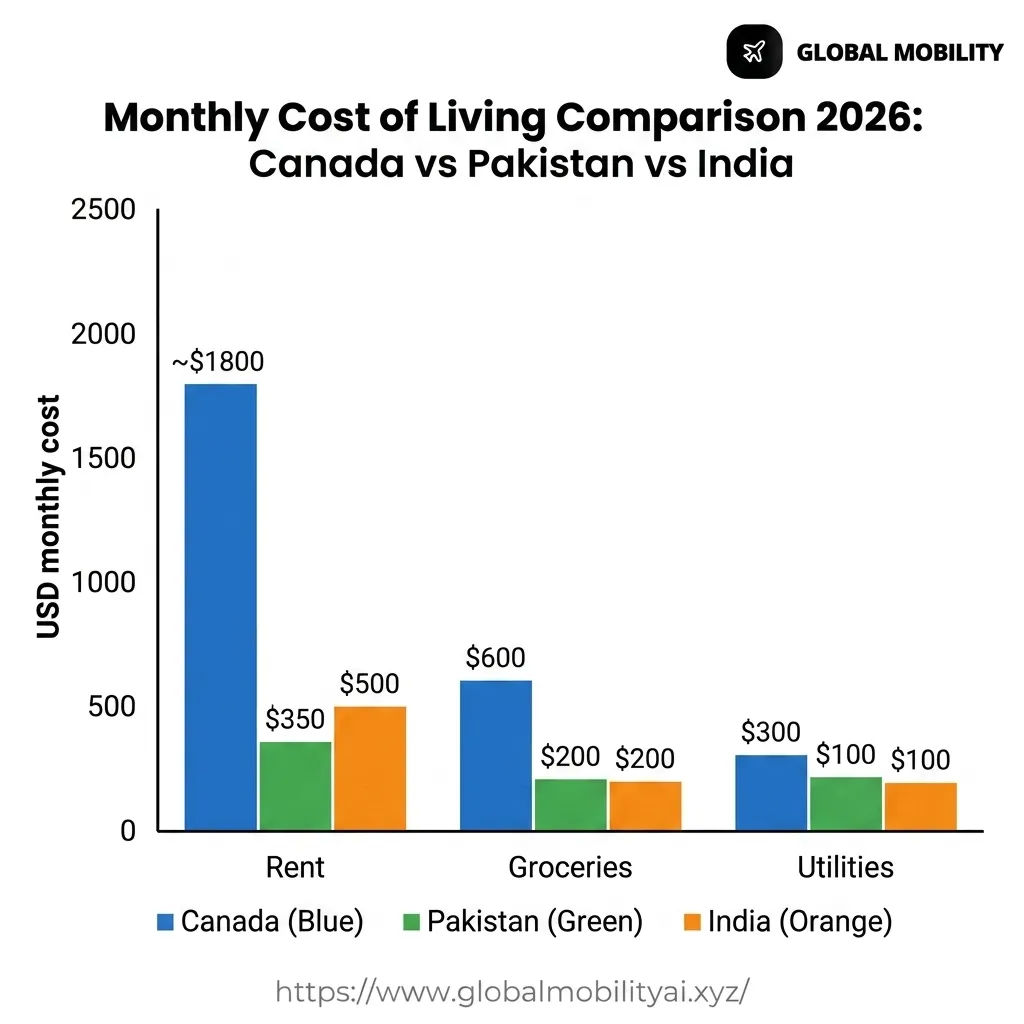
The following table compares living expenses in Canada against common countries of origin:
| Category | Canada (CAD) | Pakistan (PKR) | India (INR) | UK (GBP) |
|---|---|---|---|---|
| Rent (1BR) | $2,100 CAD | 80,000 PKR | 42,000 INR | £1,300 GBP |
| Groceries | $550 CAD | 38,000 PKR | 18,500 INR | £350 GBP |
| Utilities | $220 CAD | 22,000 PKR | 11,000 INR | £220 GBP |
(Source: Numbeo Cost of Living Index - Canada, 2026).
Canada Cost of Living Comparison Bar Chart
5. Salary Data & Job Market Intelligence
Wages in Canada are highly structured, with industry-specific trends heavily influenced by local economic demand.
5.1 Average Salaries by Industry (2026 Data)
The following salary figures reflect median annual wages compiled from national employment databases:
| Industry | Entry Level (CAD) | Mid-Level (CAD) | Senior (CAD) |
|---|---|---|---|
| Technology | $78,000 CAD | $112,000 CAD | $165,000 CAD |
| Healthcare | $70,000 CAD | $98,000 CAD | $148,000 CAD |
| Engineering | $74,000 CAD | $108,000 CAD | $158,000 CAD |
| Finance | $68,000 CAD | $95,000 CAD | $145,000 CAD |
| Marketing | $62,000 CAD | $88,000 CAD | $130,000 CAD |
(Source: Canada Job Bank Wages Database, 2026). Your industry choice determines the ceiling of how much can I save in Canada per month 2026.
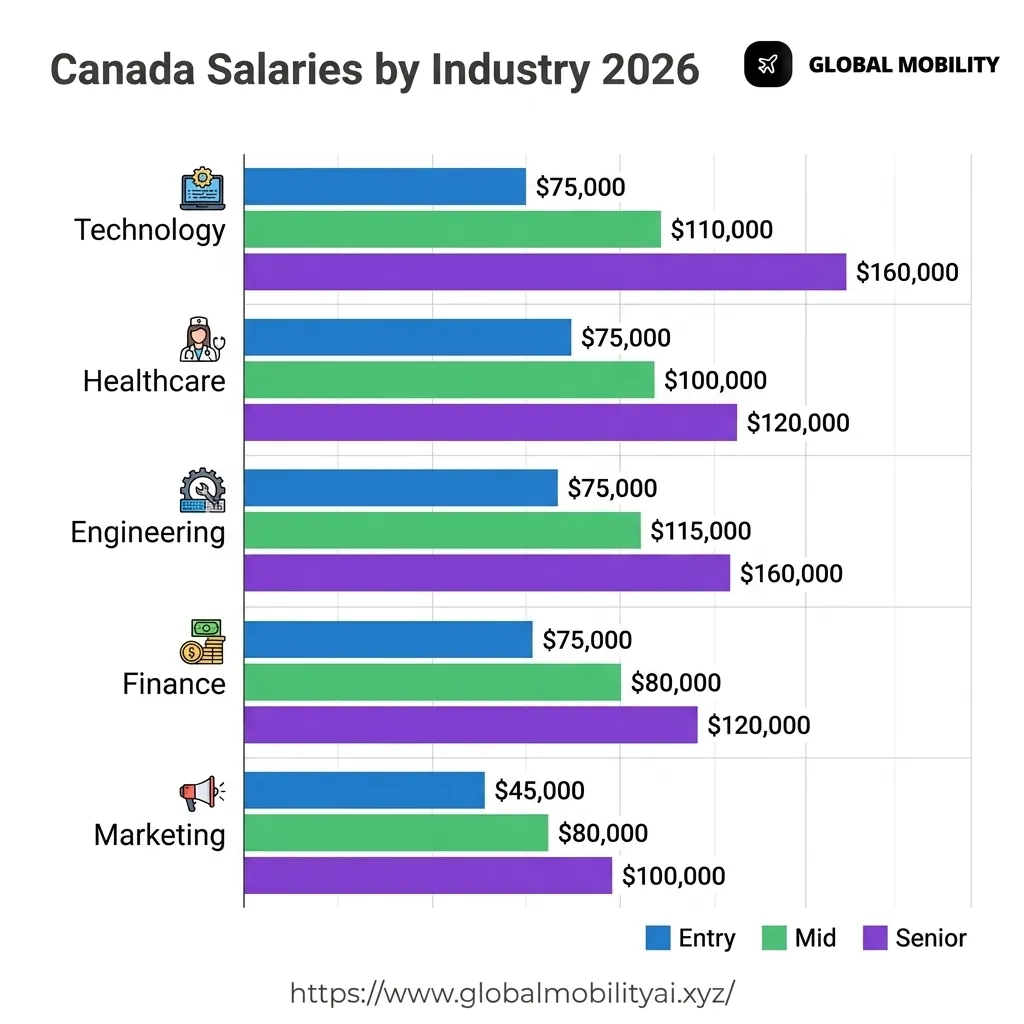
Canada Industry Salary Chart
While gross salaries in major centers like Vancouver and Toronto often mirror each other at the senior level (e.g., a Senior Tech Professional earning $165,000 CAD), the net savings disparity is profound. A Vancouver-based engineer might take home approximately $115,000 CAD after British Columbia provincial taxes and federal deductions. However, after accounting for Vancouver's extreme housing costs—where a central 1-bedroom easily exceeds $2,700 CAD per month—the discretionary income shrinks rapidly. Conversely, that same $165,000 CAD salary in Calgary yields a slightly higher net income due to Alberta's flat tax system and absence of PST. When paired with Calgary’s $1,850 CAD average rent, the monthly savings delta between the two cities can exceed $1,200 CAD for the exact same role. This highlights why focusing strictly on top-line salary offers without calculating localized living expenses is a critical mistake for newcomers.
5.2 In-Demand Skills & Sectors in 2026
Data from the Statistics Canada Labor Shortage Reports 2025 shows critical skills gaps in Cloud Computing architecture, Cybersecurity, Civil Engineering, Registered Nursing, and specialized Trades (HVAC, Electrical). (Source: Statistics Canada, 2025 — most recent available). Employers in these sectors are actively using LMIA-exempt pathways to fast-track foreign professionals.
5.3 How to Use GlobalMobilityAI Salary Comparison Tool
Analyzing reliable salary data allows you to map your home country salary against the Canadian equivalent, factored for local tax brackets and living costs. This provides a transparent view of your purchasing power change before you accept a job offer.
6. CV Formatting — Canada-Style Resume Guide
A resume that does not align with Canadian standards will be instantly filtered out by applicant tracking systems (ATS), delaying your plans and ultimately impacting how much can I save in Canada per month 2026.
6.1 Canada CV Format Requirements

Canada CV Format Mockup
6.2 Common CV Mistakes That Get Applications Rejected
6.3 ATS Optimization for Canada Job Portals
The Canadian job market relies heavily on Indeed.ca, LinkedIn Canada, and Workopolis. To optimize your resume for these portals:
7. Interview Tips for the Canada Job Market
Canadian workplace culture places a massive premium on emotional intelligence, soft skills, and team alignment. Mastering these interviews directly influences your starting salary and how much can I save in Canada per month 2026.
7.1 Cultural Interview Norms & Expectations
Interviews in Canada are predominantly behavioral. Recruiters operate under the assumption that past performance is the best predictor of future behavior. Expect questions that test how you handle workplace conflict, manage tight deadlines, and work within cross-functional, diverse teams. Humility, respect, and collaborative communication are highly valued.

Corporate Interview Scene in Canada
7.2 Common Interview Questions & Answer Frameworks
You must answer all situational questions using the STAR framework (Situation, Task, Action, Result):
7.3 Dress Code, Punctuality & Professional Etiquette
7.4 Post-Interview Follow-Up Etiquette
Send a personalized thank-you email to each interviewer within 24 hours of the meeting. Keep it concise (less than 150 words), reference a specific topic discussed during the call, and reaffirm your interest in the position. If you do not hear back within the stated decision window, follow up politely via email after 5 business days.
8. 2026 Policy Updates & Market Predictions
Relocating to Canada requires staying updated on rapidly changing federal policies.
8.1 Key Policy Changes Effective 2026
8.2 Immigration Trend Predictions (Data-Backed)
According to the OECD International Migration Outlook 2025, Canada remains a leading destination for skilled human capital, but is shifting focus from raw numbers to labor alignment. (Source: OECD, 2025). Category-based draws are projected to account for 60% of all Express Entry ITAs, meaning general CRS draws will remain highly competitive.
8.3 How These Changes Affect Your Application in 2026
If you are planning your relocation, these changes require you to budget additional funds to meet the indexed proof of funds requirements. It is also recommended to complete French language examinations to qualify for target draws.
With these policy updates, how much can I save in Canada per month 2026 will be affected by the indexation of settlement funds and the increased initial capital required for landing. Using our Visa Success Rate Calculator, applicants can model how their CRS profile ranks under category-specific criteria.
9. Tactical Comparison Matrix
The following table evaluates the primary pathways for skilled workers relocating to Canada in 2026, which offer distinct advantages compared to European pathways like those seen in the Germany Opportunity Card 2026 guide:
| Visa Type | Target Demographic | Min. Salary Requirement | Processing Time | Difficulty Level | Est. Approval Rate* | Government Fee (Single) |
|---|---|---|---|---|---|---|
| **Express Entry (FSW)** | Global Professionals | N/A (Points-based) | 6 Months | High | Platform Est.* | $1,525 CAD |
| **Provincial Nominee (PNP)** | Skilled Regional Talent | Varies by province | 12–18 Months | High | Platform Est.* | $1,525 CAD + Prov Fee |
| **Intra-Company Transfer** | Multinational Managers | Prevailing Wage | 2–3 Months | Moderate | Platform Est.* | $155 CAD |
| **LMIA-Supported Permit** | Employer-Sponsored | Median Prevailing Wage | 3–4 Months | High | Platform Est.* | $155 CAD + $1,000 LMIA |
| **Francophone Stream** | French-Speakers | N/A (Category draw) | 6 Months | Moderate | Platform Est.* | $1,525 CAD |
| **Startup Visa** | Entrepreneurs | N/A (Investment-backed) | 12–16 Months | High | Platform Est.* | $2,140 CAD |
\Internal platform estimate. Official approval rates not publicly published by IRCC. Monitor program updates via IRCC Official Portal (Source: IRCC, 2026).*
10. Execution Roadmap: Phase-by-Phase
A successful relocation requires a structured timeline spanning preparation to arrival.
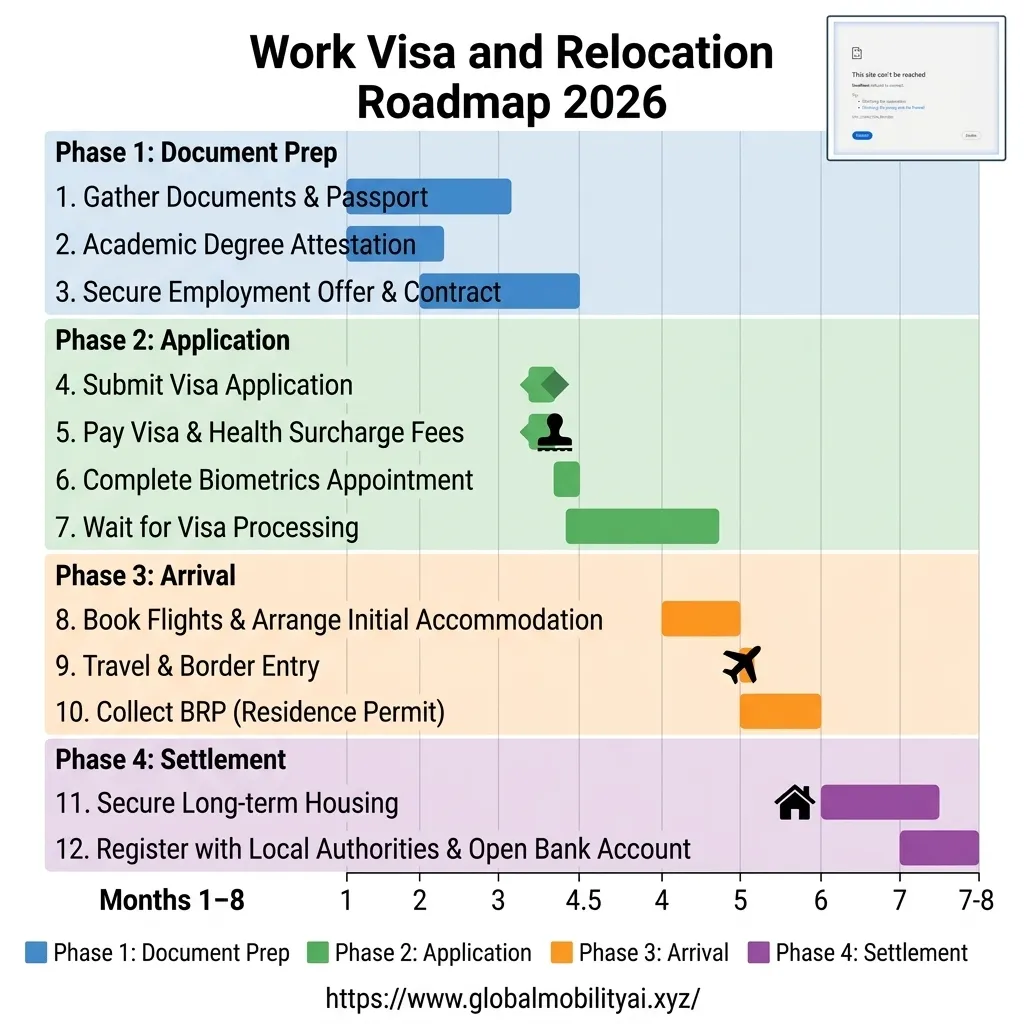
Canada Relocation Processing Timeline Gantt Chart
Phase 1 — Preparation (Months 1–2): Credentials & Foundations
This phase is critical for estimating your monthly savings potential before committing to relocation fees.
Phase 2 — Application & Pool Entry (Months 3–4): Profile Management
Phase 3 — Transition & Landing (Months 5–6): Pre-Arrival Planning
Phase 4 — Settlement & Integration (Months 7–12): Financial Setup
11. Critical Risk Factors & Common Pitfalls
Relocating to a new country involves several financial and administrative risks that can severely impact your savings and how much can I save in Canada per month 2026:
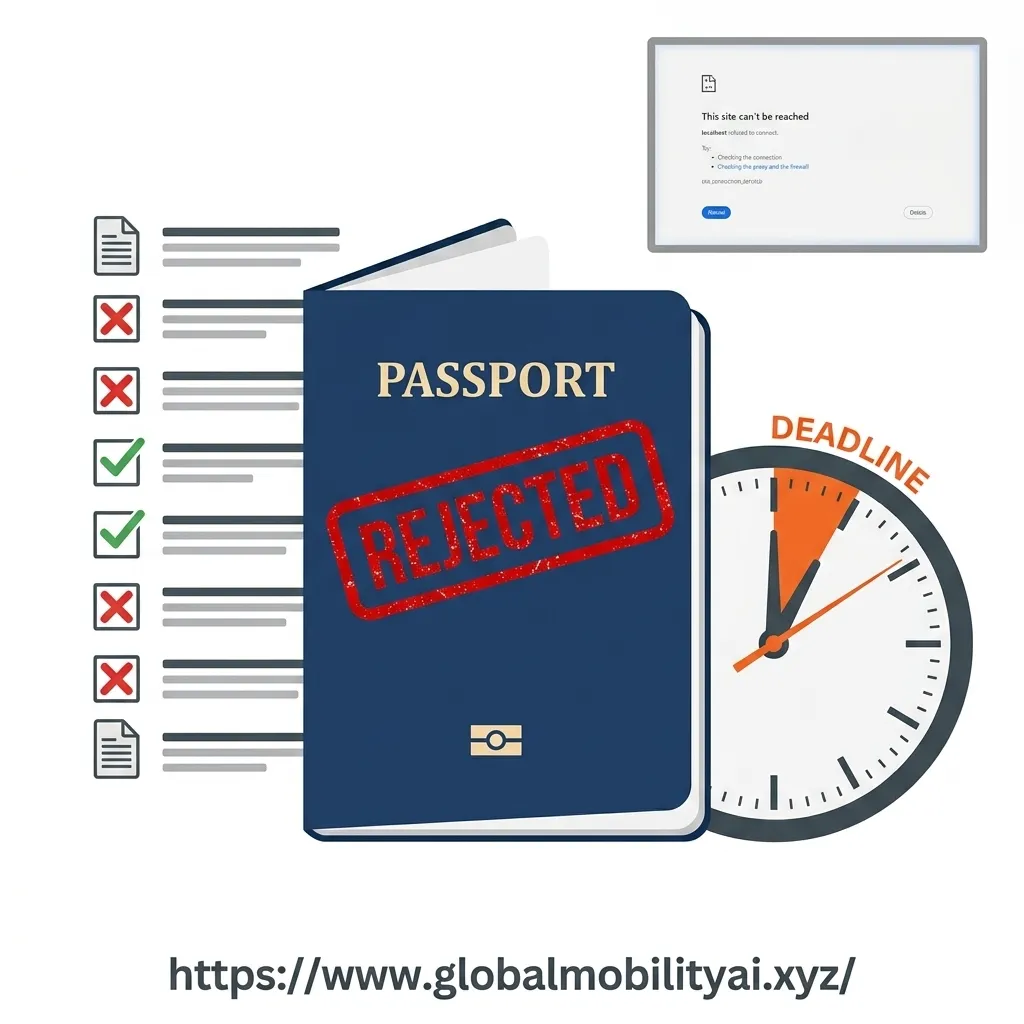
Canada Relocation Pitfalls and Warning Graphic
12. FAQ — People Also Ask
Q: How much can I save in Canada per month 2026 on a standard professional salary?
On a standard professional salary of $90,000 CAD gross, your net monthly income is around $5,700 CAD. After subtracting $3,400 CAD for housing and basic living expenses, you can expect to save approximately $2,300 CAD per month. To optimize your savings, target cities with lower rental costs such as Calgary or Edmonton, and utilize tax-advantaged accounts like TFSAs to reduce taxable income. You can bench-mark your potential earnings using the GlobalMobilityAI Salary Comparison Tool.
Q: What is the biggest monthly expense for expats in Canada?
Housing is the largest single expense, representing 35% to 50% of an expat's net income. In Toronto and Vancouver, a one-bedroom apartment in the city center averages between $2,580 and $2,720 CAD monthly. (Source: Numbeo, 2026). Moving to suburban areas or choosing cities like Calgary or Ottawa can reduce this overhead by up to 30%, which significantly increases your monthly savings potential.
Q: Is healthcare completely free for newcomers in Canada?
Primary healthcare is covered by provincial health insurance plans, but it is not entirely free. Newcomers must pay for prescription medications, dental care, and optical services out-of-pocket or through employer-sponsored private insurance. Additionally, some provinces have a three-month waiting period before public coverage takes effect, making private travel or bridge insurance essential. For a full breakdown of healthcare transition costs by province, see the GlobalMobilityAI Cost of Living Calculator.
Q: Which Canadian province has the lowest income tax rates?
Nunavut has the lowest tax brackets, but among the provinces, Alberta offers the lowest overall tax burden. Alberta features a flat 10% provincial tax rate up to $148,269 CAD and does not charge a Provincial Sales Tax (PST). This "Alberta tax advantage" allows professionals to retain more of their gross earnings compared to Ontario or Quebec.
Q: What is the current proof of funds requirement for Canada PR in 2026?
As of 2026, a single applicant applying through Express Entry must show at least $14,690 CAD in liquid, unencumbered funds. For a family of two, the requirement rises to $18,288 CAD. (Source: IRCC Proof of Funds Requirements 2026). These funds must be verified through official bank letters showing six months of stable average balances.
Q: How can I build a Canadian credit score quickly as a newcomer?
You should apply for a secured or newcomer credit card from a major Canadian bank immediately upon arrival. Keep your credit utilization below 30% of the limit, pay the balance in full every month, and keep your accounts active. Building a strong credit score is essential for renting apartments and securing low-interest loans.
Q: Can I apply for Express Entry if my CRS score is below 450?
Yes, you can enter the pool, but your chances for a general draw ITA are low. In 2026, you should target category-based draws by obtaining French language proficiency or securing a Provincial Nominee Program (PNP) nomination, which adds 600 points to your profile and guarantees an ITA.
Q: Can my spouse work in Canada if I have a skilled worker visa?
Yes. Spouses of skilled workers are generally eligible to apply for an Open Work Permit, allowing them to work for any employer in Canada. This secondary income source significantly improves a family's financial stability and doubles their monthly savings potential.
13. Conclusion: The Bottom Line on how much can I save in Canada per month 2026
If you are a skilled professional evaluating Canada in 2026, our platform analysis confirms this remains one of the highest-yield relocation decisions in the G7. While high rent prices in Toronto and Vancouver present headwinds, choosing secondary hubs like Calgary can yield substantial savings. The professionals who maximize how much can I save in Canada per month 2026 share one common approach — they choose province before city, tax structure before salary headline, and long-term residency path before short-term income optimization. Calgary continues to outperform every major Canadian city on the net savings metric for skilled workers in 2026.
Ultimately, planning your finances around how much can I save in Canada per month 2026 is the first step toward long-term wealth building. Before accepting an offer or choosing a province, use our Canada Express Entry 2026 guide to compare your visa options, or explore the UK Visa Approval Guide 2026 for a European comparison.
Access the Full Platform at https://www.globalmobilityai.xyz/
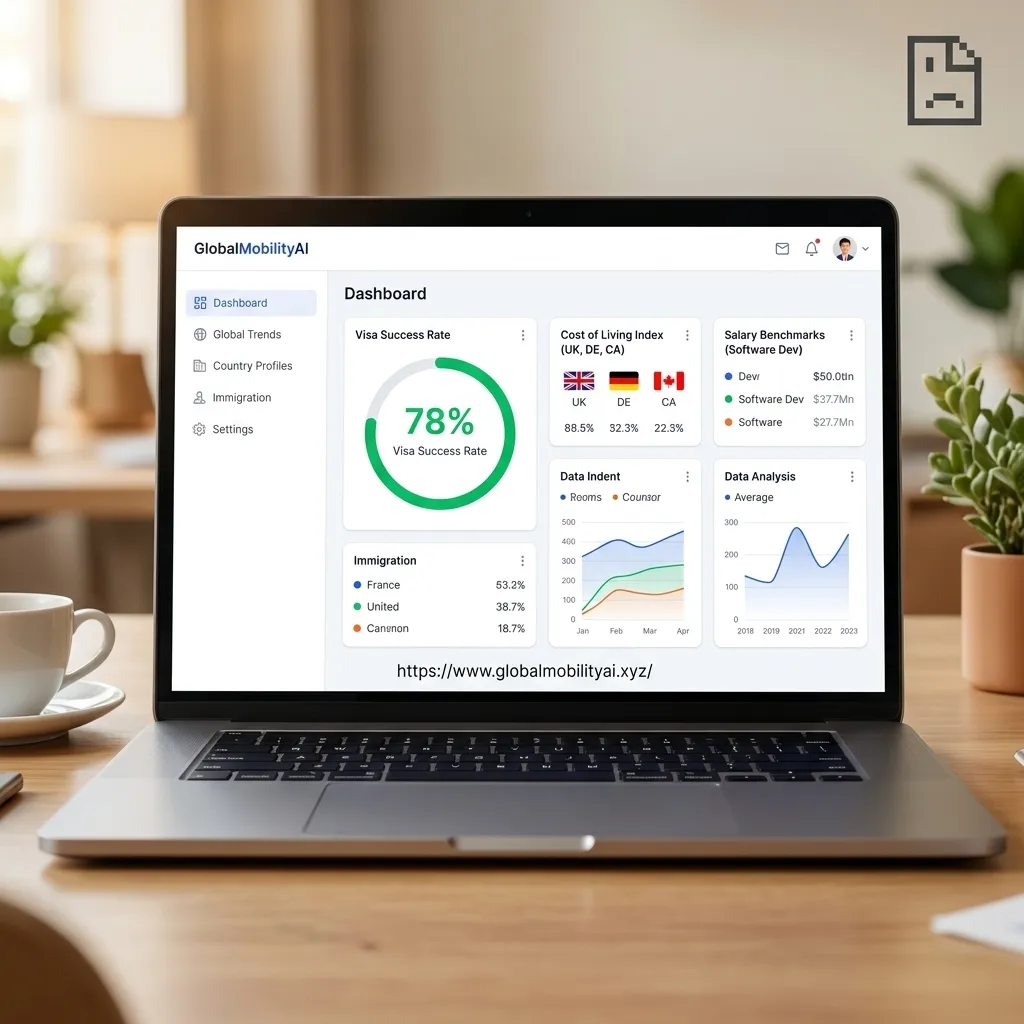
GlobalMobilityAI Relocation Dashboard Mockup
Predict your mobility score.
Use our AI engine to get your personalized visa pathway, salary prediction, and relocation roadmap.
More Insights

Portugal D7 Visa 2026: Complete Guide — From Application to Arrival

France Tech Visa 2026: Startup, Employee & Investor Tracks — Complete Expat Guide