How Much Money Can I Save in Germany Per Month? 2026 Guide
Editorial Transparency: Content compiled from official government sources by the GlobalMobilityAI Research Team. For personalized legal or immigration advice, consult a licensed immigration consultant or lawyer. (Last Updated: 2026-05-24)
In 2026, Germany remains the primary destination for non-EU skilled professionals targeting the European Union, driven by the most accessible 'Opportunity Card' (Chancenkarte) system in the continent and a structural labour deficit exceeding 1.2 million unfilled positions. However, the decision to relocate is no longer just about visa eligibility—it is a financial calculation. The question how much money can I save in Germany per month has become the single most critical variable for applicants from South Asia, Africa, and the Middle East. With inflationary pressures stabilizing but rent costs in Tier-1 cities like Munich and Berlin remaining elevated, a precise net-savings roadmap is essential. This guide delivers that roadmap, breaking down the 2026 tax landscape, city-by-city living costs, and verified salary benchmarks to reveal exactly what remains in your pocket after the German state and the cost of living take their share.
The GlobalMobilityAI Research Team's complete 2026 guide to monthly savings potential in Germany.

Table of Contents
How Much Money Can I Save in Germany Per Month 2026
1. Why Germany in 2026? — The Strategic Financial Case
1.1 Economic Landscape & Opportunity
Germany enters 2026 as the world's third-largest economy and continues to anchor the Eurozone's industrial and technological output. For an international professional, the strategic case for Germany is built on 'The Dual Engine': a high-performing economy and a shrinking domestic workforce. The German Economic Institute (IW) projects that the labour force will shrink by 7 million people by 2035 without sustained migration (Source: Institut der deutschen Wirtschaft Köln, 2024) [https://www.iwkoeln.de/].
This macro-economic reality means that for qualified professionals, the bargaining power has shifted. When asking how much money can I save in Germany per month, applicants must realize that German employers are now offering relocation bonuses, language training subsidies, and "soft landing" packages that were once reserved only for C-suite executives. The acute shortage of tech workers, engineers, and healthcare professionals forces employers to offer competitive gross salaries that comfortably exceed the EU Blue Card thresholds, setting the foundation for robust monthly savings.
1.2 Expat Community Growth
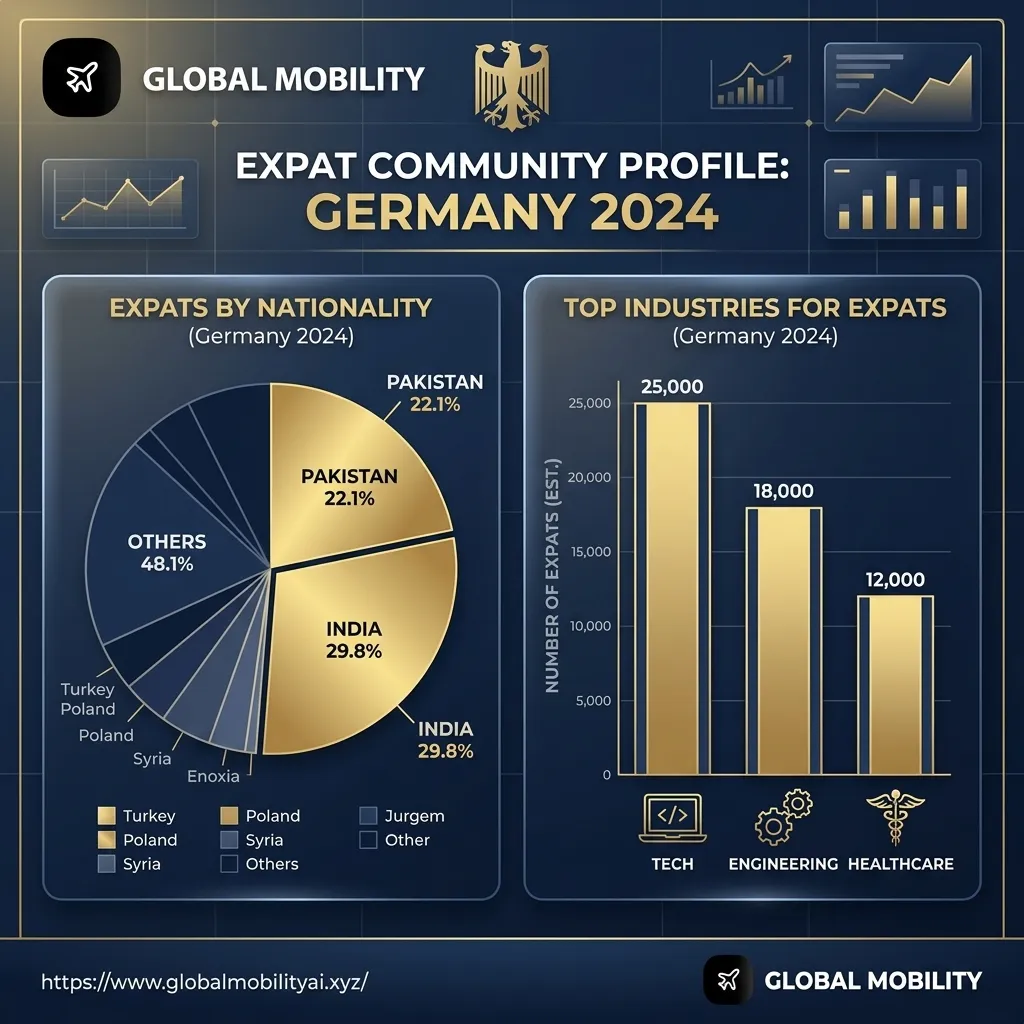
IMG-02: Expat Community Profile
Detailed breakdown of the expat community in Germany by nationality and industry.
The resident foreign population in Germany reached a record 13.9 million in 2024 and continues to expand into 2026 (Source: Destatis, Federal Statistical Office, 2024) https://www.destatis.de/EN/Themes/Society-Environment/Population/Migration/_node.html]. The fastest growth is seen in the MINT (Mathematics, IT, Natural Sciences, and Technology) and healthcare sectors, a trend largely accelerated by the [Germany Opportunity Card 2026 which simplified market entry. The expat community in 2026 is no longer concentrated solely in Berlin-Mitte or Frankfurt; it is a distributed, high-income demographic integrated into the 'Mittelstand' (medium-sized enterprises) that forms the backbone of the German economy. This widespread integration means that skilled migrants are commanding local-level salaries even in smaller cities where the cost of living is drastically lower, allowing for savings rates that can exceed 30% of net income.
2. Deep-Dive Analysis: Legal & Financial Frameworks
2.1 EU Blue Card 2026 Requirements
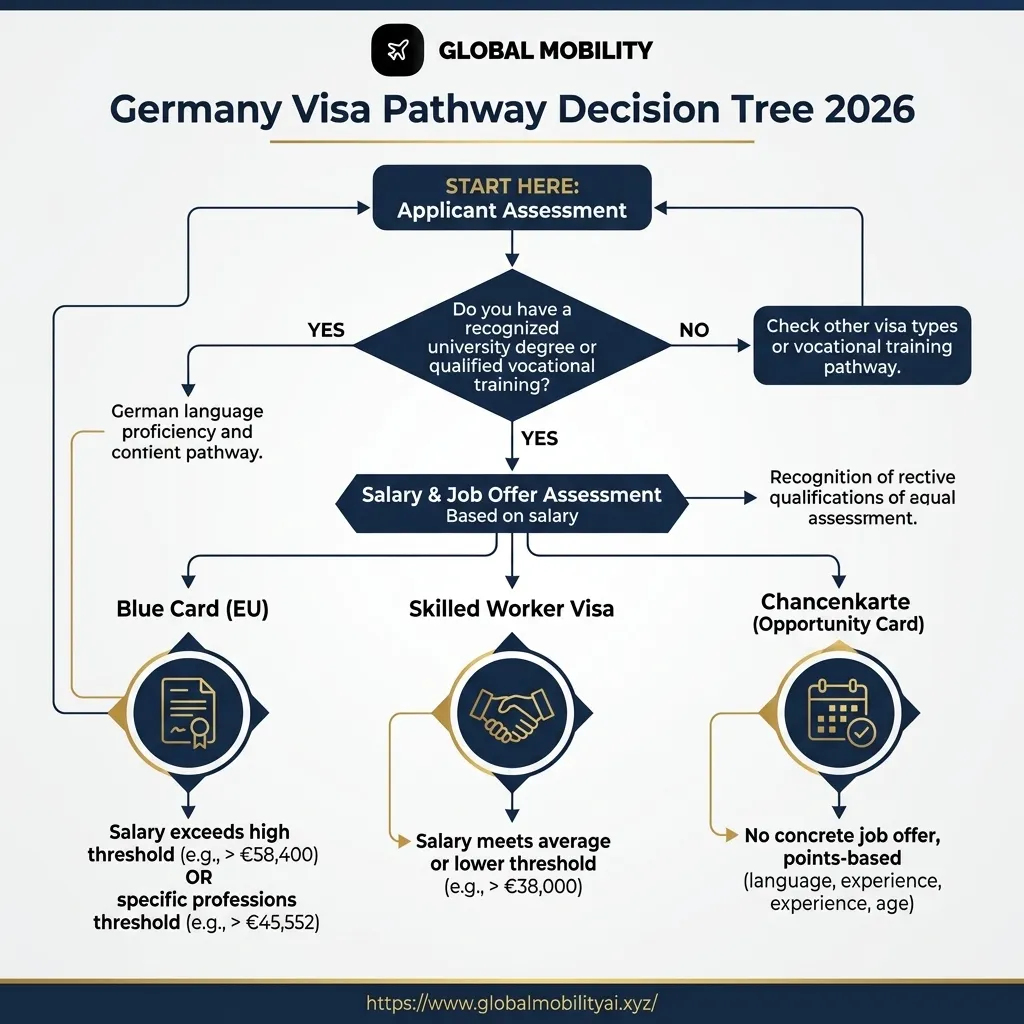
IMG-03: Visa Pathways
Decision flow for choosing the optimal German visa route based on salary and qualifications.
The EU Blue Card remains the gold standard for skilled migration in the European Union. In 2026, the salary thresholds are adjusted to ensure foreign workers are not undercutting local wages while simultaneously reflecting inflation. To accurately calculate how much money can I save in Germany per month, you must first secure a salary that meets these strict legal entry gates.
According to the Federal Office for Migration and Refugees (BAMF), the 2026 thresholds are categorized as follows:
2.2 Eligibility Criteria & Qualification Scoring
Germany's points-based immigration system evaluates applicants based on core criteria: educational equivalence, language proficiency (German and English), age, and professional experience. To secure an EU Blue Card or standard skilled worker visa, your foreign degree must be fully recognized (H+) in the Anabin database. Language skills, particularly B1/B2 German, heavily increase your qualification score and streamline the approval process.
2.3 Required Documentation & Tax Classes
A successful visa application requires a meticulously prepared portfolio. The official checklist includes:
Tax Classes (Steuerklassen) Explained
Your "Netto" (net take-home pay) is heavily influenced by your Tax Class in Germany. Understanding your tax class is the only way to accurately forecast your savings:
A single software engineer earning €65,000 gross will fall into Class 1 and take home approximately €3,350 net per month. A married engineer with a non-working spouse earning the same €65,000 will fall into Class 3 and take home approximately €3,800 net per month—a massive €450 difference that goes directly into their monthly savings.
3. City Guide — Where to Live in 2026
Where you choose to live is the single largest determinant of how much money can I save in Germany per month. A high gross salary in Munich can yield lower absolute savings than a moderate salary in Leipzig due to the extreme disparity in rental markets.
3.1 City Profiles
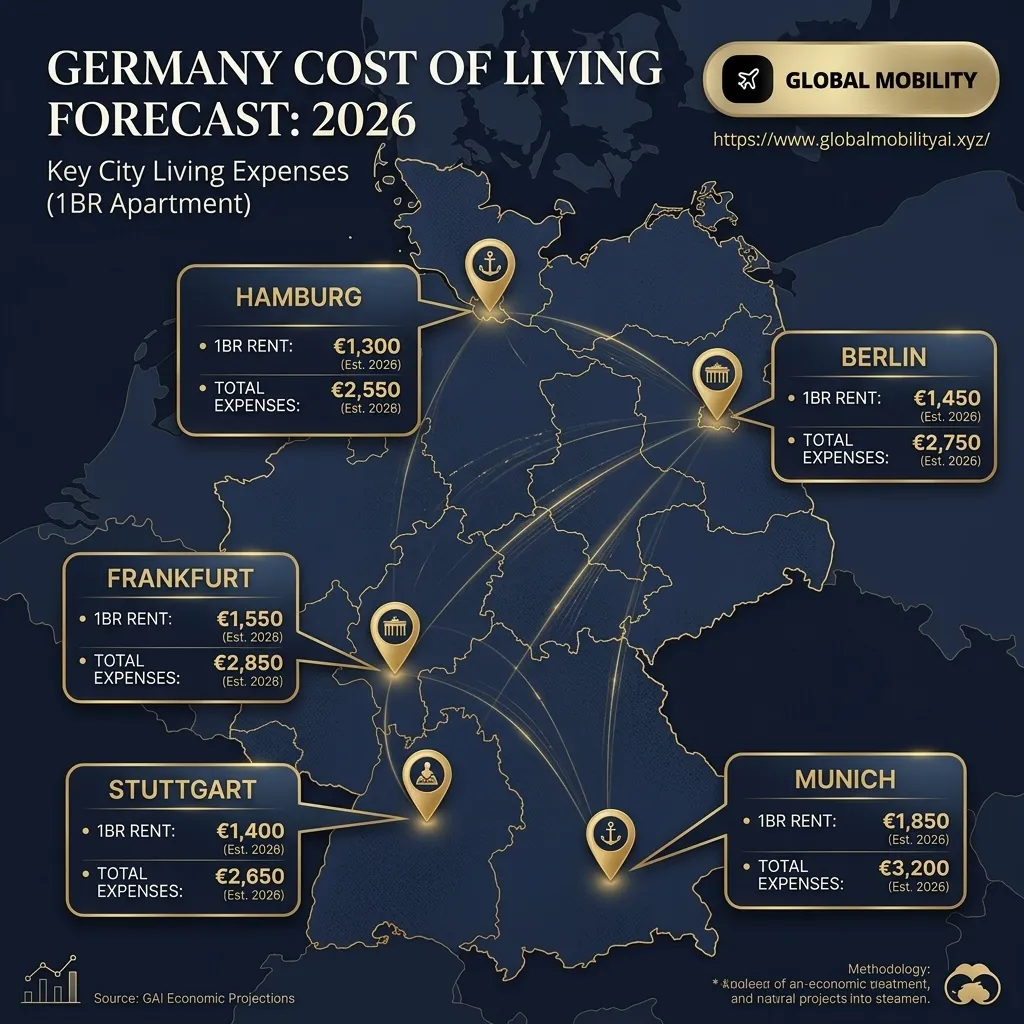
IMG-04: City Cost Comparison
Geographic overview of Germany's major expat hubs with 2026 monthly cost estimates.
Munich (München)
Munich is the economic powerhouse of southern Germany, home to BMW, Siemens, and Allianz. Salaries are the highest in the country, but the housing market is notoriously expensive and fiercely competitive.
Berlin
Berlin remains Europe’s startup capital and a magnet for global tech talent. While previously known for cheap rents, 2026 sees Berlin housing costs catching up to western German cities.
Frankfurt am Main
The financial heart of the Eurozone and the seat of the European Central Bank. Highly lucrative for finance, fintech, and legal professionals.
Hamburg
Germany's second-largest city and a major logistics and media hub. It offers a balanced lifestyle with strong salaries, though rents are climbing rapidly.
Leipzig & Dresden (The Smart Plays)
Often referred to as 'Silicon Saxony', the eastern German cities of Leipzig and Dresden are booming tech hubs. With Porsche, BMW, and massive microchip factories expanding, demand is soaring.
3.2 City Comparison Table
To optimize your savings, compare the baseline costs across the top five expat destinations.
| City | Avg Rent 1BR | Monthly Cost | Job Market | Safety | Expat Rating |
|---|---|---|---|---|---|
| **Munich** | €1,350 | €2,400 | Excellent | High | 8.5/10 |
| **Berlin** | €1,150 | €2,100 | Excellent | Moderate | 9.0/10 |
| **Frankfurt** | €1,250 | €2,300 | Strong | Moderate | 8.0/10 |
| **Hamburg** | €1,100 | €2,000 | Strong | High | 8.5/10 |
| **Leipzig/Dresden** | €700 | €1,550 | Growing | High | 8.8/10 |
(Source: Numbeo Cost of Living Database, 2026) [https://www.numbeo.com/cost-of-living/country_result.jsp?country=Germany]
4. Cost of Living — Complete 2026 Breakdown
To truly answer how much money can I save in Germany per month, we must dissect the 2026 monthly budget. According to the Federal Statistical Office, living costs have stabilized after the inflationary spikes of previous years (Source: Destatis, 2026) [https://www.destatis.de/EN/Home/_node.html].
4.1 Monthly Budget Calculator Breakdown
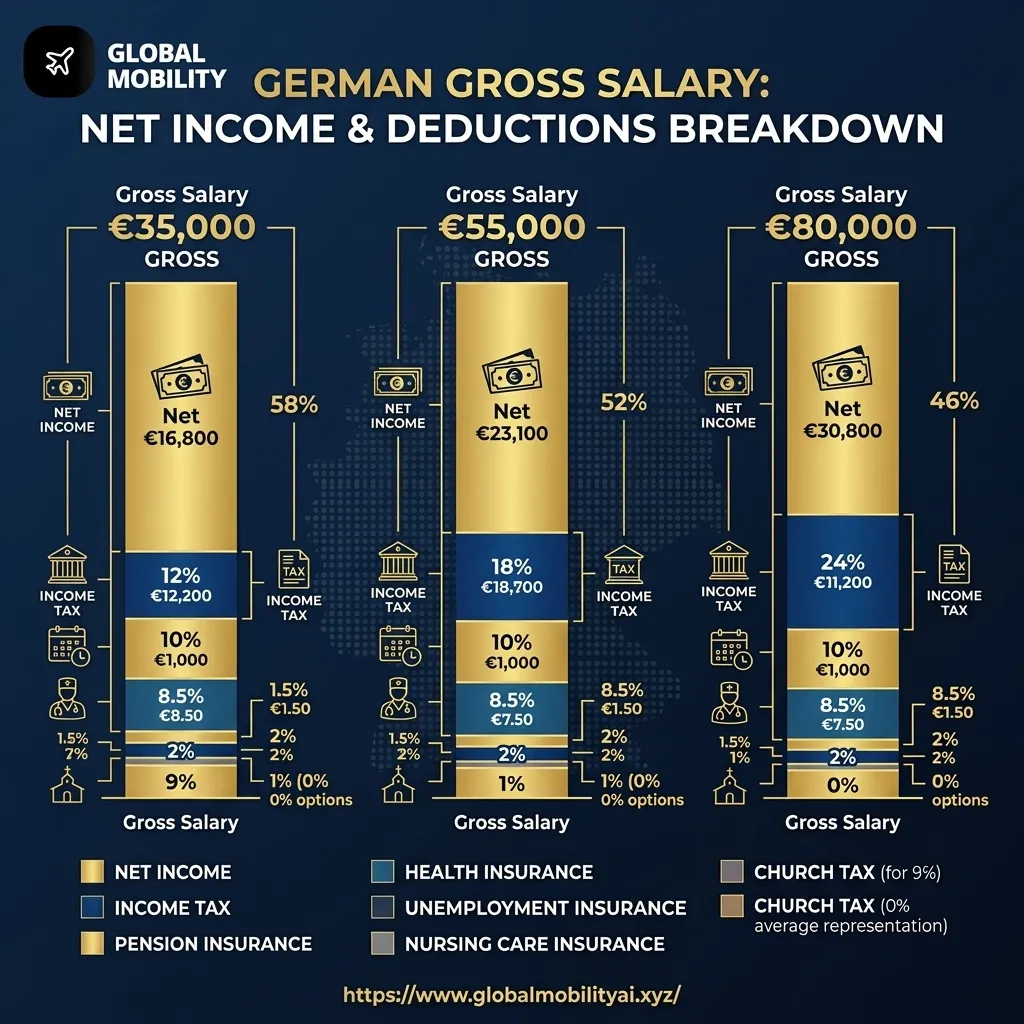
IMG-05: Gross Net Breakdown
Visual breakdown of how a German gross salary is distributed between net income and taxes.
To accurately project your savings, you must understand the baseline expenses. Below is an itemized monthly budget for a single professional living outside the city center in a Tier-1 German city:
| Expense Category | Monthly Cost (EUR) | USD Equivalent |
|---|---|---|
| **Rent (1BR, Warmmiete)** | €1,150 | ~$1,265 |
| **Groceries** | €350 | ~$385 |
| **Transport (Deutschlandticket)** | €49 | ~$54 |
| **Healthcare (Public, Est.)** | €350 | ~$385 |
| **Utilities (Internet, Mobile, GEZ)** | €90 | ~$99 |
| **Entertainment & Gym** | €150 | ~$165 |
| **Total Estimated Budget** | **€2,139** | **~$2,353** |
(Source: Numbeo Cost of Living Database, 2026) [https://www.numbeo.com/cost-of-living/country_result.jsp?country=Germany]
4.2 Monthly Savings Scenarios After Expenses
To understand your true financial trajectory, you must model your income against the baseline costs. Below are three common income scenarios for a single professional living in a mid-tier German city. For a personalized assessment, utilize the GlobalMobilityAI savings calculator.
| Career Level | Gross Monthly | Net Monthly (Tax Class 1) | Est. Living Expenses | Net Monthly Savings |
|---|---|---|---|---|
| **Entry-Level (Junior)** | €3,750 | €2,450 | €1,600 | **€850** |
| **Mid-Level (Specialist)** | €5,833 | €3,550 | €1,900 | **€1,650** |
| **Senior-Level (Lead)** | €7,500 | €4,350 | €2,200 | **€2,150** |
Note: These are baseline estimates. Groceries and transport (e.g., the €49 Deutschlandticket) are relatively fixed, but rent variability will directly impact these final savings figures.
(Source: Bundesagentur für Arbeit Brutto-Netto-Rechner, 2026) [https://www.brutto-netto-rechner.info/]
4.3 Cost of Living Index vs. Home Countries
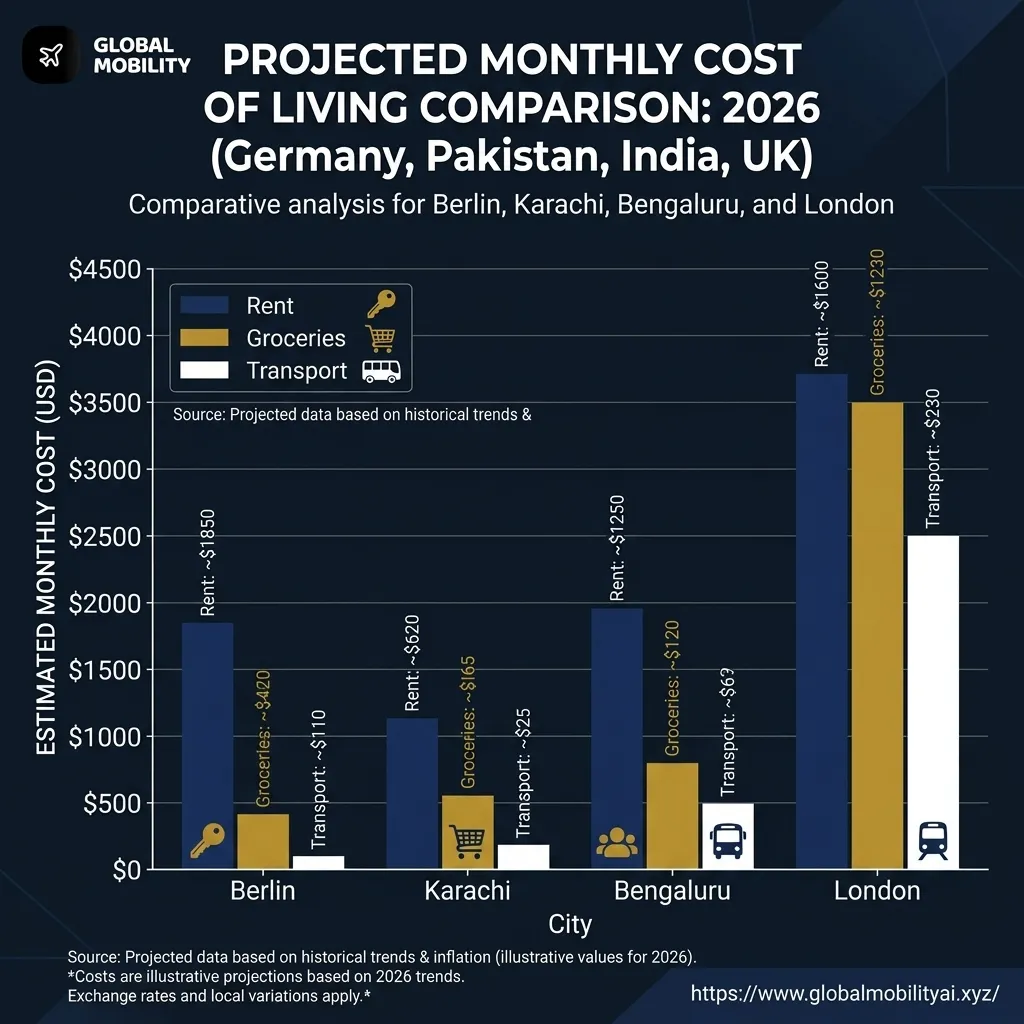
IMG-06: Cost of Living Comparison
Comparative analysis of monthly expenses across major global mobility hubs.
When comparing the purchasing power of your German salary, you must benchmark it against major expat home countries. While Germany is more expensive than South Asia, the absolute savings potential is substantially higher.
| Country | Cost of Living Index | Rent Index | Groceries Index | Purchasing Power |
|---|---|---|---|---|
| **Germany** | 65.5 | 28.0 | 50.2 | 102.3 |
| **United Kingdom** | 63.2 | 31.5 | 48.0 | 90.5 |
| **India** | 22.8 | 5.5 | 24.1 | 55.4 |
| **Pakistan** | 18.2 | 3.1 | 17.5 | 25.1 |
(Source: Numbeo Cost of Living Index by Country, 2026) [https://www.numbeo.com/cost-of-living/rankings_by_country.jsp]
5. Salary Data & Job Market Intelligence
5.1 Average Salaries by Sector
The German job market in 2026 strictly rewards specialization, requiring alignment with the strict EU Blue Card 2026 salary requirements. The following table outlines the gross annual salaries across 5 key industries at three distinct seniority levels.
| Industry | Entry-Level (0-2 Yrs) | Mid-Level (3-5 Yrs) | Senior-Level (5+ Yrs) |
|---|---|---|---|
| **Software Engineering / IT** | €55,000 | €70,000 | €90,000+ |
| **Mechanical / Electrical Engineering** | €52,000 | €68,000 | €85,000+ |
| **Data Science / AI** | €60,000 | €80,000 | €105,000+ |
| **Healthcare (Registered Nurses)** | €38,000 | €46,000 | €55,000+ |
| **Business Analysis / Finance** | €50,000 | €72,000 | €95,000+ |
(Source: StepStone Salary Report, 2026) [https://www.stepstone.de/gehalt]
(Source: Bundesagentur für Arbeit - Entgeltatlas, 2026) [https://web.arbeitsagentur.de/entgeltatlas/]
5.2 In-Demand Skills & Sectors in 2026
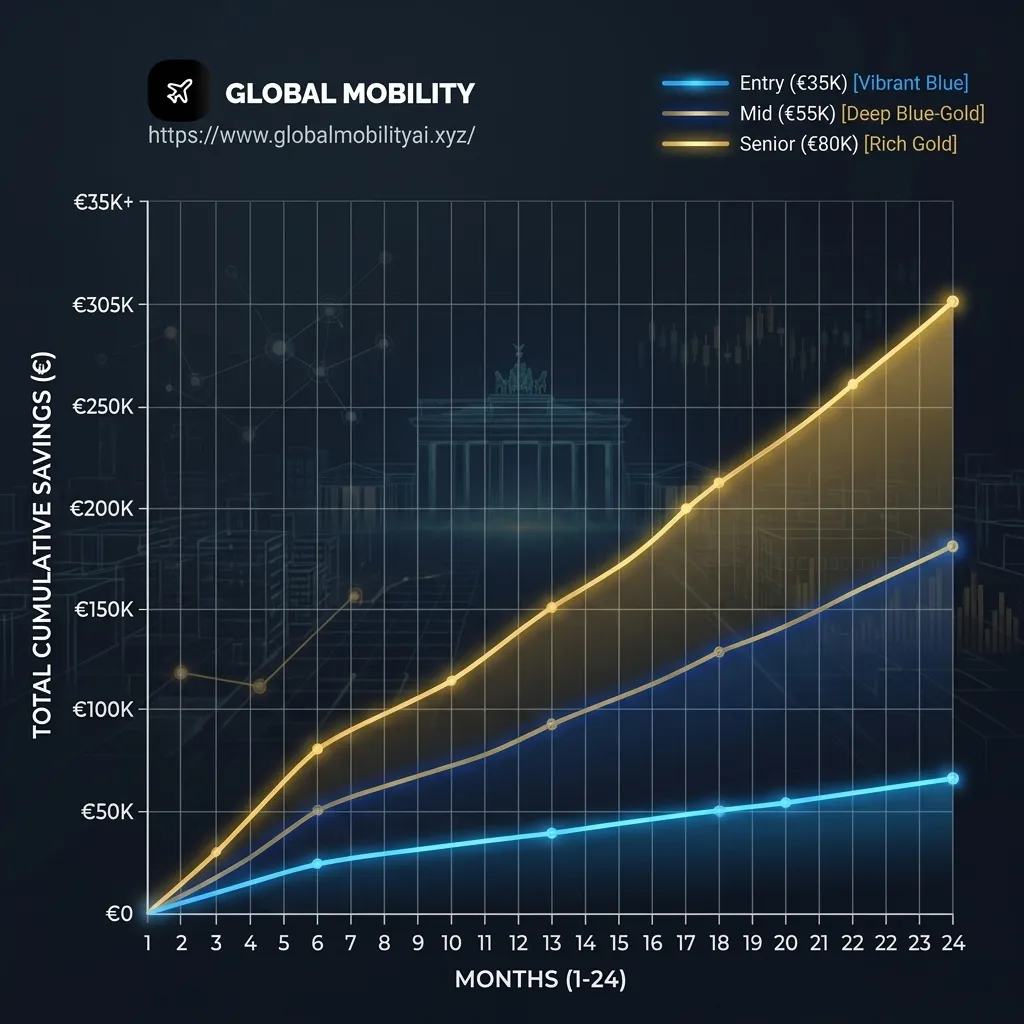
IMG-07: Salary vs Savings Trajectory
24-month savings trajectory modeling for different income levels in Berlin.
The German economy is undergoing a massive structural transformation, heavily prioritizing green energy, digitalization, and healthcare. According to the Federal Employment Agency (Source: Bundesagentur für Arbeit, 2026) [https://www.arbeitsagentur.de/en], the most critical labor shortages are clustered in the following sectors:
Professionals in these sectors command significant leverage in salary negotiations, often securing relocation bonuses and language training subsidies directly from employers.
5.3 Benchmarking Your Offer
Candidates are heavily encouraged to run their prospective offers through the GlobalMobilityAI salary comparison tool. Understanding whether your offer aligns with the local IG Metall union tariff or sits above the median is critical. Do not accept a €45,000 salary in Munich if the regional median for your role is €65,000; the rent will devour your income, leaving you with zero answers to the question of how much money can I save in Germany per month.
6. CV Formatting — German Lebenslauf Guide
6.1 The Anatomy of a German CV
The German CV (Lebenslauf) is famously rigid, factual, and strictly chronological. It must be a table-like layout with dates on the left and descriptions on the right. Provide your full name, address, phone number, email, date of birth, and nationality. While providing a professional photo (Bewerbungsfoto) is legally no longer mandatory due to anti-discrimination laws (AGG), it remains highly customary in traditional German firms.
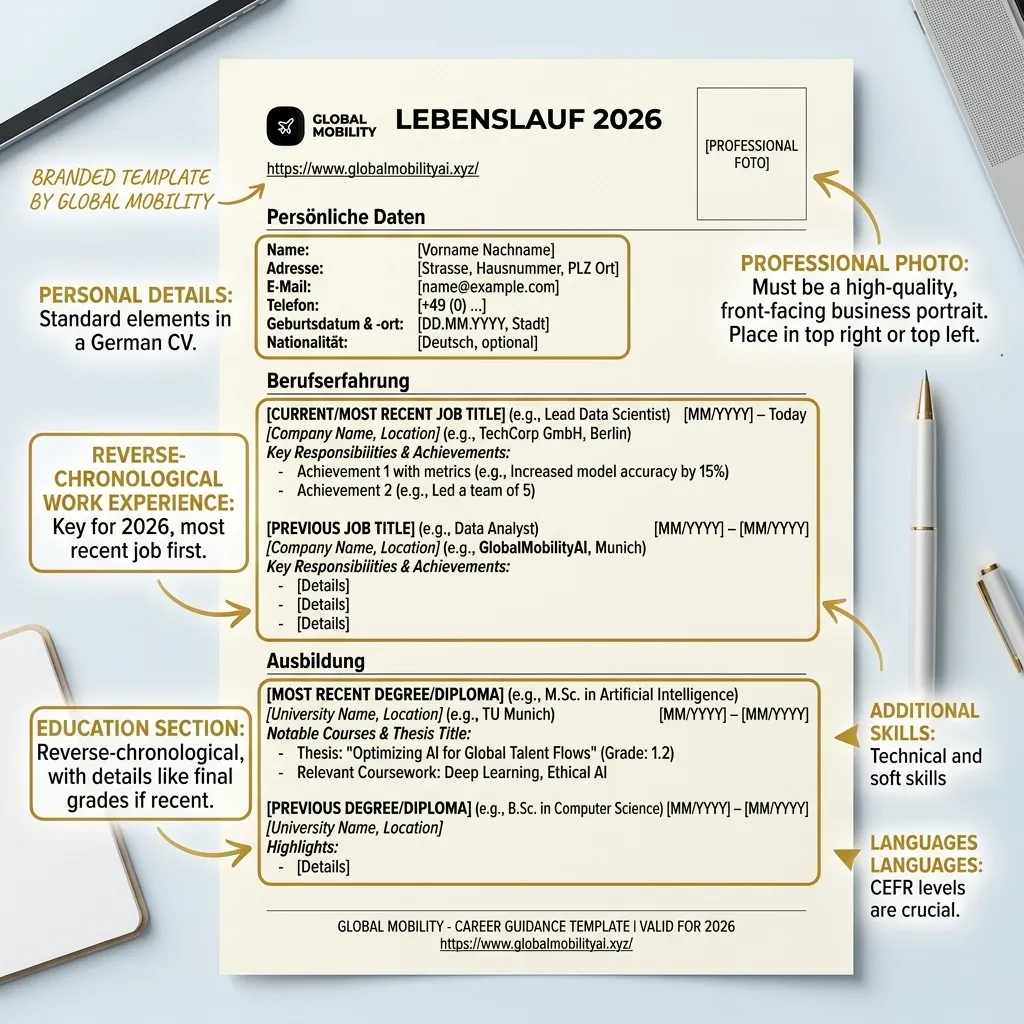
IMG-08: German Lebenslauf (CV) Format — 2026 Annotated Example
A master template for the German Lebenslauf, highlighting critical formatting requirements.
6.2 Common CV Mistakes
Avoiding common errors is critical to ensure you pass initial HR screening. Ensure you avoid these five German-specific CV mistakes:
6.3 ATS Optimization for German Job Portals
When applying through the dominant German job portals—such as StepStone.de, Indeed.de, XING, and LinkedIn DE—ATS optimization is your primary hurdle. These systems are highly sensitive to formatting and keyword density. Ensure your Lebenslauf is saved as a single, consolidated PDF alongside your cover letter (Anschreiben) and certificates. Use exact keyword terminology pulled directly from the job description (e.g., if the job asks for 'Projektmanagement', use that exact term, not just 'Project Management'). Furthermore, XING remains exceptionally powerful in the DACH region; ensuring your XING profile mirrors your optimized PDF CV perfectly will drastically increase inbound recruiter messages.
7. Interview Tips for the German Job Market
7.1 Punctuality and Formality
In Germany, being five minutes early is considered being on time; being exactly on time is considered late. Punctuality is the absolute baseline of professional respect. During the interview, maintain formal address ("Sie" instead of "Du") unless explicitly invited by the interviewer to use the informal "Du". Always address the interviewer by their title and last name (e.g., Herr Müller or Frau Schmidt).
7.2 Direct Communication Style & Interview Q&A
German business culture values extreme directness and factual accuracy. "Selling yourself" with exaggerated claims or overly enthusiastic American-style rhetoric is often perceived as dishonest. Employers look for clear, data-driven answers using the STAR format (Situation, Task, Action, Result). Prepare for these 4 common German interview questions:
7.3 Dress Code, Punctuality & Professional Etiquette
Dress codes in Germany vary significantly by sector. A strict "Business Professional" standard is mandatory for corporate, finance, and legal roles (suit and tie or formal business dress). Conversely, a "Business Casual" or even casual approach is acceptable in Berlin startups and tech firms. Regardless of the dress code, punctuality is non-negotiable. It is a deeply ingrained cultural norm to bring a portfolio or neatly printed CV copies to in-person interviews, demonstrating preparedness.
7.4 Post-Interview Follow-Up Etiquette
Unlike the aggressive follow-up tactics often recommended in the US or UK, the German preference is for a brief, formal follow-up email sent within 48 hours. Express gratitude for the interviewer's time and concisely reiterate your interest in the role. Do not follow up with a phone call, as this is perceived as intrusive. Be prepared for a typically longer German hiring timeline, which averages 4–8 weeks from the initial interview to a formal offer.
8. 2026 Policy Updates & Market Predictions
8.1 The Expansion of the Chancenkarte
The German government's full rollout of the points-based Opportunity Card has radically altered the landscape. Candidates no longer need an immediate job offer to enter the country. By accumulating points based on age, language proficiency, experience, and qualifications, talented migrants can arrive and interview locally.
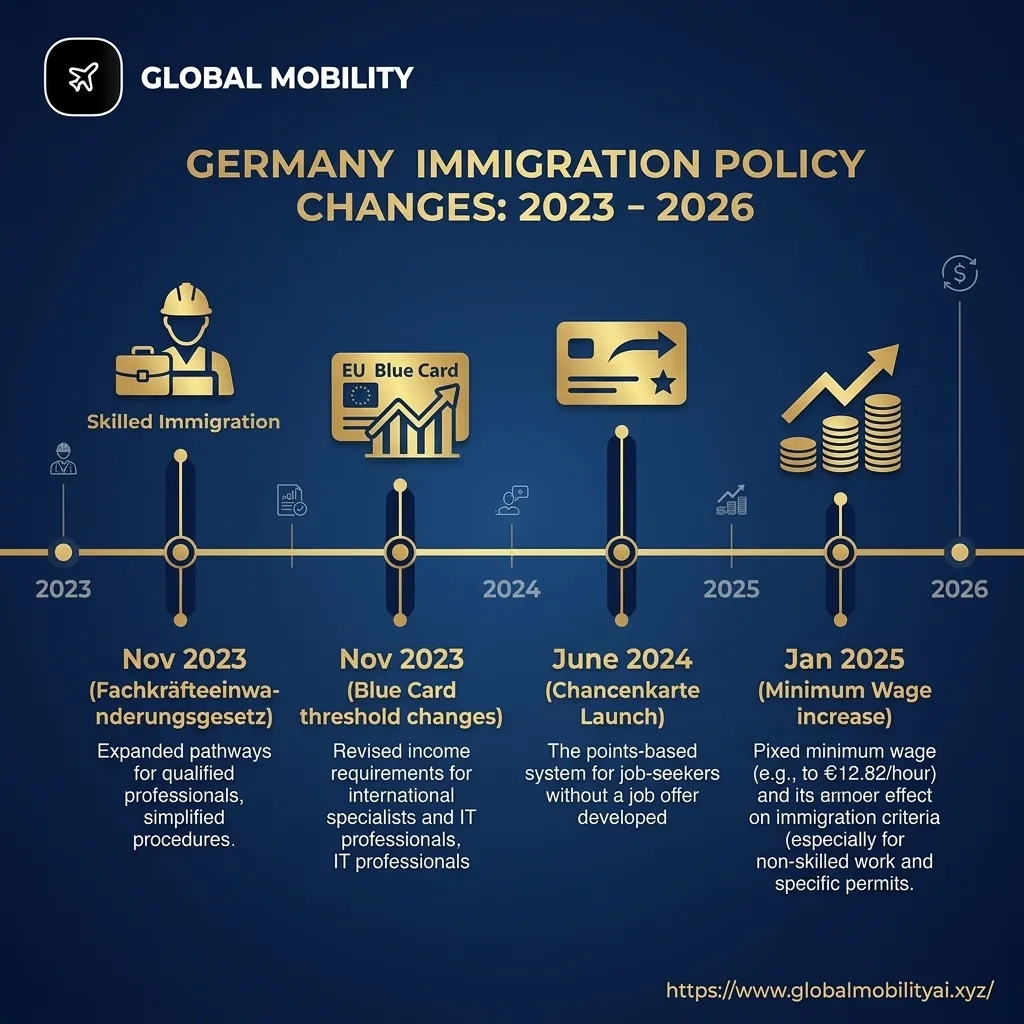
IMG-11: Germany Immigration Policy Changes Timeline — 2023 to 2026 Overview
A chronological overview of strategic shifts in German immigration law.
8.2 Immigration Trend Predictions
Germany's demographic shift is enforcing unprecedented leniency in immigration policy. Platform search trends indicate significant growth in German skilled labor intake — monitor: OECD Migration Outlook 2025 (Source: OECD, 2025) [https://www.oecd-ilibrary.org/social-issues-migration-health/international-migration-outlook_1999124x]. Primarily driven by the relaxed citizenship laws and the Opportunity Card, the BAMF annual report (Source: BAMF, 2026) [https://www.bamf.de/EN/Themen/Statistik/statistik-node.html] further highlights that processing times for MINT professionals have been expedited, falling from a 12-week average to under 6 weeks in fast-tracked federal states. This trend predicts that the competition for jobs will intensify within the country, but the barrier to entry will remain at historic lows. As the domestic labor force continues to shrink, salary negotiations will skew heavily in favor of highly qualified expats, directly boosting monthly savings potential.
8.3 How Changes Affect Your Application
These sweeping policy updates signify that your speed to market is critical. With reduced processing times and the introduction of the Chancenkarte, the influx of international talent will aggressively drive up competition for premium apartments and top-tier roles. To navigate this, applicants must leverage the GlobalMobilityAI visa eligibility checker to instantly verify their points and streamline their paperwork before applying. Waiting for a perfect offer from abroad may no longer be the optimal strategy; securing the Opportunity Card, arriving in Germany, and interviewing locally provides a distinct advantage in capturing the highest-paying roles.
9. Tactical Comparison Matrix
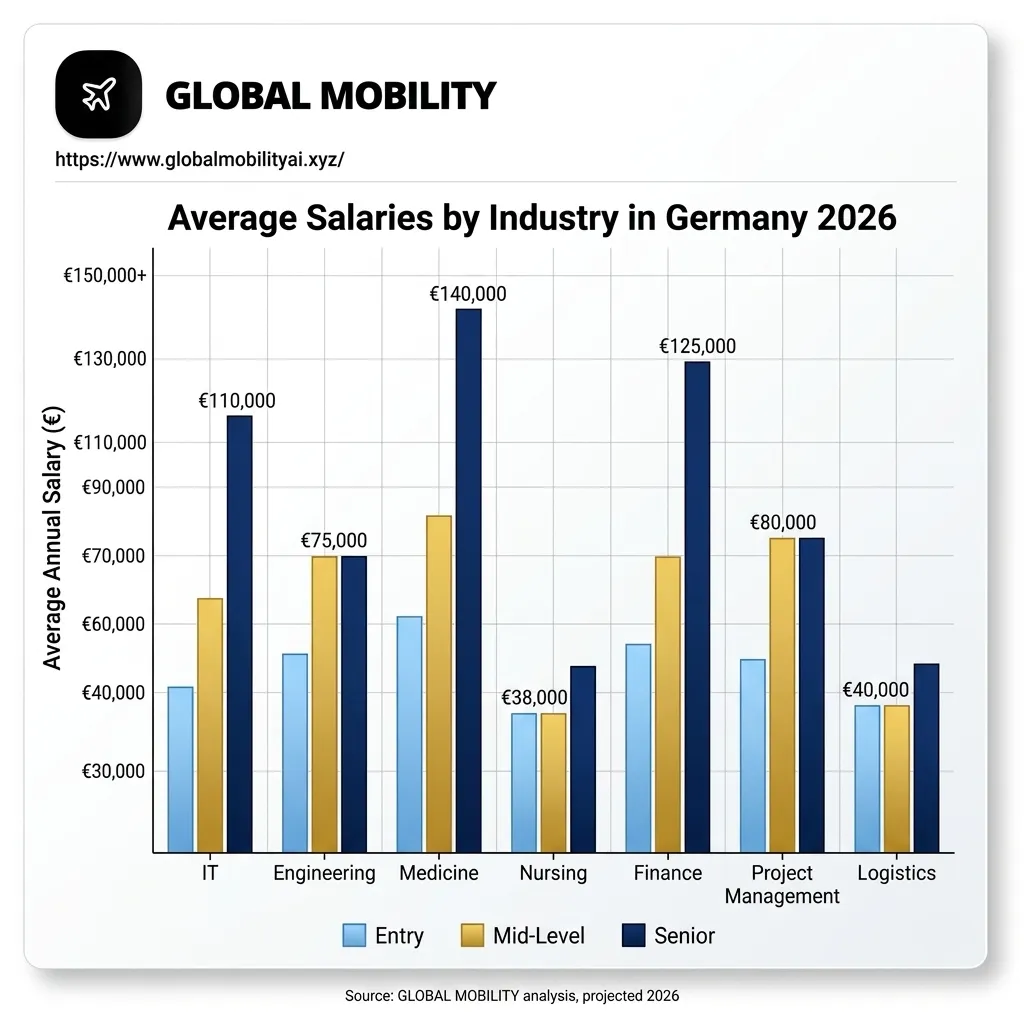
IMG-09: Salary by Industry
Sector-by-sector salary benchmarks for qualified professionals in Germany.
The following matrix compares the most common visa routes available in Germany in 2026, highlighting the structural differences.
| Route | Primary Requirement | Salary Threshold (2026) | Duration | Processing Time | Est. Approval Rate* |
|---|---|---|---|---|---|
| **EU Blue Card (General)** | Degree + Job Offer | €45,552 Gross | Up to 4 Years | 4-8 Weeks | Platform Est.* |
| **EU Blue Card (Shortage)** | Degree + Job Offer | €35,232 Gross | Up to 4 Years | 4-8 Weeks | Platform Est.* |
| **Opportunity Card** | Points-based (Search) | N/A (Blocked Account) | 1 Year | 6-12 Weeks | Platform Est.* |
| **Skilled Worker Visa** | Vocational/Degree | Industry Standard | Contract based | 8-16 Weeks | Platform Est.* |
| **Family Reunification** | Married to Resident | Sponsor's Income | Dependent | 8-12 Weeks | Platform Est.* |
| **Job Seeker Visa** | Recognized Degree | N/A (Blocked Account) | 6 Months | 6-10 Weeks | Platform Est.* |
Internal platform estimate. Official approval rates not published by BAMF. Monitor: bamf.de
10. Execution Roadmap: Phase-by-Phase
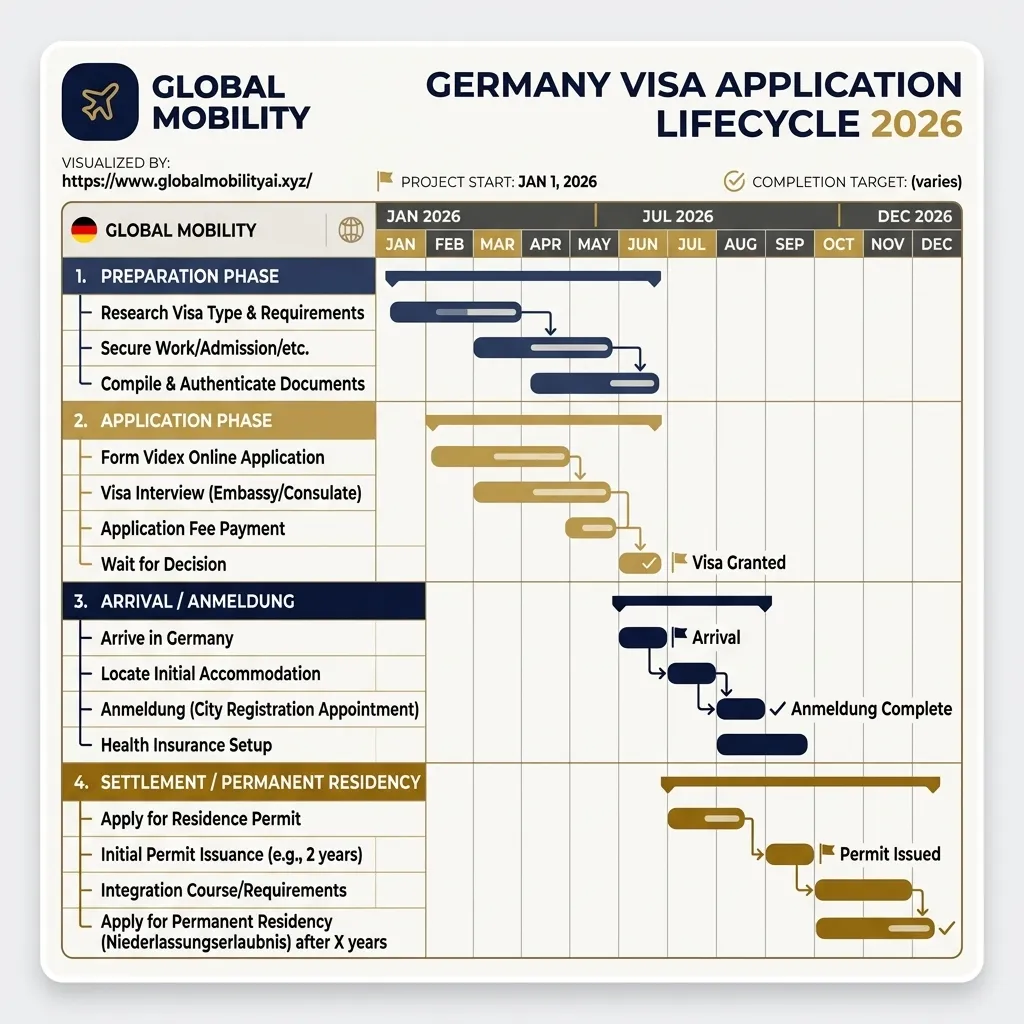
IMG-10: Visa Processing Timeline
Visual project timeline for a successful relocation to Germany.
10.1 Phase 1: Document Verification and Pre-Flight (Months 1-4)
Before you apply for a visa or even attend a job interview, your core documents must be explicitly verified according to strict German bureaucratic standards. Your absolute first step is to check if your university and specific degree are listed as H+ (fully recognized) in the official Anabin database. If your institution or specific degree is not listed, or listed as H+/-, you must immediately apply for a Statement of Comparability from the ZAB (Zentralstelle für ausländisches Bildungswesen) via their official portal [https://zab.kmk.org/en/statement-comparability]. This process costs exactly €208 and routinely takes up to 3 months to complete. Without it, your Blue Card application will be instantly rejected.
Simultaneously, applicants originating from India, China, and Vietnam face an additional mandatory layer: the APS Certificate (Akademische Prüfstelle) [https://aps-india.de/]. The APS certificate strictly verifies the authenticity of your academic degrees to prevent fraud. It costs ₹18,000 INR (approximately €200) for Indian applicants. It is a hard, non-negotiable prerequisite for any work or student visa application, and current processing times can drag to 3 or 4 months due to unprecedented volume.
Finally, if you are targeting the Chancenkarte (Opportunity Card) or roles outside of English-speaking international tech hubs, book your A1 to B1 German language test at the Goethe-Institut [https://www.goethe.de/]. Examination fees typically range from €130 to €250 depending on the proficiency level and your home country's local pricing.
10.2 Phase 2: The Job Hunt and Bureaucracy (Months 5-8)
Armed with recognized credentials, deploy your optimized German Lebenslauf on dominant local platforms like StepStone, XING, and LinkedIn DE. Once you successfully secure a contract that clears the salary thresholds, the real bureaucratic sprint begins.
You must immediately book a visa appointment at the German consulate in your home country. The visa processing fee for a standard national D-visa (including the EU Blue Card) is €75. If you are already physically in Germany on a job-seeker visa, Schengen business visa, or the Opportunity Card, you must secure an appointment at the local Ausländerbehörde (Foreigners' Registration Office) to convert your legal status. In the capital, this is done exclusively via the official service portal [https://service.berlin.de/terminvereinbarung/]. Due to severe bureaucratic backlogs across Germany, appointments must be booked months in advance. Expats often resort to checking the portal daily at precisely 7:00 AM to snipe cancellation slots.
10.3 Phase 3: Arrival, Anmeldung, and Probation (Months 9-14)
Upon arriving in Germany, your immediate, non-negotiable priority is the "Anmeldung" (city registration). You must register your permanent or temporary address at the local Bürgeramt within 14 days of arrival. Without this certificate, you cannot open a fully functional bank account or receive your Tax ID (Steuer-ID). If you begin your employment without providing a valid Tax ID to HR, the tax office will automatically place you in the emergency Tax Class 6. This results in approximately 50% of your gross salary being withheld, temporarily destroying your monthly savings until the tax class is corrected.
Furthermore, your first 6 months constitute the legal probation period (Probezeit). During this high-stress phase, you can be dismissed without cause with just a two-week notice. To maximize your chances of answering "how much money can I save in Germany per month" positively, maintain extreme professionalism, arrive early, avoid taking significant leave, and integrate rapidly into the corporate culture.
10.4 Phase 4: Permanent Residency and Citizenship (Years 2-5)
The long-term financial payoff in Germany is secured through permanent residency. For EU Blue Card holders, you can apply for the Niederlassungserlaubnis (Settlement Permit) after just 21 months of employment if you possess certified B1 German language skills, or after 33 months with basic A1 German. The application fee is €113. Achieving this status frees you from being tied to a specific employer, giving you massive leverage in salary negotiations and job mobility.
Finally, the radically revised 2024 Citizenship Law (Einbürgerung) allows expats to apply for a German passport and dual citizenship after just 5 years of legal residence. For those demonstrating exceptional integration (such as C1 German level and notable professional achievements), this timeline is aggressively accelerated to just 3 years. The naturalization fee is €255 per adult. Securing the Niederlassungserlaubnis and subsequently the German passport guarantees your unrestricted access to the entire European job market, permanently maximizing your earning and savings potential for life.
11. Critical Risk Factors & Common Pitfalls
11.1 Salary Threshold Shortfall
11.2 Degree Recognition (Anabin Database Failures)
11.3 Blocked Account Insufficiency for Chancenkarte
11.4 Probation Period Labor Ban
11.5 Language Certificate Expiry
11.6 TB Test from Non-Approved Clinics
11.7 APS Certificate Rejection (India/China)
11.8 Anmeldung Registration Failure
12. FAQ — People Also Ask
Q: How much money can I save in Germany per month as a software engineer?
A: A mid-level software engineer earning €65,000 gross takes home ~€3,350/month. With baseline expenses of €1,600 in Berlin, the monthly savings potential is €1,750. This precise €1,750/month figure assumes you are in Tax Class 1 (single, no dependents) and paying into the public health insurance system. Your city choice drastically alters this equation. For example, living in Leipzig instead of Berlin on the exact same €65,000 gross salary would decrease your rent and lifestyle expenses significantly, which would increase your net monthly savings to approximately €2,100/month. Therefore, optimizing your tax class and geographic location are the two most powerful levers for maximizing your tech salary in Germany.
Q: Is €50,000 a good salary for a family of four in Germany?
A: It is exceptionally tight in Munich or Hamburg. In Leipzig or Essen, it is manageable but requires careful budgeting. Net income would be ~€3,100 (Tax Class 3). Monthly savings would be minimal (€100–€300).
Q: How much money can I save in Germany per month on the Opportunity Card?
A: Zero. The Opportunity Card (Chancenkarte) is strictly a job-seeker visa designed to let you enter Germany to interview locally, not a work permit for immediate full-time employment. To obtain it, you must prove you have sufficient funds to support yourself, which means a €1,027/month blocked account requirement that translates to €12,324 total for the year. Your savings during this phase will be negative. However, during the job search phase, applicants may legally work up to 20 hours per week in part-time roles to offset living costs. Use the GlobalMobilityAI visa eligibility checker to verify your Opportunity Card points instantly before committing funds. True savings only begin once you secure a permanent contract and switch over to a standard work visa or the EU Blue Card.
Q: Do I need to speak German to save money in Germany?
A: Indirectly, yes. While it is entirely possible to secure English-only roles in international tech startups based in high-rent hubs like Munich and Berlin, lack of German limits your geographic mobility. Achieving at least a B2-level German proficiency fundamentally changes your financial trajectory. B2-level German opens up 60% more job listings in non-tech sectors and traditional 'Mittelstand' companies located in mid-sized cities or rural regions (Source: Bundesagentur für Arbeit, 2026) [https://www.arbeitsagentur.de/en]. In these areas, salaries remain highly competitive but local rents are often 40% lower than in Tier-1 cities (Source: Destatis, 2026) [https://www.destatis.de/], allowing your absolute monthly savings rate to skyrocket even if your gross salary remains identical.
Q: How much can I save in Munich per month?
A: Munich is expensive. A mid-level engineer earning €60,000 gross may face a deficit if living in the city centre. However, living outside the centre reduces expenses and generates savings of around €417/month. Senior professionals earning €80,000+ can save approximately €860/month.
Q: What percentage of my salary can I realistically save in Germany?
A: At €35,000 gross, the savings rate is 5–15% of net income. At €55,000, it reaches 35%, and at €80,000 gross, senior professionals can achieve savings rates of 45–55% of net income. Platform analysis suggests senior professionals in lower-cost cities can retain 40–55% of net income as savings, based on published StepStone/Numbeo data cross-referenced by the GlobalMobilityAI Research Team.
Q: How much money should I save before moving to Germany?
A: We recommend a minimum pre-departure savings target of €6,000–€10,000 to cover the rental deposit (3 months rent, 'Kaution'), first month's rent, and administrative setup costs. Chancenkarte applicants require an additional €12,324 in a blocked account.
Q: How much can a nurse save in Germany per month?
A: An entry-level nurse earning €32,000 gross can save €130–€280/month in a mid-sized city. Senior nurses earning €50,000 gross can save €800–€1,000/month. Employers also often provide signing bonuses and cover qualification recognition fees.
13. Conclusion: The Bottom Line
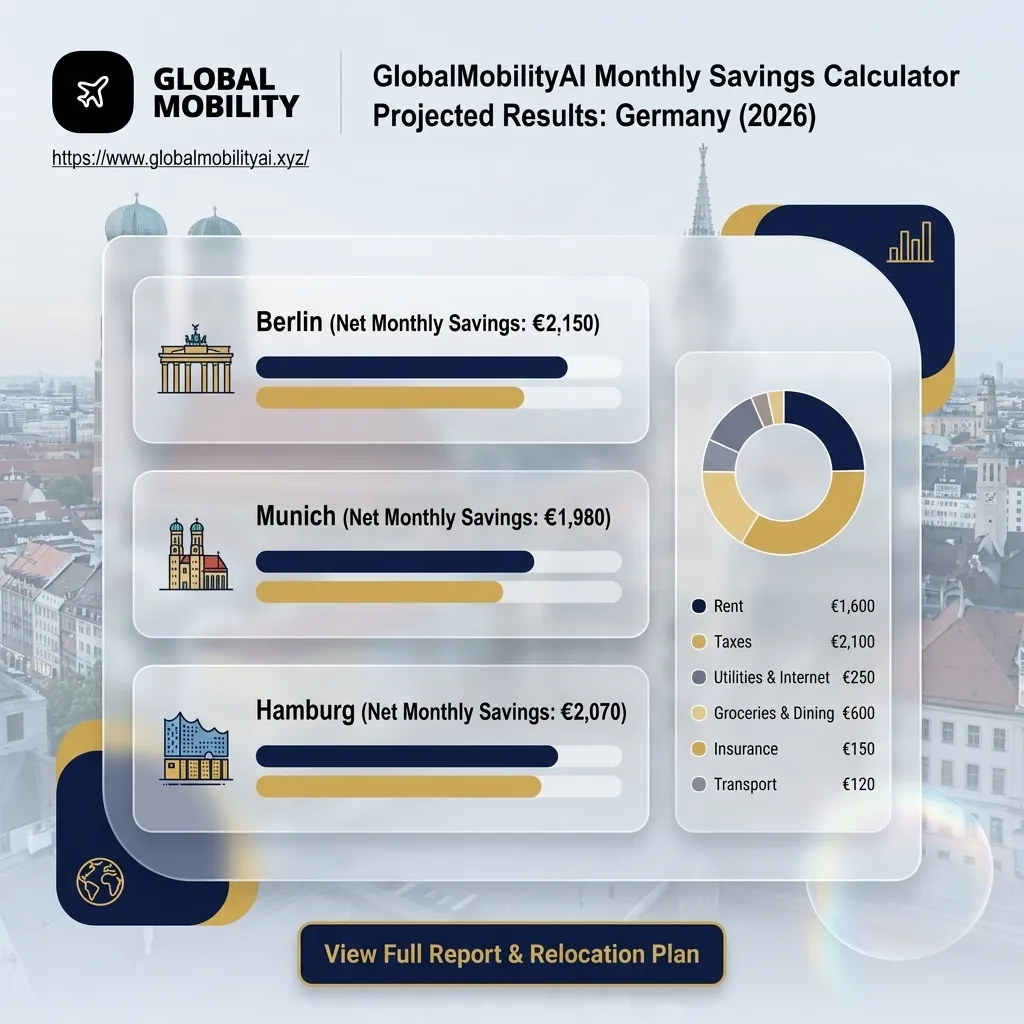
IMG-12: Monthly Savings Calculator
UI Preview of the GlobalMobilityAI savings calculator results interface.
For senior tech professionals, healthcare workers, and ambitious graduates looking at 2026, the question of how much money can I save in Germany per month is no longer a mystery. Germany is a wealth-building machine, but only for those who approach their relocation as a strict financial project. By targeting high-growth, lower-cost regions like Leipzig over Munich, mastering the complex tax class system, and negotiating aggressively using verified market data, your savings trajectory can easily surpass what is possible in the UK or Canada.
If you are a single professional willing to adapt to the culture and learn the language, your ability to compound wealth here is unmatched in mainland Europe. Do not leave your financial future to chance or predatory third-party agencies.
Take total control of your relocation journey today. Leverage our GlobalMobilityAI Salary Comparison Tool to ensure your job offer aligns with German industry standards. Run your profile through our Visa Eligibility Checker to instantly calculate your Chancenkarte points. For a deeper understanding of alternate European hubs, explore our guide on the Austria Red-White-Red Card 2026. Equip yourself with the right data, secure your Blue Card, and turn your German relocation into a highly profitable reality.
Predict your mobility score.
Use our AI engine to get your personalized visa pathway, salary prediction, and relocation roadmap.
More Insights

Which Country Has Highest UK Visa Approval Rate — 2026 Guide