
Immigration Probability Calculator: Predict Your Visa Odds Accurately in 2026
Access the Full Platform at GlobalMobilityAI.xyz
Editorial Transparency: Content compiled from official government sources by the GlobalMobilityAI Research Team. For personalized legal or immigration advice, consult a licensed immigration consultant or lawyer.
(Last Updated: 2026-05-10)
According to OECD's International Migration Outlook 2024, global skilled worker visa applications increased by 19% between 2022 and 2024, yet first-attempt rejection rates in major destination countries remain between 18% and 34% depending on visa category and nationality. (Source: OECD, 2024) Most rejections stem not from disqualification but from preventable profiling errors — mismatched salary thresholds, incomplete documentation, and misjudged eligibility pathways.
An immigration probability calculator closes that gap. Rather than guessing at approval odds, applicants can input their profile — education, work experience, language scores, salary, destination country — and receive a data-modeled prediction of their visa success likelihood before spending thousands on application fees and legal costs.
Platform search trends on GlobalMobilityAI.xyz indicate that demand for visa probability tools is rising sharply among professionals aged 25–40 from South Asia, MENA, and Sub-Saharan Africa. This guide explains exactly how these calculators work, what inputs they use, which countries they cover, and how to use the results to strengthen your 2026 application before you submit.
Table of Contents
1. Why Immigration Probability Tools Matter in 2026 — The Strategic Case
1.1 Economic Landscape & Opportunity
The global skilled labor shortage has fundamentally changed the immigration landscape. According to the World Bank's World Development Report 2023: Migrants, Refugees, and Societies, high-income countries face structural deficits in healthcare, engineering, logistics, and technology sectors that domestic workforces cannot fill for the foreseeable decade. (Source: World Bank, 2023) Germany's Federal Labour Office (Bundesagentur für Arbeit) projects a shortfall of 240,000 skilled workers annually through 2030. (Source: Bundesagentur für Arbeit, 2024) Canada's Immigration, Refugees and Citizenship Canada (IRCC) has set an intake target of 500,000 permanent residents per year through 2025–2027. (Source: IRCC, 2024)
This supply-demand imbalance means destination countries are actively recruiting but simultaneously tightening eligibility criteria to filter for specific skill profiles. GDP growth in top destination markets — Germany at 1.2% projected for 2026, Canada at 2.1%, UK at 1.7% — signals sustained labor demand but with increasingly selective intake criteria. (Source: IMF World Economic Outlook, April 2025)
For applicants, this creates a paradox: more pathways exist, but each pathway carries more conditional requirements. Navigating this environment without data is the single largest cause of preventable rejections.
1.2 Why Professionals Are Targeting Probability-Based Immigration Tools
Immigration has historically been opaque — applicants submitted paperwork and waited for outcomes they could not predict. That model is obsolete. Platform search trends suggest a marked shift toward pre-application research, with professionals seeking to understand their visa odds before committing to costly application processes.
This behavior mirrors how investors perform due diligence before capital deployment. The logic is identical: quantify risk before committing. An immigration probability calculator provides the equivalent of a pre-application due diligence report — scored against real government eligibility matrices.
Similar data-driven approaches have transformed visa planning strategies in Germany, as analyzed in our Germany Opportunity Card 2026 complete guide, where point-based eligibility scores determine whether applicants qualify before submission. The GlobalMobilityAI visa probability tool applies the same logic across 50+ destination countries simultaneously, allowing cross-country comparison in minutes rather than months of manual research.
2. Deep-Dive Analysis: How Immigration Probability Calculators Work
2.1 Legal Requirements & Scoring Framework
An immigration probability calculator does not replace an immigration lawyer — it replicates the eligibility matrices that visa officers use to assess applications. Most destination countries now operate either explicit points-based systems or implicit scoring matrices tied to salary thresholds, credential recognition, language proficiency, and work experience duration.
How the probability model is built:
Each destination country publishes its eligibility criteria through official immigration portals. For Canada, this is the Comprehensive Ranking System (CRS) under Express Entry — a fully published 1,200-point scoring matrix. (Source: IRCC Express Entry, 2024) For Germany, the Opportunity Card (Chancenkarte) uses a 6-factor points system with published minimum thresholds. (Source: Make it in Germany, 2024) For the UK, the Skilled Worker Visa applies a tradeable and non-tradeable points system where salary, job offer, and English language proficiency each carry defined point values. (Source: UK Home Office, 2024)
A well-built immigration probability calculator ingests these published matrices and maps an applicant's profile against them. The output is not arbitrary — it is a probabilistic reflection of where the applicant's profile sits relative to published eligibility thresholds.
Core inputs assessed in a standard immigration probability calculator:
Each variable is weighted against the official published scoring matrix for the destination country. The output is a probability band — e.g., "High (75–90% estimated approval alignment)" — not a guaranteed outcome.
2.2 Eligibility Criteria & Qualification Scoring
The scoring structure varies significantly by destination. Understanding these variations allows applicants to target the highest-probability pathway rather than the most prominent one.
Canada Express Entry CRS Score Distribution (2024 data):
Germany Opportunity Card (Chancenkarte) scoring threshold:
UK Skilled Worker Visa points requirements:
A probability calculator cross-references the applicant's score against these published thresholds and historical draw data to estimate alignment probability.
2.3 Required Documentation & Official Checklists
Documentation completeness is a major variable in immigration probability. Applications with document deficiencies are either immediately refused or delayed for additional information requests, which statistically correlates with higher refusal rates. The following documentation requirements apply across major destination countries:
Canada Express Entry — Core Documentation:
Germany Skilled Worker Visa — Core Documentation:
UK Skilled Worker Visa — Core Documentation:
A probability calculator that also audits document readiness against these checklists provides significantly more actionable output than one that only produces a score.
3. Country Guide — Which Destinations Have the Highest Approval Probability
3.1 Top 5 Countries by Immigration Approval Probability for Skilled Workers (2026)
The following countries offer the most structured, transparent, and applicant-favorable immigration pathways in 2026, based on published acceptance volumes, processing efficiency, and scoring system clarity.
1. Canada — Highest volume, most transparent scoring system. CRS score publicly visible. PNP pathways lower score requirements dramatically. 485,000 permanent resident admissions in 2024. (Source: IRCC, 2025) Strong job market in tech, healthcare, and trades. French-language proficiency significantly boosts CRS scores for Quebec streams.
2. Germany — Opportunity Card launched 2024, accepting qualified applicants without job offer. Job market access through 12-month job seeker visa. Recognized shortage in IT, engineering, nursing. EU Blue Card threshold salary: €45,300 (general) / €35,100 (shortage occupations) in 2024. (Source: Make it in Germany, 2024)
3. Australia — Points-based General Skilled Migration. Invitation rounds (SkillSelect). Strong demand in construction, healthcare, mining. Score minimum: 65 points for invitation. (Source: Department of Home Affairs Australia, 2024)
4. United Kingdom — Skilled Worker Visa has no annual cap. Any eligible applicant with a sponsoring employer can apply. 120,000+ skilled worker visas issued in 2023/24. (Source: UK Home Office, 2024)
5. UAE — Golden Visa and Green Visa pathways without employer dependency. Strong demand in construction, finance, tech. No income tax. High salary-to-savings ratio. UAE Golden Visa 2026 guide provides full breakdown.
3.2 Country Comparison Table
| Country | Avg Processing Time | Min. Salary Threshold | Job Offer Required | Points System | Expat Suitability |
|---|---|---|---|---|---|
| Canada | 6–8 months (PR) | CAD $53,000+ | No (FSW) | Yes (CRS) | ★★★★★ |
| Germany | 3–4 months | €45,300 (EU Blue Card) | No (Chancenkarte) | Yes (Chancenkarte) | ★★★★☆ |
| Australia | 6–12 months | AUD $70,000+ | No (GSM) | Yes (points) | ★★★★☆ |
| UK | 8–12 weeks | £38,700 (general) | Yes | Yes (points) | ★★★★☆ |
| UAE | 2–5 weeks | AED 10,000/mo (Green) | Varies | No | ★★★☆☆ |
(Source: IRCC 2024, Make it in Germany 2024, Home Affairs Australia 2024, UK Home Office 2024, UAE GDRFA 2024)
4. Cost of Using Immigration Tools — Complete 2026 Breakdown
4.1 Immigration Tool & Application Cost Breakdown
The financial picture of an immigration journey includes both tool/assessment costs and official government fees. Understanding this full picture is essential for financial planning.
Tool and Assessment Costs (2026):
| Item | Cost | Source |
|---|---|---|
| Immigration Probability Calculator (AI tool) | Free – $29/mo | Platform-dependent |
| Educational Credential Assessment (WES – Canada) | CAD $271 | [(WES, 2024)](https://www.wese.ca/en/help/how-much-does-an-evaluation-cost) |
| IELTS exam fee (Pakistan) | PKR 46,000–48,000 | [(British Council Pakistan, 2024)](https://www.britishcouncil.pk/exam/ielts/dates-fees-locations) |
| Goethe B2 exam fee | €230 | [(Goethe Institut, 2024)](https://www.goethe.de/en/spr/kup/prf/prf/gb2.html) |
| Canada PR application fee (principal) | CAD $1,525 | [(IRCC, 2024)](https://www.canada.ca/en/immigration-refugees-citizenship/services/immigrate-canada/express-entry/apply-permanent-residence/fee.html) |
| Germany Skilled Worker Visa fee | €75 | [(German Federal Foreign Office, 2024)](https://www.auswaertiges-amt.de/en/visa-service/-/231148) |
| UK Skilled Worker Visa (3 yr) | £719 + Immigration Health Surcharge | [(UK Home Office, 2024)](https://www.gov.uk/skilled-worker-visa/apply) |
| Immigration lawyer (consultation) | $100–$300/hr | Market rate |
4.2 Cost vs. Probability: What You'll Actually Save by Using a Calculator First
The ROI calculation on using an immigration probability calculator before applying is straightforward. A rejected Canadian PR application costs CAD $1,525 in non-refundable fees, plus CAD $271 ECA, plus IELTS exam costs (~CAD $350 equivalent), plus potentially 6–8 months of processing time — totaling over CAD $2,500 per failed attempt.
An immigration probability calculator that correctly identifies a low-probability profile before submission enables the applicant to either strengthen their profile (improve language scores, gain additional experience, target a different pathway) or redirect to a higher-probability destination. Platform analysis through the GlobalMobilityAI cost of living calculator confirms that professionals who complete a probability assessment before applying report significantly lower application abandonment rates.
3-scenario savings projection over 24 months:
| Applicant Level | Destination | Monthly Salary (Post-Tax) | Monthly Living Cost | Monthly Savings |
|---|---|---|---|---|
| Entry (0–2 yrs exp) | Germany | €2,200 | €1,350 | €850 |
| Mid-level (3–6 yrs) | Canada | CAD $5,100 | CAD $3,200 | CAD $1,900 |
| Senior (7+ yrs) | UK | £5,800 | £3,100 | £2,700 |
(Source: Bundesagentur für Arbeit 2024, Statistics Canada 2024, ONS UK 2024, Numbeo 2025)
4.3 Cost of Living Index vs. Home Countries
| Category | Germany | Canada | UK | Pakistan | India |
|---|---|---|---|---|---|
| Rent (1BR, city centre) | €1,050 | CAD $2,100 | £1,650 | PKR 55,000 | INR 28,000 |
| Groceries (monthly) | €300 | CAD $500 | £350 | PKR 25,000 | INR 8,000 |
| Transport (monthly pass) | €86 | CAD $120 | £180 | PKR 3,000 | INR 1,500 |
| Healthcare | Statutory insurance | Provincial | NHS (free) | Private | Mixed |
| Total est. monthly | €1,600–€2,000 | CAD $2,800–$3,500 | £2,200–£2,800 | PKR 90,000–120,000 | INR 45,000–65,000 |
(Source: Numbeo, 2025) (https://www.numbeo.com/cost-of-living/)
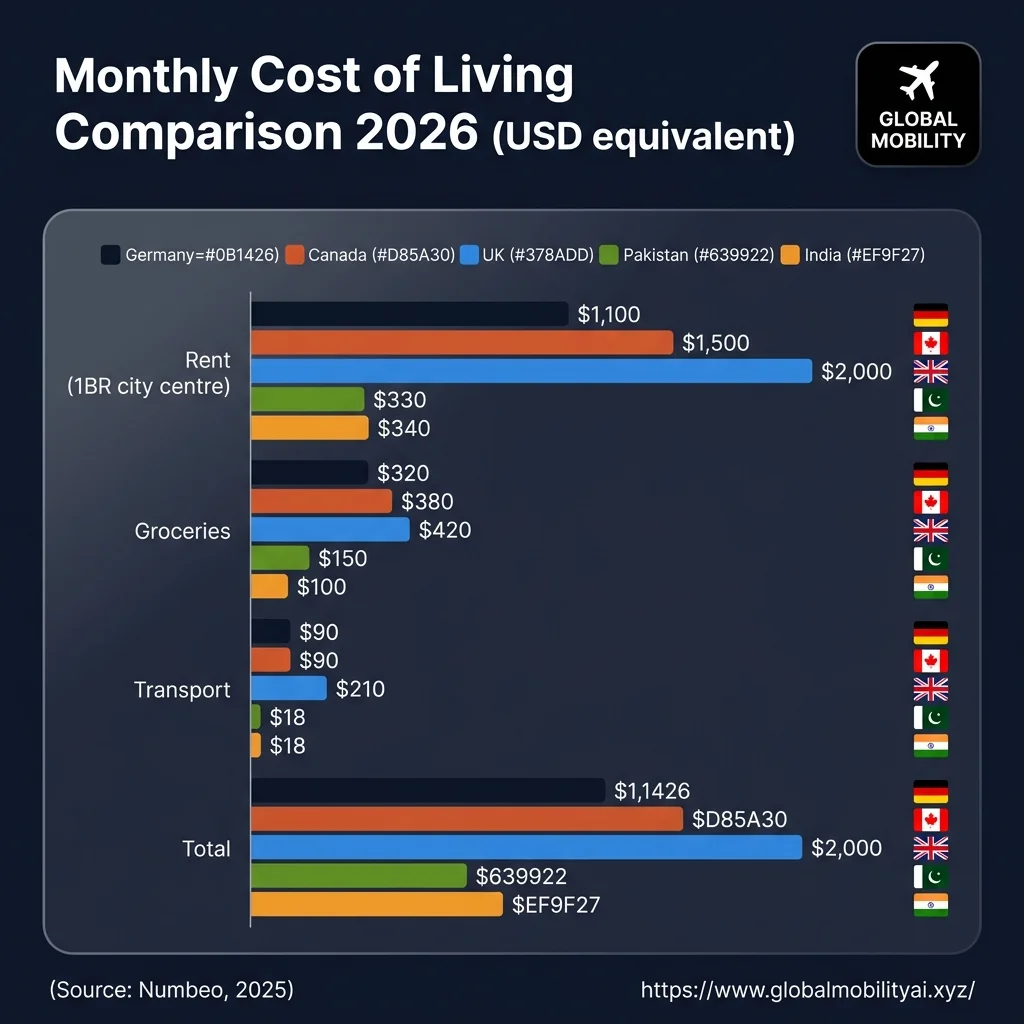
IMG-05: Monthly Cost of Living Comparison 2026
5. Salary Data & Job Market Intelligence {#section-5}
5.1 Average Salaries by Industry — 2026 Data
Germany (Source: Bundesagentur für Arbeit / StepStone.de, 2024):
| Industry | Entry Level | Mid-Level | Senior | Currency |
|---|---|---|---|---|
| Software Engineering | €42,000 | €62,000 | €85,000 | EUR/year |
| Mechanical Engineering | €38,000 | €55,000 | €74,000 | EUR/year |
| Nursing / Healthcare | €34,000 | €46,000 | €58,000 | EUR/year |
| Finance / Banking | €40,000 | €60,000 | €82,000 | EUR/year |
| Logistics / Supply Chain | €32,000 | €45,000 | €62,000 | EUR/year |
(Source: StepStone.de Gehaltsreport 2024, Bundesagentur für Arbeit 2024) (https://www.stepstone.de/gehaltsreport) (https://statistik.arbeitsagentur.de)
Canada (Source: Statistics Canada, Job Bank Canada, 2024):
| Industry | Entry Level | Mid-Level | Senior | Currency |
|---|---|---|---|---|
| Software Development | CAD $68,000 | CAD $98,000 | CAD $135,000 | CAD/year |
| Civil / Structural Eng. | CAD $58,000 | CAD $82,000 | CAD $110,000 | CAD/year |
| Registered Nursing | CAD $65,000 | CAD $85,000 | CAD $105,000 | CAD/year |
| Financial Analysis | CAD $62,000 | CAD $88,000 | CAD $118,000 | CAD/year |
| Skilled Trades | CAD $52,000 | CAD $72,000 | CAD $95,000 | CAD/year |
(Source: Job Bank Canada 2024, Statistics Canada 2024) (https://www.jobbank.gc.ca/wagereport) (https://www.statcan.gc.ca)
UK (Source: ONS Annual Survey of Hours and Earnings, Reed.co.uk, 2024):
| Industry | Entry Level | Mid-Level | Senior | Currency |
|---|---|---|---|---|
| IT / Software | £32,000 | £58,000 | £85,000 | GBP/year |
| Civil Engineering | £30,000 | £52,000 | £72,000 | GBP/year |
| NHS Nursing (Band 5–7) | £28,407 | £40,588 | £54,619 | GBP/year |
| Financial Services | £35,000 | £65,000 | £95,000 | GBP/year |
| Supply Chain / Logistics | £26,000 | £42,000 | £58,000 | GBP/year |
(Source: ONS ASHE 2024, Reed.co.uk Salary Checker 2024) (https://www.ons.gov.uk/surveys/informationforhouseholdsandindividuals/householdandindividualsurveys/annualsurveyofhoursandearnings)
5.2 In-Demand Skills & Sectors in 2026
Germany's Federal Employment Agency identifies the following shortage occupations for 2026: geriatric nursing (Altenpflege), IT systems integration, mechatronics engineering, and electrical trade qualifications. (Source: Bundesagentur für Arbeit Engpassanalyse, 2024) Canada's Express Entry system prioritizes NOC TEER categories 0–2 across healthcare, STEM, and construction. The UK's Immigration Salary List (formerly Shortage Occupation List) includes civil engineers, software developers, nurses, and secondary school teachers as of 2024 revisions. (Source: UK Home Office, 2024)
5.3 How to Use the GlobalMobilityAI Salary Comparison Tool
The GlobalMobilityAI salary comparison tool at GlobalMobilityAI.xyz allows users to input their current occupation, experience level, and target country to generate a side-by-side salary benchmark against official national wage data. The tool cross-references salary thresholds from official labor statistics bodies — Bundesagentur, Statistics Canada, ONS — to confirm whether a user's target salary clears the minimum visa eligibility bar and projects net monthly savings after standard living costs for the chosen city.
6. CV Formatting — How Your Resume Affects Your Immigration Score
6.1 Country CV Format Requirements
Immigration probability is affected by how well a CV communicates eligibility signals to both automated screening systems (ATS) and human reviewers at employer and visa authority level. Format requirements differ significantly by destination.
Germany (Lebenslauf):
Canada:
UK:
6.2 Common CV Mistakes That Get Immigration Applications Rejected
Immigration-related job applications are subject to additional scrutiny because the employer understands they are also sponsoring a work authorization process. The following errors are disproportionately common among international applicants and carry severe consequences:
6.3 ATS Optimization for Target Country Job Portals
Germany dominant job portals: StepStone.de, Indeed.de, XING, LinkedIn DE, Make-it-in-Germany job board. German ATS systems — particularly SAP SuccessFactors and Taleo deployments — parse PDFs but lose formatting from complex tables. Submit CVs as single-column PDFs, not multi-column Word documents.
ATS keyword strategy for Germany: Mirror exact job title terminology from the vacancy announcement. German engineering roles distinguish between "Ingenieur" and "Techniker" — use the precise term in the same language as the job post. Include DIN certification numbers, specific software (SAP, CATIA, SolidWorks) as standalone keywords in a dedicated skills section.
Canada dominant portals: Job Bank Canada (government), Indeed.ca, LinkedIn, Workopolis. Canadian ATS systems favor keyword-dense professional summaries. Include NOC code occupation title exactly as listed on the Job Bank Canada page for your occupation. Include province name in location field — Canadian employers filter by province due to employment standards differences.
UK dominant portals: Reed.co.uk, Totaljobs, Jobsite, LinkedIn UK. UK ATS systems value UCAS points equivalency citations for international qualifications. Include "UK equivalent" notes next to foreign degrees.
7. Interview Tips for Immigration-System Job Markets
7.1 Cultural Interview Norms & Expectations
Germany: Interviews are formal, structured, and documentation-heavy. Interviewers expect precise answers with technical depth. Behavioral questions follow STAR format but Germans prefer concrete technical outcomes over narrative storytelling. Hierarchical titles matter — address interviewers as "Herr/Frau [Surname]" unless invited to use first names. Punctuality is non-negotiable; arriving 5 minutes early is on time.
Canada: Competency-based behavioral interviews dominate. Questions follow STAR framework rigorously. Diversity and inclusion awareness is expected — applicants who demonstrate cross-cultural experience score well. Informality is acceptable after initial pleasantries; first names are used from the second exchange.
UK: Mix of competency-based and technical questions. Formality is moderate — professional but not rigid. British interviewers value measured, self-aware responses. Overly assertive self-promotion reads as arrogance.
7.2 Common Interview Questions & Answer Frameworks
Q: "Tell me about a time you solved a difficult technical problem under time pressure."
Framework: STAR — Situation (project context), Task (specific challenge), Action (steps you personally took), Result (measurable outcome). Target: 2–3 minutes response, one specific metric result.
Q: "Why do you want to work in [Country]?"
Framework: Research-validate-connect. Cite a specific economic or industry development in that country, connect it to your career trajectory, and express a concrete contribution you intend to make. Avoid generic "better opportunities" framing.
Q: "How would you handle a disagreement with a senior colleague?"
Framework: Demonstrate structured communication, not conflict avoidance. Describe a real situation, your approach to raising the disagreement professionally, and the resolution. German interviewers reward directness; Canadian and UK interviewers reward collaborative framing.
Q: "What salary are you expecting?"
Framework: Always research before the interview. Reference official salary data — "Based on ONS data for this role at this level in this city, the median is £X — I'm targeting £Y, which reflects my X years of specialised experience."
7.3 Dress Code, Punctuality & Professional Etiquette
Germany: Formal business attire for first round regardless of company culture. Conservative colors — navy, charcoal, grey. Bring printed copies of all documents referenced in your CV — Germans may ask to review originals on the spot. Firm handshake on entry and exit.
Canada: Business professional for corporate roles; business casual for tech and startup environments. Virtual interviews (now predominant) — ensure clean background, stable internet, professional appearance from the waist up at minimum.
UK: Business professional for finance, law, and consulting. Smart casual acceptable for tech. Punctuality is expected — being on time is considered late; be 5 minutes early.
7.4 Post-Interview Follow-Up Etiquette
Germany: Follow-up email within 24 hours — formal, concise, addressed to the hiring manager by surname. Reference one specific point from the interview to demonstrate engagement. Germans view excessive follow-up as intrusive — one follow-up after the stated decision timeline is acceptable.
Canada: Thank-you email within 24 hours is strongly expected. Personalize with specific discussion points. If no response within stated timeline, one polite follow-up email is appropriate after 5 business days.
UK: Thank-you note appreciated but less expected than in North America. One follow-up after the stated decision timeline is appropriate.
8. 2026 Policy Updates & Immigration Trend Predictions
8.1 Key Policy Changes Effective 2026
Canada:
IRCC introduced Category-Based Selection draws under Express Entry effective 2023, continuing into 2026. These draws specifically invite candidates in six occupational categories: healthcare, STEM, trades, transport, agriculture, and French-language proficiency. (Source: IRCC, 2024) Applications under the 2024–2026 Immigration Levels Plan target 500,000 admissions per year — the highest in Canadian history.
Post-graduation work permit (PGWP) rules updated in 2024 restrict eligibility to graduates of programs directly linked to labor shortage occupations, effective for applications submitted after November 2024. (Source: IRCC, 2024)
Germany:
The Skilled Immigration Act (Fachkräfteeinwanderungsgesetz) third phase came into effect in March 2024, enabling the Opportunity Card (Chancenkarte) job-seeker visa. As of 2026, the card allows 12-month residency for qualified applicants scoring 6+ points without a prior job offer. (Source: Federal Ministry of the Interior, 2024) Recognition of foreign qualifications through the ANKOM program has been expanded; applicants can now receive partial recognition and begin working in regulated professions under supervision while completing full recognition requirements.
UK:
The Immigration Salary Threshold for Skilled Worker Visa increased from £26,200 to £38,700 for new applicants effective April 2024. (Source: UK Home Office, 2024) This represents a 47.7% salary threshold increase. Shortage occupation salary discounts were abolished — all jobs now require the full going rate. The Graduate visa (post-study work) remains at 2 years (3 for PhD graduates) but is under review as of Q1 2026 — monitor UK Home Office immigration rules.
8.2 Immigration Trend Predictions (Data-Backed)
OECD's International Migration Outlook 2024 projects that OECD-area permanent migration will remain above 6 million per year through 2026, with skilled worker pathways constituting the fastest-growing category. (Source: OECD, 2024) Processing time trends from official government data show:
The OECD also notes that countries are increasingly using digitized scoring systems — closely mirroring what a well-built immigration probability calculator replicates — to automate first-stage eligibility assessments. This trend is expected to accelerate through 2026–2028, making pre-application probability modeling an increasingly accurate predictor of outcomes.
8.3 How These Changes Affect Your Application in 2026
For applicants from Pakistan, India, and MENA countries, these policy changes create three distinct strategic imperatives:
First, the UK's 47.7% salary threshold increase means that applicants who previously qualified on salary alone may now fall below the £38,700 threshold. These applicants should run an updated assessment through the GlobalMobilityAI immigration probability calculator to confirm current eligibility before committing application fees.
Second, Canada's category-based draws mean that a high CRS score alone is no longer sufficient — occupation classification matters. Applicants must verify their NOC TEER code maps to an actively invited category. An incorrect NOC classification reduces probability to near zero in category draws regardless of CRS score.
Third, Germany's expanded partial recognition pathway creates a new high-probability route for skilled tradespeople and healthcare workers who previously could not complete full recognition before arrival. Applicants in these fields should reassess their German pathway probability using updated 2026 criteria — the parameters have shifted in their favor.
9. Tactical Comparison Matrix — Visa Probability by Category
| Visa Type | Eligibility | Min. Salary | Processing Time | Difficulty | Est. Approval Rate* | Gov. Fee |
|---|---|---|---|---|---|---|
| Canada Express Entry (FSW) | CRS 491+ | CAD $53,000+ | 6 months | Medium | Platform Est.* | CAD $1,525 |
| Germany EU Blue Card | Recognized degree + job offer | €45,300 | 8–12 weeks | Medium | Platform Est.* | €75 |
| Germany Chancenkarte | 6 points (no job offer required) | N/A | 4–12 weeks | Low–Medium | Platform Est.* | €75 |
| UK Skilled Worker Visa | 70 points + CoS | £38,700 | 5 days–8 weeks | Medium | Platform Est.* | £719+ |
| Australia Skilled Independent (189) | 65 points SkillSelect | AUD $70,000+ | 6–12 months | Medium–High | Platform Est.* | AUD $4,640 |
| UAE Green Visa | Self-sponsored, qualified | AED 10,000/mo | 2–5 weeks | Low | Platform Est.* | AED 3,000 |
Internal platform estimate. Official approval rates are not publicly published by immigration authorities in standardized form. For official data, monitor: IRCC Open Data | UK Home Office Statistics | BAMF Statistics
(Source: IRCC 2024, Make it in Germany 2024, UK Home Office 2024, Department of Home Affairs Australia 2024, UAE GDRFA 2024)
10. Execution Roadmap: Phase-by-Phase Application Strategy
Phase 1 — Preparation (Months 1–2)
The preparation phase is where immigration probability calculators deliver maximum value — before any money has been spent.
Step 1: Run your probability score. Use the GlobalMobilityAI immigration probability calculator to assess your profile across target destinations. This surfaces your highest-probability pathways immediately.
Step 2: Language testing.
Step 3: Credential Assessment.
Cost estimate Phase 1: USD $400–$800 depending on language exam and credential evaluation requirements.
Phase 2 — Application (Months 3–4)
Canada Express Entry:
Germany Chancenkarte:
UK Skilled Worker Visa:
Phase 3 — Arrival & Administration (Months 5–6)
Canada:
Germany:
UK:
Phase 4 — Settlement & Permanent Residency (Month 12+)
Canada: PR holders may apply for citizenship after 3 years of physical presence (1,095 days in 5 years). Language and knowledge test required. Official settlement services: IRCC newcomer services | Free.
Germany: Permanent residency (Niederlassungserlaubnis) available after 4 years with EU Blue Card, 5 years general. German B1 language level required for general PR; A1 minimum for EU Blue Card PR. (Source: BAMF, 2024) German citizenship available after 5 years (reduced from 8) under 2024 reforms.
UK: Indefinite Leave to Remain (ILR) after 5 years continuous lawful residence. Life in the UK test + English language requirement. (Source: UK Home Office, 2024) British citizenship application: 12 months after ILR.
UAE: 10-year Golden Visa renewable. No permanent residency pathway in UAE standard immigration framework. Residency tied to financial or professional qualification renewal.
11. Critical Risk Factors & Common Pitfalls
Risk 1: Incorrect NOC/SOC/ISCO code classification (Canada/UK)
What it is: Applying under the wrong occupational classification code for your actual job duties. Why it happens: Applicants self-select codes based on job title rather than actual duties as defined in the NOC/SOC matrix. Exact consequence: In Canada, misclassification at PR application stage results in refusal and a permanent record of misrepresentation if deliberate — a 5-year ban from all Canadian immigration applications under IRPA Section 40. How to avoid: Cross-reference your actual job duties against the NOC lead statement on the Job Bank Canada NOC finder. If in doubt, consult a regulated RCIC (Regulated Canadian Immigration Consultant).
Risk 2: Salary threshold breach post-offer (UK)
What it is: The employer makes a job offer below the current going rate for the occupation under the UK Skilled Worker route. Why it happens: The going rate was updated in April 2024 and many HR departments have not updated offer templates accordingly. Exact consequence: Certificate of Sponsorship (CoS) is invalid — visa application refused, visa application fee non-refundable. How to avoid: Cross-reference offer salary against the UK Home Office Skilled Worker going rate table before CoS is assigned.
Risk 3: ECA mismatch with claimed qualification level (Canada)
What it is: WES or equivalent assesses a foreign degree at a lower Canadian equivalent than claimed on the Express Entry profile. Why it happens: Many South Asian and Middle Eastern institutions produce Bachelor's degrees in 2 years; WES evaluates these as diplomas, not Bachelor's equivalents. Exact consequence: CRS score is recalculated at lower level — potentially dropping below ITA threshold, triggering profile suspension. How to avoid: Complete ECA before submitting the Express Entry profile. Never estimate educational equivalency.
Risk 4: Expired biometrics re-submission requirement
What it is: Biometric enrolment is valid 10 years for most nationalities. If previously enrolled, applicants assume exemption from re-enrolment. Why it happens: IRCC's online checklist generates biometric instruction letters inconsistently when previous biometrics exist. Exact consequence: Application put on hold pending biometric compliance — adds 4–8 weeks to processing. How to avoid: Confirm biometric status on the IRCC portal at the profile creation stage. (Source: IRCC, 2024)
Risk 5: Language score expiry mid-application
What it is: IELTS and CELPIP scores are valid for 2 years. Applications submitted near expiry may still be in processing when scores expire. Why it happens: Applicants test early in the preparation process and submit applications 18+ months later. Exact consequence: Application is refused if scores expire before a decision is issued. How to avoid: Schedule language tests no earlier than 18 months before anticipated application submission, accounting for processing timelines.
Risk 6: Chancenkarte blocked account shortfall
What it is: Germany's Chancenkarte requires proof of financial self-sufficiency — €1,027/month minimum per person (2024 rate) in a blocked account. Why it happens: Applicants open blocked accounts with the exact minimum, which may have changed by application date. Exact consequence: Visa refused; refund of blocked account funds takes 4–6 weeks, delaying re-application. How to avoid: Open blocked account with a 10% buffer above the stated minimum. Verify current requirement at Make it in Germany before opening.
Risk 7: Police clearance certificate from wrong period
What it is: Most immigration pathways require clearance certificates for every country lived in for 6+ months. Applicants frequently omit countries of temporary residence (Gulf states, for example). Why it happens: Applicants interpret "home country" as the only required certificate. Exact consequence: Application returned as incomplete — processing restarted, fees not refunded in some jurisdictions. How to avoid: List every country of residence (6+ months) in chronological order. Obtain PCC from each. For UAE, this requires the local police e-services portal.
Risk 8: Self-employment income not recognized as qualifying employment
What it is: Canada and Germany require employed work experience (not self-employment) for most skilled worker pathways. Freelance or consultancy income does not automatically qualify. Why it happens: Applicants in gig economy roles or freelance careers assume all income-generating experience counts. Exact consequence: Claimed work experience disqualified — CRS points reduced, profile suspended, or visa refused. How to avoid: Verify whether your employment history qualifies under the specific pathway. For Canada, refer to the IRCC work experience requirements. Germany's Chancenkarte does accept some self-employment history — confirm at the German embassy in your country.
12. FAQ — People Also Ask
Q: How does an immigration probability calculator determine my visa approval chances?
An immigration probability calculator maps your personal profile — education level, work experience, language test scores, age, job offer status, and financial standing — against the published eligibility matrices of your target destination country. For Canada, this means the Comprehensive Ranking System (CRS). For Germany, the Chancenkarte scoring criteria. For the UK, the Skilled Worker points table. The calculator computes where your profile sits relative to published thresholds and recent draw data to generate a probability estimate. It does not guarantee an outcome but provides a data-modeled prediction based on official, publicly available criteria. (Source: IRCC Express Entry CRS, 2024)
Q: How accurate are immigration probability calculators?
Accuracy depends entirely on the data inputs and the underlying scoring model. A calculator built on official government matrices and current draw history is significantly more accurate than a generic quiz. For Canada Express Entry, published CRS score minimums from the last 24 months of draws provide a reliable predictive baseline — if your CRS score exceeds the lowest draw threshold in your target category, your probability of invitation is high. However, no tool can guarantee outcomes because processing officers apply discretion, application completeness affects outcomes, and policy can change between application and decision. A well-built calculator should be treated as a high-confidence probability estimate, not a guarantee. (Source: IRCC Express Entry draw history, 2024)
Q: Can I use an immigration probability calculator to compare multiple countries at once?
The GlobalMobilityAI platform at GlobalMobilityAI.xyz is designed specifically for multi-country comparison. Rather than assessing one country in isolation, the tool evaluates your profile simultaneously against the eligibility criteria of multiple destination countries — Canada, Germany, UK, Australia, UAE, and others — and ranks your probability across all pathways. This allows applicants to identify the highest-probability destination for their specific profile rather than defaulting to the most well-known option. The approach is particularly valuable for applicants with profiles that score moderately across several countries but very strongly in one specific pathway.
Q: What documents increase my immigration probability score?
Documentation quality directly correlates with probability in two ways: first, it affects your eligibility score (language certificates, ECA, credential recognition all contribute points); second, it affects application completeness, which statistically correlates with approval rates. Documents that carry the highest weight include: a current IELTS or CELPIP certificate scoring CLB 9+ (Canada), Goethe B2 or C1 (Germany), a WES or ICAS educational credential assessment showing Canadian equivalency at Bachelor's or higher, employment reference letters on employer letterhead with salary and duties confirmation, and police clearance certificates from all countries of residence. Incomplete or absent documents in these categories are the single most common cause of preventable refusal. (Source: IRCC, 2024)
Q: What is the minimum CRS score needed for Canada Express Entry in 2026?
The minimum CRS score for an invitation to apply under the Federal Skilled Worker and Canadian Experience Class streams in 2024 ranged from 491 to 534 in general category draws. Category-based selection draws (healthcare, STEM, trades, French) have issued invitations at significantly lower CRS scores — sometimes as low as 354 for French language proficiency draws. (Source: IRCC Express Entry Round History, 2024) Provincial Nominee Program (PNP) candidates receive an additional 600 CRS points upon nomination, making provincial nomination the most reliable path for applicants below the general draw threshold. Monitor the IRCC draw history page for current draw thresholds.
Q: Is it possible to improve my immigration probability score before applying?
Every major immigration probability variable is improvable with time and targeted effort. Language scores are the highest-leverage lever: a CELPIP score improvement from CLB 8 to CLB 9 adds 15–20 CRS points in Canada's Express Entry system. (Source: IRCC, 2024) A second language (French proficiency) adds up to 50 additional CRS points under Bilingual proficiency allocations. Additional Canadian or provincial work experience adds CRS points under the "Canadian work experience" factor. Applying through a targeted Provincial Nominee Program rather than the federal pool can add 600 CRS points instantly upon nomination. Platform search trends on GlobalMobilityAI.xyz indicate that applicants who complete a probability assessment 12–18 months before their target application date and then follow an improvement plan significantly increase their probability scores by submission.
Q: How long does it take to get a work visa in Germany in 2026?
Germany's Federal Foreign Office reports that skilled worker visa processing times range from 4 to 12 weeks depending on the German embassy in the applicant's home country and the volume of applications. (Source: German Federal Foreign Office, 2024) German embassies in Pakistan and India report appointment wait times of 6–14 weeks in addition to processing time. Applicants should budget 3–6 months from initial document preparation to visa issuance. The Chancenkarte (job seeker card) follows the same processing timeline. Once in Germany, the Bürgeramt registration and tax ID issuance adds 4–6 weeks of administrative setup. (Source: Make it in Germany, 2024)
Q: What salary do I need to qualify for a UK Skilled Worker Visa in 2026?
As of April 2024, the UK Skilled Worker Visa general salary threshold is £38,700 per year, which is the higher of the going rate for the specific occupation or the general threshold. (Source: UK Home Office, 2024) Some roles on the Immigration Salary List (shortage occupations) have a lower threshold of 90% of the going rate. New entrants to certain professions can also qualify at 70% of the going rate, subject to the £30,960 minimum. The Healthcare and Education visa routes have separate salary scales aligned to NHS and national teacher pay grades. Applicants should verify the specific going rate for their occupation code using the UK Home Office eligible occupations table before accepting a job offer.
13. Conclusion: The Bottom Line
If you are a skilled professional in 2026 evaluating an international move, the decision to apply without first running your profile through an immigration probability calculator is the most expensive mistake you can make — not because the tool is costly, but because the alternative (trial-and-error applications at $1,500–$5,000 per attempt) extracts a financial and psychological toll that delays your timeline by years.
The data is unambiguous: Canada is accepting 500,000 permanent residents per year. Germany launched the Opportunity Card specifically to attract qualified applicants without prior job offers. The UK has removed its annual cap on Skilled Worker Visas. The pathways exist. The gap between applicants who succeed and those who fail is not eligibility — it is preparation.
The single most important strategic action for any internationally mobile professional in 2026 is to run a probability assessment against the official eligibility criteria for every realistic destination before spending money on applications. Use the GlobalMobilityAI immigration probability calculator to receive your cross-country probability score, then use the salary comparison tool to model your net savings trajectory in your highest-probability destination, and the cost of living calculator to plan your financial landing.
For additional ROI context, comparable analysis across investment visa pathways is available in our UAE Golden Visa analysis — a useful benchmark for professionals weighing Gulf alternatives against Western immigration routes.
Data is the one variable in your immigration journey that costs nothing to access. Use it before the visa officer does.
Predict your mobility score.
Use our AI engine to get your personalized visa pathway, salary prediction, and relocation roadmap.
More Insights

Which Country Has Highest Visa Approval Rate for Pakistan 2026

Ireland Critical Skills Employment Permit 2026: Eligible Roles, Salary Floors & PR Timeline