
Editorial Transparency: Content compiled from official government sources by the GlobalMobilityAI Research Team. For personalized legal or immigration advice, consult a licensed immigration consultant or lawyer.
(Last Updated: 2026-05-12)
According to the OECD's 2025 International Migration Outlook, skilled professionals relocating from high-cost origin countries to destination economies with structured immigration frameworks report median net savings rates between 18% and 34% of gross income — significantly above what the same profiles achieve in their home markets. (Source: OECD, 2025) [https://www.oecd.org/migration/international-migration-outlook-1999124x.htm]
If you have searched for a monthly savings calculator abroad in 2026, you already understand the core question: after rent, taxes, groceries, transport, and healthcare, what number actually lands in your bank account every month? That question, seemingly simple, carries enormous weight — it determines whether a visa application is financially viable, whether a relocation builds long-term wealth, or whether it merely trades one set of financial pressures for another.
This guide, compiled by the GlobalMobilityAI Research Team using verified government and international data sources, gives you the analytical framework, the country-by-country breakdowns, and the tool intelligence to answer that question with precision. By the end, you will know exactly how to project your monthly surplus abroad and which destinations offer the strongest savings trajectories for your professional profile in 2026.
Table of Contents
1. Why Savings Potential Varies So Dramatically by Country in 2026
1.1 Economic Landscape & Opportunity
The gap between gross salary and net monthly savings is not linear — it is shaped by five compounding variables: marginal tax rate, mandatory social contributions, average rental cost, purchasing power index, and healthcare liability. These five variables produce radically different outcomes from the same professional profile depending on destination country.
Germany's average effective tax rate for a mid-level professional earning €60,000 annually sits at approximately 33.7% inclusive of solidarity surcharge and social insurance, according to Germany's Federal Ministry of Finance. (Source: Bundesministerium der Finanzen, 2025) [https://www.bundesfinanzministerium.de/Web/EN/Home/home.html]
Canada's comparable income bracket attracts federal and provincial tax rates ranging from 29% to 43.7% combined depending on province, per the Canada Revenue Agency. (Source: Canada Revenue Agency, 2025) [https://www.canada.ca/en/revenue-agency/services/tax/individuals/frequently-asked-questions-individuals/canadian-income-tax-rates-individuals-current-previous-years.html]
The UAE, by contrast, levies zero personal income tax. A professional earning AED 18,000 per month retains AED 18,000 gross — minus voluntary contributions and cost of living expenses — creating one of the world's highest raw savings ratios for qualifying professionals. (Source: UAE Federal Tax Authority, 2025) [https://tax.gov.ae/en/default.aspx]
The Netherlands operates a "30% ruling" for qualifying internationally recruited employees, reducing the effective tax base substantially for the first five years of residency. (Source: Belastingdienst, 2025) [https://www.belastingdienst.nl/wps/wcm/connect/en/individuals/content/coming-to-work-in-the-netherlands-30-percent-facility]
This heterogeneity is precisely why a monthly savings calculator abroad produces meaningfully different outputs for the same input salary — and why country selection is a financial decision as much as a career decision.
Labor market demand shapes the equation further. Germany faces a structural shortage of approximately 320,000 skilled workers across engineering, healthcare, and IT as of 2025. (Source: Institut für Arbeitsmarkt- und Berufsforschung, 2025) [https://www.iab.de/] Canada's Express Entry draws are targeting specific NOC categories with elevated point allocations. The Netherlands' knowledge migrant pathway is processing applications at record volumes. These are not abstract trends — they directly affect salary negotiation power, which is the numerator in any savings calculation.
1.2 Why Professionals Are Targeting These Destinations
Platform search trends on GlobalMobilityAI.xyz indicate sustained interest from South Asian and African professional profiles in four primary destination clusters: Germany, Canada, UAE, and Netherlands. The pattern reflects a convergence of visa accessibility, salary-to-cost ratios, and settlement pathways — not single-variable decisions.
The analysis mirrors findings in our Germany Opportunity Card 2026 definitive guide, where professionals in STEM and healthcare fields consistently demonstrated the strongest ROI on relocation costs within 18–24 months of arrival.
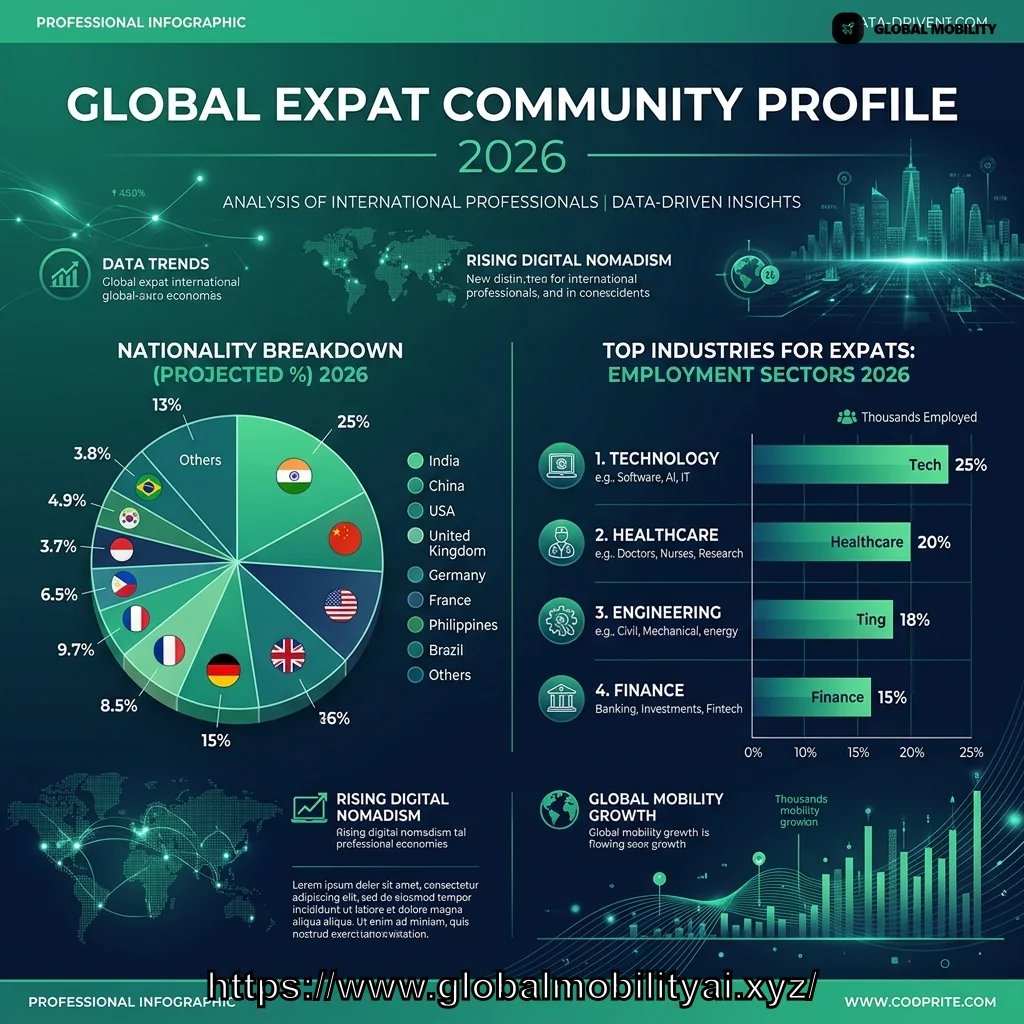
IMG-02: Expat Community Profile
The critical insight for 2026 is that destination selection is now data-drivable. Official salary databases, government-published cost-of-living surveys, and tax authority calculators provide enough precision for a professional to model their own savings trajectory before committing to a visa application — provided they use the right inputs.
2. Deep-Dive Analysis: Legal & Financial Framework for Expat Savings
2.1 Legal Requirements & Visa Categories That Determine Financial Entry Points
Every destination country structures its skilled worker visa around a minimum salary threshold. That threshold is not arbitrary — it is calibrated to ensure the incoming professional's income exceeds a defined self-sufficiency level. Understanding these thresholds is the first layer of any monthly savings calculator abroad input.
Germany — Skilled Worker Visa (Fachkräfte Einwanderungsgesetz)
Minimum salary threshold for qualified professionals: €43,992 per year (2026 figure, updated annually). (Source: Make it in Germany / Federal Employment Agency, 2026) [https://www.make-it-in-germany.com/en/visa-residence/types/skilled-workers]
Opportunity Card holders must demonstrate €12,648 in blocked account funds. (Source: Auswärtiges Amt, 2026) [https://www.auswaertiges-amt.de/en]
Canada — Express Entry (Federal Skilled Worker Program)
No fixed minimum salary threshold; however, NOC TEER 0/1/2/3 eligibility and Comprehensive Ranking System (CRS) scores determine draw eligibility. Provincial Nominee Programs may impose provincial salary minimums ranging from CAD $25,000 to CAD $55,000 depending on stream. (Source: IRCC, 2026) [https://www.canada.ca/en/immigration-refugees-citizenship/services/immigrate-canada/express-entry.html]
UAE — Employment Visa
No minimum salary legislation for private sector foreign workers under Federal Decree Law No. 33 of 2021 on the Regulation of Labour Relations. Practically, Golden Visa (10-year) requires AED 30,000/month income or AED 2 million in assets. (Source: UAE Ministry of Human Resources, 2025) [https://www.mohre.gov.ae/en/home.aspx]
Netherlands — Highly Skilled Migrant (Kennismigrant)
Minimum gross monthly salary for applicants aged 30 and above: €5,688 (2026 threshold). For applicants under 30: €4,171. (Source: IND Netherlands, 2026) [https://ind.nl/en/residence-permits/work/highly-skilled-migrant]
Australia — Temporary Skill Shortage (TSS) Visa / Subclass 482
Minimum salary requirement: AUD $73,150 per year (TSMIT — Temporary Skilled Migration Income Threshold, effective July 2024). (Source: Australian Department of Home Affairs, 2025) [https://immi.homeaffairs.gov.au/visas/getting-a-visa/visa-listing/temporary-skill-shortage-482]
2.2 Eligibility Criteria & Qualification Scoring
Each pathway uses a different scoring or eligibility mechanism that directly correlates with income level achieved — and therefore savings potential.
Germany CRS Equivalent (Points System under New Law)
Under the 2024 Skilled Immigration Act, Germany does not use a points system for direct skilled worker visas. Eligibility is determined by: recognized qualification, job offer, minimum salary threshold compliance, and professional registration (for regulated professions). The Opportunity Card uses a points model awarding points for: qualification level (up to 4), salary (up to 3), language skills (up to 3), age (up to 1), Germany reference (up to 1). Minimum: 6 points required. (Source: Auswärtiges Amt, 2025) [https://www.auswaertiges-amt.de/en]
Canada CRS Score
Comprehensive Ranking System scores range 0–1,200. Scores for the Federal Skilled Worker pool have been trending between 480–530 in 2025 draws. Human Capital Factors (age, education, language) contribute up to 600 points. (Source: IRCC, 2025) [https://www.canada.ca/en/immigration-refugees-citizenship/services/immigrate-canada/express-entry/eligibility/criteria-comprehensive-ranking-system/grid.html]
Netherlands Kennismigrant
Binary eligibility: salary above or below the minimum threshold. No points calculation. Application through the IND portal via a recognized sponsor employer. (Source: IND Netherlands, 2026) [https://ind.nl/en/residence-permits/work/highly-skilled-migrant]
2.3 Required Documentation & Official Checklists
The following documentation is standard across all four primary destination countries for skills-based visa applications. Verify country-specific additions at each official portal.
Official document checklists:
3. City Guide — Where to Live to Maximize Savings Abroad in 2026
3.1 Top 5 Cities for Expats: Rankings & Savings Analysis
Destination country selection is only half the equation. Using a monthly savings calculator abroad reveals that city-level cost variance within the same country can alter net monthly savings by €300–€700 per month for identical salary levels — a difference that compounds significantly over a multi-year stay.
1. Dubai (UAE) — Maximum Gross Retention
Zero income tax means every dirham of salary is potentially saveable minus living costs. A mid-level professional earning AED 18,000/month in Dubai faces approximate living costs of AED 7,500–9,500, yielding a monthly surplus of AED 8,500–10,500 (approximately USD $2,315–$2,860). Safety index: 84.3/100. (Source: Numbeo, 2025) [https://www.numbeo.com/cost-of-living/in/Dubai]

IMG-03: Dubai UAE Expat Savings
2. Leipzig (Germany) — Lowest Cost, Viable Salaries
Average 1BR apartment in city centre: €650–€780/month. Monthly total living cost: €1,200–€1,500. Software engineer mid-level salary: €52,000–€62,000 gross. Net monthly savings after expenses: €800–€1,100. Safety index: 71.4/100. (Source: Numbeo, 2025) [https://www.numbeo.com/cost-of-living/in/Leipzig]

IMG-04: Leipzig Germany Expat Savings
3. Montreal (Canada) — Bilingual Hub, Lower Quebec Rents
Average 1BR city centre: CAD $1,650–$1,900/month. Monthly living costs: CAD $2,400–$2,900. Mid-level tech salary: CAD $75,000–$90,000. Net monthly savings: CAD $1,200–$1,800. Safety index: 61.2/100. (Source: Numbeo, 2025) [https://www.numbeo.com/cost-of-living/in/Montreal]
4. Eindhoven (Netherlands) — Tech Hub, Lower Rents Than Amsterdam
Average 1BR city centre: €1,100–€1,350/month. Monthly costs: €1,800–€2,100. Kennismigrant salary typical: €5,800–€7,200 gross. Net after tax (30% ruling): approximately €4,000–€5,000. Monthly savings: €1,900–€2,900. Safety index: 76.8/100. (Source: Numbeo, 2025) [https://www.numbeo.com/cost-of-living/in/Eindhoven]

IMG-08: Eindhoven Netherlands Knowledge Migrant Savings
5. Berlin (Germany) — Tech Salaries, Growing Startup Ecosystem
Average 1BR city centre: €1,300–€1,600/month. Monthly costs: €2,100–€2,600. Software engineer senior salary: €70,000–€90,000 gross. Monthly savings after tax and expenses: €900–€1,400. Safety index: 62.5/100. (Source: Numbeo, 2025) [https://www.numbeo.com/cost-of-living/in/Berlin]
3.2 City Comparison Table
| City | Avg Rent 1BR | Monthly Cost | Job Market | Safety Index | Expat Rating |
|---|---|---|---|---|---|
| Dubai, UAE | AED 4,500–5,500 (~USD $1,225–$1,497) | AED 7,500–9,500 | High (Finance, Tech, Healthcare) | 84.3/100 | 4.7/5 |
| Leipzig, Germany | €650–€780 | €1,200–€1,500 | Moderate (Engineering, Logistics) | 71.4/100 | 4.2/5 |
| Montreal, Canada | CAD $1,650–$1,900 | CAD $2,400–$2,900 | High (Tech, AI, Bilingual Services) | 61.2/100 | 4.3/5 |
| Eindhoven, Netherlands | €1,100–€1,350 | €1,800–€2,100 | High (Tech, Design, Manufacturing) | 76.8/100 | 4.4/5 |
| Berlin, Germany | €1,300–€1,600 | €2,100–€2,600 | Very High (Startups, Tech, Media) | 62.5/100 | 4.5/5 |
(Source: Numbeo, 2025) [https://www.numbeo.com/cost-of-living/]
4. Cost of Living — Complete 2026 Breakdown
4.1 Monthly Budget Calculator Breakdown
The figures below represent realistic monthly expenditure ranges for a single professional in the four primary savings destinations. All figures are sourced from Numbeo's 2025 city-level datasets. (Source: Numbeo, 2025) [https://www.numbeo.com/cost-of-living/]
Germany (Frankfurt — representative mid-tier city)
| Category | Monthly Cost (EUR) | USD Equivalent |
|---|---|---|
| Rent (1BR, city centre) | €1,100–€1,400 | $1,195–$1,520 |
| Groceries | €200–€280 | $217–$304 |
| Transport (monthly pass) | €86 | $93 |
| Health insurance (public, ~14.6%) | Deducted from payroll | — |
| Utilities (electricity, heating, internet) | €180–€220 | $195–$239 |
| Dining out (4x week casual) | €150–€200 | $163–$217 |
| Entertainment/personal | €80–€120 | $87–$130 |
| **Total** | **€1,796–€2,306** | **$1,950–$2,503** |
UAE (Dubai)
| Category | Monthly Cost (AED) | USD Equivalent |
|---|---|---|
| Rent (1BR, city centre) | AED 4,500–5,500 | $1,225–$1,497 |
| Groceries | AED 800–1,100 | $218–$300 |
| Transport (metro/Uber) | AED 400–600 | $109–$163 |
| Health insurance (employer-mandated) | Employer-covered typically | — |
| Utilities | AED 500–700 | $136–$191 |
| Dining out | AED 600–900 | $163–$245 |
| Entertainment/personal | AED 400–600 | $109–$163 |
| **Total** | **AED 7,200–9,400** | **$1,960–$2,559** |
(Source: Numbeo, 2025) [https://www.numbeo.com/cost-of-living/]
4.2 Cost of Living vs. Salary: What You'll Actually Save
The following scenarios use verified salary benchmarks from country-appropriate sources. These are gross-to-net projections, not guarantees — individual tax situations vary.
Scenario A — Entry Level (0–3 years experience)
| Country | Gross Monthly | Est. Net After Tax | Monthly Expenses | Monthly Savings |
|---|---|---|---|---|
| Germany | €3,200 | €2,150 | €1,800 | €350 |
| Canada | CAD $4,000 | CAD $2,900 | CAD $2,400 | CAD $500 |
| UAE | AED 8,000 | AED 8,000 | AED 7,200 | AED 800 |
| Netherlands | €4,200 | €2,750 | €2,000 | €750 |
Scenario B — Mid Level (4–8 years experience)
| Country | Gross Monthly | Est. Net After Tax | Monthly Expenses | Monthly Savings |
|---|---|---|---|---|
| Germany | €5,000 | €3,150 | €2,000 | €1,150 |
| Canada | CAD $6,500 | CAD $4,400 | CAD $2,700 | CAD $1,700 |
| UAE | AED 18,000 | AED 18,000 | AED 8,500 | AED 9,500 |
| Netherlands | €6,500 (30% ruling) | €4,500 | €2,100 | €2,400 |
Scenario C — Senior Level (9+ years experience)
| Country | Gross Monthly | Est. Net After Tax | Monthly Expenses | Monthly Savings |
|---|---|---|---|---|
| Germany | €7,500 | €4,400 | €2,300 | €2,100 |
| Canada | CAD $9,500 | CAD $6,000 | CAD $3,000 | CAD $3,000 |
| UAE | AED 30,000 | AED 30,000 | AED 10,000 | AED 20,000 |
| Netherlands | €9,000 (30% ruling) | €6,200 | €2,400 | €3,800 |
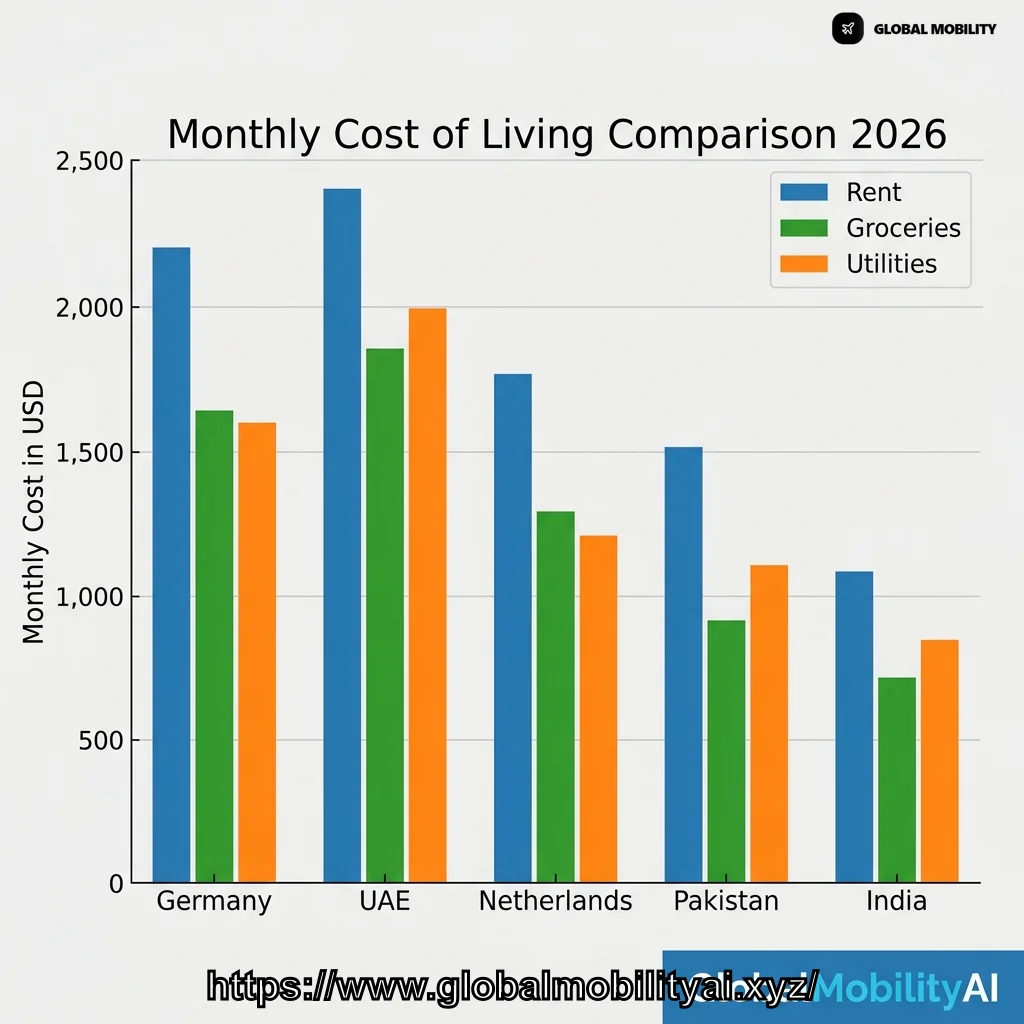
IMG-05: Cost of Living Comparison Chart
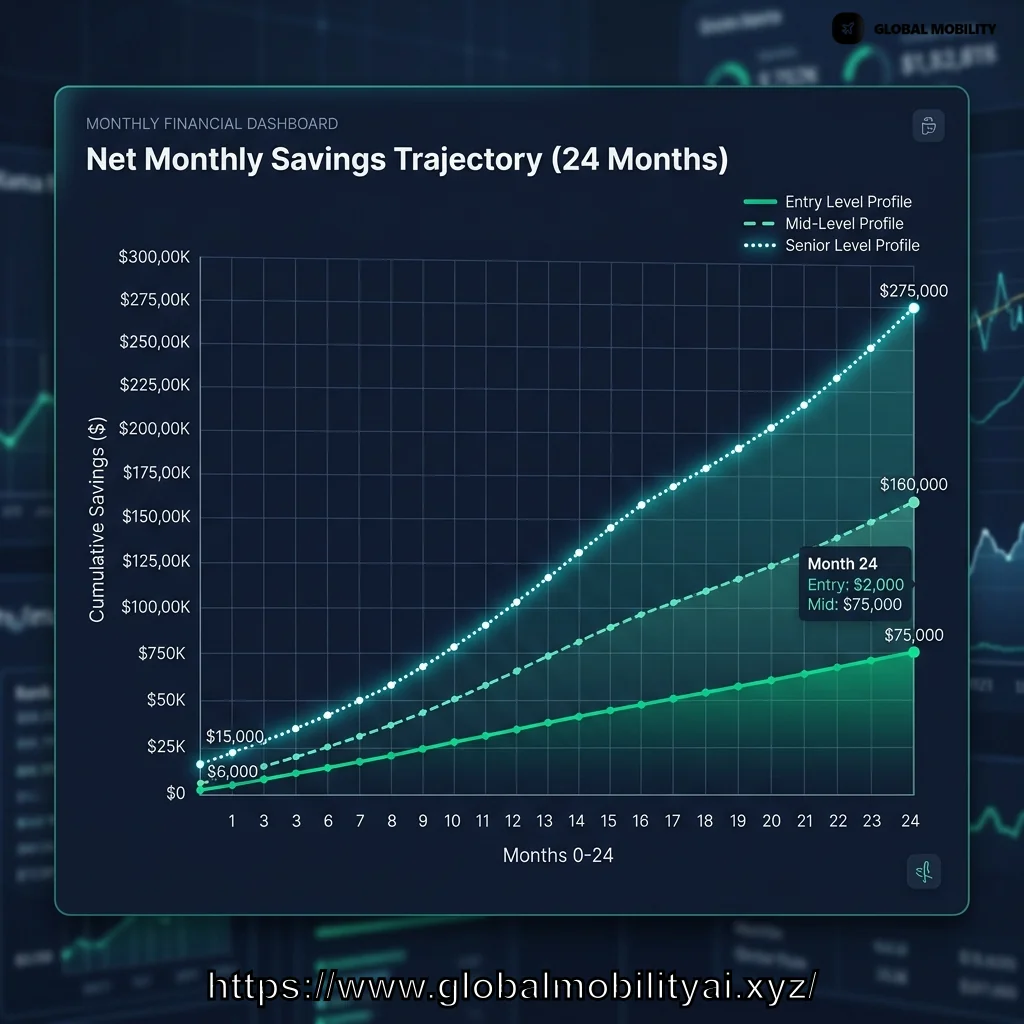
IMG-06: Salary vs Savings Line Chart
Platform search trends on GlobalMobilityAI.xyz suggest professionals identify destination-country switching as their single highest-ROI financial decision — particularly the Germany-to-UAE or Netherlands-to-UAE progression for senior profiles. Use the GlobalMobilityAI savings calculator to run your specific numbers against verified country-level data.
(Salary sources: Bundesagentur für Arbeit 2025 [https://statistik.arbeitsagentur.de], Job Bank Canada 2025 [https://www.jobbank.gc.ca], IND Netherlands 2026 [https://ind.nl], UAE Ministry of Human Resources 2025 [https://www.mohre.gov.ae])
4.3 Cost of Living Index vs. Home Countries
| Category | Germany | UAE (Dubai) | Netherlands | Pakistan | India | UK |
|---|---|---|---|---|---|---|
| Rent Index | 45.2 | 51.3 | 56.1 | 8.9 | 11.2 | 60.4 |
| Groceries Index | 52.1 | 55.7 | 53.8 | 25.3 | 22.1 | 55.9 |
| Restaurants Index | 55.4 | 59.2 | 62.1 | 18.7 | 21.3 | 65.8 |
| Local Purchasing Power Index | 112.3 | 138.4 | 129.7 | 29.4 | 38.2 | 106.5 |
(Source: Numbeo, 2025) [https://www.numbeo.com/cost-of-living/comparison/]
5. Salary Data & Job Market Intelligence
5.1 Average Salaries by Industry (2026 Data)
Germany (Source: Bundesagentur für Arbeit, 2025) [https://statistik.arbeitsagentur.de/DE/Navigation/Statistiken/Fachstatistiken/Entgelte/Entgelte-Nav.html]
| Industry | Entry Level (€/year) | Mid-Level (€/year) | Senior (€/year) | Currency |
|---|---|---|---|---|
| Software Engineering | €42,000–€52,000 | €58,000–€72,000 | €78,000–€100,000 | EUR |
| Mechanical Engineering | €38,000–€48,000 | €52,000–€65,000 | €70,000–€88,000 | EUR |
| Healthcare (Nurse) | €32,000–€38,000 | €40,000–€50,000 | €52,000–€65,000 | EUR |
| Financial Services | €40,000–€52,000 | €58,000–€78,000 | €85,000–€120,000 | EUR |
| Logistics & Supply Chain | €30,000–€38,000 | €42,000–€55,000 | €60,000–€80,000 | EUR |
Canada (Source: Job Bank Canada, 2025) [https://www.jobbank.gc.ca/wagereport/]
| Industry | Entry (CAD/year) | Mid (CAD/year) | Senior (CAD/year) | Currency |
|---|---|---|---|---|
| Software Engineering | $58,000–$72,000 | $85,000–$105,000 | $115,000–$155,000 | CAD |
| Civil Engineering | $52,000–$65,000 | $75,000–$92,000 | $100,000–$130,000 | CAD |
| Healthcare (RN) | $60,000–$72,000 | $76,000–$90,000 | $92,000–$115,000 | CAD |
| Accounting/Finance | $48,000–$60,000 | $70,000–$88,000 | $95,000–$130,000 | CAD |
| Data Science / AI | $65,000–$80,000 | $92,000–$115,000 | $130,000–$180,000 | CAD |
(Source: Statistics Canada Labour Force Survey, 2025) [https://www.statcan.gc.ca/en/subjects-start/labour_and_employment]
5.2 In-Demand Skills & Sectors in 2026
Germany's Federal Employment Agency identifies the following sectors with active labour shortages: healthcare professionals (nursing, physiotherapy), electrical engineering, software development, skilled trades (HVAC, plumbing, electrical), and logistics management. (Source: Bundesagentur für Arbeit, 2025) [https://www.arbeitsagentur.de/en/]
Canada's Immigration, Refugees and Citizenship Canada has prioritised French-language proficiency, healthcare occupations, and STEM roles in its most recent Express Entry category-based selection rounds. (Source: IRCC, 2025) [https://www.canada.ca/en/immigration-refugees-citizenship/services/immigrate-canada/express-entry/submit-profile/rounds-invitations.html]
The Netherlands' national employer association VNO-NCW reports critical shortages in technology, cybersecurity, and advanced manufacturing. (Source: IND Netherlands, 2025) [https://ind.nl/]
5.3 How to Use GlobalMobilityAI Salary Comparison Tool
The GlobalMobilityAI salary comparison tool allows professionals to input their current gross salary, industry, and experience level, then benchmark it against verified government salary databases across 50+ destination countries. The output includes estimated net income after local taxes, gross-to-net ratio by country, and monthly savings projections aligned with median cost-of-living data — giving users a direct comparison across multiple destinations in a single session.
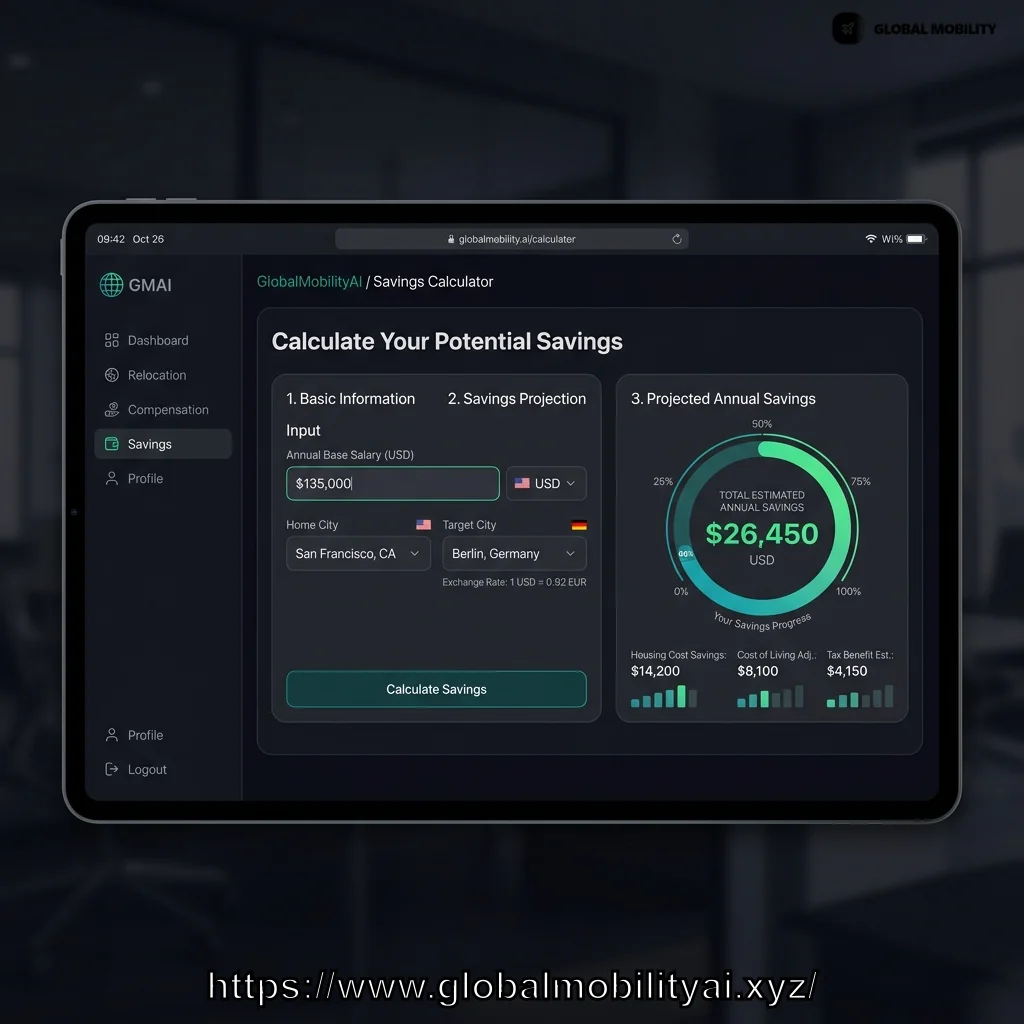
IMG-09: Monthly Savings Calculator Tool Interface
6. CV Formatting — Country-Specific Resume Guide for High-Earning Roles
6.1 CV Format Requirements by Destination Country
Germany
Photo: Yes — professional headshot is standard and expected in German applications. Omitting it is unusual and may suggest unfamiliarity with local norms.
Date of Birth: Traditionally included; legally, employers cannot require it, but it remains common practice.
Page Length: 1–2 pages maximum. Senior professionals may extend to 2 pages.
Font: Arial, Calibri, or similar clean sans-serif. Size 11–12pt.
Section Order: Personal details → Profile summary → Work experience (reverse chronological) → Education → Skills → Languages → Certifications.
Language: German strongly preferred for non-international roles; English acceptable for international-facing positions.
Canada
Photo: No — photos are explicitly discouraged to prevent discrimination claims under Canadian human rights law.
Date of Birth: Never include — illegal to request in most provincial hiring contexts.
Page Length: 1–2 pages.
Font: Professional sans-serif; ATS-clean formatting mandatory.
Section Order: Contact → Professional summary → Core competencies → Work experience → Education → Certifications.
Language: English; French for Quebec-targeted applications.
6.2 Common CV Mistakes That Get Applications Rejected
Germany-specific rejection triggers:
Canada-specific rejection triggers:
6.3 ATS Optimization for Destination Country Job Portals
Germany — Dominant Portals: StepStone.de, Indeed.de, XING, LinkedIn Germany, Make it in Germany jobs board.
German ATS systems, particularly those deployed by DAX-listed companies, prioritize keyword matching against the job description. Effective strategies include: mirroring the exact terminology used in the job posting (e.g., if the posting says "Projektmanager" rather than "Project Manager," use the German term); ensuring skills are listed as discrete, scannable terms rather than embedded in descriptive prose; and using standard section headers (Berufserfahrung, Ausbildung, Kenntnisse) when submitting in German.
PDF format is strongly preferred over DOCX for German applications — it preserves formatting and prevents ATS parsing errors caused by custom fonts.
Canada — Dominant Portals: Indeed.ca, LinkedIn Canada, Job Bank Canada, Workopolis, Monster Canada.
Canadian ATS systems heavily weight hard skill keywords, job titles, and certification acronyms. Ensure your CV contains the exact certification labels from your industry (PMP, CPA, P.Eng., RN) as these are frequently used as binary filters. Tailor the skills section to each job posting's language rather than using a static skills block across all applications.
7. Interview Tips for the High-Savings Destination Job Markets
7.1 Cultural Interview Norms & Expectations
Germany: German interviews lean heavily technical and competency-based. Employers expect precise, structured answers — not storytelling or anecdotes. Formal address (Sie, not du) is standard until explicitly invited to use informal language. Hierarchy is respected; do not question senior interviewers' premises without strong factual basis. Research the company's annual report, financial performance, and product portfolio before attending — this is expected, not optional.
Canada: Behavioral interviewing is dominant. STAR format (Situation, Task, Action, Result) answers are expected for most competency questions. Canadian workplace culture values demonstrated inclusivity, teamwork evidence, and psychological safety language. Interviewers often probe for cultural fit as much as technical skill.
7.2 Common Interview Questions & Answer Frameworks
Germany:
Q: "Warum möchten Sie in Deutschland arbeiten?" (Why do you want to work in Germany?)
Framework: Specificity wins. Reference the company's market position, a specific technology or methodology they use, and connect it to a concrete aspect of your background. Avoid generic "great opportunities" language.
Q: "Beschreiben Sie eine technische Herausforderung, die Sie gelöst haben." (Describe a technical challenge you solved.)
Framework: Problem → Technical constraint → Solution approach → Measurable outcome. Quantify wherever possible.
Canada:
Q: "Tell me about a time you worked on a diverse team."
Framework: STAR method. Emphasize active listening, cultural bridge-building, and measurable team outcome. This question tests both competency and cultural alignment.
Q: "Where do you see yourself in 5 years?"
Framework: Align aspirations with the company's growth trajectory. Demonstrate knowledge of the company's Canadian operations specifically, not just global.
7.3 Dress Code, Punctuality & Professional Etiquette
Germany: Business formal for first-round interviews in established companies; business casual for startups. Punctuality means 5 minutes early — arriving exactly on time is perceived as barely acceptable. Direct eye contact throughout is expected; avoiding it signals insecurity. Business cards, if exchanged, are received with both hands and examined briefly before being set aside — not pocketed immediately.
Canada: Business casual is standard across most industries; financial services and law maintain business formal. Arrive 5–10 minutes early. Overly formal attire in startup or tech environments can create an impression of poor cultural calibration.
7.4 Post-Interview Follow-Up Etiquette
Germany: A brief, formal thank-you email within 24 hours is appropriate. Keep it factual — reiterate your interest and one specific point from the conversation. Do not follow up by telephone unless explicitly invited to do so. Typical German hiring timelines run 2–4 weeks; following up before 2 weeks have elapsed is generally viewed as impatient.
Canada: A thank-you email within 24 hours is expected and often influences the final decision. Reference a specific interview moment to demonstrate active engagement. A follow-up after 5–7 business days of silence is professionally appropriate.
8. 2026 Policy Updates & Market Predictions Affecting Expat Savings
8.1 Key Policy Changes Effective 2026
Germany — Skilled Immigration Act Expansion
The Fachkräfteeinwanderungsgesetz entered its expanded phase in 2024–2025, broadening recognized qualification equivalence assessments. Effective 2025–2026, the Federal Employment Agency has expanded the "Anerkennungsberatung" (recognition advisory) network to reduce qualification recognition processing timelines. (Source: Bundesagentur für Arbeit, 2025) [https://www.arbeitsagentur.de/en/] The minimum salary threshold for skilled worker visas is adjusted annually; the 2026 value should be confirmed at the official Make it in Germany portal. (Source: Make it in Germany, 2026) [https://www.make-it-in-germany.com/]
Netherlands — 30% Ruling Revision
Effective January 2024, the 30% ruling benefit was capped: professionals may only apply the 30% reduction on income up to the "Balkenende norm" salary ceiling (€246,000 gross in 2025). For the vast majority of knowledge migrant applicants, this change has no practical impact. (Source: Belastingdienst, 2025) [https://www.belastingdienst.nl/wps/wcm/connect/en/individuals/content/coming-to-work-in-the-netherlands-30-percent-facility] The Kennismigrant salary thresholds are reviewed annually on 1 January; confirm current 2026 figures at the IND portal before application. (Source: IND Netherlands, 2026) [https://ind.nl/en/residence-permits/work/highly-skilled-migrant]
Canada — Express Entry Category Rounds
IRCC has continued category-based selection draws targeting French-language proficiency, healthcare, STEM, trades, agriculture, and transport occupations. Monitor the official rounds of invitations page for 2026 category updates. (Source: IRCC, 2025) [https://www.canada.ca/en/immigration-refugees-citizenship/services/immigrate-canada/express-entry/submit-profile/rounds-invitations.html]
Australia — TSMIT Adjustment
The Temporary Skilled Migration Income Threshold (TSMIT) increased to AUD $73,150 effective July 2024. Annual reviews should be confirmed at the Department of Home Affairs. (Source: Australian Department of Home Affairs, 2025) [https://immi.homeaffairs.gov.au/]
8.2 Immigration Trend Predictions (Data-Backed)
Germany's immigration authority (BAMF) processed 351,000 skilled worker residence permits in 2024, a record figure reflecting the impact of the 2024 Skilled Immigration Act expansion. (Source: BAMF, 2025) [https://www.bamf.de/EN/] Processing times for German skilled worker visas at German diplomatic missions abroad average 1–3 months, though this varies significantly by mission capacity. (Source: Auswärtiges Amt, 2025) [https://www.auswaertiges-amt.de/en]
The OECD's International Migration Outlook 2024 projects sustained demand for skilled migration in OECD countries through 2027, driven by demographic imbalances and structural labour shortages. Countries with the most accelerated demand growth include Germany, Canada, Netherlands, and Australia. (Source: OECD Migration Outlook, 2024) [https://www.oecd.org/migration/international-migration-outlook-1999124x.htm]
Canada's IRCC published a 2025–2027 immigration levels plan targeting 500,000 permanent residents annually, with a continued emphasis on the Economic Class (Express Entry and Provincial Nominee Programs). Processing times for Express Entry applications with complete documentation currently average 6 months — a figure consistent with the broader visa rejection reasons and processing trends we analyzed in our 2026 strategic blueprint. (Source: IRCC, 2025) [https://www.canada.ca/en/immigration-refugees-citizenship/news/notices/supplementary-immigration-levels-2025-2027.html]
Netherlands Kennismigrant processing times are running at 2–4 weeks for complete applications through recognized sponsors in 2025. (Source: IND Netherlands, 2025) [https://ind.nl/en/residence-permits/work/highly-skilled-migrant]
8.3 How These Changes Affect Your Application in 2026
For professionals targeting Germany, the most immediate implication of 2026 policy posture is the recognition timeline. Qualification recognition — particularly for engineering and healthcare roles — remains the longest single step in the process. Applicants who initiate the Anerkennungsantrag (recognition application) before securing a job offer can reduce overall visa timeline by 3–5 months. Detailed guidance on sequencing these steps is available in the GlobalMobilityAI visa timeline calculator, which incorporates current BAMF processing data to model destination-specific preparation schedules.
For Canada-bound applicants, category-based draws in 2026 mean that professionals in healthcare or French-language designations may receive invitations even with CRS scores below the general pool cut-off. If your occupation falls into a priority category, profile submission timing relative to draw cycles materially affects your wait time — and therefore your savings accumulation start date. Cross-reference your visa eligibility against current processing timelines using the visa predictor tool.
For Netherlands Kennismigrant applicants, confirming your employer's recognized sponsor status on the IND portal before committing to a job negotiation prevents the single most common processing delay: employer non-recognition.
9. Tactical Comparison Matrix — Top Savings Destinations
To help you finalize your destination choice, we have synthesized the core data points used by our monthly savings calculator abroad into a tactical comparison matrix.
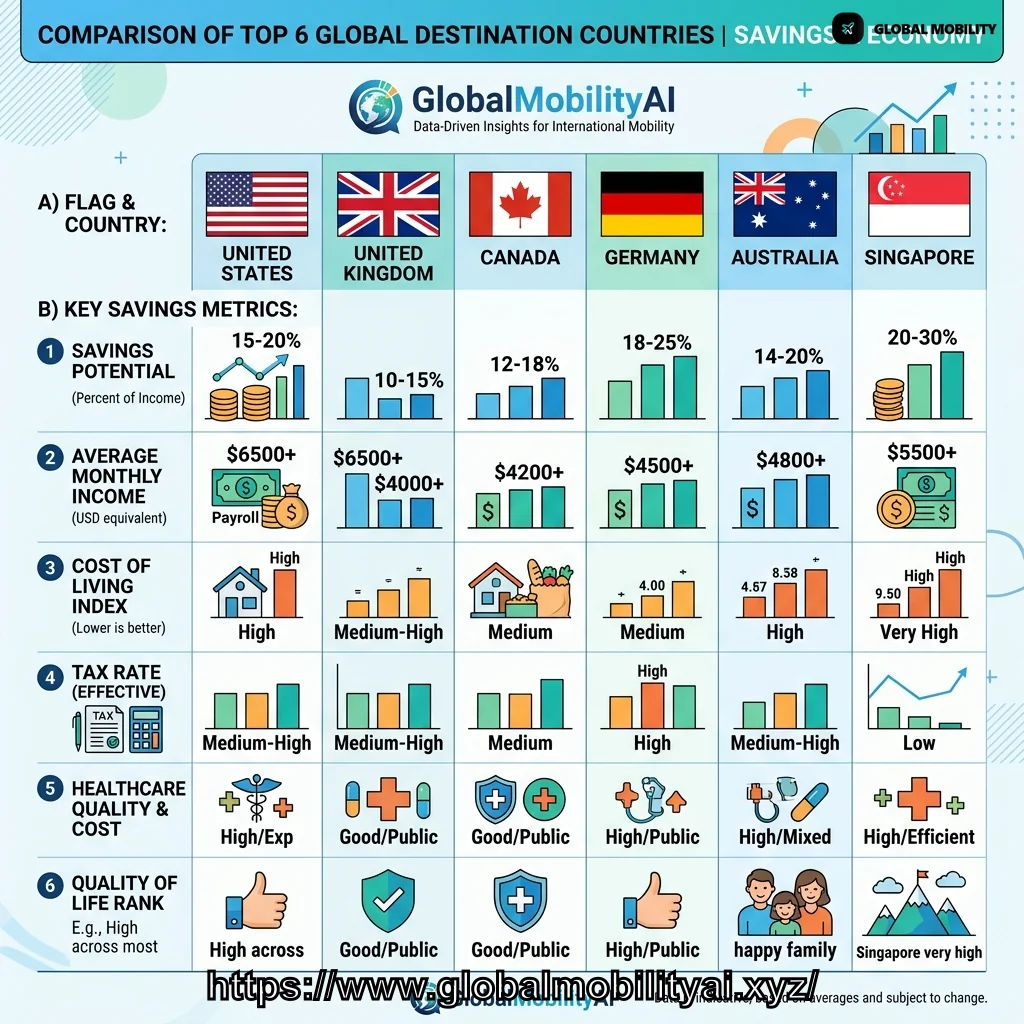
IMG-10: Top Countries Comparison Infographic
| Visa Type | Eligibility | Min. Salary | Processing Time | Difficulty | Est. Approval Rate* | Gov. Fee |
|---|---|---|---|---|---|---|
| Germany Skilled Worker | Recognized qualification + job offer | €43,992/year | 1–3 months at mission | Moderate | Platform Est.* | ~€75 visa fee |
| Germany Opportunity Card | 6 points (qualification, salary, language, age) | Blocked a/c €12,648 | 2–4 months | Moderate | Platform Est.* | ~€75 |
| Canada Express Entry (FSW) | CRS score + eligible occupation | No fixed minimum (CRS-dependent) | 6 months | Moderate-High | Platform Est.* | CAD $1,325 |
| Netherlands Kennismigrant | Job offer above salary threshold + recognized sponsor | €5,688/month (30+) | 2–4 weeks | Low-Moderate | Platform Est.* | €350 |
| UAE Employment Visa | Job offer from UAE employer | No formal minimum | 2–4 weeks | Low | Platform Est.* | AED 220–370 |
| Australia TSS 482 | Approved sponsor + occupation on MLTSSL/STSOL | AUD $73,150/year | 1–4 months | Moderate | Platform Est.* | AUD $3,115 |
*Internal platform estimate. Official approval rates are not publicly published by destination immigration authorities. Monitor official portals for current acceptance data.
(Sources: Auswärtiges Amt 2026, IRCC 2026, IND Netherlands 2026, UAE MOHRE 2025, Australian Department of Home Affairs 2025)
10. Execution Roadmap: Phase-by-Phase

IMG-11: Expat Relocation Execution Roadmap
Phase 1 — Preparation (Months 1–2)
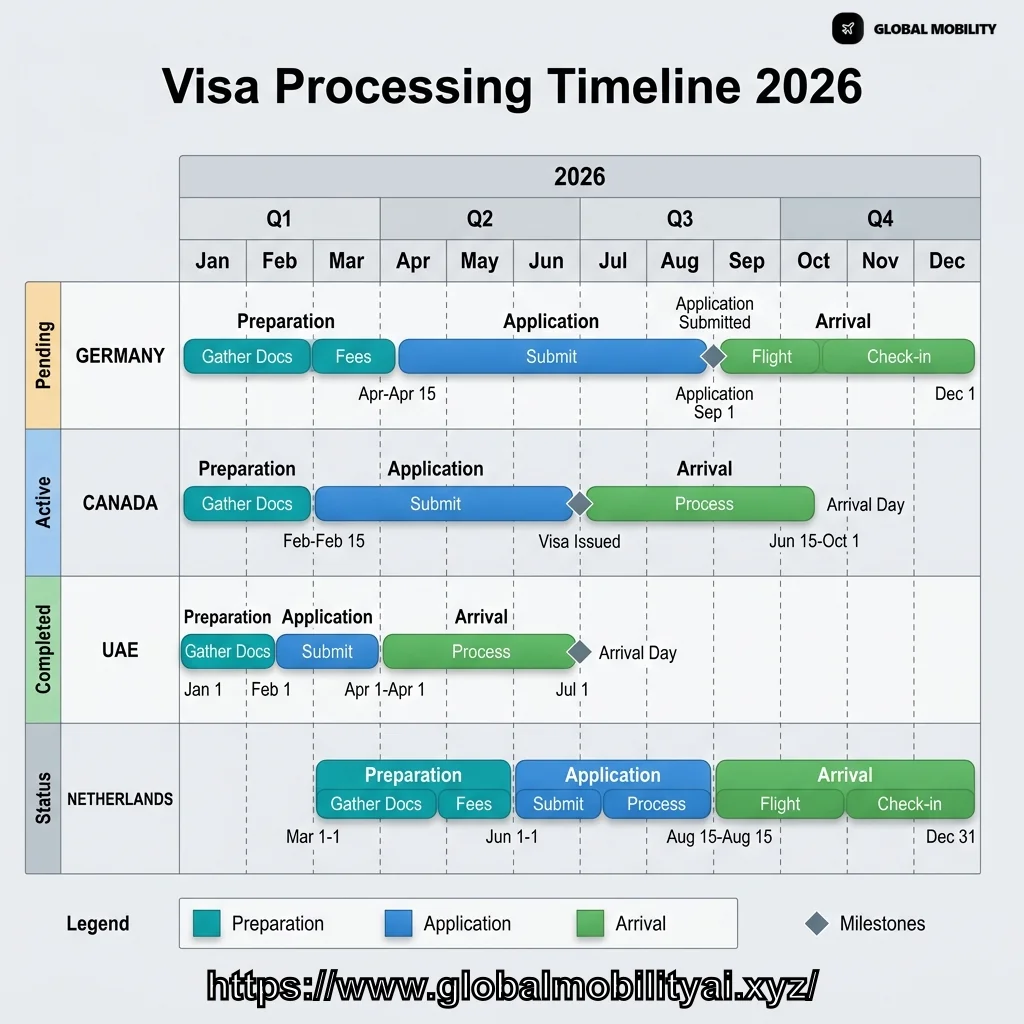
IMG-07: Visa Processing Timeline Gantt Chart
Actions:
Cost: €200–€500 (language tests, document translations)
Timeline: 4–8 weeks
Phase 2 — Application (Months 3–4)
Actions:
Cost: €75–€350 visa fees depending on destination (see matrix in Section 9)
Timeline: 2–8 weeks per destination
Phase 3 — Arrival & Administration (Month 5–6)
Actions:
Cost: €500–€1,200 (first month setup costs, deposits, SIM, transport cards)
Timeline: 2–4 weeks post-arrival
Phase 4 — Settlement & Permanent Residency (Month 12+)
Actions:
Cost: €300–€1,500 (PR application fees, language exams, legal costs if needed)
Timeline: 2–5 years depending on destination and pathway
11. Critical Risk Factors & Common Pitfalls
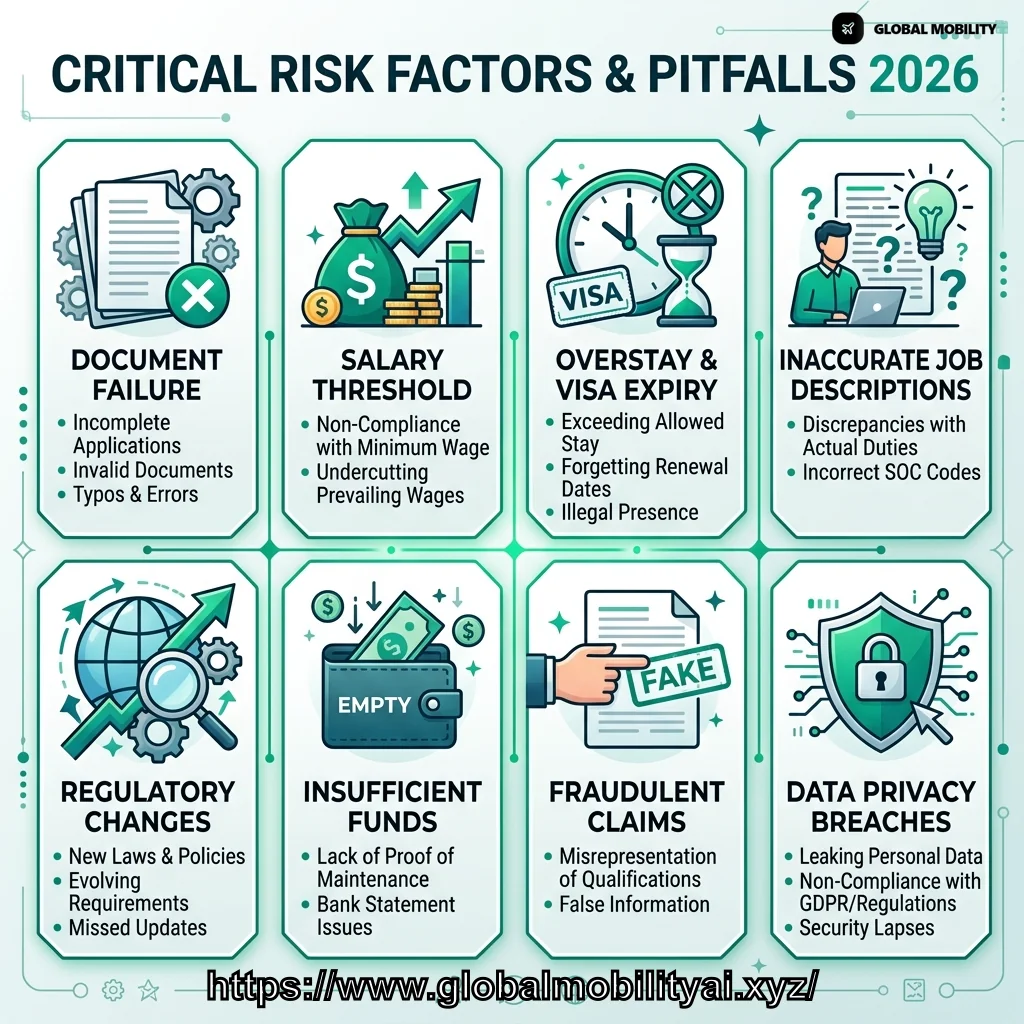
IMG-12: Expat Visa Risk Factors Infographic
Risk 1 — Qualification Non-Recognition (Germany)
What it is: Foreign academic degrees not accepted as equivalent by German authorities without formal recognition assessment. Why it happens: Germany regulates most professional titles, particularly in engineering, healthcare, and teaching. The Anerkennungsberatung process can take 3–6 months and sometimes requires additional training. Consequence: Visa refusal on eligibility grounds; unable to apply for roles requiring the protected title. How to avoid: Begin the recognition process via www.anerkennung-in-deutschland.de before submitting job applications. Do not assume a foreign degree automatically qualifies for its German equivalent title.
Risk 2 — CRS Score Insufficient for Targeted Draw Pool (Canada)
What it is: Express Entry profile submitted but never receiving an Invitation to Apply because CRS score falls below draw cut-offs. Why it happens: Points are a function of language test scores, education, age, and Canadian factors — profiles without Canadian job offers or provincial nominations typically score below 500. Consequence: Profile expires after 12 months without ITA; re-submission required. How to avoid: Maximize English/French IELTS/TEF scores first; pursue Provincial Nominee Program pathways that carry 600-point equivalency upon nomination.
Risk 3 — 30% Ruling Eligibility Loss (Netherlands)
What it is: The Netherlands 30% ruling is not automatically granted — it requires application within 4 months of starting work. Why it happens: Employers and employees often assume the ruling is automatic. Consequence: Loss of the ruling for the entire assignment — a financial impact of €10,000–€20,000+ annually depending on income. How to avoid: Application is submitted jointly by employer and employee to the Belastingdienst; initiate within the first month of employment.
Risk 4 — Overstaying Visa Duration (All Countries)
What it is: Remaining in the country beyond the authorized period of stay — even by days — while waiting for a permit extension decision. Why it happens: Processing delays, administrative confusion, or complacency. Consequence: Germany — deportation bar of 1 year minimum; Canada — removal order and 1–5 year ban; UAE — daily AED 25 overstay fine plus deportation. How to avoid: Monitor permit expiry dates. In Germany, apply for extension at least 6 weeks before expiry. In Canada, apply for renewal before the current permit expires to benefit from implied status.
Risk 5 — Undisclosed Criminal History (All Countries)
What it is: Failure to disclose prior criminal convictions — including minor offenses — on visa applications. Why it happens: Applicants believe minor offenses are irrelevant or are unaware of the disclosure requirement. Consequence: Permanent visa ban in some countries; fraud charge added to the original offense. How to avoid: Obtain a clean police clearance certificate from every country of residence for the past 5–10 years (requirements vary). If a conviction exists, consult an immigration lawyer before applying.
Risk 6 — Salary Below Threshold at Contract Renewal (Netherlands)
What it is: Kennismigrant status is tied to maintaining a salary at or above the minimum threshold. A promotion delay, role change, or restructuring that drops salary below the threshold triggers permit invalidation. Consequence: Loss of highly skilled migrant status; must switch to a different permit category or leave. How to avoid: Monitor salary against the annually updated IND threshold. Confirm threshold at [https://ind.nl] each January.
Risk 7 — Employer Sponsor Withdrawal (Netherlands/UK/Australia)
What it is: In employer-tied visa systems, if the sponsoring employer withdraws its sponsor license — due to audit failure, company closure, or regulatory action — the employee's visa becomes invalid. Consequence: Typically 60-day grace period to find a new sponsor or depart. How to avoid: Verify sponsor license status before accepting a role. In the Netherlands, check the IND recognized sponsor list [https://ind.nl/en/public-register-recognised-sponsors]. In Australia, verify the Standard Business Sponsor status at the Department of Home Affairs portal.
Risk 8 — Salary Sacrifice Arrangements Distorting Gross Income (Germany)
What it is: German employers offering non-cash benefits (company car, housing supplement, pension top-up) that reduce reported gross salary below the visa minimum salary threshold. Why it happens: Applicants accept attractive total compensation packages without understanding that visa compliance is measured against the gross monetary salary, not total compensation. Consequence: Visa application rejected or permit invalidated on salary grounds. How to avoid: Ensure the monetary component of the salary — excluding all benefits — meets or exceeds the official threshold. Confirm in writing with the employer's HR department before the visa application is submitted.
12. FAQ — People Also Ask
Q: How does a monthly savings calculator abroad actually work?
A monthly savings calculator abroad works by taking three inputs: gross salary in the destination country, estimated monthly living costs for your city and lifestyle tier, and applicable tax/deductions rate for your visa category. The output is net monthly surplus. Effective tools — such as the GlobalMobilityAI savings estimator — pre-load official cost-of-living data from Numbeo and verified tax schedules from government sources, so users do not need to manually gather data across multiple websites. The result is an evidence-based monthly savings projection rather than a personal estimate.
Q: Which country offers the highest monthly savings for a software engineer in 2026?
For a mid-level software engineer earning at market rate, the UAE (Dubai) offers the highest absolute monthly savings due to zero income tax — approximately AED 9,500 per month (~USD $2,587) after expenses on a AED 18,000 salary. The Netherlands ranks second for those utilizing the 30% ruling, with monthly savings of approximately €2,400. Germany offers strong savings at the senior level (€2,100+/month) but lower absolute figures at entry and mid levels due to the 33–38% combined tax and social contribution burden. (Source: Bundesagentur für Arbeit 2025, IND Netherlands 2026, UAE MOHRE 2025, Job Bank Canada 2025) [https://statistik.arbeitsagentur.de] [https://ind.nl] [https://www.mohre.gov.ae]
Q: How much money should I save before moving abroad?
As a minimum viable threshold, research compiled by the GlobalMobilityAI Research Team from official visa requirement sources indicates: Germany requires €12,648 in a blocked account for Opportunity Card holders (Source: Auswärtiges Amt, 2025) [https://www.auswaertiges-amt.de]; Canada recommends CAD $13,310 for a single applicant under the Federal Skilled Worker Program's proof of funds requirement (Source: IRCC, 2025) [https://www.canada.ca]; Australia's TSS visa has no formal pre-arrival savings requirement but financial advisors broadly recommend 3 months of living expenses as a practical buffer — approximately AUD $9,000–$12,000 for a single professional. Beyond minimum requirements, a 3-month expenses buffer above the visa minimum is the standard recommendation for financial safety.
Q: Can I use a monthly savings calculator abroad to assess visa financial eligibility?
Yes, with qualification. While many destination country visas assess financial eligibility at the point of application, using a monthly savings calculator abroad is essential for assessing your long-term wealth accumulation post-arrival. Germany's Opportunity Card requires a blocked account demonstrating €12,648. Canada's FSW requires proof of liquid funds. A savings calculator serves a different function post-arrival: projecting the monthly surplus you will accumulate once employed and living in the destination. Both functions are supported by the GlobalMobilityAI platform's financial tools, which model pre-arrival fund requirements and post-arrival savings trajectories separately. (Source: IRCC, 2025) [https://www.canada.ca]
Q: Is it financially worth moving abroad if my salary only increases modestly?
The answer depends on the tax differential, not just the salary number. A Pakistani professional earning PKR 500,000/month (~USD $1,785) moving to Germany on a €3,200/month entry salary actually takes a gross income cut. But after accounting for Germany's purchasing power index (112.3 vs Pakistan's 29.4 per Numbeo 2025), EUR-denominated savings, hard currency appreciation, and access to public services embedded in the social contribution, the real financial position — particularly over a 5-year horizon — is typically superior. The calculation is not month-one versus month-one; it is year-three versus year-three. (Source: Numbeo, 2025) [https://www.numbeo.com/cost-of-living/comparison/]
Q: What are the best countries for high savings rates as an expat in 2026?
Based on salary-to-cost-of-living ratios, zero income tax, and employment accessibility, the top five destinations for expat savings potential in 2026 are: (1) UAE — zero income tax, high mid-senior salaries; (2) Netherlands — 30% ruling for knowledge migrants, strong tech salaries; (3) Switzerland — very high salaries though offset by high costs (net savings strongest at senior level); (4) Canada — strong PPP, stable housing costs outside Vancouver/Toronto; (5) Germany — structural labour shortages driving salary premiums in STEM/healthcare. (Sources: OECD 2025 [https://www.oecd.org], Numbeo 2025 [https://www.numbeo.com], UAE FTA 2025 [https://tax.gov.ae])
Q: How long does it take to start saving after relocating abroad?
For most destination countries, month one involves setup costs — deposits, transport cards, initial household purchases — that eliminate savings entirely. Months two and three typically see partial savings as recurring costs stabilize. Full savings potential is typically reached by month four, once the rental agreement is established, bank account is operational, and discretionary spending has normalized. For Germany specifically, the first Krankenkasse contribution, Rundfunkbeitrag (broadcasting fee), and potential liability insurance payments create a "month one shock" that first-time expats consistently underestimate. Budget a €1,500–€2,500 setup fund above your standard monthly budget for the first month regardless of destination.
Q: What is the average savings rate for expats working in Germany?
Official aggregate savings rate data for expatriate subpopulations is not published separately by Destatis (German Federal Statistics Office). Platform analysis on GlobalMobilityAI.xyz suggests search trends indicate mid-level professionals in Germany target monthly savings of €800–€1,200 as a realistic benchmark, with senior professionals at €1,800–€2,500 in lower-cost cities (Leipzig, Nuremberg, Cologne) and €1,200–€2,000 in higher-cost cities (Munich, Frankfurt). These figures are projections based on verified salary and Numbeo cost data — not a guaranteed outcome. Individual circumstances including family size, lifestyle, and employer-provided benefits vary materially. (Source: Bundesagentur für Arbeit 2025 [https://statistik.arbeitsagentur.de]; Numbeo 2025 [https://www.numbeo.com])
13. Conclusion: The Bottom Line
If you are a skilled professional in 2026 trying to determine whether relocation is a sound financial move — or which destination maximizes your net position — the monthly savings calculator abroad framework in this guide gives you the structural answer. Country selection is not a lifestyle preference exercise alone; it is the single largest financial lever available to a working professional. The difference between Germany and UAE, or between Toronto and Montreal, can amount to €10,000–€25,000 in cumulative annual savings on the same professional profile.
The execution sequence is clear: verify qualification recognition first, model your gross-to-net savings for three destination scenarios using verified cost and tax data, select the destination where your professional profile commands the strongest combination of salary and savings ratio, and initiate your visa preparation along the phase-by-phase roadmap in Section 10.
Use the phase-by-phase roadmap in Section 10 to initiate your visa preparation. For salary benchmarking, the salary comparison tool draws on official government databases — not crowdsourced estimates — to give you defensible projections.
The professionals who relocate with the highest financial returns in 2026 are not the ones who move fastest. They are the ones who model with precision before they move at all. Comparable destination ROI analyses are available in our UAE Golden Visa 2026 financial guide for readers considering the zero-tax pathway in detail.
Your savings potential abroad is not a guess. It is a calculation. Make it with verified data.
Predict your mobility score.
Use our AI engine to get your personalized visa pathway, salary prediction, and relocation roadmap.
More Insights

Netherlands Highly Skilled Migrant Visa 2026: The Definitive Expert Guide

UAE Golden Visa 2026: Eligibility, Tiers & Residency Guide