
Editorial Transparency: Content compiled from official Norwegian government sources (Norwegian Directorate of Immigration - UDI) by the GlobalMobilityAI Research Team. For personalized legal or immigration advice, consult a licensed Norwegian immigration lawyer. (Last Updated: 2026-05-29)
For international professionals seeking a relocation destination that guarantees an uncompromising standard of living, the Scandinavian peninsula remains the absolute gold standard. However, in 2026, the economic narrative has narrowed significantly, placing Norway—with its vast sovereign wealth fund, hyper-resilient tech sector, and fiercely protected work-life balance—at the absolute peak of expatriate desirability. The gateway to this high-trust, egalitarian society is the Norway skilled worker visa 2026. This immigration pathway is not a lottery; it is a highly structural, merit-based framework operated by the Norwegian Directorate of Immigration (UDI). It requires meticulous alignment between your foreign qualifications and Norwegian statutory salary requirements. Whether you are an offshore engineering specialist heading to Stavanger, or an AI developer securing a role in Oslo's booming green-tech corridor, understanding the mechanical realities of the Norway skilled worker visa 2026 is critical. At GlobalMobilityAI.xyz, our research team has mapped the exact financial thresholds, bureaucratic hurdles, and cultural nuances required to secure your approval and thrive within the Nordic model.
A comprehensive visual overview of the Norwegian expatriate lifestyle and Skilled Worker residency opportunities for 2026.
Table of Contents
1. Why Norway in 2026? — The Strategic Case
While other European nations grapple with economic volatility, Norway operates from a position of profound financial insulation. Powered by responsible state capitalism and a massive shift towards green technology, Norway offers a stability that is exceedingly rare in 2026.

Historic Norwegian wooden architecture juxtaposed with modern tech workers in Bergen.
1.1 Economic Landscape & Opportunity
The Norwegian economy in 2026 is characterized by low unemployment, massive state investment in renewable energy infrastructure (wind, hydro, and battery technology), and a digitization rate that leads the continent. The Norwegian sovereign wealth fund provides a macro-economic buffer that virtually eliminates the risk of sudden, deep recessions. For foreign workers, the Norway skilled worker visa 2026 represents a legally protected integration into this system. Unlike temporary guest-worker programs in other regions, this visa is explicitly designed to transition highly educated professionals into long-term taxpayers and eventual citizens (Source: Statistics Norway - SSB, 2026) [https://www.ssb.no/en].
1.2 Why Professionals Are Targeting This Destination
The primary draw for senior professionals from North America, the UK, and Asia is the uncompromising work-life balance codified into Norwegian law. The standard work week is strictly 37.5 hours. Overtime is culturally discouraged, and five weeks of paid vacation is the mandatory minimum. Furthermore, the Norway skilled worker visa 2026 allows immediate family reunification, granting spouses full, unrestricted working rights immediately upon arrival. This dual-income capacity dramatically offsets the notoriously high Norwegian cost of living, creating a massive net-savings potential for expat families.

DEMO-INFOGRAPHIC-01: Expat Community Profile
A demographic breakdown of international professionals and their families migrating to Norway's primary tech and energy hubs.
2. Deep-Dive Analysis: Legal & Financial Framework
The Norwegian Directorate of Immigration (UDI) operates with clinical efficiency. The Norway skilled worker visa 2026 (officially the Residence Permit for Skilled Workers) has absolute, non-negotiable requirements regarding education and salary.
2.1 Legal Requirements & Visa Categories
To qualify as a "skilled worker," you must fall into one of three legally defined educational categories:
2.2 The Concrete Job Offer & Salary Thresholds
You cannot apply for the Norway skilled worker visa 2026 without a concrete, written job offer from a registered Norwegian employer. The employer must utilize the standard UDI Offer of Employment form.
Crucially, the pay and working conditions must not be worse than what is normal in Norway.
(Note: If your industry has a collective bargaining agreement, the salary must meet the tariff rates of that specific agreement, even if it is higher than the UDI minimum.) (Source: UDI, 2026) [https://www.udi.no/en/].
2.3 Required Documentation & Official Checklists
The documentary burden is heavy and must be translated into English or Norwegian.
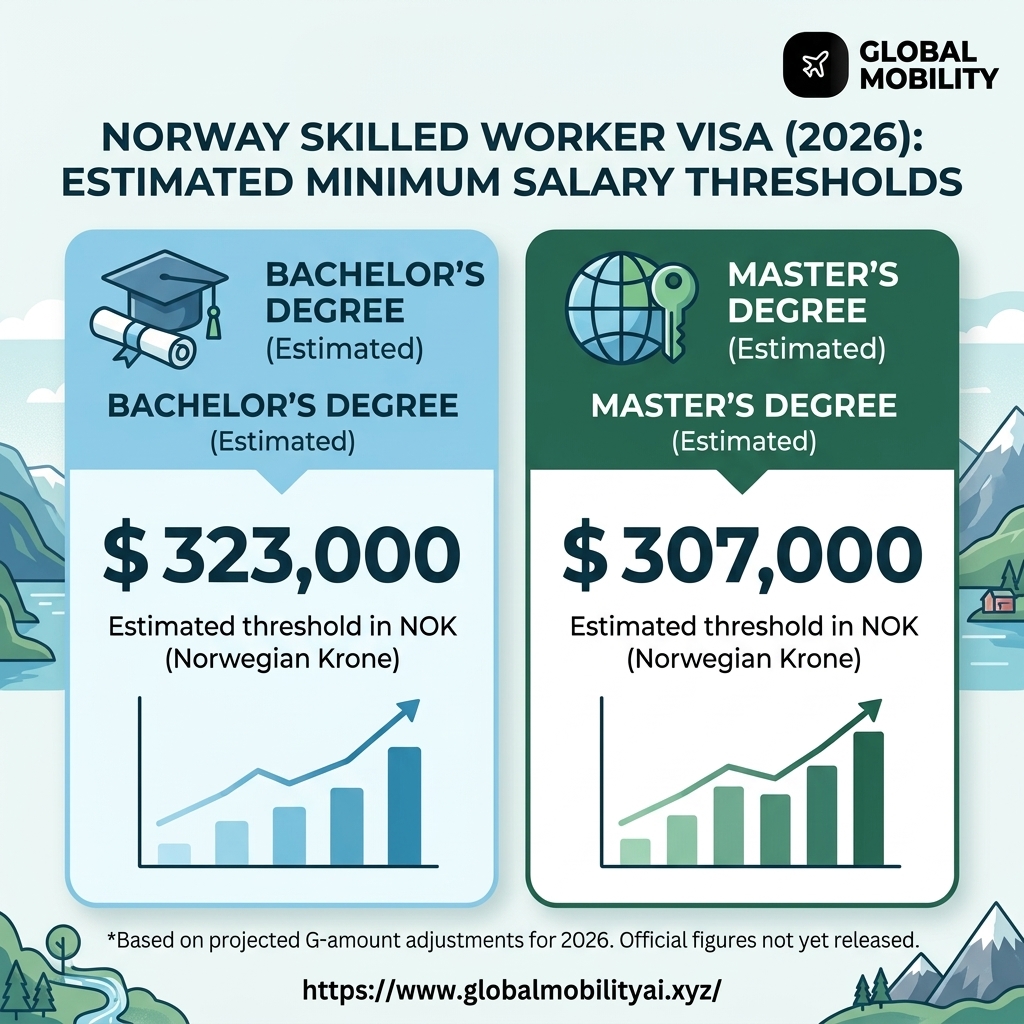
IMG-02: Work Permit Categories
Visual classification of the educational pathways and salary thresholds for the Norwegian Skilled Worker permit.
3. City Guide — Where to Live in Norway in 2026
Your geographic destination in Norway will heavily dictate your industry focus and lifestyle. While the country is vast, expat professionals are overwhelmingly concentrated in four main hubs.
3.1 Top 4 Cities for Expats: Rankings & Analysis
3.2 City Comparison Table
| City | Avg Rent 1BR | Monthly Cost | Primary Industry | Expat Rating |
|---|---|---|---|---|
| Oslo | NOK 18,000 | NOK 38,000 | Tech, Finance | 9.2/10 |
| Stavanger | NOK 14,000 | NOK 32,000 | Energy, Green Tech | 8.8/10 |
| Bergen | NOK 15,000 | NOK 34,000 | Maritime, Aqua | 8.9/10 |
| Trondheim | NOK 14,500 | NOK 33,000 | Deep-Tech, R&D | 9.0/10 |
(Source: Numbeo Norway 2026, 2026)
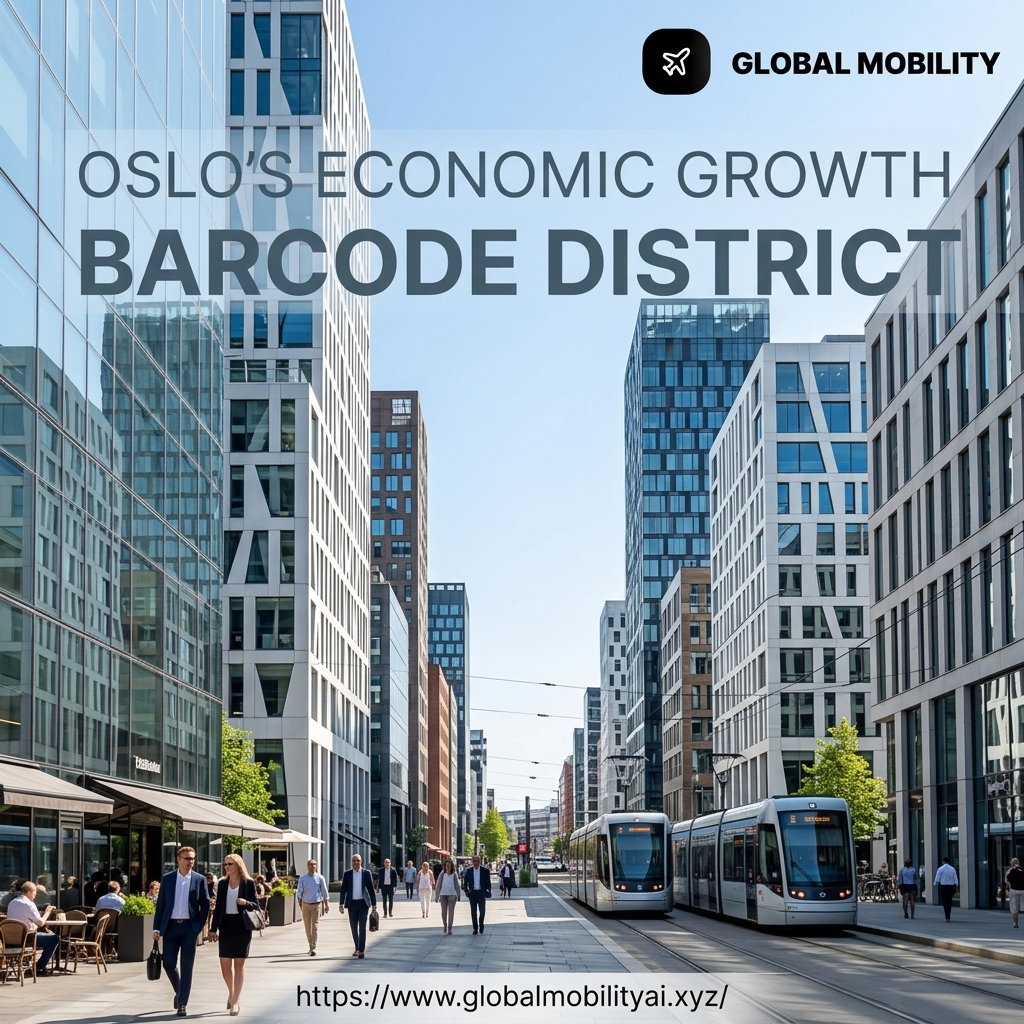
IMG-03: Oslo Tech Skyline
The modern skyline of Oslo's Barcode Project, highlighting rapid urban and economic development.
4. Cost of Living — Complete 2026 Breakdown
Norway is notoriously expensive. To utilize the Norway skilled worker visa 2026 effectively, you must understand that high gross salaries are heavily taxed, and daily consumer goods carry a premium.
4.1 Monthly Budget Calculator Breakdown
For a single professional residing in a modern 1-bedroom apartment in Oslo:

Expats dining outdoors at a vibrant waterfront cafe in a Norwegian city square.
(Source: Numbeo Cost of Living Survey, 2026) [https://www.numbeo.com/cost-of-living/in/Oslo]
4.2 Cost of Living vs. Salary: What You'll Actually Save
Norwegian taxes are highly progressive but fund an incredibly robust welfare state (free healthcare, subsidized childcare at ~NOK 3,000/month maximum, free university).
We strongly advise utilizing our GlobalMobilityAI Cost of Living Calculator to accurately model your post-tax savings potential. The true financial power in Norway unlocks when a spouse begins working, turning a single highly-taxed income into a dual-income powerhouse with subsidized childcare.

CHART-1: Cost of Living Comparison Bar Chart
Comparative analysis of living expenses between Norway, the UK, the US, and Sweden for 2026.

CHART-2: Salary vs. Savings Potential Line Chart
Projected 24-month savings trajectory for international professionals operating in the Norwegian market.
4.3 Cost of Living Index vs. Home Countries
(Note: Norway = Index 100. All values relative to the Norwegian baseline.)
| Category | Norway | United States | United Kingdom | Sweden |
|---|---|---|---|---|
| Groceries Index | 100 | 95.4 | 68.2 | 82.1 |
| Rent Index | 100 | 125.1 | 95.6 | 72.5 |
| Local Purchasing Power | 100 | 120.2 | 90.5 | 105.8 |
(Source: Numbeo Cost of Living Comparison, 2026) [https://www.numbeo.com/cost-of-living/compare_countries.jsp]
5. Salary Data & Job Market Intelligence
The Norwegian job market is highly unionized, transparent, and structured.
5.1 Average Salaries by Industry (2026 Data)
| Industry | Entry Level | Mid-Level | Senior | Currency |
|---|---|---|---|---|
| IT & Software Dev | NOK 600K | NOK 850K | NOK 1.2M+ | NOK |
| Engineering (Energy) | NOK 650K | NOK 900K | NOK 1.3M+ | NOK |
| Finance & Auditing | NOK 580K | NOK 800K | NOK 1.1M+ | NOK |
| Healthcare (Doctors) | NOK 700K | NOK 950K | NOK 1.4M+ | NOK |
| Project Management | NOK 620K | NOK 880K | NOK 1.1M+ | NOK |
(Source: Tekna & NITO Salary Statistics, 2026)
5.2 In-Demand Skills & Sectors in 2026
In 2026, the Norwegian government’s pivot away from fossil fuels has created a massive skills deficit in offshore wind engineering, grid infrastructure optimization, and battery cell manufacturing. Simultaneously, the digitization of the public sector requires vast numbers of cybersecurity experts, cloud architects, and data engineers. If you possess these skills, securing the initial job offer required for the Norway skilled worker visa 2026 is highly probable.
5.3 How to Use GlobalMobilityAI Salary Comparison Tool
Never accept a job offer in Norway without cross-referencing the union tariff rates. Use the GlobalMobilityAI Salary Comparison tool to benchmark your offer against local Norwegian standards. Being underpaid is actually a ground for visa rejection by the UDI, as it constitutes "social dumping."

IMG-04: Norwegian Corporate Hub
International professionals collaborating in a modern, flat-hierarchy corporate office in Oslo.
6. CV Formatting & GDPR Compliance Guide
The Norwegian recruitment process is highly pragmatic and deeply regulated by European data protection laws.
6.1 Norway CV Format Requirements
6.2 The Mandatory GDPR Clause
Norway is a member of the EEA and fully enforces the European General Data Protection Regulation (GDPR - Personvernforordningen).
To ensure corporate ATS systems can legally store your data, you must include a consent clause at the footer of your CV.
GDPR Consent Clause (English):
"I hereby consent to the processing of the personal data contained in this CV for the purpose of recruitment and potential employment, in accordance with the GDPR."
6.3 Common CV Mistakes That Get Applications Rejected
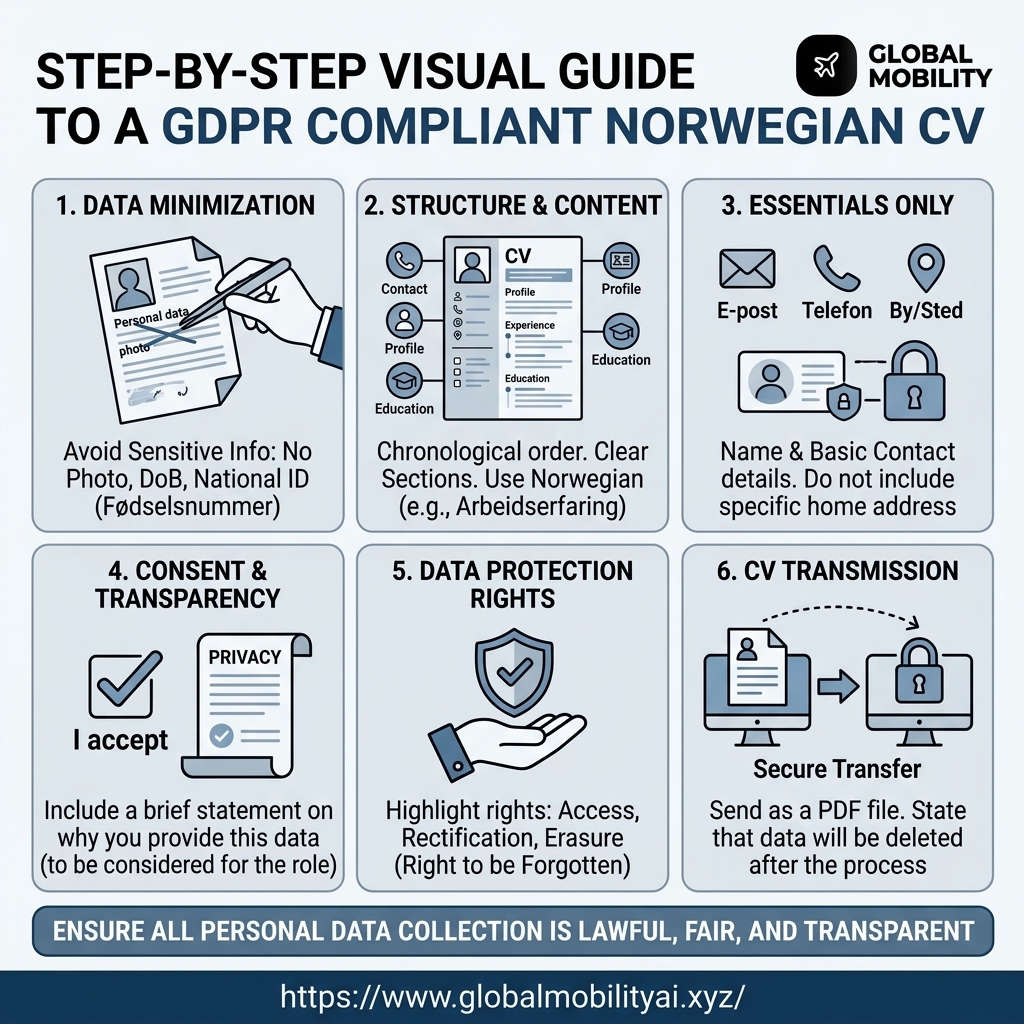
IMG-05: CV Optimization Process
A visual guide to structuring a GDPR-compliant, culturally optimized Norwegian resume.
7. Interview Tips for the Norwegian Job Market
Interviewing in Norway is often a profound culture shock for expats accustomed to aggressive, hyper-competitive corporate environments.
7.1 Cultural Interview Norms & Expectations
Norwegian interviews are often described as "structured conversations." The hierarchy is extremely flat. You may be interviewed by a panel consisting of the CEO, an HR rep, and a prospective peer, and they will all treat each other as absolute equals. Do not direct all your attention solely to the most senior person in the room; this is considered highly disrespectful to the team dynamic.
7.2 Common Interview Questions & Answer Frameworks
7.3 Dress Code, Punctuality & Professional Etiquette

IMG-06: Corporate Interview Setup
Professional etiquette in a relaxed, egalitarian Norwegian startup office environment.
8. 2026 Policy Updates & Market Predictions
The UDI frequently updates its processing protocols to manage the influx of skilled labor.
8.1 Key Policy Changes Effective 2026

Digital interface of the Norwegian UDI portal for visa permits.
8.2 Immigration Trend Predictions (Data-Backed)
As global geopolitical instability rises, we project a massive surge in applications for the Norway skilled worker visa 2026 from highly skilled professionals in the US and UK seeking societal stability (Source: UDI Annual Report Projections, 2025) [https://www.udi.no/en/]. Consequently, while the processing protocols are efficient, wait times for police appointments (to hand in physical documents and biometrics) in Oslo are expected to become severe bottlenecks.
8.3 How These Changes Affect Your Application in 2026
You must ensure your employer is fully compliant with UDI requirements before you resign from your current job. Utilize the GlobalMobilityAI Immigration Probability Score to pre-vet your employer’s offer against standard Norwegian union tariffs. If the salary is borderline, demand renegotiation before submitting the UDI application.
9. Tactical Comparison Matrix
How does the Norway skilled worker visa 2026 compare to other Nordic options?
| Feature | Norway Skilled Worker | Sweden Work Permit | Denmark Pay Limit Scheme |
|---|---|---|---|
| **Min. Salary Requirement** | ~NOK 530,000/yr | ~SEK 33,000/month | DKK 487,000/yr |
| **Processing Time** | 4 - 8 Weeks | 3 - 5 Months | 1 - 2 Months |
| **Spouse Working Rights** | Yes (Unrestricted) | Yes (Unrestricted) | Yes (Unrestricted) |
| **Pathway to Citizenship** | 7 Years | 5 Years | 9 Years |
| **Language Requirement for PR** | Yes (A2-B1 Level) | Yes (Proposed 2026) | Yes (PD3 Level) |
| **Platform Estimate*** | Highly Favorable | Favorable | Highly Favorable |
*Internal platform estimate. Official approval rates vary by specific case profile.
(Source: UDI, Migrationsverket, SIRI, 2026)

CHART-3: Visa Processing Timeline Gantt Chart
Realistic phase-by-phase timeline for securing your Norwegian residency and work permit.
10. Execution Roadmap: Phase-by-Phase
Securing the Norway skilled worker visa 2026 requires flawless coordination with your Norwegian employer.
Phase 1 — The Job Offer & UDI Form (Month 1):
You successfully pass the interviews and receive a job offer. The employer must complete and sign the "UDI Offer of Employment" form. You must gather your university degrees, passport copies, and CV.
Cost: Zero | Link: UDI Document Checklist | Timeline: 2-4 weeks
Phase 2 — Online Application Submission (Month 2):
You create a profile on the UDI Application Portal, fill in the skilled worker application, and pay the application fee. You then book an appointment to hand in the physical documents. Depending on your nationality, you do this either at a Norwegian Embassy/VFS Global in your home country, or at the police/SUA in Norway (if you are eligible to enter visa-free).
Cost: NOK 6,300 (Application Fee) | Link: UDI Portal | Timeline: 1 week
Phase 3 — Document Hand-in & Processing (Months 2–3):
You attend your appointment, hand over the physical certified copies of your documents, and provide biometrics. The UDI (or the local police) processes the application. The target processing time is roughly 4 weeks for standard skilled workers if the employer is trusted.
Cost: Travel to Embassy/Police | Link: VFS Global Norway | Timeline: 4-8 weeks
Phase 4 — Arrival & Police Registration (Month 4):
Upon receiving approval, you travel to Norway. Within 7 days of arrival, you must attend a pre-booked appointment at the local police station or SUA (Service Centre for Foreign Workers) to finalize your registration. You will receive your residence card in the mail, allowing you to open a bank account and receive your Norwegian ID number (Personnummer or D-number).
Cost: Flight to Norway | Link: SUA Norway | Timeline: 1-2 weeks post-arrival
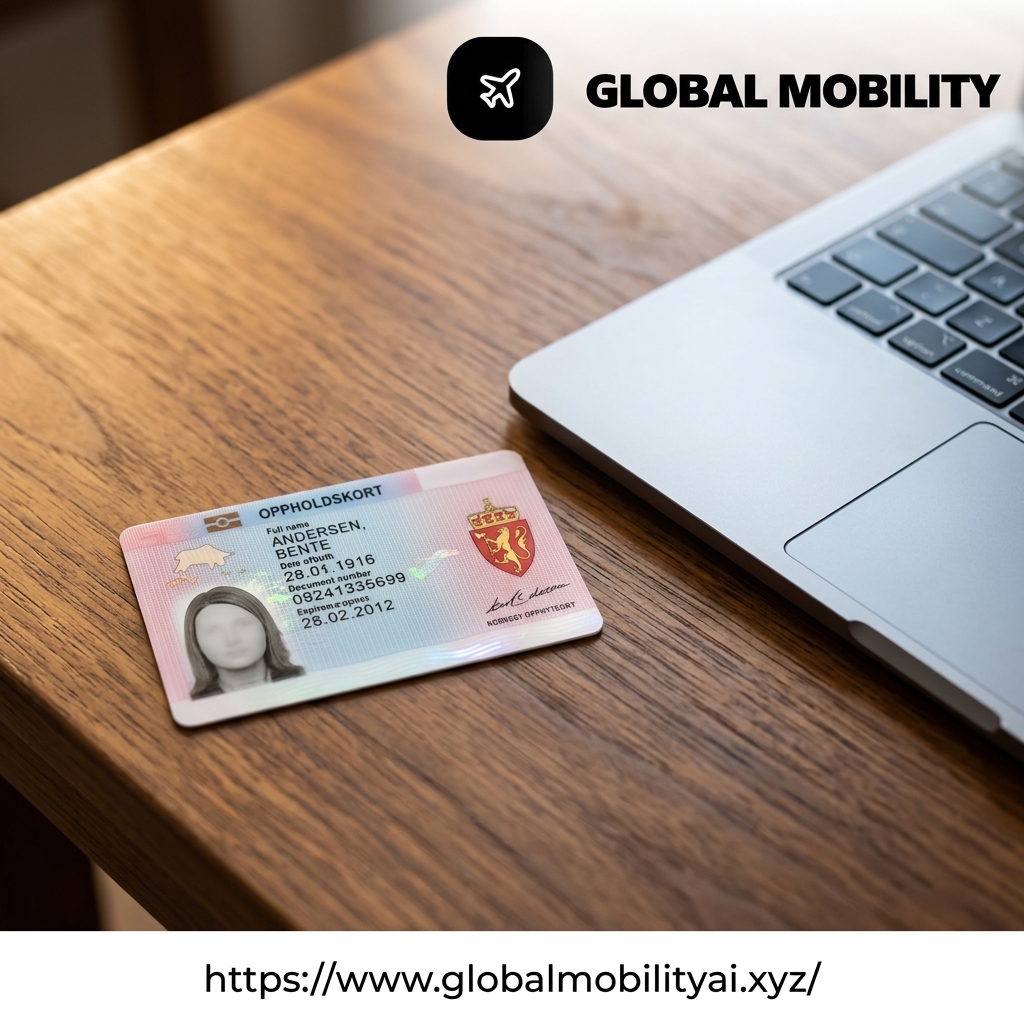
IMG-07: Norwegian Residency Card
The physical Norwegian Residence Card (Oppholdskort) issued to Skilled Worker visa holders.
11. Critical Risk Factors & Common Pitfalls
The Norway skilled worker visa 2026 is highly structured; minor bureaucratic missteps result in severe delays.

IMG-08: Document Compliance Audit
A meticulous review of employment contracts and immigration documents by Norwegian legal officers.
12. FAQ — People Also Ask
Q: Can I apply for the Norway skilled worker visa 2026 without a job offer?
No. A concrete job offer from a Norwegian employer is the absolute foundational requirement for this visa. The only exception is a specific 6-month job-seeker visa available only to researchers and highly qualified applicants, but it does not permit you to work until a job is secured.
Q: How much does a skilled worker earn in Norway?
The statutory minimums for 2026 are approximately NOK 530,000 for positions requiring a Bachelor's degree and NOK 560,000 for Master's degree roles. However, actual market salaries in tech and engineering generally start around NOK 650,000 and easily exceed NOK 1,000,000 for senior talent.
Q: Can my spouse work if I get the Norway skilled worker visa?
Yes. This is one of the greatest advantages of the Norwegian system. If you are granted a skilled worker permit, your spouse (or registered cohabitant) is eligible for family reunification. Once their permit is granted, they have full and unrestricted rights to work in any industry in Norway.
Q: How long does it take to get permanent residency in Norway?
Currently, you must hold legal residence (such as the skilled worker visa) continuously for 3 years to be eligible to apply for permanent residency. However, you must also pass Norwegian language tests (minimum A2 level, though B1 is highly recommended) and a social studies test.
Q: Is it true that Norway has a 37.5 hour work week?
Yes. The standard working week is 37.5 hours (usually 08:00 to 15:30 or 09:00 to 16:30 with a 30-minute unpaid lunch). Overtime is strictly regulated by law and heavily compensated. Work-life balance is culturally enforced; staying late to "look busy" is viewed as inefficient, not dedicated.
Q: Do I need to speak Norwegian to get a job?
In tech, engineering, and academia, English is universally spoken and is often the primary corporate language. You do not strictly need Norwegian to secure the visa. However, lacking Norwegian limits your social integration and upward mobility into senior management outside of major international corporations.
Q: What is the processing time for the UDI in 2026?
If your employer is well-known and you submit a flawless application through the standard channels, processing can take between 4 to 8 weeks. However, if your educational background requires auditing or you use the "special qualifications" route, processing can exceed 4 months.
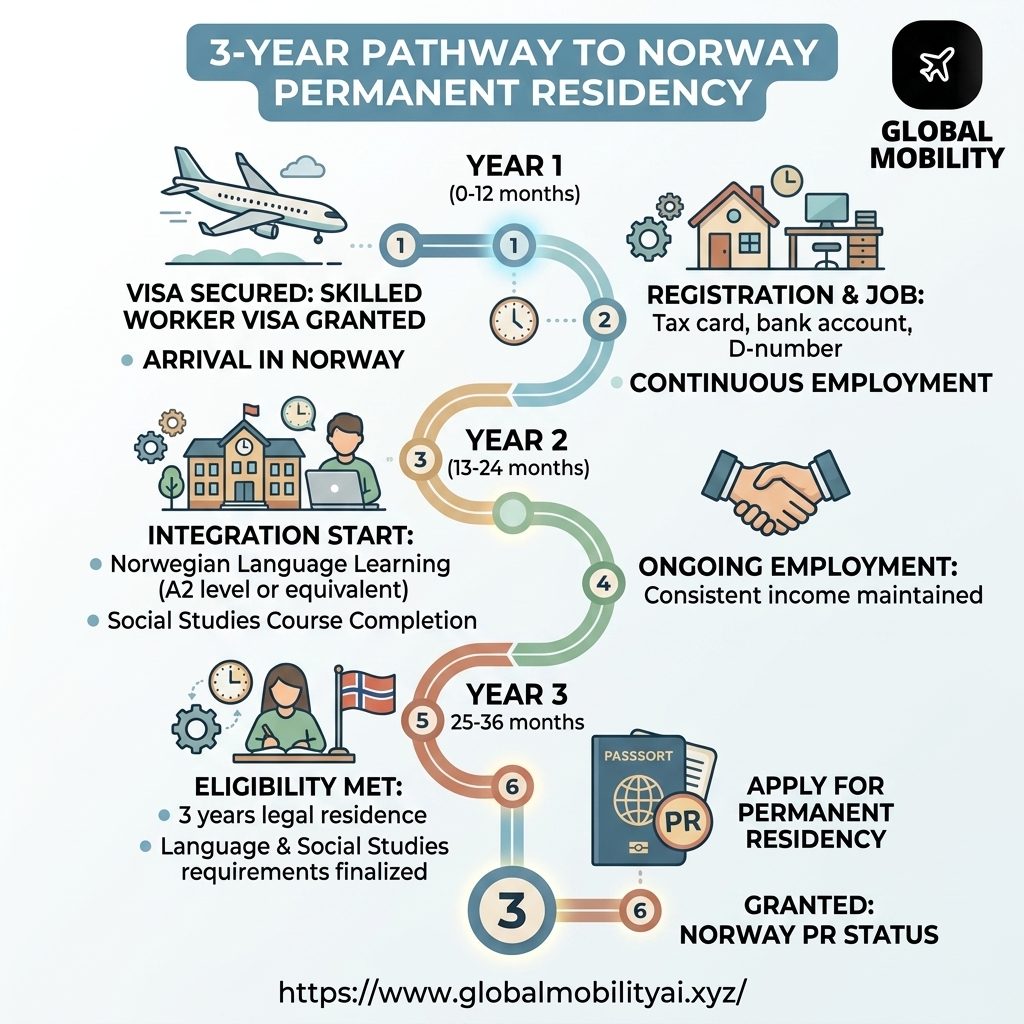
IMG-09: Norway Residency Pathway
Visualizing the 3-year pathway from Skilled Worker Visa to Norwegian Permanent Residency.
13. Conclusion: The Bottom Line
The Norway skilled worker visa 2026 offers an unparalleled gateway into one of the most stable, wealthy, and egalitarian societies on earth. By strictly enforcing high salary thresholds and demanding rigorous educational qualifications, the Norwegian government protects both its labor market and its foreign workers from exploitation. The financial trade-off is clear: you will face high taxes and an exorbitant cost of living, but in return, you receive world-class public services, immense geopolitical security, and a work-life balance that simply does not exist in North America or Asia.
Your strategic imperative is total compliance. You must ensure your Norwegian employer formally utilizes the UDI framework and that your offered salary definitively clears the statutory minimums for your specific degree level. Benchmark your offer using the GlobalMobilityAI Salary Comparison tool to avoid the "social dumping" trap, and leverage the Immigration Probability Score to pre-vet your documentation before entering the UDI portal. The Norway skilled worker visa 2026 is a highly efficient, transparent system—but only for professionals who respect the rules, adapt to the flat hierarchy, and execute the paperwork flawlessly.
Predict your mobility score.
Use our AI engine to get your personalized visa pathway, salary prediction, and relocation roadmap.
More Insights

Germany Opportunity Card 2026: Points, How to Apply & Fastest Jobs

The Ultimate Golden Visa Masterclass 2026: The Strategic Wealth & Mobility Blueprint