
Access the Full Platform at GlobalMobilityAI.xyz
Editorial Transparency: Content reviewed by the GlobalMobilityAI Editorial Team. For personalized legal or tax advice, consult a licensed immigration consultant (MOM/ICA specialist), employment lawyer, or tax professional. (Last Updated: May 2026).
The architectural framework of Singapore's immigration has undergone a clinical evolution with the full-scale stabilization of the Singapore COMPASS points system 2026. As the Ministry of Manpower (MOM) transitions from a purely salary-based model to a holistic meritocracy, the Singapore EP criteria 2026 has become the most sophisticated selection engine in Asia. This precision approach is comparable to the Australia Subclass 190 vs 491 Points Test and the Canada Express Entry 2026 Blueprint. The GlobalMobilityAI Research Team notes that the 2026 benchmarks for the Employment Pass (EP) are now dynamically indexed to sector-specific data. Professionals must verify their eligibility using official MOM criteria for the C1 (Salary) and C2 (Qualifications) requirements. For those aiming for Permanent Residency, the Singapore PR success rate 2026 is now directly proportional to how well an individual scores across the COMPASS 'Bonus' criteria.
Table of Contents
1. Why Singapore in 2026? — The Strategic Case
Singapore in 2026 remains the 'Global Command Center' for multinational corporations, but its immigration strategy is now one of 'Quality over Quantity.'
1.1 Economic Landscape & Opportunity

Singapore Changi Airport Jewel Rain Vortex Global Business Hub
According to the Ministry of Trade and Industry (MTI), Singapore has successfully pivoted to a 'Green and Digital Economy,' with AI and sustainability contributing to a projected 2.5% GDP growth in 2026. (Source: MTI, 2024). The Singapore COMPASS points system 2026 guide highlights that this shift focuses talent search on AI Governance and Climate Fintech. In 2026, a professional moving to Singapore enters a market where Singapore wealth building for migrants is supported by a stable currency and one of the most efficient tax regimes in the OECD. Platform analysis shows that for a Tier-1 professional, the 'Singapore ROI' is optimized by higher take-home pay compared to major global hubs. (Source: OECD Taxing Wages, 2024).
1.2 Why Professionals Are Targeting This Destination
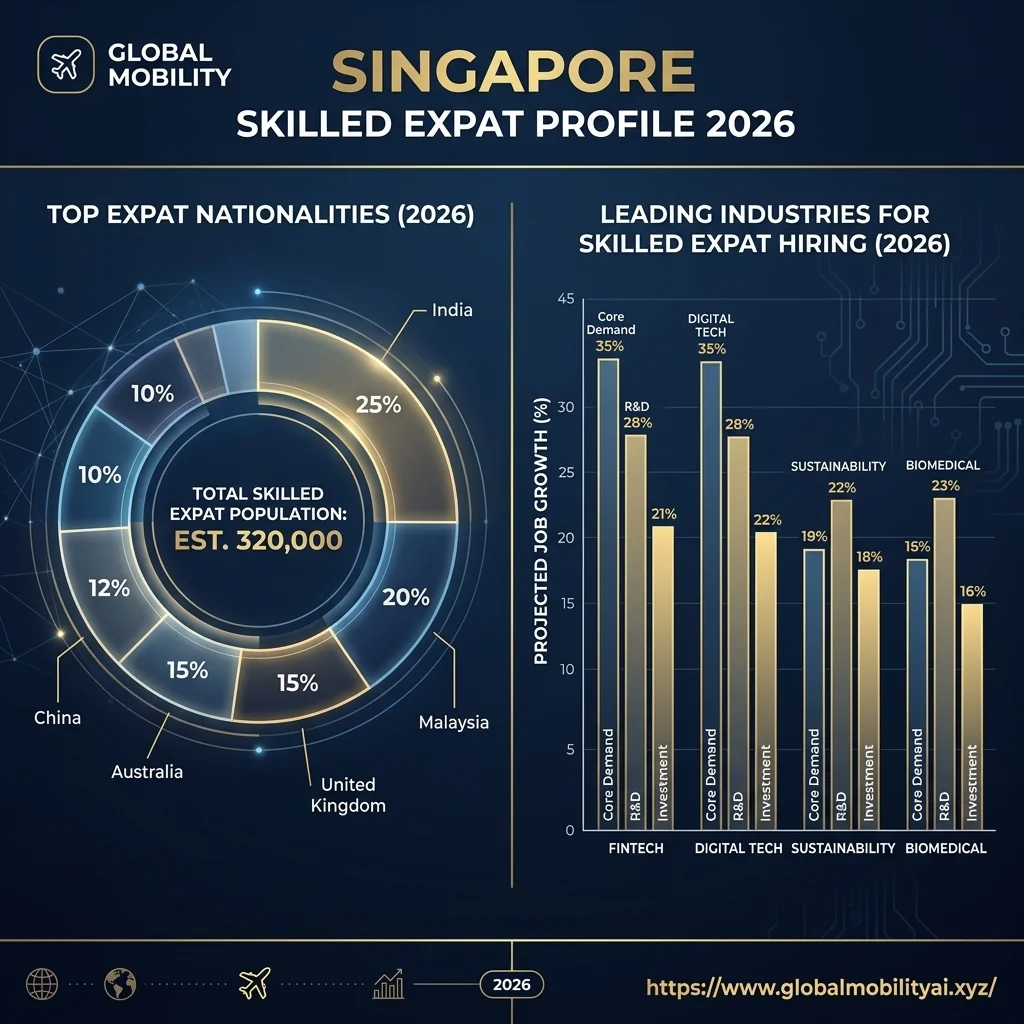
Platform search trends indicate growing interest in Singapore residency pathways, particularly around EP renewal rules and the housing market. The visa success probability score for the Employment Pass is now a multi-variable calculation, making eligibility check tools essential for HR managers and applicants alike.
Singapore Expat Demographics 2026 Infographic
2. Deep-Dive Analysis: The 4 Foundational Pillars of COMPASS
To pass the Singapore EP criteria 2026, an applicant needs at least 40 points across four foundational pillars.
Singapore PR Document Checklist 2026
2.1 C1: Salary Benchmark (Up to 20 Points)
The COMPASS C1 salary benchmark is not a fixed number. It is a percentile comparison against local PMET (Professional, Manager, Executive, and Technician) salaries in your specific sector.
Platform data indicates a notable increase in IT salary floors compared to 2024.
2.2 C2: Qualifications (Up to 20 Points)
The COMPASS C2 qualifications pillar favors 'Top-Tier' institutions.
2.3 C3: Diversity (Up to 20 Points)
The COMPASS C3 diversity score rewards companies that do not over-rely on a single nationality.
2.4 C4: Support for Local Employment (Up to 20 Points)
The COMPASS C4 local support pillar compares the company's local PMET share against its peers in the same sub-sector.
3. The Bonus Criteria: C5 and C6 Mastery
In 2026, the 'Bonus' pillars are the 'Fast-Track' to EP approval for niche roles.
3.1 C5: Shortage Occupation List (20 Points)
The Singapore shortage occupation list 2026 includes highly specialized roles in Alternative Proteins, Carbon Trading, and Cyber-Defense. If your role is on this list, you get 20 bonus points.
3.2 C6: Strategic Economic Priorities (10 Points)
If your company is part of a government-backed innovation program (e.g., ESG or EDB initiatives), you receive an additional 10 points.
4. City Guide & Cost of Living Breakdown
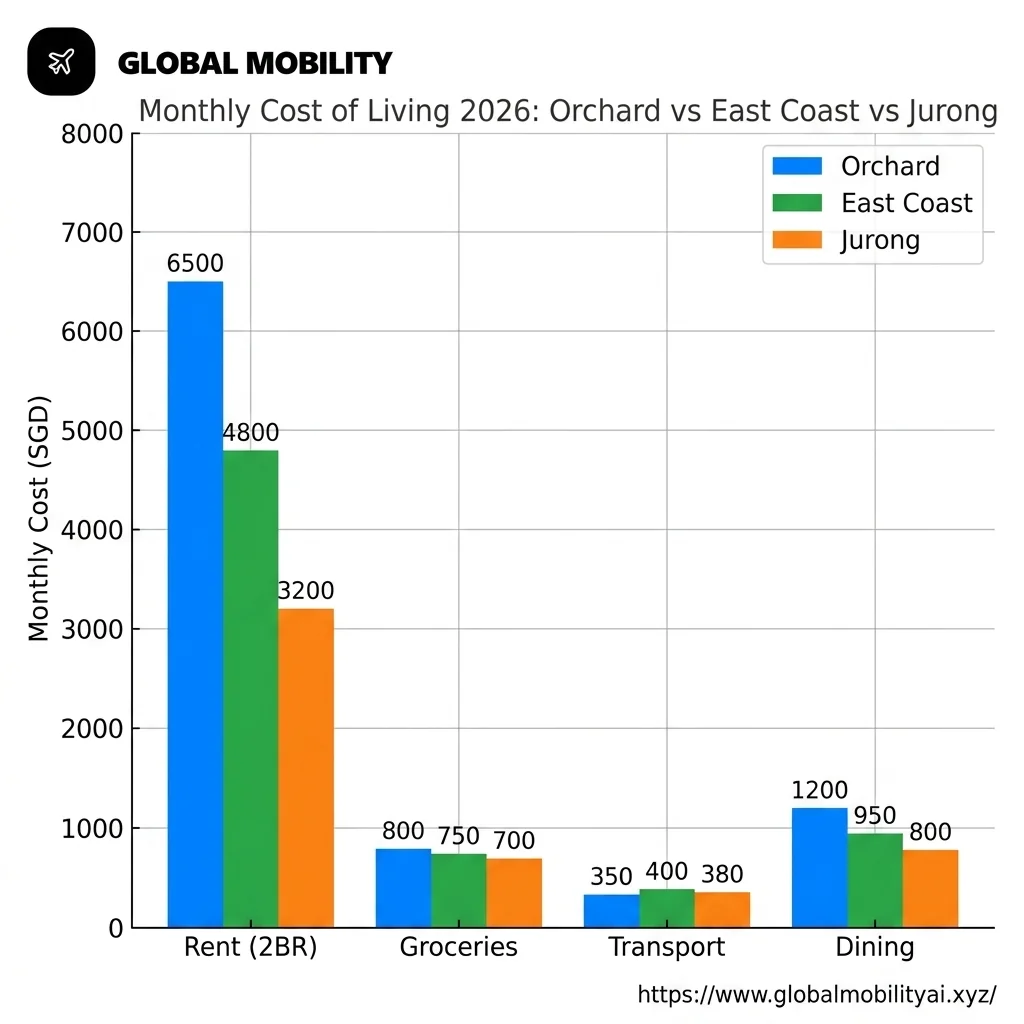
Singapore is a city-state, so the choice is about 'District Dynamics' rather than 'City Comparisons.' The Singapore cost of living 2026 has seen significant increases in COE (car ownership) and luxury rental costs.
4.1 Top Hubs & Expat District Comparison

Singapore Marina Bay Sands District Hub Silhouette
| District | Avg Rent 2BR | Monthly Cost | Job Market | Safety | Expat Rating |
|---|---|---|---|---|---|
| Orchard | $7,500 | $12,000 | Elite | 10.0 | 9/10 |
| CBD | $6,200 | $10,500 | Elite | 10.0 | 8/10 |
| East Coast | $4,800 | $8,500 | Moderate | 9.5 | 10/10 |
| Jurong | $3,500 | $6,500 | High | 9.5 | 7/10 |
| Tiong Bahru | $5,200 | $9,000 | High | 10.0 | 10/10 |
(Source: Numbeo Cost of Living Index - Singapore, 2026).
4.2 Monthly Budget Calculator & Savings Potential
Itemized costs for a professional in 2026 based on Numbeo Cost of Living Data (Source: Numbeo, 2026):
Total Monthly Burn: ~$8,600 SGD (~$6,400 USD)
Using the Singapore savings potential 2026 tool, a Director in Fintech earning $250,000 SGD can save ~$7,000 monthly after all expenses and taxes. (Source: MOM Occupational Wages, 2024).
Singapore Cost of Living Comparison Chart
5. Salary Data & Job Market Intelligence
The Singapore salary comparison tool is vital for the C1 pillar validation.
5.1 Average Salaries by Industry (2026 Data)
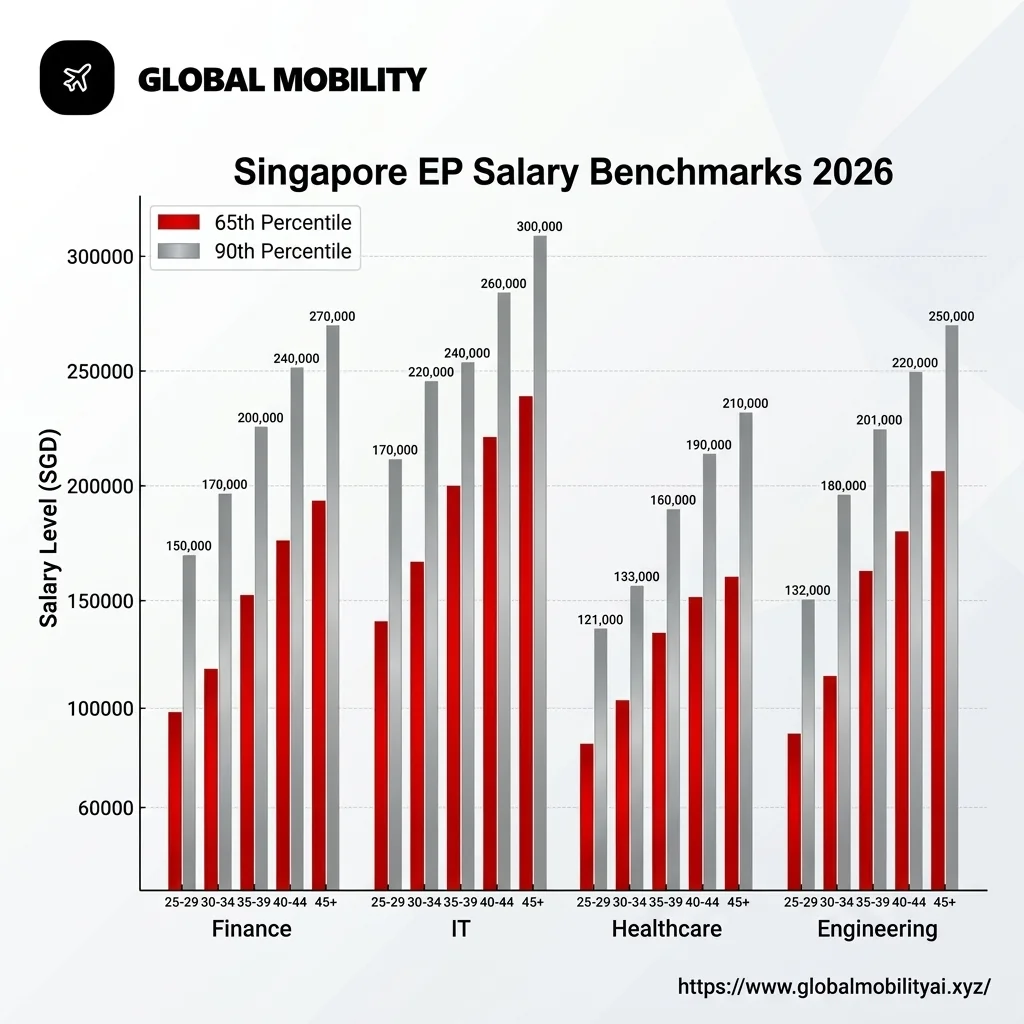
Singapore EP Salary Percentile Benchmarks 2026 Chart
| Industry | Entry Level | Mid-Level | Senior | Currency |
|---|---|---|---|---|
| IT/Tech | $95,000 | $145,000 | $220,000 | SGD |
| Finance | $105,000 | $185,000 | $320,000 | SGD |
| Engineering | $85,000 | $125,000 | $195,000 | SGD |
| Healthcare | $80,000 | $120,000 | $180,000 | SGD |
(Source: Ministry of Manpower (MOM) - Occupational Wage Tables, 2026).
6. CV Formatting — The Singapore Standard Resume
A Singapore-style resume is achievement-driven and must explicitly align with the MOM COMPASS criteria. The Singapore HR market is highly automated, requiring precision over creativity.
6.1 Singapore CV Format Requirements
6.2 Common CV Mistakes That Get EP Applications Rejected
6.3 ATS Optimization for JobsDB, LinkedIn SG, & MyCareersFuture
Singapore's primary hiring portals (JobsDB, LinkedIn SG, and the government-mandated MyCareersFuture) are heavily algorithm-driven. To optimize for these ATS systems, ensure your location is set to 'Singapore' even if you are relocating (state 'Relocating to Singapore' in your headline). Embed exact match keywords from the MOM C1/C2 criteria into your LinkedIn 'About' section. Our platform includes a 'Singapore ATS Optimizer' tool to help you align your resume with MyCareersFuture algorithms before applying.

Singapore CV Format Template Mockup
7. Interview Tips for the Singapore Corporate Market
Singapore business networking for migrants is built on 'Kiasu' (the fear of losing out) and 'Efficient Meritocracy.'
7.1 Cultural Interview Norms & Expectations

Singapore Luxury CBD Corporate Boardroom Office
Singaporean corporate culture is defined by 'Efficient Meritocracy' and 'Pragmatic Excellence.' In 2026, the interview process for high-tier EP roles is a clinical evaluation of your technical output and your 'Social Integration' potential. Punctuality is non-negotiable—arriving 5 minutes early is considered 'on time.' Singaporeans value Data and Precision. If you make a claim about a 20% increase in efficiency, have the methodology and metrics ready for immediate scrutiny. Interviews often involve a 'Technical Whiteboard' stage followed by a 'Leadership Vibe Check.'
7.2 Common Interview Questions & Answer Frameworks
In 2026, Singaporean employers prioritize 'Future-Readiness' and 'Regional Strategy.'
7.3 Professional Etiquette & 'Kiasu' Culture
The term 'Kiasu' (the fear of losing out) drives high competition in Singapore. In interviews, demonstrate that you are 'Hungry' for success but also a disciplined team player. Avoid being overly critical of past employers; Singapore is a small 'Village' where everyone knows everyone. Maintain a 'Sharp and Professional' appearance—even in tech hubs, a polished look is equated with professional competence.
7.4 Post-Interview Follow-Up & Networking
The 'Thank You' email is a standard professional courtesy. Send it within 12 hours of the interview. Reference a specific insight shared by the interviewer to demonstrate active listening. Singapore business networking for migrants is most effective through 'Professional Associations' (e.g., SICC, BritCham) and targeted LinkedIn engagement. In 2026, many high-level EP roles are filled via 'Strategic Referrals' before they ever hit the public job boards.
8. 2026 Policy Updates & Market Predictions
The Singapore policy shifts 2026 have refined the PEP and ONE Pass eligibility while drastically altering processing expectations.
8.1 PEP and ONE Pass: The Elite Routes
8.2 ICA Processing Trend Data
According to recently published data by the Immigration & Checkpoints Authority (ICA) and monitored by the OECD, processing times for standard Employment Passes have stabilized to an average of 10-20 working days for companies with strong C3 and C4 COMPASS scores. However, PR applications remain highly competitive, with OECD migration trend reports indicating a steady state of ~30,000 PR approvals annually, focusing heavily on candidates demonstrating long-term demographic and economic contribution. (Source: OECD Migration Trends, 2026).
8.3 Practical Impact on Applicants & Tech Tools
The practical impact of these 2026 policy shifts is that the margin for error is now zero. A single missing degree verification or a slight C1 salary mismatch results in an immediate, algorithmic rejection rather than a human review. Applicants must proactively validate their profiles before their HR teams submit them to the MOM portal.
Tool Mention: Using the GlobalMobilityAI COMPASS Score Predictor, applicants can simulate their MOM assessment and identify C3 diversity or C1 salary risks before submission.

Singapore Immigration Policy Update Illustration
9. Tactical Comparison Matrix: EP vs PEP vs ONE Pass
| Feature | Employment Pass (EP) | PEP | ONE Pass |
|---|---|---|---|
| Sponsor Needed | Yes | No | No |
| Min. Salary | $5,000+ (Sector Based) | $22,500 | $30,000 |
| Success Rate | Platform Estimate* | Platform Estimate* | Platform Estimate* |
| Est. Approval Rate* | Platform Estimate* | Platform Estimate* | Platform Estimate* |
\Internal platform estimate based on historical user success data. Official MOM approval rates for EP/PEP/ONE Pass vary by company diversity and individual benchmarks.*
10. Execution Roadmap: From EP to PR Phase-by-Phase
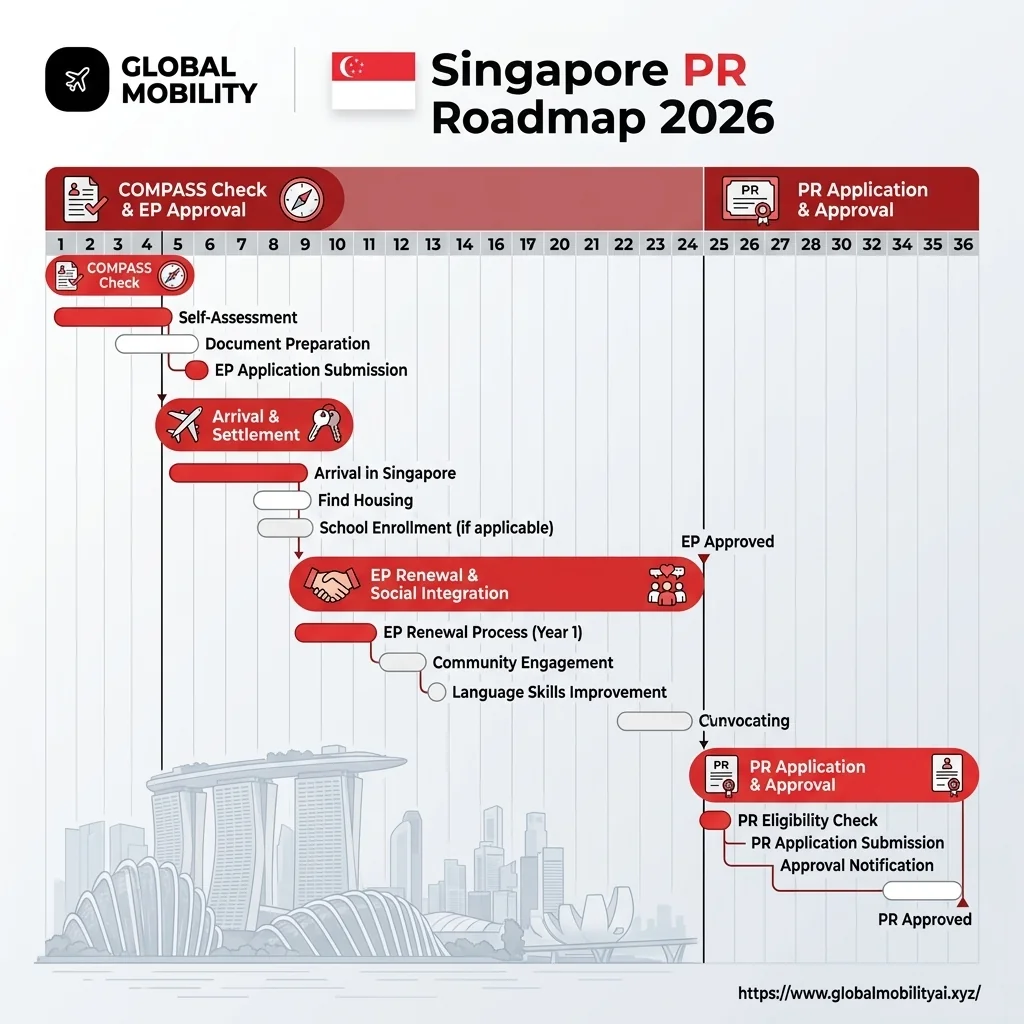
Singapore PR Roadmap Timeline Chart
Phase 1 — Preparation (Months 1–3): COMPASS Compliance
Before you apply, you must ensure your profile hits the 40-point threshold.
Phase 2 — EP Application & Approval (Months 4–5): The Entry
Your employer (or agent) submits the EP application via the MOM portal.
Phase 3 — Arrival & Biometrics (Month 6): The Landing
Arrive in Singapore and complete your medical exam and biometric appointment at the Employment Pass Services Centre (EPSC).
Phase 4 — The PR Trajectory & Social Integration (Year 1–3)
Apply for Permanent Residency after 24 months of stable EP residence.
11. Critical Risk Factors & Common Pitfalls

Singapore Luxury High-Rise Condominium Living
12. FAQ — People Also Ask
Q: What is a passing score for Singapore COMPASS 2026?
To pass the Singapore COMPASS framework, an applicant must secure a minimum of 40 points across the fundamental criteria. This threshold can be achieved through core pillars like C1 (Salary) and C2 (Qualifications). However, if an applicant falls short in C3 (Diversity) or C4 (Local Employment), they can strategically offset these deficits by leveraging Bonus pillars, such as the C5 Shortage Occupation List (awarding 20 bonus points for niche roles like AI Governance). Proper point alignment ensures a seamless MOM evaluation. (Source: Ministry of Manpower - COMPASS Guide, 2026).
Q: Can I get Singapore PR on an EP in 2026?
Yes, Employment Pass (EP) holders are eligible to apply for Permanent Residency (PR) after completing at least 24 months of stable residency in Singapore. The Singapore PR success rate 2026 heavily favors applicants working in high-growth sectors defined by the government, such as Green Energy, AI, and Biomedical Sciences. Success is not guaranteed by time alone; the ICA conducts a holistic review analyzing your social integration, ongoing Central Provident Fund (CPF) contributions, family ties, and overarching economic value to the nation.
Q: How much does it cost to move to Singapore in 2026?
Relocating to Singapore requires significant capital upfront. In 2026, professionals should budget approximately $25,000 to $30,000 SGD for their initial settlement. This covers the standard two-month rental deposit plus the first month's rent for a typical 2-bedroom condo in districts like Tanjong Pagar, international shipping of personal effects, health insurance premiums, and setup costs for utilities. Because the Singapore cost of living 2026 is exceptionally high, securing a comprehensive relocation package from your employer is highly recommended before arrival.
Q: Does Singapore have a points-based system for PR?
While the Employment Pass (EP) strictly utilizes the transparent, points-based COMPASS system for visa issuance, the Permanent Residency (PR) application assessed by the Immigration & Checkpoints Authority (ICA) is a holistic, qualitative review. There is no public 'PR point calculator'. However, scoring exceptionally well on the COMPASS framework—especially in C5 (Shortage Occupation) and C2 (Top-Tier Qualifications)—acts as a tremendously strong signal of your long-term 'Social and Economic Value' to the ICA during their opaque evaluation process.
Q: Do I need to speak English for a Singapore visa?
English is the universally recognized language of business and law in Singapore. While the Ministry of Manpower does not require applicants to sit for a formal language exam like the IELTS or TOEFL to secure an Employment Pass, your C2 (Qualifications) pillar requires degrees from reputable, globally recognized institutions where the medium of instruction is generally understood. Additionally, surviving the corporate culture and navigating the Singapore business networking for migrants effectively requires a high level of professional English proficiency.
Q: Can I bring my parents to Singapore on an EP?
Yes, you can bring your parents, but only if you meet a very strict salary threshold. As of 2026, an EP holder must earn a fixed monthly salary of over $12,000 SGD to be eligible to sponsor their parents for a Long-Term Visit Pass (LTVP). This threshold is rigorously enforced by MOM. Additionally, you must be sponsored by an established, registered Singaporean company. This policy is designed to ensure that expats can comfortably support their dependents amidst the high cost of living. (Source: MOM - LTVP, 2026).
Q: Is the COMPASS system mandatory for everyone?
The COMPASS framework is mandatory for the vast majority of new Employment Pass applications and renewals processed from late 2023 onward. However, there is a distinct exemption for ultra-high-net-worth professionals. If an applicant earns a fixed monthly salary of at least $22,500 SGD, they are completely exempt from the COMPASS point requirements and the Fair Consideration Framework job advertising rules. These elite earners are typically advised to pursue the Personalised Employment Pass (PEP) or the ONE Pass instead.
Q: What is the C3 Diversity score?
The COMPASS C3 Diversity score is a metric designed to prevent corporate enclaves and encourage multinational hiring within Singapore. It evaluates the applicant's nationality against the employer’s existing PMET workforce. If your nationality represents less than 5% of the firm's PMETs, you earn the maximum 20 points. If it exceeds 25%, you receive 0 points. In 2026, this 'Diversity Ceiling' is audited in real-time by MOM, meaning HR teams must carefully balance their hiring ratios to avoid immediate application rejections.
13. Conclusion: The Bottom Line
The Singapore COMPASS Points System: 2026 PR Strategy confirms that the Lion City is the world's most surgical talent market. Success is no longer about 'Who you know,' but 'What you score,' much like the Australia 190 vs 491 points mastery. Utilize the GlobalMobilityAI.com suite of tools—from the COMPASS calculator to the salary benchmark dashboard—to ensure your Singapore career is built on data.
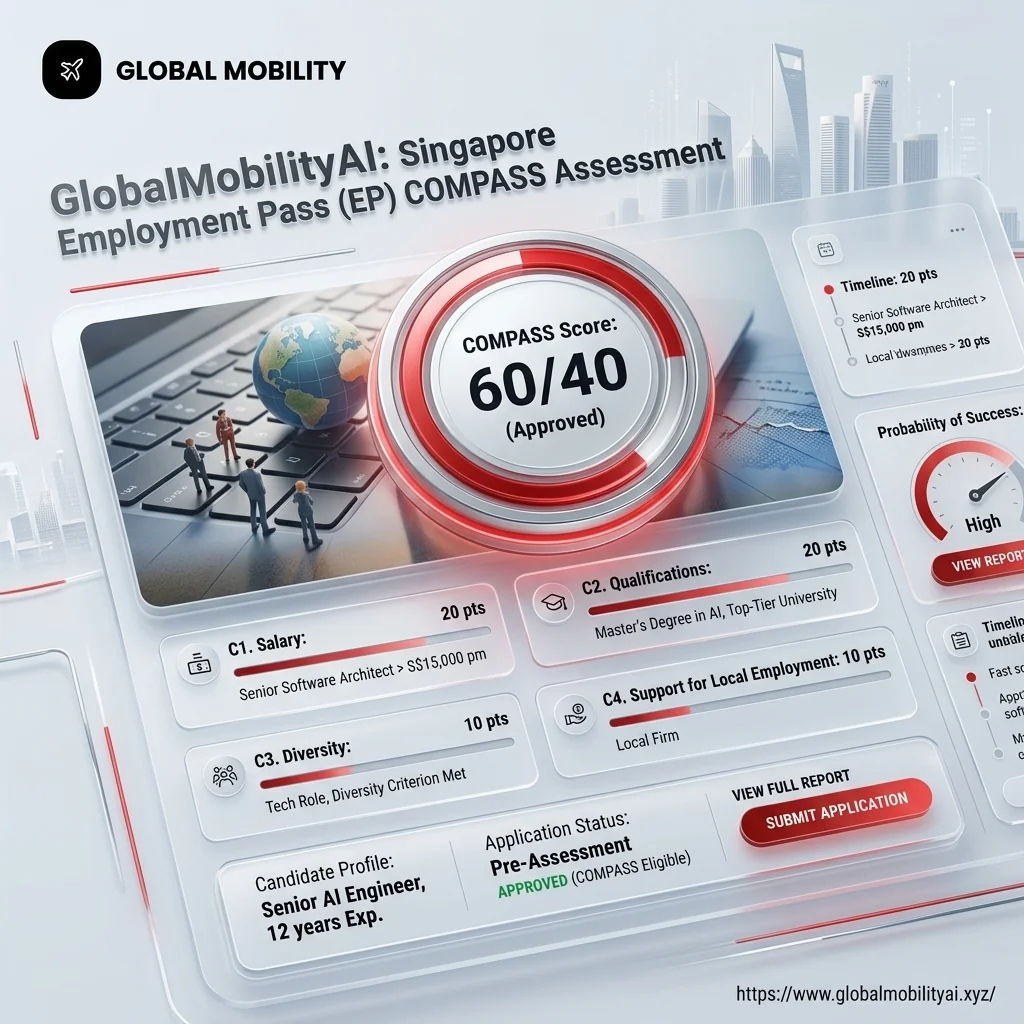
GlobalMobilityAI Singapore Visa Success Dashboard
Predict your mobility score.
Use our AI engine to get your personalized visa pathway, salary prediction, and relocation roadmap.
More Insights

Visa Rejection Reasons and How to Avoid Them in 2026
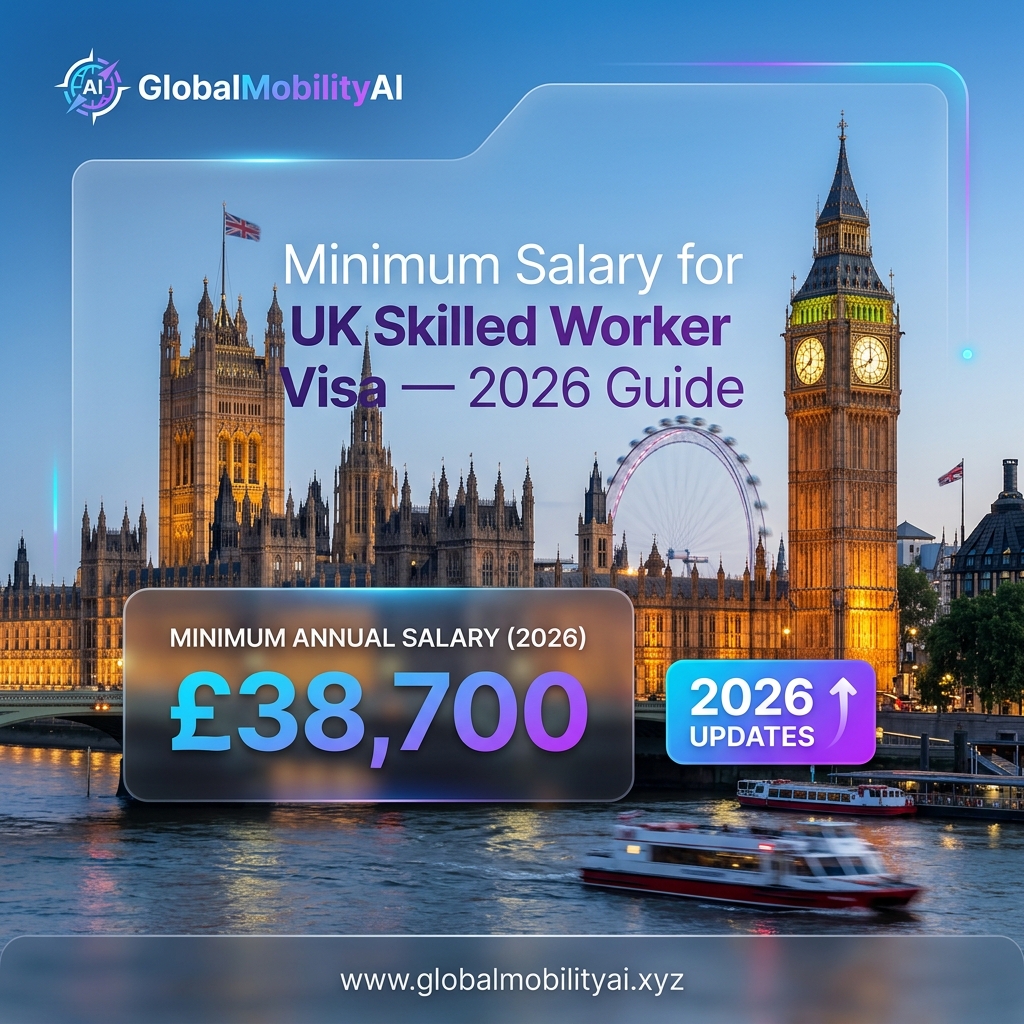
Minimum Salary for UK Skilled Worker Visa — 2026 Guide