
Editorial Transparency: Content compiled from official Spanish government sources (Ministerio de Inclusión, Seguridad Social y Migraciones) by the GlobalMobilityAI Research Team. For personalized legal or tax advice, consult a licensed Spanish immigration lawyer or gestor. (Last Updated: 2026-05-28)
The European landscape for remote work and tech entrepreneurship has been permanently altered, and at the absolute vanguard of this movement is the Spain startup law visa 2026. Originally born from the highly ambitious "Ley de Startups" legislation, the 2026 iteration of this visa framework has matured into the most aggressive, tax-efficient, and streamlined immigration pathway in the European Union. Designed explicitly to drain global tech talent from restrictive jurisdictions, this visa is not a standard work permit—it is a comprehensive legislative package that offers a flat 24% tax rate (the expanded Beckham Law), expedited processing for startup founders, and a direct runway to permanent residency and citizenship. Whether you are a solo digital nomad optimizing your tax burden in the sun-drenched tech hub of Malaga, or a venture-backed founder pitching your business plan to ENISA in Madrid, understanding the mechanical realities of the Spain startup law visa 2026 is critical. At GlobalMobilityAI.xyz, our research team has mapped the exact financial thresholds, bureaucratic hurdles, and strategic pivots required to secure your approval without relying on expensive, outdated legal advice.
A comprehensive visual overview of the Spanish remote tech lifestyle and Startup Law residency opportunities for 2026.
Table of Contents
1. Why Spain in 2026? — The Strategic Case
For decades, Northern Europe dominated the tech migration narrative. However, the Spain startup law visa 2026 has successfully diverted the flow of global talent southward, combining aggressive tax incentives with a highly favorable climate and cost of living arbitrage.

Historic Spanish architecture juxtaposed with modern tech workers in Valencia.
1.1 Economic Landscape & Opportunity
The Spanish economy in 2026 has successfully pivoted from a heavy reliance on tourism to becoming a formidable European digital stronghold. Driven by the "España Nación Emprendedora" strategy, foreign direct investment in Spanish tech has surged, particularly in fintech, renewable energy tech, and AI infrastructure. Unlike the UK or Germany, which have tightened immigration controls amidst political shifts, Spain has codified its welcoming stance into law. The Spain startup law visa 2026 provides a legally protected fast-track for remote workers and highly qualified professionals to integrate into this growing ecosystem, bypassing the notoriously slow traditional work visa routes (Source: Ministerio de Asuntos Económicos y Transformación Digital, 2026) [https://portal.mineco.gob.es/].
1.2 Why Professionals Are Targeting This Destination
The primary catalyst for the massive influx of foreign talent is the tax framework. The expansion of the Special Tax Regime (Régimen Especial para Trabajadores Desplazados, colloquially known as the Beckham Law) allows remote workers and startup founders entering under the Spain startup law visa 2026 to pay a flat 24% income tax on up to €600,000 of income for their first five years, exempting their global wealth from Spain's standard progressive tax rates (which can exceed 45%). Coupled with near-perfect year-round weather and robust fiber-optic infrastructure, Spain is the undisputed king of European remote work bases in 2026.

DEMO-INFOGRAPHIC-01: Expat Community Profile
A demographic breakdown of digital nomads, founders, and remote workers migrating to Spain's primary tech hubs.
2. Deep-Dive Analysis: Legal & Financial Framework
The legislation underpinning the Spain startup law visa 2026 is split into two primary, highly distinct tracks: The Digital Nomad Visa (Teletrabajador de carácter internacional) and the Innovative Startup Founder Visa (Emprendedor).
2.1 The Digital Nomad Track (Teletrabajadores)
This track is engineered for remote employees and freelancers.
2.2 The Startup Founder Track (Emprendedores)
This track requires no specific passive income, but the barrier to entry is entirely based on the merit of your business plan.
2.3 Required Documentation & Official Checklists
For the Digital Nomad track, the documentation is rigorous and requires apostilled translations.
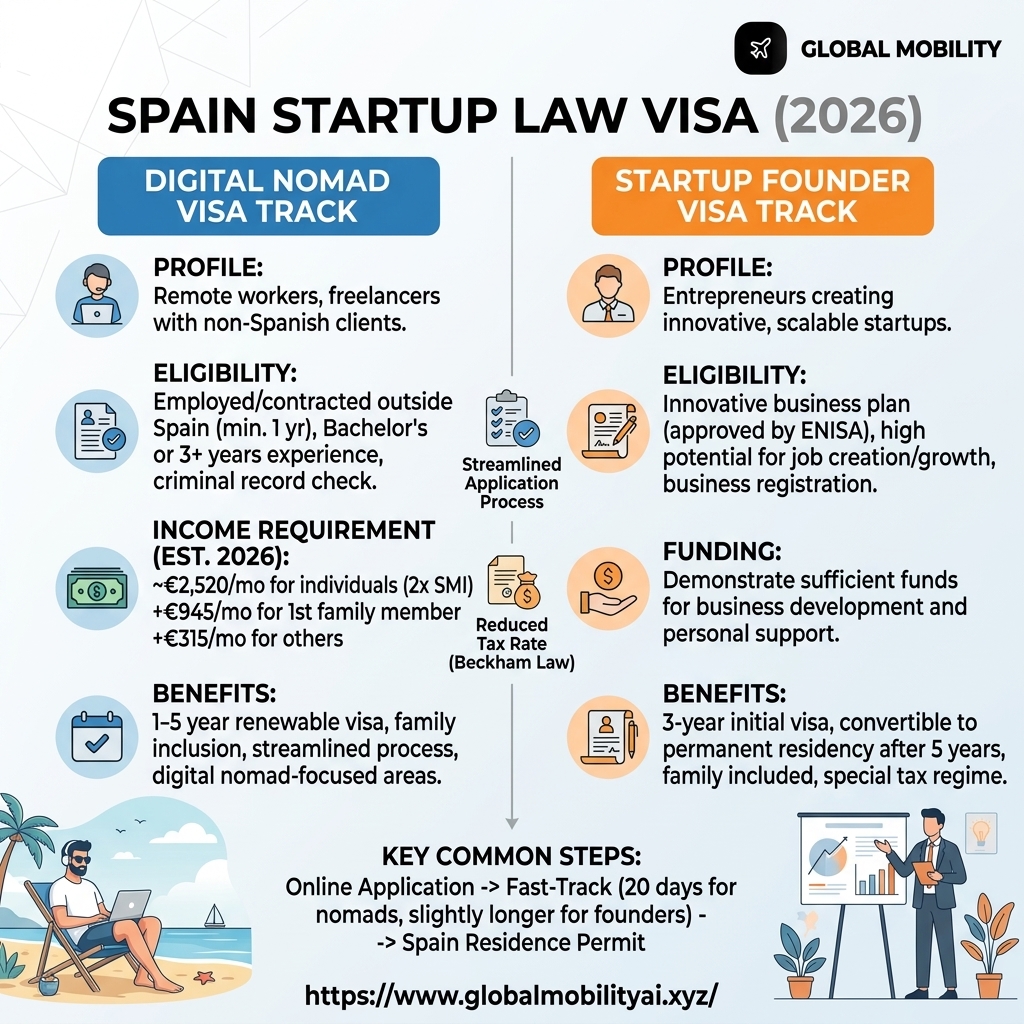
IMG-02: Work Permit Categories
Visual classification of the Digital Nomad and Startup Founder tracks under the 2026 Startup Law framework.
3. City Guide — Where to Live in Spain in 2026
Where you establish your fiscal residency under the Spain startup law visa 2026 will dictate your lifestyle, networking opportunities, and overhead costs.
3.1 Top 5 Cities for Tech & Nomads: Rankings & Analysis
3.2 City Comparison Table
| City | Avg Rent 1BR | Monthly Cost | Tech Scene | Safety | Nomad Rating |
|---|---|---|---|---|---|
| Malaga | €1,100 | €2,400 | Explosive | High | 9.8/10 |
| Barcelona | €1,400 | €2,900 | Elite | Moderate | 8.9/10 |
| Valencia | €950 | €2,100 | Growing | High | 9.5/10 |
| Madrid | €1,250 | €2,700 | Elite | High | 8.8/10 |
| Las Palmas | €850 | €1,800 | Strong | Very High | 9.2/10 |
(Source: Numbeo Spain 2026, 2026)

IMG-03: Barcelona Tech Skyline
The modern skyline of Barcelona's 22@ innovation district, a major hub for Startup Law visa holders.
4. Cost of Living — Complete 2026 Breakdown
To maximize the benefits of the Spain startup law visa 2026, you must accurately model your monthly burn rate against the €2,800 minimum income requirement.
4.1 Monthly Budget Calculator Breakdown
For a single digital nomad or remote worker residing in a premium 1-bedroom apartment in Valencia:

Expats dining outdoors at a vibrant tapas bar in a Spanish city square.
(Source: Numbeo Cost of Living Survey, 2026) [https://www.numbeo.com/cost-of-living/in/Valencia]
4.2 Cost of Living vs. Salary: What You'll Actually Save
If you are entering on the Digital Nomad track, your savings are heavily reliant on the "Beckham Law" flat tax rate.
We strongly advise running your exact figures through the GlobalMobilityAI Cost of Living Calculator to accurately assess your post-tax savings potential in Spain versus your home country.

CHART-1: Cost of Living Comparison Bar Chart
Comparative analysis of living expenses between Spain, the UK, the US, and Germany for 2026.

CHART-2: Salary vs. Savings Potential Line Chart
Projected 24-month savings trajectory for remote professionals utilizing the Beckham Law tax regime.
4.3 Cost of Living Index vs. Home Countries
(Note: Spain = Index 100. All values relative to the Spanish baseline.)
| Category | Spain | United Kingdom | United States | Germany |
|---|---|---|---|---|
| Groceries Index | 100 | 145.2 | 198.4 | 135.8 |
| Rent Index | 100 | 185.6 | 240.1 | 142.5 |
| Local Purchasing Power | 100 | 110.5 | 135.2 | 115.8 |
(Source: Numbeo Cost of Living Comparison, 2026) [https://www.numbeo.com/cost-of-living/compare_countries.jsp]
5. Salary Data & Job Market Intelligence
While the Spain startup law visa 2026 allows you to work remotely for foreign companies, many founders and highly skilled professionals eventually transition into the local ecosystem or hire local Spanish talent for their ENISA-approved startups.
5.1 Average Salaries by Industry (2026 Data)
| Industry | Entry Level | Mid-Level | Senior | Currency |
|---|---|---|---|---|
| Full-Stack Development | €30,000 | €45,000 | €65,000+ | EUR |
| Data Science & AI | €35,000 | €55,000 | €80,000+ | EUR |
| Tech Sales & BD | €25,000 | €40,000 | €60,000+ | EUR |
| Product Management | €32,000 | €50,000 | €70,000+ | EUR |
| UI/UX Design | €28,000 | €42,000 | €55,000+ | EUR |
(Source: InfoJobs Spain Salary Report, 2026) [https://www.infojobs.net/]
5.2 In-Demand Skills & Sectors in 2026
Spain is rapidly positioning itself as a European leader in Renewable Energy Tech, Web3 infrastructure, and Agritech. If you are a founder seeking ENISA approval under the Spain startup law visa 2026, aligning your business plan with the European Green Deal or Spain's National AI Strategy drastically increases your probability of immediate approval. The local talent pool is highly skilled but historically underpaid compared to Northern Europe, creating a massive opportunity for founders to build elite engineering teams at a fraction of the cost of London or Berlin.
5.3 How to Use GlobalMobilityAI Salary Comparison Tool
Founders utilizing the Spain startup law visa 2026 must execute precise payroll modeling. Use the GlobalMobilityAI Salary Comparison tool to benchmark local Spanish salaries against remote global rates, ensuring your startup remains capital-efficient while offering competitive compensation to local talent.

IMG-04: Spanish Tech Hub Office
International tech workers collaborating in a modern coworking space in Malaga.
6. CV Formatting & RGPD Compliance Guide
If you are a dependent spouse holding full work rights under the visa, or a nomad seeking local clients, your professional documentation must comply with strict European data protection laws.
6.1 Spain CV Format Requirements
6.2 The Mandatory RGPD / GDPR Clause
Spain heavily enforces the European General Data Protection Regulation (Reglamento General de Protección de Datos - RGPD). Spanish HR departments are legally forbidden from storing or processing your CV unless you explicitly grant them permission to do so within the document itself.
You must place the following legal clause in the footer of the last page of your CV. Failure to include this will result in compliance-focused recruiters instantly deleting your application to avoid massive fines.
Spanish RGPD Clause:
"De conformidad con el Reglamento (UE) 2016/679 (RGPD) y la Ley Orgánica 3/2018 (LOPDGDD), autorizo el tratamiento de mis datos personales incluidos en este currículum con la finalidad de participar en procesos de selección de personal actuales o futuros."
English Translation (If applying to a strictly English-speaking role):
"In accordance with Regulation (EU) 2016/679 (GDPR) and Organic Law 3/2018 (LOPDGDD), I authorize the processing of my personal data included in this CV for the purpose of participating in current or future personnel selection processes."
6.3 Common CV Mistakes That Get Applications Rejected
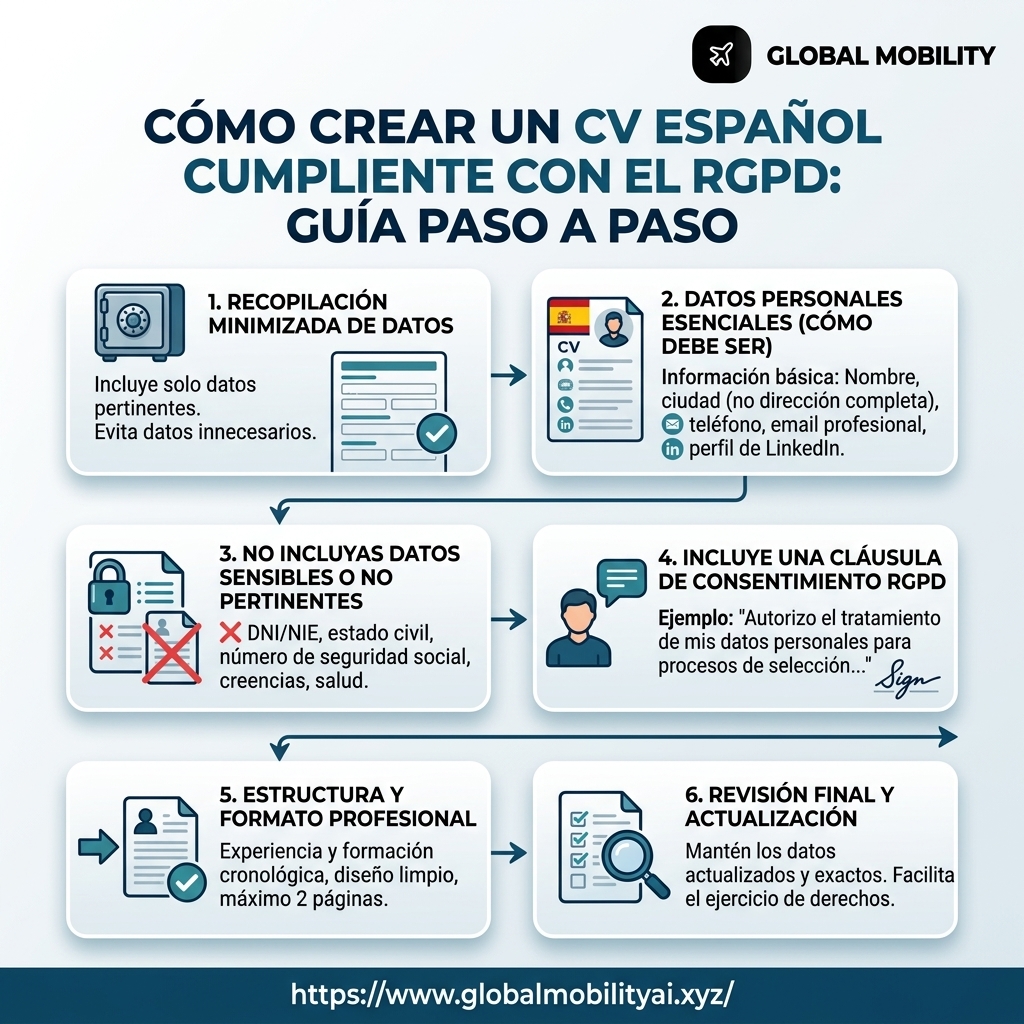
IMG-05: CV Optimization Process
A visual guide to structuring an RGPD-compliant, high-converting Spanish resume.
7. Interview Tips for the Spanish Tech Ecosystem
Navigating an interview with a Spanish startup or corporation requires a blend of European formality and Mediterranean warmth.
7.1 Cultural Interview Norms & Expectations
The Spanish business environment is highly relationship-driven. Initial interviews often focus heavily on "cultural fit" and personality rather than immediate technical grilling. Small talk is not just polite; it is a critical assessment of your interpersonal skills. Unlike the highly direct communication style of Northern Europe, Spanish communication can be more nuanced. Building rapport with your interviewer is often just as important as your technical test score.
7.2 Formal vs. Informal Language ("Usted" vs. "Tú")
In standard Spanish, "Usted" is formal, and "Tú" is informal. In the modern tech and startup scene, "Tú" is almost universally used, even in interviews. However, if you are interviewing with a traditional Spanish bank, telecom, or government entity, default to "Usted" until explicitly invited to use "Tú" (the practice of "tutear").
7.3 Common Interview Questions & Answer Frameworks
7.4 Dress Code, Punctuality & Professional Etiquette
Punctuality is expected for interviews, despite the stereotype of a relaxed Spanish timeframe. For tech startups, smart casual (clean sneakers, chinos, a button-down shirt) is standard. For finance or consulting, a suit without a tie is appropriate.

IMG-06: Corporate Interview Setup
Professional etiquette in a modern Spanish startup office environment.
8. 2026 Policy Updates & Market Predictions
The operational mechanics of the Spain startup law visa 2026 have been fine-tuned over the past three years to eliminate initial bureaucratic bottlenecks.
8.1 Key Policy Changes Effective 2026
The most impactful operational change in 2026 is the total digitization of the application process via the UGE-CE (Unidad Grande Empresas y Colectivos Estratégicos) portal (Source: UGE-CE, 2026) [https://www.mitramiss.gob.es/uge/].

Digital interface of the Spanish UGE-CE portal for visa permits.
8.2 Immigration Trend Predictions (Data-Backed)
The processing times for the Spain startup law visa 2026 have stabilized at a rapid 20 working days for the UGE-CE to issue an initial decision. However, the secondary step—securing an appointment to take your fingerprints and collect your physical TIE (Tarjeta de Identidad de Extranjero)—remains a massive bureaucratic bottleneck in major cities like Madrid and Barcelona. We predict this bottleneck will push more nomads toward highly efficient secondary cities like Valencia, Alicante, and Malaga, where police appointments are vastly easier to secure.
8.3 How These Changes Affect Your Application in 2026
You must execute a dual-track strategy. Applying for the visa is only step one; applying for the Beckham Law tax regime requires a separate, time-sensitive application to the Agencia Tributaria (Tax Agency) within six months of your arrival. Failure to hit this 6-month window means you will be subjected to standard, high progressive tax rates. Utilize the GlobalMobilityAI Immigration Probability Score to ensure your employer's corporate structure is recognized by the Spanish tax authorities before initiating the move.
9. Tactical Comparison Matrix
How does the Spain startup law visa 2026 stack up against its primary European competitors?
| Feature | Spain Digital Nomad Visa | Portugal D8 Visa | Italy Digital Nomad Visa |
|---|---|---|---|
| **Min. Income Requirement** | ~€2,800/month | ~€3,280/month | ~€2,333/month |
| **Flat Tax Rate Option** | Yes (24% Beckham Law) | No (NHR phased out) | Yes (50% exemption) |
| **Initial Visa Duration** | 3 Years (if applied in Spain) | 2 Years | 1 Year |
| **Pathway to Citizenship** | 10 Years (2 Years for LATAM) | 5 Years | 10 Years |
| **Wealth Tax Exposure** | Exempt (with Beckham Law) | N/A | Taxed on foreign assets |
| **Platform Estimate*** | Highly Favorable | Favorable | Bureaucratic |
*Internal platform estimate. Official approval rates not publicly published.
(Source: Ministerio de Inclusión, Seguridad Social y Migraciones, 2026) [https://www.inclusion.gob.es/]

CHART-3: Visa Processing Timeline Gantt Chart
Realistic phase-by-phase timeline for securing your Spanish residency and tax status.
10. Execution Roadmap: Phase-by-Phase
Securing the Spain startup law visa 2026 requires meticulous timing, especially regarding document apostilles which expire after 90 days.
Phase 1 — Document Gathering & Apostilles (Months 1–2):
Your criminal record check must be clean and freshly apostilled. You must gather your university degrees, a formal letter from your employer authorizing remote work, and three months of bank statements proving you meet the €2,800/month threshold. All non-Spanish documents must be translated by a Sworn Spanish Translator (Traductor Jurado).
Cost: Document Fees | Link: Traductor Jurado Registry | Timeline: 4-6 weeks
Phase 2 — Tourist Entry & UGE-CE Submission (Month 3):
Enter Spain on a standard Schengen visa (or visa-free if eligible). Submit your entire dossier electronically via the UGE-CE portal using a digital certificate. This is highly recommended to be done via a Spanish immigration lawyer to avoid technical errors. The UGE-CE has a statutory limit of 20 working days to respond (administrative silence is officially considered positive, though rarely utilized).
Cost: Legal Fees (€1,000-€2,000) | Link: UGE-CE Portal | Timeline: 20 Working Days
Phase 3 — TIE Collection & Tax Registration (Months 4–5):
Upon approval, you must secure a "Cita Previa" (prior appointment) at a local police station to register your fingerprints and collect your physical TIE residency card. Simultaneously, you must apply to the Agencia Tributaria for the Beckham Law special tax regime within your first 6 months.
Cost: Visa Fees (~€75) | Link: Agencia Tributaria | Timeline: 4-8 weeks
Phase 4 — Social Security & Healthcare (Month 6):
Depending on your home country, you will either continue paying social security in your home country (via a bilateral certificate of coverage) or register as an Autónomo in Spain and begin paying monthly social security contributions, which grants you access to the phenomenal Spanish public healthcare system.
Cost: ~€85/mo (Initial Autónomo) | Link: Seguridad Social | Timeline: Ongoing
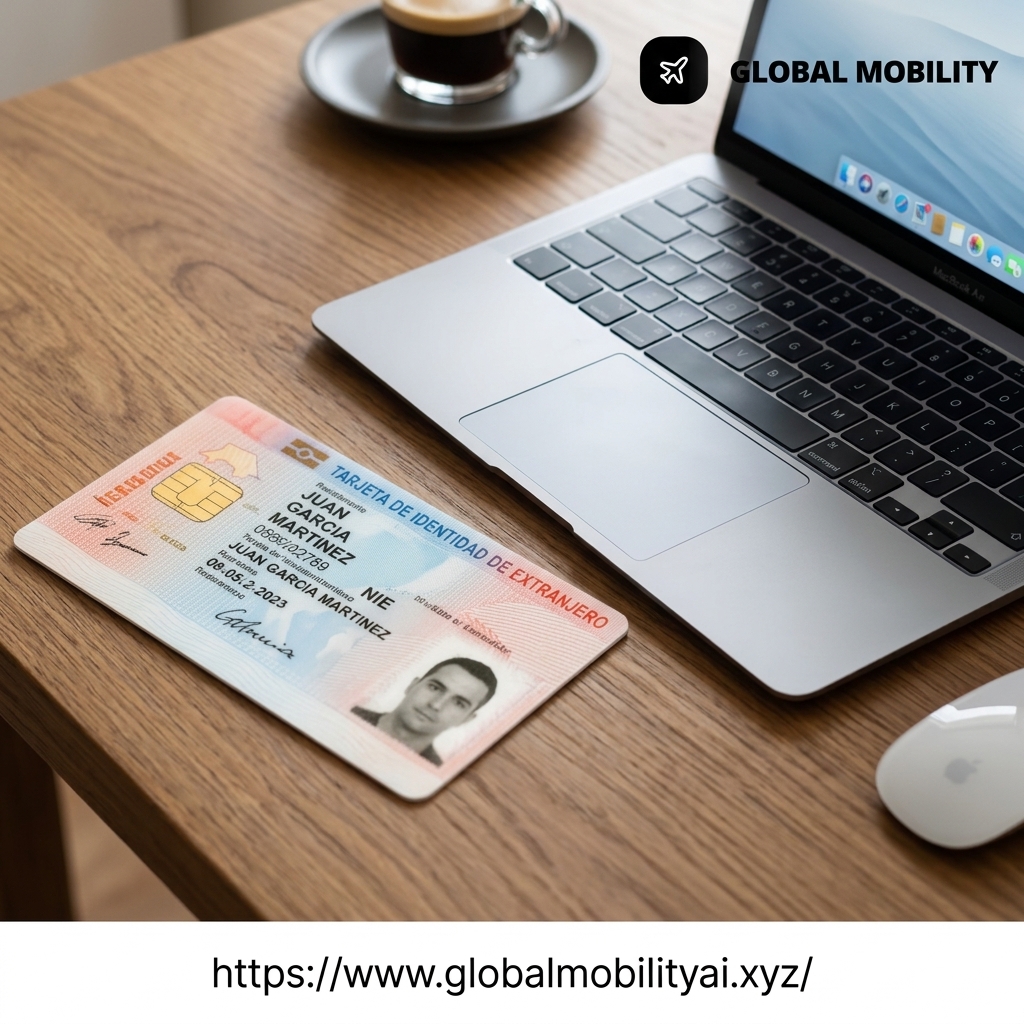
IMG-07: Spanish Residency Card
The physical Tarjeta de Identidad de Extranjero (TIE) issued to Startup Law visa holders.
11. Critical Risk Factors & Common Pitfalls
The Spain startup law visa 2026 is structurally sound, but applicant errors lead to high rejection rates in the pre-screening phase.

IMG-08: Document Compliance Audit
A meticulous review of immigration documents and sworn translations by Spanish legal officers.
12. FAQ — People Also Ask
Q: What is the Spain startup law visa 2026 income requirement?
For the Digital Nomad track, you must earn at least 200% of the Spanish Minimum Wage (SMI). In 2026, this translates to approximately €2,800 per month or €33,600 per year, proven via three months of bank statements and valid contracts.
Q: Does the Spain Digital Nomad Visa lead to permanent residency?
Yes. The visa is initially granted for 3 years (if applied for from within Spain) and can be renewed for an additional 2 years. After 5 continuous years of legal residency in Spain, you are eligible to apply for permanent residency.
Q: Can my spouse and children come with me?
Yes, the Spain startup law visa 2026 allows you to bring your spouse and dependent children. Your income threshold increases by 75% of the SMI for the first dependent, and 25% for each additional dependent. Crucially, your spouse is granted full working rights in Spain.
Q: How does the Beckham Law work for remote workers in 2026?
The newly expanded Beckham Law allows digital nomads and startup founders to opt into a flat income tax rate of 24% on up to €600,000 of income for their first five years in Spain. It also exempts you from the Spanish Wealth Tax on assets held outside of Spain. You must apply for this within 6 months of arrival.
Q: Do I need to speak Spanish to get the visa?
There is no language requirement to obtain the Spain startup law visa 2026. However, navigating the bureaucratic system (police appointments, renting apartments, opening bank accounts) without Spanish is extremely difficult. We highly recommend achieving at least an A2 level or hiring a local relocation gestor.
Q: Can I apply for the visa if I am already in Spain as a tourist?
Yes. One of the greatest advantages of the Startup Law is that you can enter Spain on a tourist visa (Schengen) and apply directly through the UGE-CE portal. This bypasses the consulate in your home country and grants you a 3-year residency permit right away.
Q: What is ENISA and why do I need their approval?
If you are applying under the Startup Founder track (Emprendedor), you must submit your business plan to the Empresa Nacional de Innovación (ENISA). They evaluate the scalability, technological innovation, and economic impact of your project. You cannot apply for the Founder visa without ENISA's formal approval certificate.
Q: Are UK citizens eligible after Brexit?
Absolutely. The Spain startup law visa 2026 is incredibly popular among UK citizens, as it provides a clear pathway back into a European residency framework. The requirements are identical for all non-EU/EEA nationals.
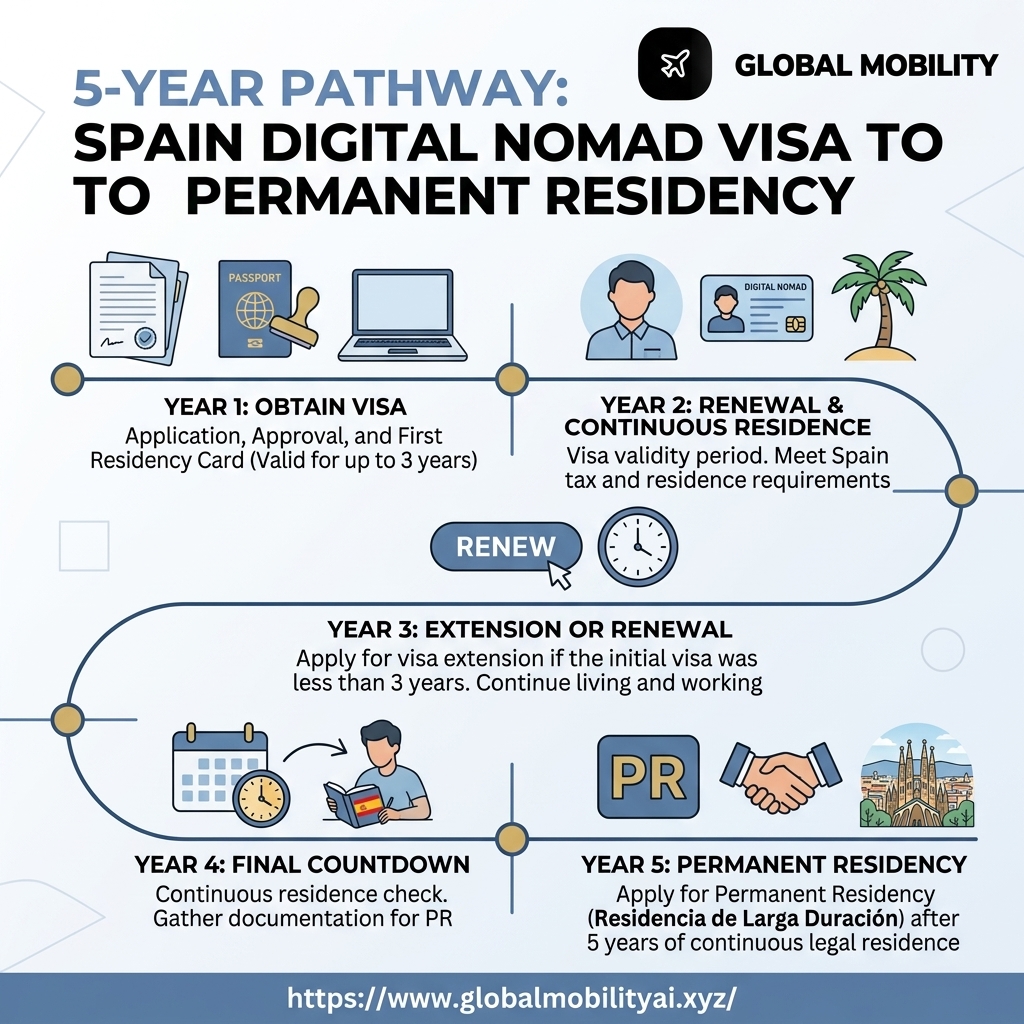
IMG-09: Spain Residency Pathway
Visualizing the 5-year pathway from Digital Nomad Visa to Spanish Permanent Residency.
13. Conclusion: The Bottom Line
The Spain startup law visa 2026 is arguably the most aggressively optimized immigration vehicle in Europe today. By fusing a highly accessible Digital Nomad track with powerful tax incentives (the Beckham Law) and a dedicated pathway for innovative startup founders, Spain has effectively weaponized its high quality of life to capture elite global talent. The 24% flat tax rate is a massive financial lever for high-earning remote tech workers seeking to escape punitive tax regimes in Northern Europe or North America.
However, the margin for administrative error is zero. The Spanish bureaucracy is notoriously rigid; a 91-day old criminal record check or a misunderstood social security agreement will result in instantaneous rejection. Your strategic imperative is to utilize the UGE-CE portal from within Spain to secure the 3-year permit, aggressively pursue your Beckham Law tax status within the critical 6-month window, and ensure your employment contracts are structurally compliant with Spanish labor laws. Run your financial and compliance profile through the Immigration Probability Score at GlobalMobilityAI.xyz before booking your flight. The Spain startup law visa 2026 offers an unparalleled European lifestyle and massive tax arbitrage—but only for those who execute the paperwork with flawless precision.
Predict your mobility score.
Use our AI engine to get your personalized visa pathway, salary prediction, and relocation roadmap.
More Insights

Germany Opportunity Card 2026: Points, How to Apply & Fastest Jobs

The Ultimate Golden Visa Masterclass 2026: The Strategic Wealth & Mobility Blueprint