
Editorial Transparency: Content compiled from official
government sources by the GlobalMobilityAI Research Team.
For personalized legal or immigration advice, consult a
licensed immigration consultant or lawyer.
(Last Updated: 2026-05-27)
According to the OECD International Migration Outlook (2024), over 65% of all skilled economic migration to high-income nations is managed via points-based selection models, making these frameworks the primary gateway for global professionals. (Source: OECD, 2024) [https://www.oecd.org/migration/international-migration-outlook-1999124x.htm] If you are a skilled professional asking which immigration points system do I qualify for 2026, this clinical self-assessment blueprint will guide you through the process. By integrating official regulatory datasets from immigration authorities in Canada, Australia, the UK, Germany, and New Zealand with real-time relocation metrics from GlobalMobilityAI.xyz, this guide provides a tactical framework to evaluate your eligibility, compare processing times, and optimize your chances of success. By the end of this analysis, you will possess a phase-by-phase roadmap to transition from candidate to permanent resident.
A comprehensive global comparison of points-based immigration systems for 2026, highlighting paths for skilled workers across key destinations.
Table of Contents
1. Why Points Systems in 2026? — The Strategic Case
Points-based systems have become the global standard for managing economic migration. For host nations, they filter applicants according to human capital attributes that predict long-term economic integration. For applicants, they offer a transparent, rule-governed selection process free from arbitrary administrative decisions.
1.1 Economic Landscape & Opportunity
The demand for high-skilled human capital remains critical across the major destinations. In 2023, Germany's GDP reached approximately $4.46 trillion, yet it faces a structural deficit of over 1.7 million vacant positions in technical, medical, and scientific sectors. (Source: World Bank, 2023) [https://data.worldbank.org/indicator/NY.GDP.MKTP.CD?locations=DE] Similarly, Canada, with a 2023 GDP of $2.14 trillion, relies on immigration for approximately 98% of its net labor force growth. (Source: World Bank, 2023) [https://data.worldbank.org/indicator/NY.GDP.MKTP.CD?locations=CA] and (Source: Statistics Canada, 2024) [https://www150.statcan.gc.ca/n1/daily-quotidien/240327/dq240327c-eng.htm]
For global professionals, points-based routes are highly appealing because they often grant a direct path to permanent residency (PR) or open work permits, bypassing the need for a direct employer tie. Under traditional work permit schemes, an expat’s legal status is tied to a single employer, leaving them vulnerable to layoffs and exploitation. Points-based pathways, like Canada’s Federal Skilled Worker program or Australia’s subclass 189, grant independent residency status, allowing candidates to switch jobs, negotiate salaries, and move freely within the country’s economic zones.
1.2 Why Professionals Are Targeting This Destination
Search trends and data from GlobalMobilityAI.xyz show a significant, sustained increase in self-assessments from tech, engineering, and healthcare professionals. The transparency of scoring systems means candidates can calculate their scores in advance, target their deficits (such as improving language scores or obtaining a credential evaluation), and proceed with confidence.
As we analyzed in our Germany Opportunity Card 2026 guide, the European market has adapted to points-based recruiting to match traditional Commonwealth destinations. While Canada and Australia remain top choices due to their established English-speaking communities, Germany’s Chancenkarte provides a lower financial barrier to entry for job seekers. Choosing the right country is a strategic decision that depends on where your specific qualifications yield the highest points and the best career growth.
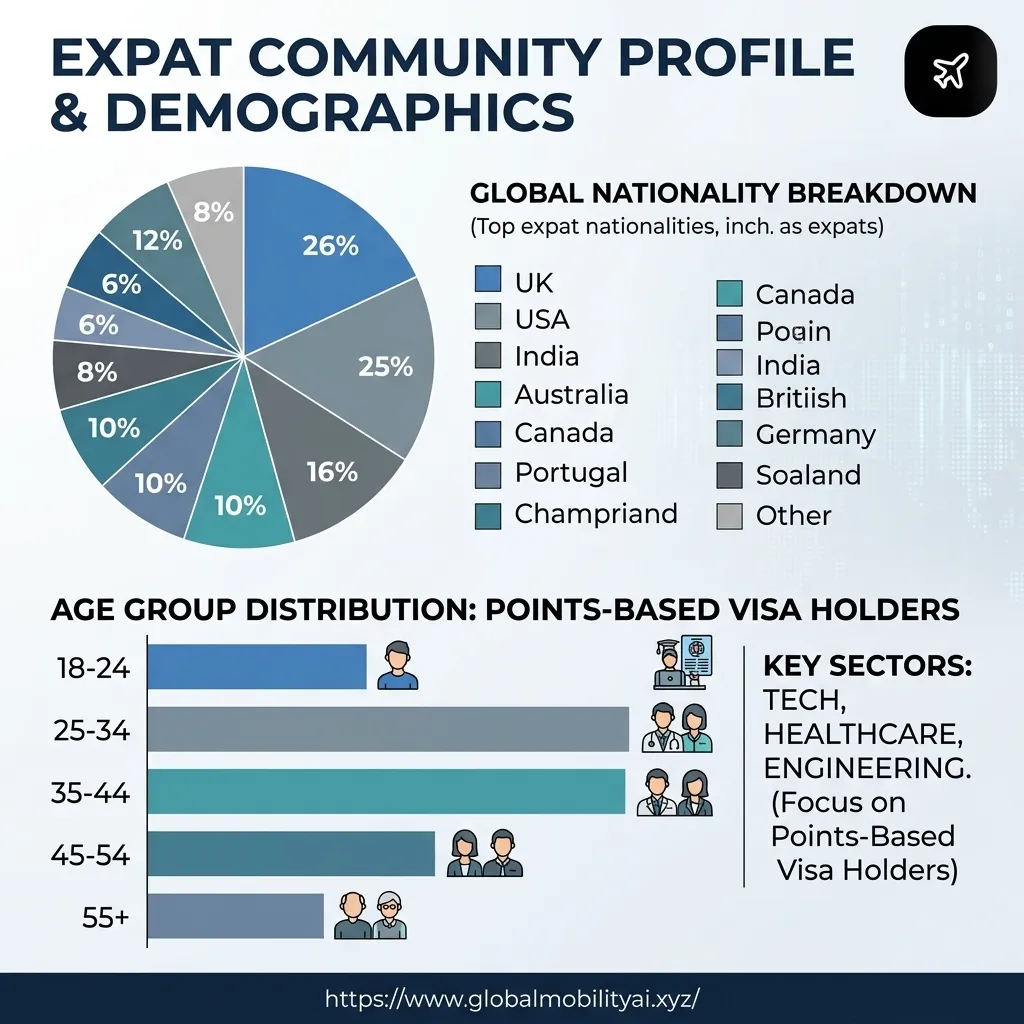
DEMO-INFOGRAPHIC-01: Expat Community Profile - Global Points Visas
Expat community demographics across points-based visa holders, illustrating the nationality breakdown and distribution across tech, healthcare, and engineering.
(Source: OECD Migration Statistics, 2024) [https://www.oecd.org/migration/]
2. Deep-Dive Analysis: Which Immigration Points System Do I Qualify For 2026?
To evaluate which immigration points system do I qualify for 2026, we must break down the legal and scoring frameworks of the five primary points-based visas.
2.1 Legal Requirements & Visa Categories
Points-based systems fall into two main categories: independent pathways (no job offer required) and employer-sponsored points pathways (job offer required but evaluated via points).

IMG-05: Documentation Legalization Office
Official credential assessments and language proficiency results are the foundation of points verification.
2.2 Eligibility Criteria & Qualification Scoring
The table below breaks down the points scoring metrics for the five countries, allowing you to estimate where your profile fits:
To model your qualification score, you can access the GlobalMobilityAI AI Visa Predictor to compare your scores across these frameworks in a single calculation.
2.3 Required Documentation & Official Checklists
Before submitting an application, you must prepare the following core documents:

Professional Engineer Analyzing Blueprint on Desk
3. City Guide — Where to Live based on Points Pathways
Where you choose to settle should align with both your visa pathway (some visas restrict you to specific regions) and your industry.
3.1 Top 5 Cities for Points Visas: Rankings & Analysis

Toronto Downtown Skyline and Skyscrapers Ontario Canada

IMG-03: Modern Tech Campus in Munich
Munich serves as a major target city for Chancenkarte holders seeking tech positions.
3.2 City Comparison Table
| City | Avg Rent 1BR (Centre) | Total Monthly Cost (Single) | Job Market | Safety Index | Expat Rating |
|---|---|---|---|---|---|
| Munich | €1,450 | €2,500 | High | Exceptional | 9.2/10 |
| Melbourne | €1,550 | €2,650 | High | Very High | 9.0/10 |
| Toronto | €1,750 | €2,950 | Exceptional | High | 8.8/10 |
| London | €2,100 | €3,300 | Exceptional | Medium-High | 8.5/10 |
| Auckland | €1,300 | €2,400 | Medium-High | High | 8.7/10 |
(Source: Numbeo City Comparison Index, 2024)
4. Cost of Living — Complete 2026 Breakdown
Relocation costs extend beyond visa fees. Your monthly budget will depend heavily on local taxes and consumer indices.
4.1 Monthly Budget Calculator Breakdown
For a single expat professional in 2026, the estimated monthly budget (excluding rent) is summarized below:
| Category | Toronto (CAD) | Melbourne (AUD) | Munich (EUR) | London (GBP) |
|---|---|---|---|---|
| Groceries | $450 | $500 | €350 | £320 |
| Transport | $150 | $160 | €49 (Ticket) | £180 |
| Healthcare | $80 (Private) | $120 (Private) | €120 (Public) | £0 (IHS paid) |
| Utilities | $200 | $220 | €250 | £210 |
| Dining/Leisure | $350 | $400 | €300 | £400 |
| **Total (Excl. Rent)** | **~$1,230 CAD** | **~$1,400 AUD** | **~€1,069 EUR** | **~£1,110 GBP** |
(Source: Numbeo Cost of Living Database, 2024) [https://www.numbeo.com/cost-of-living/]
4.2 Cost of Living vs. Salary: What You'll Actually Save
To evaluate the long-term financial viability of these points-based destinations, we must model net savings potential across entry, mid, and senior levels.
Note: Calculations assume 2024 national tax tables. To customize these calculations to your specific family size and salary offer, use the GlobalMobilityAI Cost of Living Calculator to model your target destination.
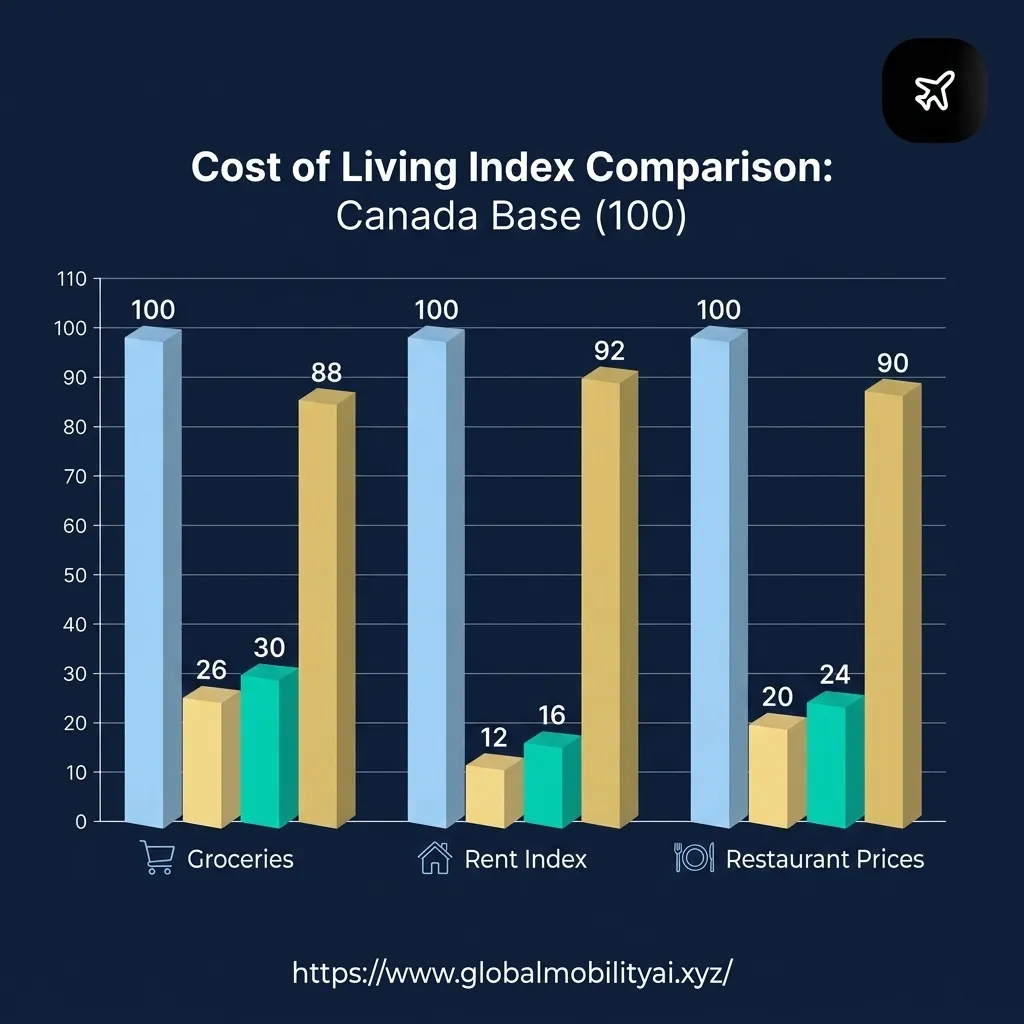
CHART-1: Cost of Living Comparison Bar Chart
A comparative analysis of the cost of living index across points-based destinations relative to Major Expat Senders.
4.3 Cost of Living Index vs. Home Countries
| Category | Canada | Pakistan | India | UK |
|---|---|---|---|---|
| Groceries | 100 (Base) | 26 | 30 | 88 |
| Rent Index | 100 (Base) | 12 | 16 | 92 |
| Restaurant | 100 (Base) | 20 | 24 | 90 |
(Source: Numbeo, 2024) [https://www.numbeo.com/cost-of-living/compare_countries.jsp?country1=Canada]
5. Salary Data & Job Market Intelligence
Points-based systems target sectors with structural labor shortages. Securing a visa in these fields ensures stable career prospects and high compensation.
5.1 Average Salaries by Industry (2026 Data)
| Industry | Entry Level | Mid-Level | Senior | Currency |
|---|---|---|---|---|
| Software Engineering | $65,000 | $98,000 | $145,000 | CAD |
| Data Science/AI | $70,000 | $105,000 | $155,000 | CAD |
| Project Management | $60,000 | $90,000 | $130,000 | CAD |
| Mechanical Engineering | $62,000 | $92,000 | $135,000 | CAD |
| Financial Analysis | $58,000 | $85,000 | $125,000 | CAD |
(Source: Job Bank Canada, 2024) [https://www.jobbank.gc.ca/trend-analysis/search-occupations] and Statistics Canada, 2024 [https://www150.statcan.gc.ca/t1/tbl1/en/tv.action?pid=1410006401]
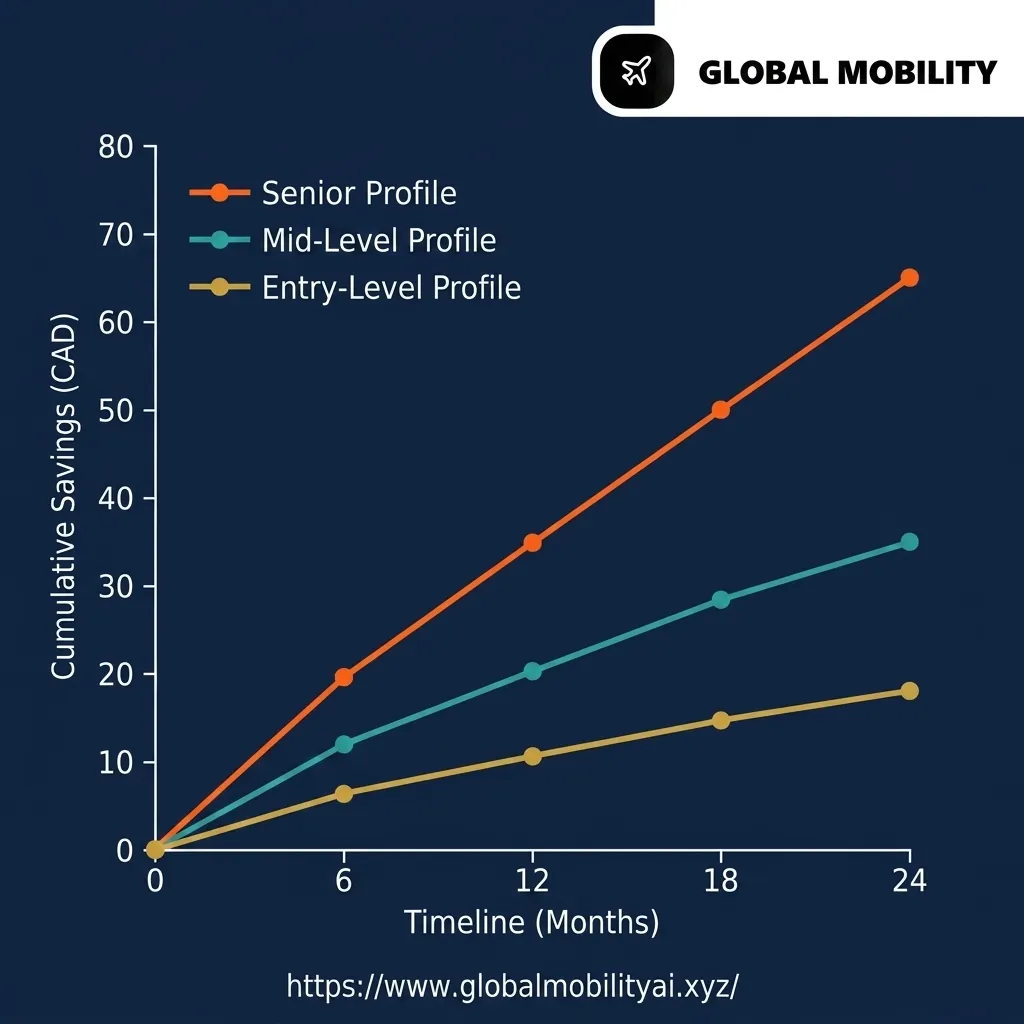
CHART-2: Salary vs. Savings Trajectory Line Chart
Projected 24-month savings trajectory across entry, mid, and senior profiles settling in a points-based destination.
5.2 In-Demand Skills & Sectors in 2026
The national labor registries of the target nations highlight critical shortages in:
5.3 How to Use GlobalMobilityAI Salary Comparison Tool
Before selecting your destination, it is crucial to verify that your expected salary meets local visa thresholds. The GlobalMobilityAI Salary Comparison Tool allows you to enter your target country, industry, and role to get a comprehensive breakdown of median salaries. This prevents the risk of visa rejection due to sub-threshold salary offers, which is a common issue for UK Skilled Worker and New Zealand SMC applications.
6. CV Formatting — Resumes for Points-Based Markets
A major mistake made by points-system applicants is using their home-country resume format when applying for jobs in their target market.
6.1 Country CV Format Requirements
6.2 Common CV Mistakes That Get Applications Rejected
6.3 ATS Optimization for Global Job Portals
Most multinational employers route resumes through ATS platforms. To pass:
7. Interview Tips for Points-Based Markets
Points-system destinations feature distinct interview styles that reflect their local corporate values.
7.1 Cultural Interview Norms & Expectations
In Canada and the UK, interviews focus on "cultural fit" and collaborative work styles. Employers prioritize soft skills and humility. In contrast, German and Australian interviewers are more direct and technical. They expect structured, detailed answers about your specific past project contributions, with less focus on soft-skill storytelling.

Modern Corporate Office Space with Professionals Collaborating
7.2 Common Interview Questions & Answer Frameworks
7.3 Dress Code, Punctuality & Professional Etiquette
7.4 Post-Interview Follow-Up Etiquette
Send a concise thank-you email within 24 hours of the interview. Keep it to 3–4 sentences, reiterating your interest and referencing a specific topic discussed. If you do not hear back within the stated timeline, a single follow-up email after one week is acceptable.
8. 2026 Policy Updates: Which Immigration Points System Do I Qualify For 2026?
Point requirements are not static; they change in response to national labor market needs.
8.1 Key Policy Changes Effective 2026
The most critical changes for 2026 involve adjustments to selection targets:
8.2 Immigration Trend Predictions (Data-Backed)
Data from the OECD Migration Outlook suggests that points-based programs are shifting from general queues to sector-targeted selections. This means candidates with lower overall points but highly demanded skills (such as nursing or civil engineering) will receive invitations ahead of candidates with higher points in saturated business fields. Average processing times are expected to remain stable, with Canada aiming for 6 months and Australia processing subclass 189/190 in 4–8 months. (Source: OECD, 2024) [https://www.oecd.org/migration/international-migration-outlook-1999124x.htm]
8.3 How These Changes Affect Your Application in 2026
Because points requirements change frequently, relying on historical points data can result in delays. We recommend using our Immigration Probability Score tool to test your current profile against active 2026 point requirements, ensuring you target the system where you have the highest probability of success.
9. Tactical Comparison Matrix
The table below provides a comparative analysis of the five points-based pathways to help you choose the best route for your profile.

British Pound Coins and Notes on Desk near UK Passport
| Country | Points Pathway | Min. Points Required | Processing Time | Application Difficulty | Est. Approval Rate* | Gov. Fee |
|---|---|---|---|---|---|---|
| Canada | Express Entry (PR) | 67 (FSWP Entry) | 6 Months | Medium | Platform Est.* | $1,525 CAD |
| Australia | Subclass 189 (PR) | 65 (EOI Entry) | 6–9 Months | High | Platform Est.* | $4,640 AUD |
| UK | Skilled Worker Visa | 70 (Mandatory + Trade) | 3 Weeks | Low | Platform Est.* | £822 – £1,500 |
| Germany | Chancenkarte | 6 Points | 1 Month | Low-Medium | Platform Est.* | €75 |
| New Zealand | SMC Resident Visa | 6 Points | 6–8 Weeks | Medium | Platform Est.* | $4,890 NZD |
*Internal platform estimate. Official approval rates not publicly published by immigration authorities.
(Source: Official Immigration Fee Schedules, 2024: Canada Fee List, Australia Fee List, UK Fee List, Germany Fee List, New Zealand Fee List)
10. Execution Roadmap: Phase-by-Phase
A successful points-based relocation is a project management exercise. Follow this timeline to ensure a smooth transition.
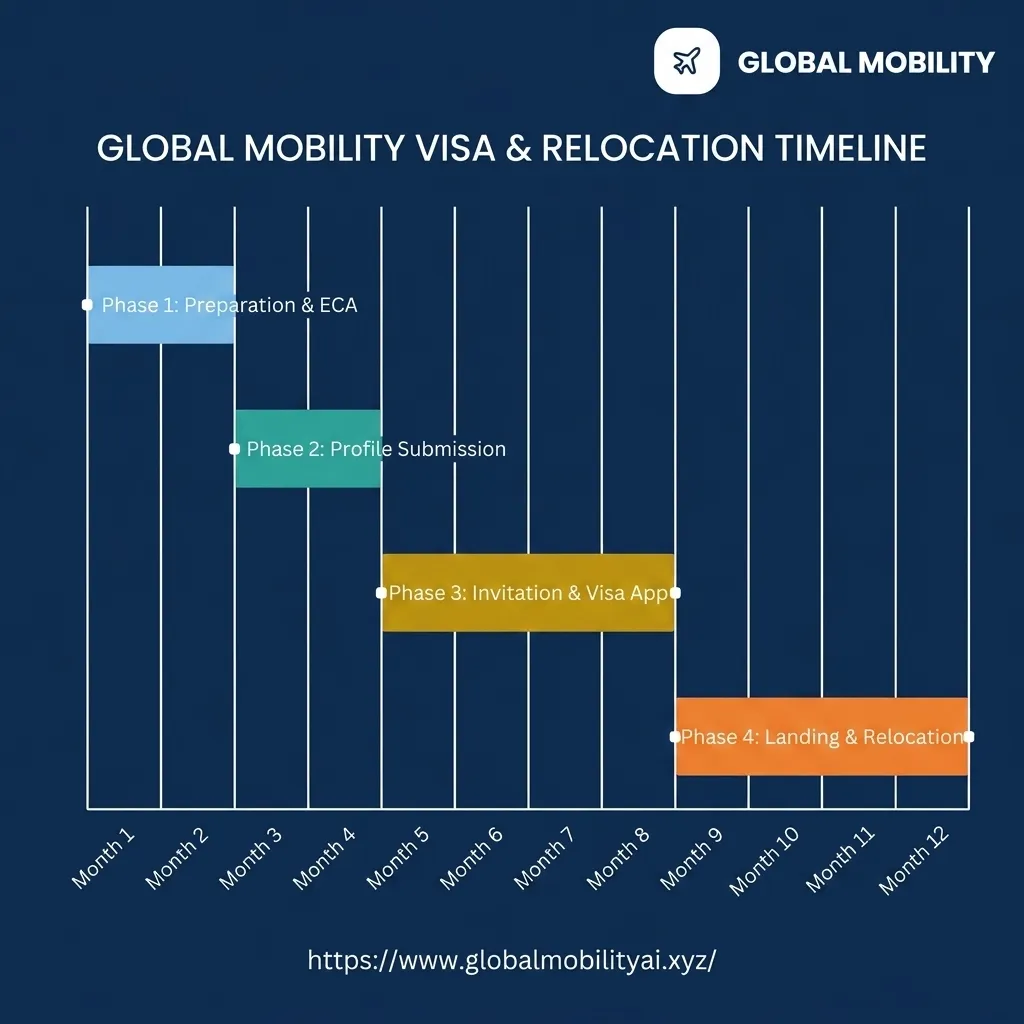
CHART-3: Visa Processing Timeline Gantt Chart
Visual timeline of the relocation process, from initial document preparation to final arrival and registration.
Phase 1 — Preparation (Months 1–2):
Evaluate which immigration points system do I qualify for 2026 by completing your language tests (IELTS/PTE) and submitting your educational credentials (ECA/Anabin) for assessment.
Phase 2 — Profile Submission (Months 3–4):
Submit your profile to the immigration pool. For Canada, enter the Express Entry pool; for Australia, submit your Expression of Interest (EOI). For Germany, apply directly at the German embassy in your home country.
Phase 3 — Invitation & Visa Application (Months 5–8):
Upon receiving your Invitation to Apply (ITA) or nomination, submit your complete visa application, including your medical checks and police clearance certificates.
Phase 4 — Relocation & Settlement (Months 9+):
Arrive in your destination country. Complete your local registration, open a local bank account, obtain your tax number, and register with settlement services.
11. Critical Risk Factors & Common Pitfalls
12. FAQ — People Also Ask
Q: Which immigration points system do I qualify for 2026 if I do not have a job offer?
A: If you do not have a job offer, your best options are Canada's Federal Skilled Worker Program (via Express Entry), Australia's subclass 189 visa, and Germany's Chancenkarte. Canada and Australia require high human capital scores (age, education, language), while Germany requires a minimum of 6 points under its Opportunity Card system. Use the GlobalMobilityAI AI Visa Predictor to compare your scores.
Q: What is the minimum score required to immigrate to Canada under Express Entry in 2026?
A: While the minimum score to enter the Federal Skilled Worker pool is 67 out of 100 points, your actual selection depends on your CRS score. In 2026, general CRS cut-off scores average 520+, but category-based draws (such as STEM or French speakers) select candidates with scores below 480.
Q: Can I apply for Australia’s subclass 189 visa with 65 points?
A: Yes, 65 points is the minimum required to submit an EOI. However, because invitations are competitive, the actual cut-off scores for popular occupations (such as software developers and accountants) are often 85 to 95+ points. To model your points score and explore state nomination alternatives, use the GlobalMobilityAI Cost of Living Calculator at globalmobilityai.xyz/tools/savings-calculator.
Q: Does my spouse’s profile affect my Express Entry CRS score?
A: Yes. Including a spouse can add up to 40 points to your CRS score through their education, language skills, and Canadian work experience. However, it also adjusts the point scale for the primary applicant. It is important to calculate your score both with and without a spouse to see which option yields the highest points.
Q: What happens if my language test expires while I am in the Express Entry pool?
A: If your language test expires, your profile becomes ineligible and is automatically removed from the pool. You must retake the test and update your profile to re-enter. Always track your test expiry dates and plan your retakes in advance.
Q: What is the difference between Australia subclass 189 and subclass 190?
A: Subclass 189 is an independent visa that allows you to live and work anywhere in Australia. Subclass 190 is a state-nominated visa that requires you to live and work in the nominating state for your first 2 years. State nomination adds 5 points to your EOI score. Evaluate your options with the GlobalMobilityAI Visa Success Probability Calculator.
Q: Is there an age limit for points-based immigration systems?
A: Yes. Most points systems favor younger applicants. For Canada and Australia, the age points drop to zero once you reach 45, making it very difficult to qualify without a job offer. Germany's Chancenkarte, however, still awards points for candidates aged 35–40.
Q: How does the New Zealand 6-point system work?
A: The New Zealand SMC system requires you to score 6 points. You can claim 3 to 6 points based on your qualification level, professional registration, or high income. You can combine these points with up to 3 points for local work experience. A job offer from an accredited employer is a mandatory requirement.
13. Conclusion: The Bottom Line
Evaluating which immigration points system do I qualify for 2026 is the first step toward a successful international relocation. While Canada’s Express Entry remains the most popular pathway for direct permanent residency, Australia’s state-nominated routes and Germany’s Chancenkarte offer strong alternatives for professionals who do not meet general CRS thresholds. Your choice should depend on where your unique qualifications yield the highest points.
The key to success lies in two areas: completing your credential assessments early and optimizing your language scores. Before committing to a specific pathway, we recommend running your profile through the GlobalMobilityAI AI Visa Predictor to compare your scores, and benchmarking your expected salary with the GlobalMobilityAI Salary Comparison Tool. As we analyzed in our Australia 190 vs 491 2026 comparison, point requirements change frequently; early preparation ensures you are ready to apply when draw requirements drop. Your global mobility journey starts with a single, data-backed decision.

Auckland Harbour Bridge Scenic Waterfront Daytime New Zealand
Predict your mobility score.
Use our AI engine to get your personalized visa pathway, salary prediction, and relocation roadmap.
More Insights

Best Countries for Pakistani Immigrants Salary Comparison 2026

Spain Non-Lucrative Visa 2026: Passive Income Proof, Renewal Rules & Path to Residency