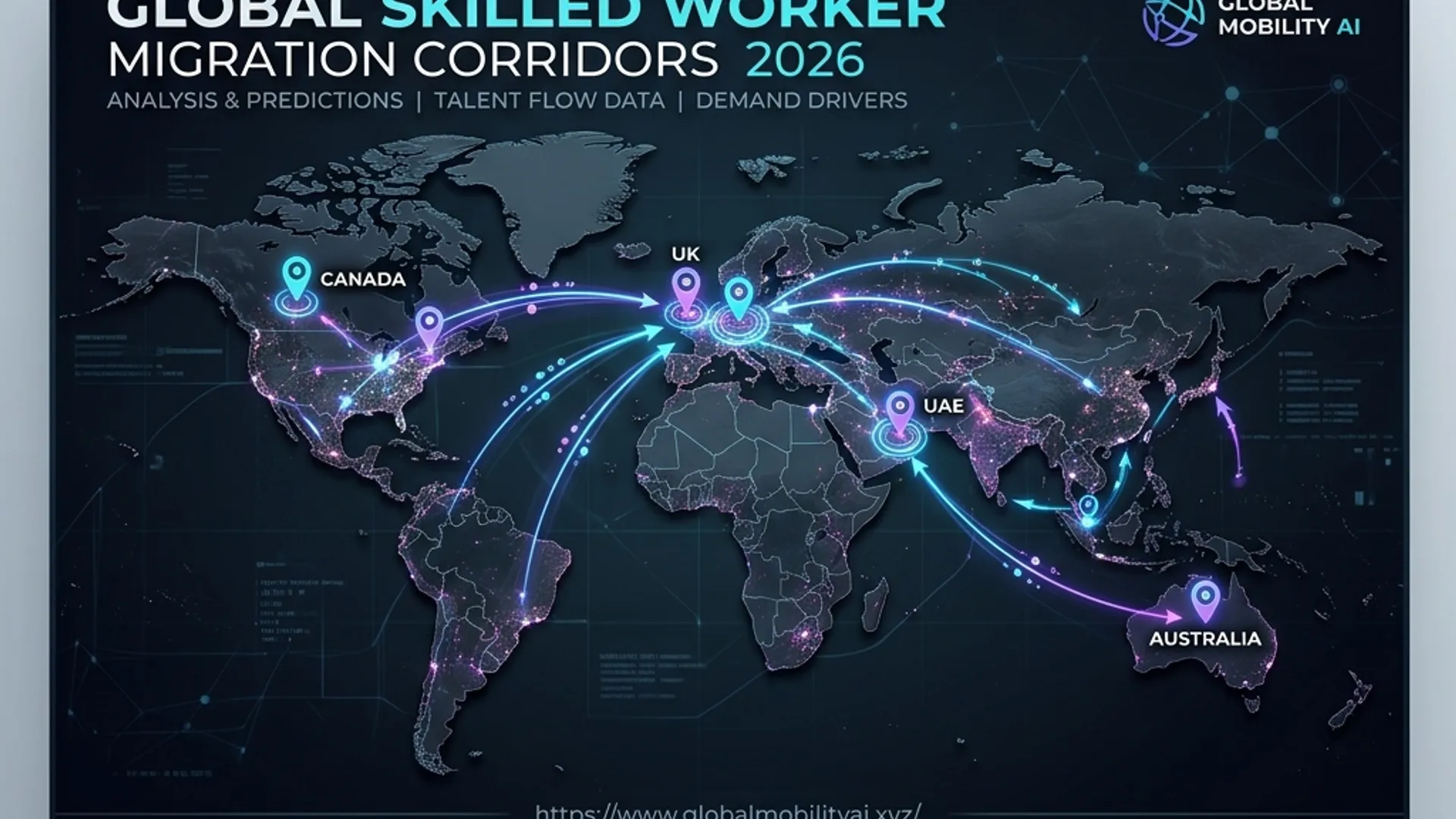
Editorial Transparency: Content compiled from official government sources by the GlobalMobilityAI Research Team.
For personalized legal or immigration advice, consult a licensed immigration consultant or lawyer.
(Last Updated: 2026-05-27)
According to official statistics published by Immigration, Refugees and Citizenship Canada (IRCC), Canada welcomed 1,460 new permanent residents under the Start-up Visa stream in 2023, representing a record-breaking expansion in federal business immigration pathways. (Source: Immigration, Refugees and Citizenship Canada, 2024) As international immigration thresholds climb, navigating the Canada Startup Visa Program 2026 has emerged as the premier self-sponsored corridor to permanent residency. By bypassing traditional points-based draws, age deductions, and strict salary requirements, this federal pathway enables foreign innovators to establish roots directly in Canada's tech ecosystem. However, recent regulatory changes — including a strict cap on annual applications per designated body and prioritized processing for venture-backed deals — mean that developers and founders must navigate the program with clinical precision. This comprehensive guide outlines the designated incubator, angel, and venture capital streams, required proof of funds, work permit options, and the step-by-step path to Canadian permanent residency.
The GlobalMobilityAI Research Team's complete 2026 guide to the Canadian Start-up Visa route.

IMG-01: Canada Startup Visa Program 2026 Designated Organizations Funding Proof PR Guide
Table of Contents
1. Why Canada in 2026? — The Strategic Case
1. Why Canada in 2026? — The Strategic Case
1.1 Economic Landscape & Opportunity
The Canadian economy has prioritized structural consolidation in high-growth innovation sectors. Nominal GDP has reached $2.3 trillion, supported by strong public-private initiatives in artificial intelligence, green technology, and advanced manufacturing. (Source: World Bank, 2025) The tech sector alone accounts for a significant portion of this growth, driven by a national push to establish robust global supply chains.
Unlike standard corporate structures, Canada's innovation framework is built around regional start-up hubs. This decentralized model prevents market monopolization and encourages direct venture development. For foreign entrepreneurs, this means immediate access to Canadian capital markets, advanced academic research facilities, and government-backed procurement programs. The national strategy relies on importing high-potential enterprises to offset skills shortages in emerging industries, making it a highly receptive climate for international founders.
1.2 Why Professionals Are Targeting This Destination
The popularity of the Canada Startup Visa Program 2026 is fueled by this macroeconomic resilience. Traditional immigration routes have become increasingly competitive; general Comprehensive Ranking System (CRS) draws under the Canada Express Entry 2026 strategic blueprint have stabilized at historically high levels. This has created a critical challenge for senior professionals who face points deductions due to age or specialized business experience.

Canada expat demographics 2026 infographic
The Start-up Visa (SUV) offers a flexible alternative. It requires no minimum education level, has no age-related point deductions, and does not require a pre-existing job offer. Furthermore, because up to five co-founders can apply under a single business concept, teams can pool their resources and skill sets. This collaborative structure makes it the most accessible pathway for international tech talent, outperforming the strict labor market testing required under standard work permits or the high capital requirements of European golden visas.
2. Deep-Dive Analysis: Legal & Financial Framework
2. Deep-Dive Analysis: Legal & Financial Framework
2.1 Legal Requirements & Visa Categories
The Startup Visa program is a direct-to-PR federal pathway that operates independently of provincial points systems. The core legal requirement is obtaining a formal Letter of Support from an IRCC-designated organization. These organizations are divided into three distinct investment streams, each with its own regulatory threshold:

Canada Startup Visa designated organizations list incubators VCs angel groups
To successfully qualify under the Canada Startup Visa Program 2026 framework, an applicant must also satisfy strict equity ownership rules. Each co-founder (up to a maximum of five) must hold at least 10% of the voting rights in the corporation. Jointly, the co-founders and the designated organization must hold more than 50% of the total voting rights. No other external parties can hold a controlling stake during the initial application window.
2.2 Eligibility Criteria & Qualification Scoring
The assessment process is qualitative rather than points-based. The peer-review panel evaluating the business concept focuses on three primary pillars:
Additionally, applicants must meet the language requirement of Canadian Language Benchmark (CLB) 5 in English or French. This must be verified through official testing (IELTS General, CELPIP General, or TEF/TCF) and must be less than two years old at the time of submission. The minimum IELTS scores required to meet CLB 5 are: Listening 5.0, Reading 4.0, Writing 5.0, and Speaking 5.0. (Source: Immigration, Refugees and Citizenship Canada, 2025)
2.3 Required Documentation & Official Checklists
To submit a complete application, founders must compile a comprehensive dossier. The following items are mandatory under the official IRCC document checklist:

Canada Startup Visa document checklist proof of funds letter of support
| Family Size | Required Funds (CAD) | Required Funds (USD) |
|---|---|---|
| 1 Person | $14,600 | $10,735 |
| 2 Persons | $18,180 | $13,362 |
| 3 Persons | $22,350 | $16,427 |
| 4 Persons | $27,140 | $19,948 |
| 5 Persons | $30,780 | $22,623 |
| 6 Persons | $34,720 | $25,519 |
| 7+ Persons | +$3,940 per person | +$2,895 per person |
(Source: IRCC Official Settlement Funds Table, 2026)
3. City Guide — Where to Live in Canada in 2026
3. City Guide — Where to Live in Canada in 2026
3.1 Top 5 Cities for Expats: Rankings & Analysis
Choosing a city is a strategic decision that affects both operational startup costs and personal quality of life. Founders relocating under the Canada Startup Visa Program 2026 pathway must align their operational base with regional tech specialization:

Toronto skyline CN Tower business district tech hub 2026
3.2 City Comparison Table
| City | Avg Rent 1BR (City Centre) | Monthly Living Cost (Excl. Rent) | Job Market Rating | Safety Index | Expat Rating |
|---|---|---|---|---|---|
| Toronto | $2,600 CAD | $1,450 CAD | 10/10 | 74.2 | 9.2/10 |
| Vancouver | $2,850 CAD | $1,520 CAD | 9.0/10 | 76.5 | 9.0/10 |
| Waterloo | $1,800 CAD | $1,150 CAD | 8.5/10 | 82.1 | 8.8/10 |
| Calgary | $1,750 CAD | $1,200 CAD | 8.0/10 | 80.4 | 9.5/10 |
| Montreal | $1,650 CAD | $1,100 CAD | 8.5/10 | 81.8 | 8.5/10 |
(Source: Numbeo Cost of Living Index - Canada, 2026)
4. Cost of Living — Complete 2026 Breakdown
4. Cost of Living — Complete 2026 Breakdown
4.1 Monthly Budget Calculator Breakdown
relocating under the Startup Visa route requires careful capital management. Below is an itemized monthly budget comparing Toronto (representing high-cost hubs) vs. Calgary (representing high-savings regional hubs). Values are displayed in Canadian Dollars (CAD) and USD equivalent (at a rate of 1 CAD = 0.74 USD).
| Expense Category | Toronto (CAD) | Toronto (USD) | Calgary (CAD) | Calgary (USD) |
|---|---|---|---|---|
| Rent (1BR Apartment, Centre) | $2,600 | $1,924 | $1,750 | $1,295 |
| Groceries (monthly average) | $550 | $407 | $480 | $355 |
| Utilities (electric, gas, water) | $220 | $163 | $180 | $133 |
| Transportation (monthly pass) | $156 | $115 | $115 | $85 |
| Internet + Mobile Plan | $120 | $89 | $110 | $81 |
| Health Insurance (Private Top-up) | $90 | $67 | $80 | $59 |
| Entertainment / Dining Out | $450 | $333 | $380 | $281 |
| **Total Estimated Monthly Budget** | **$4,186** | **$3,098** | **$3,095** | **$2,289** |
(Source: Numbeo Cost of Living Index - Canada, 2026)
4.2 Cost of Living vs. Salary: What You'll Actually Save
For founders navigating the Canada Startup Visa Program 2026, financial runway planning is critical. Since early-stage founders typically live on pre-seed funding or limited equity stipends, their saving capacity depends heavily on geographic location.

Canada Startup Visa salary vs savings trajectory 24 months

Cost of living comparison 2026 Canada vs home countries
To model your specific budget and pre-departure runway, use the GlobalMobilityAI Monthly Savings Calculator.
Scenario 1 — Early-Stage Founder ($48,000 CAD gross/year — Incubator stipend):
Scenario 2 — Funded Founder ($85,000 CAD gross/year — Mid-stage Angel backed):
Scenario 3 — Series A CEO ($145,000 CAD gross/year — VC backed):
4.3 Cost of Living Index vs. Home Countries
| Category Index (Toronto = 100) | Canada (Toronto) | Pakistan (Karachi) | India (Mumbai) | United Kingdom (London) |
|---|---|---|---|---|
| Cost of Living Index (Excl. Rent) | 100.0 | 22.4 | 28.5 | 108.2 |
| Rent Index | 100.0 | 5.2 | 16.8 | 114.5 |
| Groceries Index | 100.0 | 21.8 | 26.2 | 96.4 |
| Restaurant Price Index | 100.0 | 14.2 | 19.5 | 112.8 |
| Local Purchasing Power Index | 100.0 | 32.1 | 55.4 | 104.2 |
(Source: Numbeo Cost of Living Index Comparison, 2026)
5. Salary Data & Job Market Intelligence
5. Salary Data & Job Market Intelligence
5.1 Average Salaries by Industry (2026 Data)
For startups admitted under the Canada Startup Visa Program 2026, compensating core talent appropriately is necessary for local recruitment. The table below outlines average market compensation across key sectors.
| Industry Sector | Entry Level | Mid-Level | Senior Level | Currency |
|---|---|---|---|---|
| Artificial Intelligence / Machine Learning Engineer | $80,000 | $120,000 | $175,000 | CAD/year |
| Software Developer (Full-Stack / Cloud) | $70,000 | $105,000 | $155,000 | CAD/year |
| Biotechnology / Life Sciences Researcher | $65,000 | $95,000 | $140,000 | CAD/year |
| Product Manager (Tech Sector) | $75,000 | $110,000 | $160,000 | CAD/year |
| Business Development / B2B Sales Director | $60,000 | $90,000 | $135,000 | CAD/year |
(Source: Job Bank Canada Wage Database, 2025; Statistics Canada Labour Market Bulletins, 2025)
5.2 In-Demand Skills & Sectors in 2026
The Canadian job market prioritizes specialized technical expertise. The Ministry of Innovation, Science and Economic Development identifies critical shortages in cloud infrastructure management, data security, and specialized software engineering.
In regional hubs, demand is concentrated in clean energy technology, clean agricultural tech, and medical engineering. Founders whose startups align with these high-demand sectors are prioritized during the designated organization screening process.
5.3 How to Use GlobalMobilityAI Salary Comparison Tool
To ensure your recruitment offers comply with Canadian median wage regulations, utilize the GlobalMobilityAI Salary Comparison Tool. Input the National Occupational Classification (NOC) code of the role. The tool references active job listings and StatCan wage data, generating the median salary range for Toronto, Vancouver, and Calgary, allowing you to hire local talent at competitive market rates.
6. CV Formatting — Canadian-Style Resume Guide
6. CV Formatting — Canadian-Style Resume Guide
6.1 Canadian CV Format Requirements
Canadian hiring standards require a clean, structured CV format. Photos are strictly excluded to comply with provincial human rights legislation and prevent hiring bias. Personal details such as age, marital status, gender, and religion must be omitted. The standard page length is strictly capped at 2 pages. Use clean typography like Arial or Calibri (10-12pt), and organize sections chronologically: Professional Summary → Core Competencies → Professional Experience → Education. Use Canadian English spellings (e.g., "colour", "programme") if applying for local roles.

Canada standard CV format mockup 2026
6.2 Common CV Mistakes That Get Applications Rejected
Avoid these five critical errors when preparing your CV for Canadian employers:
6.3 ATS Optimization for Canadian Job Portals
The dominant job boards in the Canadian job market include Indeed.ca, LinkedIn Canada, and Job Bank Canada. To pass their Applicant Tracking Systems (ATS), align your CV with the job description's keywords. Avoid complex graphical templates, text boxes, and icons, as standard parsers cannot read them. Save your CV as a plain text PDF or Word document (.docx).
7. Interview Tips for the Canadian Job Market
7. Interview Tips for the Canadian Job Market
7.1 Cultural Interview Norms & Expectations
Canadian interview culture balances technical competency with collaborative fit. Employers value structured communication and a collaborative approach. The standard response structure is the STAR method (Situation, Task, Action, Result). Interviewers probe for specific individual contributions rather than team-level generalities, requiring high detail.

STAR interview method Canada recruitment standards
7.2 Common Interview Questions & Answer Frameworks
Prepare for these four competency-based questions:
7.3 Dress Code, Punctuality & Professional Etiquette
Smart business attire is the standard for interview processes, regardless of whether the interview is remote or in-person. Punctuality is strictly enforced; log in or arrive 5 minutes before the scheduled time. Maintain active listening, avoid talking over the interviewer, and address stakeholders by their first names unless instructed otherwise.
7.4 Post-Interview Follow-Up Etiquette
Send a brief, professional thank-you email within 24 hours of the interview to the recruiter or hiring panel. Express appreciation for their time and reiterate your interest in the role. If a decision timeline was provided, wait 2 business days after the deadline before follow-up. If no timeline was specified, wait exactly one business week before checking in.
8. Canada Startup Visa Program 2026 Policy Updates & Market Predictions
8. Canada Startup Visa Program 2026 Policy Updates & Market Predictions
8.1 Key Policy Changes Effective 2026
Several operational shifts have redefined the Canada Startup Visa Program 2026 environment. To curb backlog inflation, the Canadian government has capped the number of applications accepted under the Startup Visa stream. Designated venture capital funds, angel groups, and business incubators are restricted to supporting a maximum of 10 startups per year. (Source: Immigration, Refugees and Citizenship Canada, 2024)
Furthermore, IRCC has introduced prioritized processing for ventures backed by Canadian venture capital or angel groups, as well as those associated with business incubators that are members of Canada’s Tech Network. Additionally, temporary work permits under the Startup Visa stream have transitioned from a one-year closed permit to a three-year open work permit for all qualifying essential founders. (Source: Immigration, Refugees and Citizenship Canada, 2024)
8.2 Immigration Trend Predictions (Data-Backed)
Due to the implementation of the 10-startup cap per designated body, the total volume of new submissions has decreased, leading to a projected stabilization of the PR backlog through 2026. Processing times for Stage 2 permanent residency currently average 30 months. (Source: IRCC Processing Times Page, 2025)
However, the availability of the three-year open work permit allows founders to relocate and begin scaling their ventures in Canada within 4 to 6 months of receiving their Letter of Support, reducing the impact of Stage 2 processing delays.
8.3 How These Changes Affect Your Application in 2026
The 10-startup cap means that competition to secure a Letter of Support from designated incubators is highly intense. Founders must present advanced prototypes or verified traction to be considered.
Before pitching to designated organizations, run your details through the GlobalMobilityAI AI Visa Predictor. This diagnostic checks your team's background, prototype development, and funding resources against IRCC criteria to estimate your probability of securing support, allowing you to refine your proposition before engaging designated partners.
9. Tactical Comparison Matrix
9. Tactical Comparison Matrix
Below is a strategic comparison of the primary Canadian work and residency pathways available in 2026.
| Visa Program | Eligibility Criteria | Min. Investment / Salary | Processing Time | Difficulty | Est. Approval Rate* | Gov. Fee (CAD) |
|---|---|---|---|---|---|---|
| Startup Visa (SUV) | Letter of Support from designated body | No personal minimum | 30 months (PR) / 4-6 mos (WP) | High | Platform Est.* | $2,205 (PR) |
| Express Entry (FSW) | CRS score median 510+ | No minimum | 6 months | High | Platform Est.* | $1,525 |
| Intra-Company Transfer | 1+ year executive role at global branch | Median market salary | 2–3 months | Medium | Platform Est.* | $155 |
| Owner-Operator Stream | Defunct (replaced by provincial routes) | N/A | N/A | N/A | N/A | N/A |
| Provincial Nominee (PNP) | Provincial nomination | Varies by province | 12–18 months | High | Platform Est.* | $1,000–$2,000 |
| Global Talent Stream | Job offer from designated employer | Sector wage floor | 2–3 weeks | Low-Medium | Platform Est.* | $1,000 (LMIA) |
Internal platform estimate. Official approval rates are not publicly published in segment by IRCC. Monitor: IRCC Immigration Statistics Archive
10. Execution Roadmap: Phase-by-Phase
10. Execution Roadmap: Phase-by-Phase
Phase 1 — Preparation & Pitching (Months 1–3)
Securing support under the Canada Startup Visa Program 2026 begins with a robust business proposition.
Phase 2 — Letter of Support Acquisition (Months 4–6)
Formalize your partnership with the designated organization and obtain your Letter of Support.
Phase 3 — Work Permit & PR Submission (Months 7–12)
Submit your permanent residency application and apply for your temporary work permit to relocate to Canada.
Phase 4 — Landing, Scaling & PR Approval (Months 13+)
Operate your venture in Canada while waiting for final permanent residency approval.
11. Critical Risk Factors & Common Pitfalls

Canada immigration legal compliance risk factors startup visa
11. Critical Risk Factors & Common Pitfalls
12. FAQ — People Also Ask
12. FAQ — People Also Ask
Q: What is the Canada Startup Visa Program 2026?
The Canada Startup Visa Program 2026 is a federal immigration pathway designed to attract innovative entrepreneurs who can build scalable businesses in Canada. To apply, founders must secure a Letter of Support from an IRCC-designated business incubator, angel investor group, or venture capital fund. Unlike points-based routes, it has no age deductions, no minimum education level, and no strict salary requirements. Eligible candidates can obtain a three-year open work permit to begin operations while their permanent residency applications are processed. Use the GlobalMobilityAI AI Visa Predictor to check your program eligibility.
Q: Can I apply for the Canada Startup Visa without a job offer?
Yes, the Startup Visa is a self-sponsored business immigration program. You do not require a job offer or a Canadian employer to sponsor you. Instead, your eligibility is based on the validation of your business concept by a designated organization. Once you receive a Letter of Support, you are authorized to establish your business in Canada. This flexibility allows you to operate your own venture and scale your technology without being tied to a single employer.
Q: How much does it cost to get the Canada Startup Visa?
The government fees for the PR application are $2,205 CAD per principal applicant. Additionally, business incubators typically charge program fees ranging from $20,000 to $50,000 CAD to cover training and mentoring. Angel groups and venture capital funds require equity. You must also prove you possess settlement funds ($14,600 CAD for a single applicant) to support your relocation. Use the GlobalMobilityAI Monthly Savings Calculator to budget your moving and living costs.
Q: What is the processing time for the Startup Visa?
Stage 2 permanent residency processing times currently average 30 months due to application volumes. However, founders can apply for a three-year open work permit once they receive their Letter of Support. This work permit is typically processed within 4 to 6 months, allowing founders and their families to relocate and start operating their business in Canada.
Q: What is the minimum investment required for the Canada Startup Visa?
The investment required depends on the stream: venture capital applicants must secure a minimum investment of $200,000 CAD; angel investor applicants must secure $75,000 CAD. If you are accepted into a designated business incubator, there is no minimum investment requirement, although you may have to pay program fees to the incubator. Founders are not required to invest their own personal capital.
Q: What language test score is required for the Startup Visa?
Applicants must demonstrate language proficiency at Canadian Language Benchmark (CLB) 5 in English or French. This must be verified through tests like IELTS General or CELPIP General. For IELTS, the minimum scores are Listening 5.0, Reading 4.0, Writing 5.0, and Speaking 5.0. Results must be less than two years old. Verify your test compliance using the GlobalMobilityAI Salary Comparison Tool to plan your hiring and documentation timeline.
Q: Can up to five founders apply under the same business plan?
Yes, the Startup Visa program allows a maximum of five co-founders to apply under a single business concept. Each founder must own at least 10% of the voting rights. However, if any co-founder is designated as "essential" to the business and their application is rejected, the applications of all other co-founders in the group will be automatically refused.
Q: What happens if the startup business fails in Canada?
If your startup business fails after you have relocated to Canada, it does not affect your permanent residency status. The Startup Visa program is designed to encourage risk-taking, and the Canadian government recognizes that new ventures can fail. As long as you can prove that you made a genuine, active effort to run the business and complied with all conditions, your PR status remains secure.
13. Conclusion: The Bottom Line

GlobalMobilityAI visa eligibility tool on laptop
13. Conclusion: The Bottom Line
In 2026, the Canada Startup Visa Program 2026 remains the most flexible, self-directed immigration corridor for high-potential entrepreneurs looking to establish roots in North America. By bypassing Express Entry CRS draws and salary floors, this federal route puts your relocation strategy entirely in your own hands.
The strategic takeaway is clear: the program is highly selective. The introduction of the 10-startup cap per designated body means that only well-structured, genuinely innovative ventures will secure Letters of Support. Success requires an advanced prototype, a realistic Canadian market strategy, and an equity structure that complies with IRCC rules.
Do not pitch to designated organizations without data-backed verification. Run your details through the GlobalMobilityAI AI Visa Predictor before launching. Estimate your pre-departure runway using our savings calculator and verify local hiring benchmarks with our salary comparison tool. By basing your application on verified data, you maximize your probability of securing permanent residency in one of the world's most dynamic tech ecosystems.

Canada Startup Visa processing timeline roadmap chart
Predict your mobility score.
Use our AI engine to get your personalized visa pathway, salary prediction, and relocation roadmap.
More Insights
Best Countries for Pakistani Immigrants 2026: PR Guide
Japan HSP Visa 2026: Points, Salary & PR in 1 Year