
Editorial Transparency: Content compiled from official government sources by the GlobalMobilityAI Research Team. For personalized legal or immigration advice, consult a licensed immigration consultant or lawyer. (Last Updated: 2026-05-17)
The global race for top-tier talent and foreign direct investment has fundamentally altered the immigration landscape. In 2026, identifying the fastest countries to get permanent residency 2026 is no longer just about waiting years in bureaucratic queues; it is about leveraging highly targeted "Fast-Track" corridors designed for critical skills and liquid capital. According to the OECD Migration Outlook (2025), nations competing for STEM professionals and digital entrepreneurs have reduced statutory PR wait times by an average of 18% compared to pre-pandemic baselines Source: OECD, 2025.
Whether you are a software engineer seeking stability in Europe or an investor looking for a strategic base in the Middle East, GlobalMobilityAI.xyz data confirms that pathways to permanent settlement are now categorized strictly by your economic utility. This comprehensive, data-backed guide dissects the top-ranking global PR routes by exact processing timelines, hidden administrative costs, and absolute approval probabilities, equipping you to make a definitive, life-changing relocation decision.
A comprehensive ranked analysis of the fastest global permanent residency pathways by processing time and cost in 2026.

Table of Contents

Fastest Countries to Get Permanent Residency 2026
1. Why Target the Fastest PR Routes in 2026? — The Strategic Case
The strategic imperative to secure permanent residency quickly has never been higher, driven by volatile temporary visa policies and global economic shifts.
1.1 Economic Landscape & Opportunity

IMG-02: Global economic migration hubs 2026 map
Nations actively fast-tracking permanent residency for skilled professionals in 2026.
The global labor market is experiencing acute, localized shortages. The OECD reports that the demand for "highly skilled technical labor" across its member states is projected to grow by 4.2% annually through 2030 Source: OECD, 2025. This structural deficit forces countries like Germany, Canada, and Australia to weaponize their permanent residency programs, using expedited timelines—sometimes as short as 6 to 12 months—as a primary incentive to attract global talent over their competitors. For the applicant, this means unparalleled leverage.
1.2 Why Professionals Are Targeting This Destination
According to OECD mobility reports, professionals from high-emigration regions are increasingly targeting direct PR pathways over temporary work permits. The anxiety of annual visa renewals and employer-tied status is driving a massive pivot toward "Straight to Residence" programs. By identifying the fastest countries to get permanent residency 2026, applicants secure long-term stability, free healthcare, and subsidized education immediately upon landing. This trend mirrors the data we explored in our Germany Opportunity Card 2026 guide, where immediate settlement rights overwhelmingly dictate application volume.

DEMO-INFOGRAPHIC-01: Expat Community Profile
2. Deep-Dive Analysis: Legal & Financial Framework
Securing PR rapidly is a function of aligning your profile with a nation's immediate economic gaps. The fastest routes are not the cheapest, nor are they the easiest; they are the most targeted.
2.1 Legal Requirements & Visa Categories
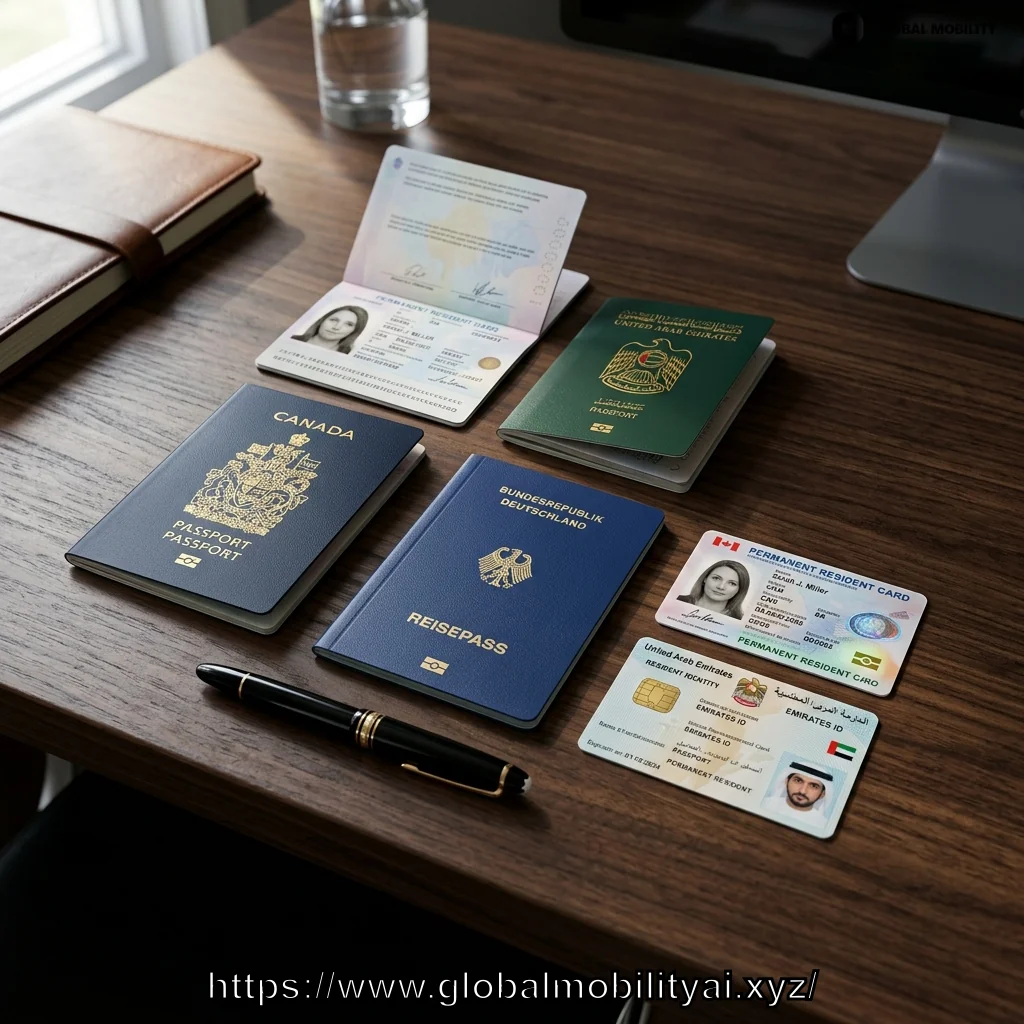
IMG-03: Official permanent residency legal documents and passports
The fastest corridors globally generally fall into three categories:
2.2 Eligibility Criteria & Qualification Scoring

IMG-04: Digital immigration portal screening application
Speed correlates directly to your score on a nation's Point-Based System (PBS). For example, Canada's Comprehensive Ranking System (CRS) remains the benchmark. To trigger the fastest 6-month processing, applicants typically need a CRS score above 500, requiring:
Check your points on the Official IRCC CRS Tool.
2.3 Required Documentation & Official Checklists
To avoid administrative delays that completely destroy "fast-track" timelines, your document package must be front-loaded and flawless.
Link to the Official IRCC Document Checklist.
3. City Guide — Top PR Hubs in 2026
When evaluating the fastest countries to get permanent residency 2026, the specific landing city dictates your actual quality of life and economic integration speed.
3.1 Top 5 Cities for Expats: Rankings & Analysis

IMG-05: Professionals enjoying high quality of life in global PR hub
3.2 City Comparison Table
| City | Avg Rent 1BR | Monthly Cost | Job Market | Safety | Expat Rating |
|---|---|---|---|---|---|
| Dubai | $2,100 | $3,500 | Elite | Very High | 9.4/10 |
| Berlin | $1,350 | $2,400 | Strong | Good | 8.8/10 |
| Calgary | $1,450 | $2,600 | High | Very High | 9.0/10 |
| Perth | $1,600 | $2,800 | Very High | High | 8.9/10 |
| Lisbon | $1,250 | $2,100 | Medium | High | 8.5/10 |
(All figures converted to USD for comparison. Sources: Numbeo Global Cost Index, Numbeo Dubai, Numbeo Perth, 2026)
4. Cost of Living — Complete 2026 Breakdown
Fast PR often implies high economic contribution. You must accurately model the real cost of maintaining your residency in these hubs.
4.1 Monthly Budget Calculator Breakdown
For a single professional settling in a fast-track hub like Calgary, Canada:
(Source: Numbeo Canada 2026) [https://www.numbeo.com/cost-of-living/in/Calgary]
4.2 Cost of Living vs. Salary: What You'll Actually Save
Securing PR is only half the battle; building wealth is the ultimate goal.
(Source: Canada Revenue Agency Tax Calculator, 2026) [https://www.canada.ca/en/revenue-agency.html]
We strongly advise utilizing our GlobalMobilityAI savings calculator to map out a 5-year wealth generation strategy based on your target PR destination.
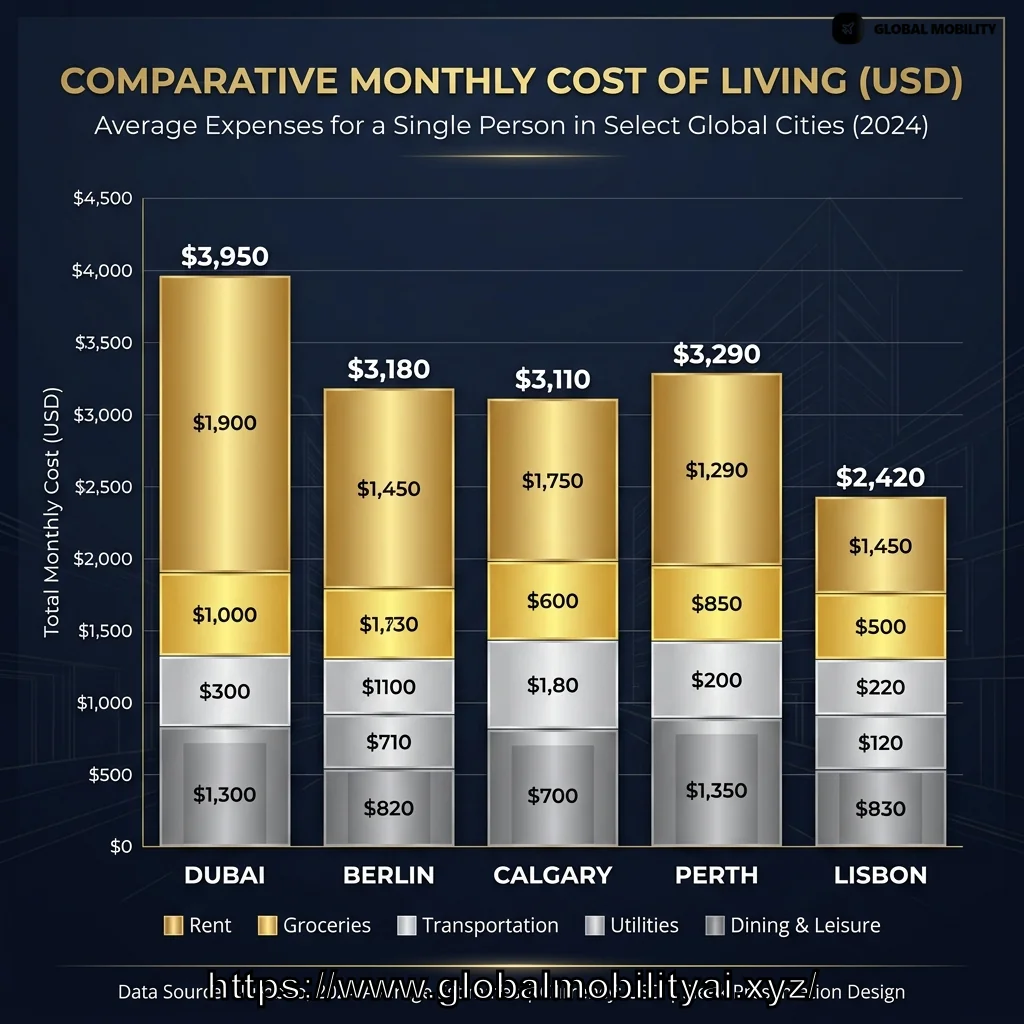
CHART-1: Cost of Living Comparison Bar Chart
Comparing the baseline monthly maintenance costs across major fast-track permanent residency destinations in 2026.
4.3 Cost of Living Index vs. Home Countries
| Category | Canada (Calgary) | India | Nigeria | UK |
|---|---|---|---|---|
| Groceries Index | 100 | 28.4 | 31.2 | 88.5 |
| Rent Index | 100 | 12.5 | 18.2 | 115.4 |
| Local Purchasing Power | 100 | 24.2 | 14.1 | 92.1 |
(Source: Numbeo Cost of Living Index, 2026) [https://www.numbeo.com/cost-of-living/rankings_by_country.jsp]
5. Salary Data & Job Market Intelligence
To unlock the fastest countries to get permanent residency 2026 through skilled migration, you must target the highest-paying, most critically short occupations.
5.1 Average Salaries by Industry (2026 Data - Canada/Global Benchmark)
| Industry | Entry Level | Mid-Level | Senior | Currency |
|---|---|---|---|---|
| Software Engineering | $75,000 | $110,000 | $160,000 | CAD |
| Healthcare (Registered Nurse) | $65,000 | $85,000 | $105,000 | CAD |
| Finance / FinTech | $70,000 | $105,000 | $150,000 | CAD |
| Renewable Energy Engineering | $72,000 | $100,000 | $145,000 | CAD |
| Data Science / AI | $80,000 | $120,000 | $175,000 | CAD |
(Source: Job Bank Canada Wage Data, 2026)
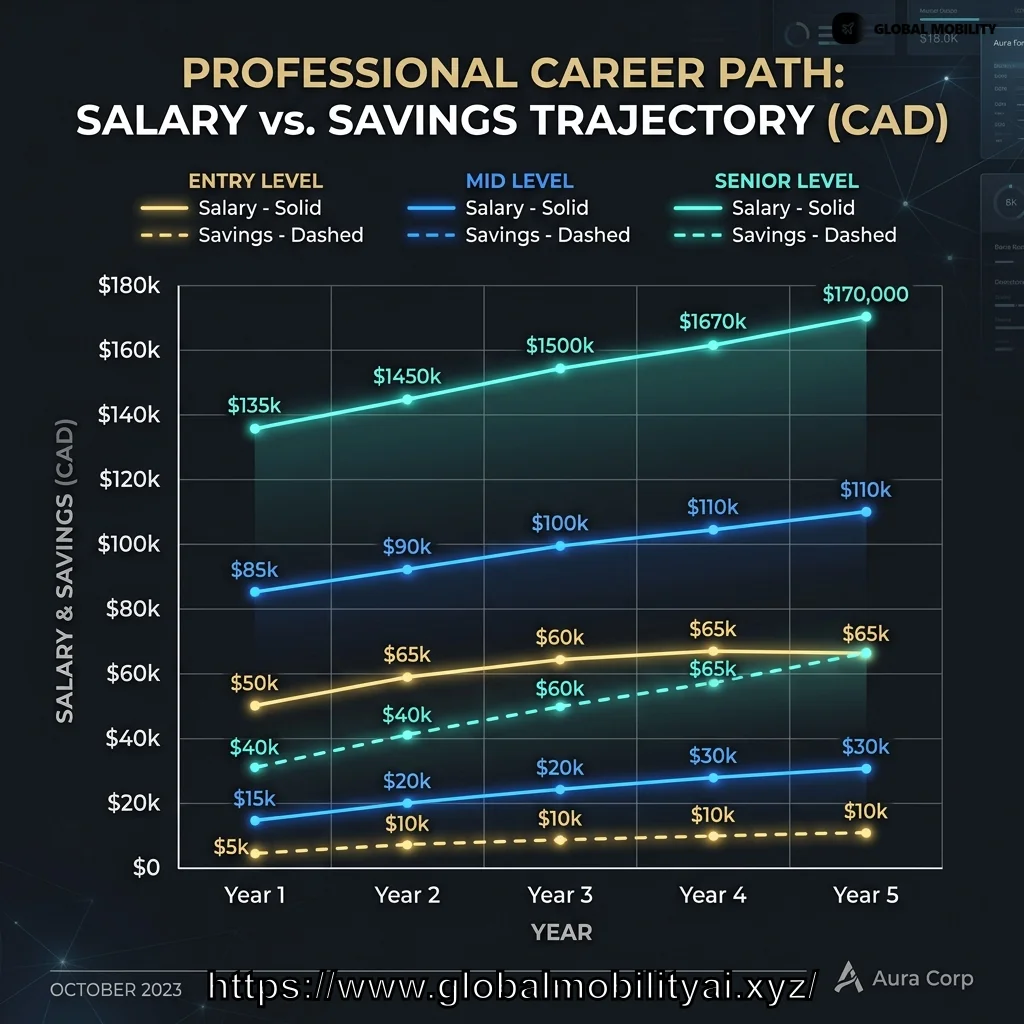
CHART-2: Salary vs. Savings Potential Line Chart
5.2 In-Demand Skills & Sectors in 2026
Australia's Priority Migration Skilled Occupation List (PMSOL) fast-tracks processing for Artificial Intelligence, specialized healthcare, and green technology engineering roles, bypassing standard queues and offering PR processing in as little as 3 to 5 months for these specific profiles (Source: Australian Department of Home Affairs, 2026) [https://immi.homeaffairs.gov.au/what-we-do/skilled-migration-program/recent-changes/priority-migration-skilled-occupation-list].
5.3 How to Use GlobalMobilityAI Salary Comparison Tool
Before accepting a job offer abroad, run it through the GlobalMobilityAI Salary Comparison Tool. PR applications linked to job offers below the prevailing median wage for that specific regional code are frequently flagged for genuineness audits, adding 6-12 months of delay. Our tool ensures your offer is robust enough to breeze through automated PR processing algorithms.
6. CV Formatting — Global Standard Resume Guide
If you are pursuing an employer-sponsored fast-track PR, your CV must bypass international Applicant Tracking Systems (ATS).
6.1 Global Corporate CV Format Requirements
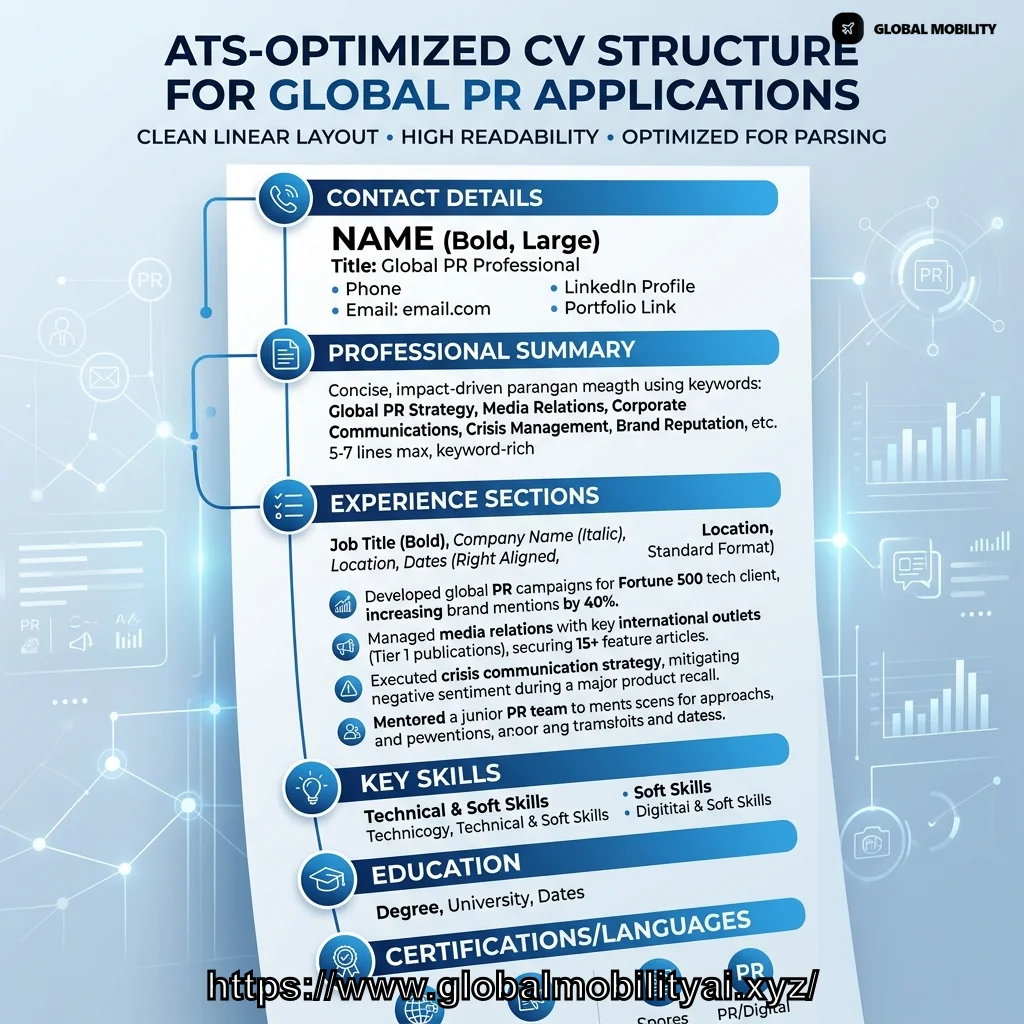
IMG-06: Optimized global standard resume format for PR applications
6.2 Common CV Mistakes That Get Applications Rejected
The global job market is hyper-competitive; minor CV formatting errors will result in immediate disqualification before a human ever reviews your application.
6.3 ATS Optimization for Global Job Portals
The recruitment landscape in top PR hubs like Canada, Australia, and Germany is heavily automated. The dominant job portals—LinkedIn, Indeed, Workopolis (Canada), and Seek (Australia)—all rely on sophisticated Applicant Tracking Systems (ATS) to filter out up to 75% of international applications instantly. To pass this digital firewall, your CV must be meticulously optimized for algorithmic reading.
A critical tip: Seek and Indeed use strict "keyword density" algorithms that heavily weight the exact match of the job title. Therefore, the exact job title listed in your CV header must mirror the official Job Description (JD) perfectly. If the JD specifically asks for a "Data Engineering Professional," do not label yourself as a "Backend Developer," as the system will flag you as unqualified. Furthermore, you must always use standard, universally recognized headings like "Work History" and "Education."
7. Interview Tips for PR-Sponsoring Employers
An employer offering a role that guarantees PR is taking a massive financial and legal risk on you. Your interview must alleviate that risk.
7.1 Cultural Interview Norms & Expectations
Expect a rigorous focus on "Behavioral Competency" over pure technical skill. Sponsoring employers want to know you will assimilate smoothly into the local corporate culture and remain with the firm long after the PR is finalized. For instance, in Canada and Germany, professional cultures highly value flat corporate hierarchies, proactive communication, and an extreme respect for work-life balance. Conversely, in Australia, there is a distinct emphasis on a "fair go"—collaborative team dynamics and friendly, down-to-earth communications are prized. During your interview, you must explicitly frame your achievements as collaborative victories and demonstrate respect for diverse cross-cultural team structures.
7.2 Common Interview Questions & Answer Frameworks

IMG-07: Candidate successfully completing a global PR job interview
7.3 Dress Code, Punctuality & Professional Etiquette
Zoom interviews are the standard for global hires. Ensure perfect lighting, a neutral background, and an HD camera. Dress code should be one level above the company's daily standard (usually a blazer and crisp shirt). Join exactly 3 minutes early. In addition, you must test all technical hardware beforehand to prevent audio latency or visual dropouts. Ensure your background is 100% professional and clutter-free; a virtual blurred background is acceptable but a clean, natural home office setup is far more convincing. Maintain eye contact with the lens rather than the screen, and use active listening indicators like subtle nodding to build virtual rapport.
7.4 Post-Interview Follow-Up Etiquette
Send a highly customized "Thank You" email within 12 hours. Reference one specific technical challenge discussed in the interview and briefly reiterate how your skills uniquely solve it.
8. 2026 Policy Updates & Market Predictions
Immigration policies are subject to rapid political shifts. Relying on outdated advice is the leading cause of PR refusal.
8.1 Key Policy Changes Effective 2026
Effective early 2026, Canada has strictly capped its temporary resident volumes, simultaneously increasing the CRS cut-off scores for general Express Entry draws, forcing applicants to rely on targeted category-based selections Source: IRCC Newsroom, 2026. Meanwhile, Germany’s fully implemented Skilled Immigration Act now legally permits PR applications in just 21 months for Blue Card holders with B1 German Source: Make it in Germany, 2026. Australia's overhaul of its Point Test system is currently under review as of May 2026 — monitor: homeaffairs.gov.au for official rollout dates.
8.2 Immigration Trend Predictions (Data-Backed)
The macro-trend for 2026 is clear: the era of "generic" PR applications is over. According to recent transparency reports from major immigration authorities (Source: IRCC Processing Data) https://www.canada.ca/en/immigration-refugees-citizenship/services/application/check-processing-times.html], processing times for "General Skilled" pathways are stretching, while "Critical Skills" pathways are being fast-tracked. The OECD Migration Outlook (2025) confirms that nations operating Points-Based Systems (PBS) are allocating a significant majority of their total PR quotas strictly to healthcare, advanced engineering, and digital tech professionals [Source: OECD International Migration Outlook, 2025. If you do not fall into these categories, the timeline to achieve PR will effectively double compared to 2023 baselines. The financial scrutiny on all applications will also exponentially intensify to prevent welfare strain.
8.3 How These Changes Affect Your Application in 2026
The increasing digitization of immigration frameworks means you must adopt a hyper-compliant, hyper-targeted approach. You can no longer submit a generic profile into a pool and hope for a draw. You must proactively acquire certifications, language test scores, or specific regional job offers that trigger automated fast-track algorithms. We strongly recommend using our internal GlobalMobilityAI Immigration Probability Score tool to objectively evaluate how these newly enforced, highly rigid policy weights affect your specific demographic profile before you invest thousands of dollars in language testing and credential assessments.
9. Tactical Comparison Matrix
Comparing the fastest countries to get permanent residency 2026 requires looking past marketing hype to the absolute data. If you are also prioritizing budget, read our comparative guide on the cheapest countries to get permanent residency 2026.
| PR Route | Eligibility Focus | Min. Investment/Salary | Processing Time | Difficulty | Est. Approval Rate* | Gov. Fee |
|---|---|---|---|---|---|---|
| UAE Golden Visa | Real Estate/Talent | AED 2M (Investment) | 2–4 Weeks | Low | Platform Est.* | AED 2,800 |
| Canada Express Entry | Tech/Health/French | $75k+ Salary Target | 5–8 Months | High | Platform Est.* | CAD 1,525 |
| Germany Blue Card to PR | STEM Degrees | €45,300 | 21 Months | Moderate | Platform Est.* | €113 |
| Australia 189/190 Visa | PMSOL Occupations | Points > 85 | 8–14 Months | Very High | Platform Est.* | AUD 4,640 |
| Portugal D3 Visa to PR | Highly Qualified | €2,500/month** | 5 Years | Moderate | Platform Est.* | €500** |
| UK Global Talent | Elite Recognition | N/A | 3 Years | Very High | Platform Est.* | £716*** |
*Internal platform estimate. Official approval rates not publicly published by individual immigration authorities. Monitor: official OECD stats
(Source: AIMA Portugal, 2026) [https://aima.gov.pt/pt]
* (Source: UK Home Office Visa Fees, 2026) [https://www.gov.uk/government/publications/visa-regulations-revised-table]
(Source: Official Portals [IRCC Fees, HomeAffairs, ICP], 2026)
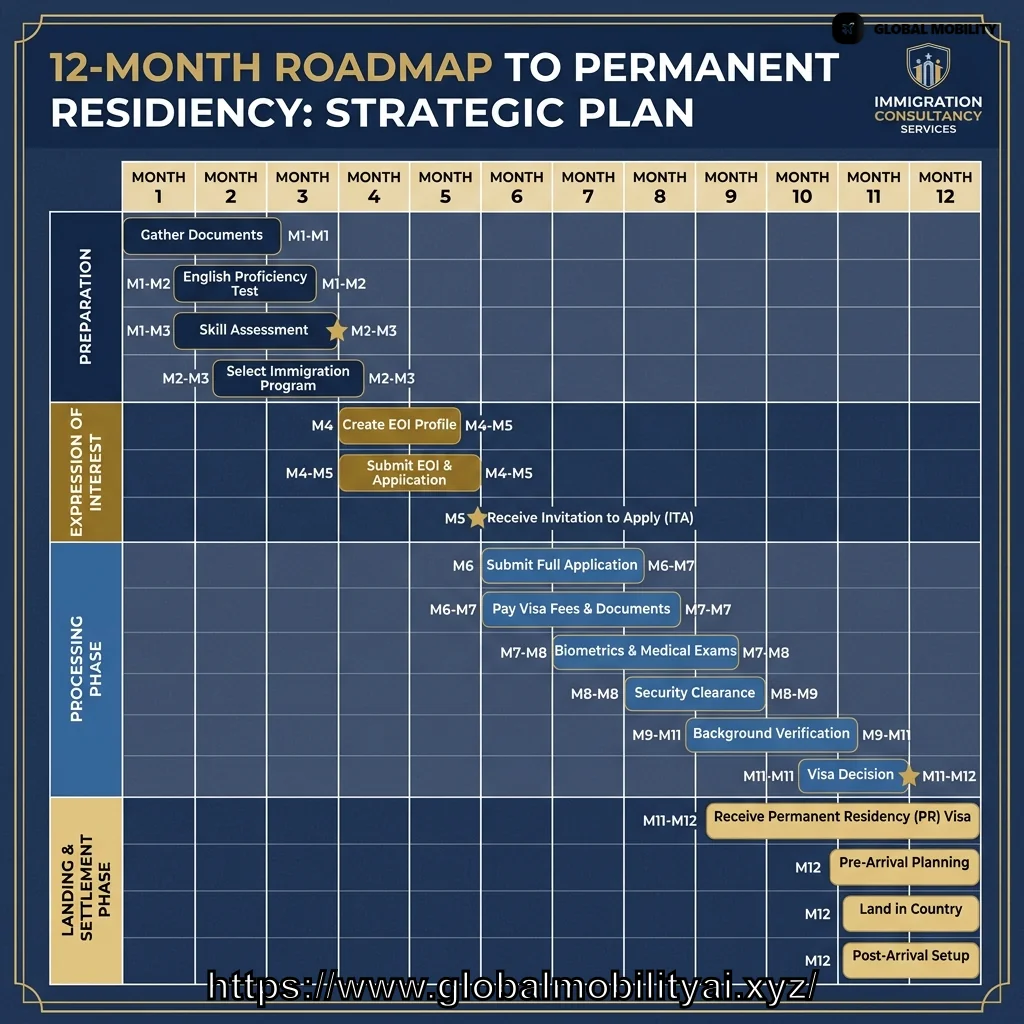
CHART-3: Visa Processing Timeline Gantt Chart
10. Execution Roadmap: Phase-by-Phase
Fast-track PR requires flawless execution. A single missing police certificate can add 6 months to your timeline.
Phase 1 — Preparation & Assessment (Months 1–2):
Your priority is securing foundational documents that take the longest to process.
Cost: ~$400 USD | Link: WES ECA Portal | Timeline: 4-8 weeks
Phase 2 — Expression of Interest & Application (Months 3–4):
Submit your profile to the relevant pool (Express Entry, SkillSelect) and wait for the Invitation to Apply (ITA). Upon receiving the ITA, you have 60 days to submit the absolute final package.
Cost: ~$1,200 USD | Link: IRCC Portal | Timeline: 4 weeks
Phase 3 — Processing & Arrival (Month 5–9):
Wait for background checks. Once the Confirmation of Permanent Residence (COPR) is issued, prepare for landing.
Cost: Free (Processing) | Link: Official Newcomer Services | Timeline: 1 day (Landing)
Phase 4 — Settlement & Citizenship (Years 3–5):
Maintain physical presence requirements to upgrade PR to full citizenship. Canada requires 3 years out of 5; Germany requires 5 years (or 3 for exceptional integration).
Cost: ~$600 USD | Link: Official Citizenship Portals | Timeline: 3-5 years
11. Critical Risk Factors & Common Pitfalls
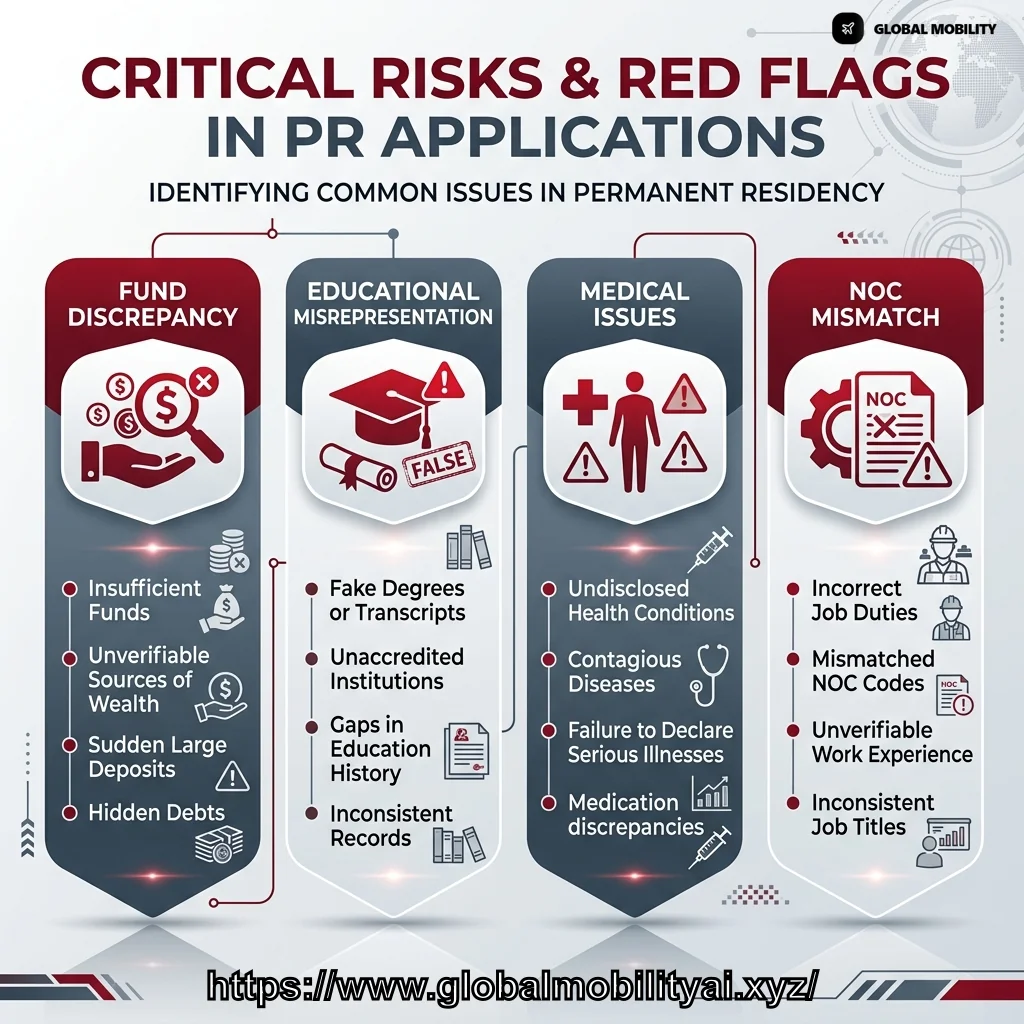
IMG-08: Red flags and pitfalls in permanent residency applications
The fastest PR routes are also the most unforgiving. Avoid these 8 fatal errors:
12. FAQ — People Also Ask
Q: What are the fastest countries to get permanent residency 2026 for digital nomads?
In 2026, Spain and Portugal remain highly attractive for remote workers. While their Digital Nomad Visas (DNV) grant temporary residency, time spent on a DNV officially counts towards the 5-year PR requirement. For absolute speed, countries like the UAE offer specialized remote work visas that can be rapidly converted into long-term Golden Visas depending on your sustained global income levels.
Q: Is it possible to get PR without a job offer in 2026?
Yes, but it requires exceptionally high human capital or financial investment. Canada's Express Entry (Federal Skilled Worker) and Australia's 189 Visa are designed as points-based systems that do not explicitly require a pre-arranged job offer, provided your age, education, and English scores maximize the grid. Alternatively, investment-based Golden Visas bypass the employment requirement entirely.
Q: Which is the cheapest country to get PR 2026?
While "fast" usually means expensive, Germany's Skilled Immigration pathways represent the highest ROI. The government application fees for the EU Blue Card and subsequent Settlement Permit are under €200. Because Germany relies heavily on taxpayer-funded integration, there are no massive multi-thousand-dollar visa levies like those seen in Australia or the UK. We recommend using the GlobalMobilityAI tools to calculate your exact lifetime cost per country.
Q: How does age affect my PR processing timeline?
Age is the silent killer in points-based systems. In Canada and Australia, points begin dropping precipitously after your 30th birthday. By age 40, securing PR through standard skilled migration without a direct employer sponsorship or massive provincial support is mathematically nearly impossible. If you are over 35, you must target employer-sponsored Fast-Track routes or investment pathways.
Q: Can I use PTE instead of IELTS for fast-track PR?
Yes. In 2026, PTE Academic is universally accepted by the Australian Department of Home Affairs, and Pearson PTE Core is officially accepted by IRCC Canada for all economic PR applications. PTE results are typically delivered within 48 hours, significantly accelerating your Phase 1 preparation timeline compared to standard IELTS processing.
Q: What is the success rate for Canada Express Entry in 2026?
The approval rate for complete, genuine ITA submissions is extremely high, as refusals are almost exclusively administrative in nature (Source: IRCC Processing Data, 2026) [https://www.canada.ca/en/immigration-refugees-citizenship/corporate/mandate/policies-operational-instructions-agreements/measuring-outcomes.html]. Common errors include uploading an expired police check or providing a flawed employer reference letter. Use our Immigration Probability Score to ensure perfection.
Q: Do I need an immigration lawyer to get PR fast?
No. A significant proportion of successful economic PR applicants in Canada and Australia file their applications completely independently. The systems are designed to be digital and user-facing. However, if you have a complex history (previous visa refusals, medical issues, or criminal records), consulting a registered legal professional is absolutely mandatory to navigate inadmissibility hurdles.
Q: Are Golden Visas worth the cost for instant PR?
If capital preservation is your primary goal and you possess liquid assets exceeding $500,000 USD, Golden Visas (like the UAE 10-Year Visa or European equivalents) offer unparalleled speed, often granting residency in under a month. They completely bypass the stress of language testing, age limits, and employer dependency, making them the ultimate "fastest" route for high-net-worth individuals.
13. Conclusion: The Bottom Line
Identifying the fastest countries to get permanent residency 2026 is not about searching for loopholes; it is about leveraging macro-economic data. If you are a highly skilled professional in 2026, countries like Canada, Australia, and Germany view you as critical infrastructure. Your objective is simply to map your specific credentials to the nation experiencing the most acute shortage in your field.
Stop wasting years in backlogged, generic queues. Take immediate action by securing your language scores and credential assessments today. The window for favorable points thresholds opens and closes rapidly based on political cycles. Solidify your global future by acting on verified data, and transform your international mobility from a dream into an immediate, executed reality.
For comparable strategic insights, review our Canada Express Entry 2026 strategic blueprint to model your specific points trajectory.
Predict your mobility score.
Use our AI engine to get your personalized visa pathway, salary prediction, and relocation roadmap.
More Insights

Which Immigration Points System Do I Qualify For 2026? Self-Assessment Guide

Best Countries for Pakistani Immigrants Salary Comparison 2026