How Much Can I Save in Dubai Per Month 2026? Expat Reality Check
Editorial Transparency: Content compiled from official
government sources by the GlobalMobilityAI Research Team.
For personalized legal or immigration advice, consult a
licensed immigration consultant or lawyer.
(Last Updated: 2026-05-21)
For professionals targeting the UAE, the central question is this: how much can I save in Dubai per month 2026? According to official UAE Ministry of Economy projections, the country's GDP growth trajectory is hovering near 4.2% for 2026. (Under review as of May 2026 — monitor: UAE Ministry of Economy) [https://www.moec.gov.ae/en/uae-economy] GlobalMobilityAI.xyz has compiled verified data to answer exactly that question for 2026.
While the fundamental allure of a 100% tax-free salary is incredibly strong and forms the foundation of the UAE's competitive advantage, the reality of rising premium accommodation costs necessitates forensic financial planning. A high top-line salary can easily be consumed by lifestyle inflation if not managed properly. By carefully examining verified salary benchmarks across key industries, up-to-date rental market averages in expat-heavy districts, and essential everyday expenditures, professionals can transition with absolute financial clarity, execute a disciplined savings strategy, and ultimately maximize their long-term wealth-building potential in the Emirates.
Dubai remains a premier destination for tax-free wealth accumulation in 2026.

Table of Contents
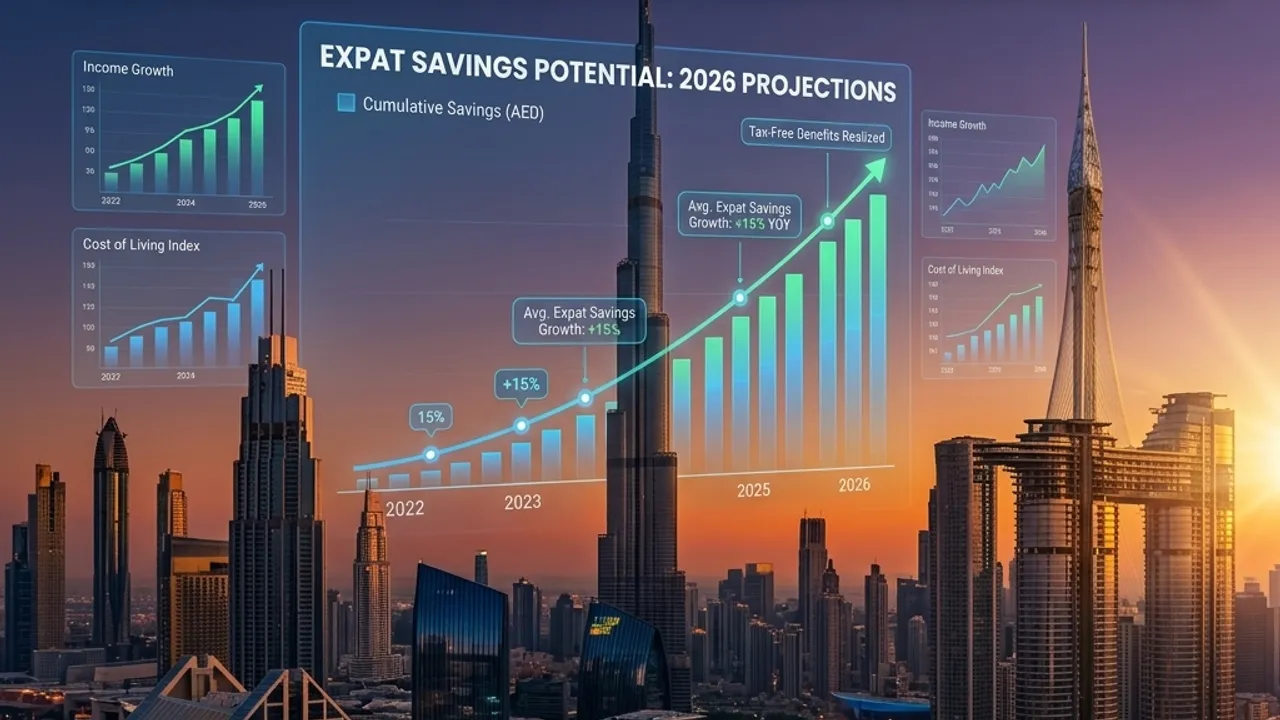
How Much Can I Save in Dubai Per Month 2026
1. Why Dubai in 2026? — The Strategic Case
1.1 Economic Landscape & Opportunity
Dubai's economic trajectory in 2026 continues to be shaped by the ambitious D33 Agenda, aiming to double the size of the emirate's economy over the next decade and position it among the top three global cities. The UAE's non-oil foreign trade has hit unprecedented milestones, with the technology, finance, e-commerce, and renewable energy sectors acting as primary growth engines. The strategic shift from oil dependency to a digital and services-led economy has attracted major multinational corporations, resulting in a surge of high-paying roles in cloud architecture, financial technology, and management consulting. The establishment of specialized free zones like Dubai Internet City and Dubai Design District has fostered localized innovation clusters, making it easier for foreign companies to operate and recruit globally. The implementation of corporate tax (at a flat rate of 9% on taxable profits exceeding AED 375,000) has matured, creating a more structured, transparent, and globally aligned corporate environment without compromising the zero-percent personal income tax benefit for individual residents. This means expats continue to enjoy a 100% tax-free personal income on salaries, interest, capital gains, and inheritance. According to the World Bank, the UAE's economic diversification strategy has successfully shielded the local job market from global inflation and volatility, offering a highly stable and robust environment for wealth accumulation. (Source: World Bank UAE Country Economic Memorandum, 2025) [https://www.worldbank.org/en/country/unitedarabemirates/overview]
1.2 Why Professionals Are Targeting This Destination
The strategic appeal of Dubai extends beyond mere taxation benefits. The emirate has solidified its position as the premier global hub bridging East and West, providing businesses and individuals with a highly connected launchpad. Professionals are increasingly targeting Dubai for its unparalleled safety, world-class healthcare, premium infrastructure, and diverse international community representing over 200 nationalities. Furthermore, the lifestyle appeal of Dubai—featuring year-round sunshine, top-tier international schools, and a highly active social and leisure calendar—makes it a compelling choice for families and single professionals alike. The government's proactive approach to safety and convenience, exemplified by the digitization of public services, has transformed Dubai into one of the most liveable cities in the world, competing directly with traditional expat hubs like London, Singapore, and New York. According to Dubai Statistics Center data, long-term residency registrations have increased year-over-year as more professionals seek permanent settlement pathways. (Source: Dubai Statistics Center, 2026) https://www.dsc.gov.ae/] The continuous evolution of the visa framework empowers expatriates to establish deep roots, invest in local real estate, and relocate their families with confidence. For those exploring comprehensive regional strategies, examining the broader landscape, such as [our comprehensive UAE Golden Visa 2026 guide, provides critical comparative context.
2. Deep-Dive Analysis: Legal and Financial Framework
2.1 Legal Requirements & Visa Categories
The UAE's residency framework is designed to attract specific tiers of talent, investment, and entrepreneurial skill. The standard Employment Visa remains the most common route, sponsored directly by a mainland or free-zone employer. Free-zone visas are typically issued for two years, whereas mainland contracts are standard. Self-sponsored options have revolutionized the landscape. The Green Visa grants five years of self-sponsored residency for freelancers, skilled employees, and investors. It requires a minimum bachelor's degree, a valid employment contract, and a salary threshold of AED 15,000 per month, eliminating the need for an employer sponsor. The Golden Visa, offering ten years of residency, targets exceptional talents, scientists, outstanding students, and property investors (requiring a minimum property investment of AED 2 million). Golden Visa holders benefit from the ability to sponsor family members and domestic helpers indefinitely, and the visa remains active even if they stay outside the UAE for extended periods. For a comprehensive overview of alternative residency paths, see our UAE Green Visa 2026 Guide. (Source: UAE Federal Authority for Identity, Citizenship, Customs and Port Security (ICP), 2026) [https://icp.gov.ae/en/services/golden-visa/]
2.2 Eligibility Criteria & Qualification Scoring
Unlike rigid, points-based systems in Canada or Australia, the UAE relies on categorical eligibility based on professional classifications and financial thresholds. For the standard Employment Visa, approval is contingent upon the employer possessing a valid quota and the applicant passing mandatory medical fitness tests. For the Green Visa (Skilled Professional category), applicants must fall into the first, second, or third occupational levels as per the Ministry of Human Resources and Emiratisation (MoHRE) classification system. Level 1 includes legislators, senior officials, and managers; Level 2 includes professionals in scientific, technical, and human fields; Level 3 includes technicians and associate professionals. Applicants must present attested educational certificates and a valid employment contract showing a monthly salary of at least AED 15,000. Freelancers must obtain a freelance permit from MoHRE and prove a minimum annual income of AED 360,000 for the previous two years. (Source: Ministry of Human Resources and Emiratisation, 2026) [https://www.mohre.gov.ae/en/home.aspx]
2.3 Required Documentation & Official Checklists
Securing residency in Dubai demands precise documentation and adherence to a strict multi-step administrative workflow. Below is the comprehensive checklist and execution guide:
Required Document Checklist:
Detailed Administrative Workflows:
To be recognized by UAE immigration authorities, your educational degree must undergo a three-tier legalization process:
Passing the medical fitness test is mandatory for all expats aged 18 and older. The screening is conducted at designated Dubai Health Authority (DHA) centers:
Residency processing is split between Dubai's local authority (GDRFA) and the federal authority (ICP):
3. City Guide — Where to Live in Dubai in 2026
3.1 Top 5 Neighborhoods for Expats: Rankings & Analysis
While Dubai is a single city, its distinct neighborhoods function as micro-cities, dramatically impacting how much can I save in Dubai per month 2026.
3.2 City Comparison Table
| Neighborhood | Avg Rent 1BR (Annual) | Monthly Cost | Job Market | Safety | Expat Rating |
|---|---|---|---|---|---|
| Dubai Marina | AED 110,000 | AED 15,500 | Excellent | High | 4.8/5.0 |
| JLT | AED 85,000 | AED 12,000 | Excellent | High | 4.6/5.0 |
| Business Bay | AED 105,000 | AED 14,800 | Excellent | High | 4.7/5.0 |
| Silicon Oasis | AED 65,000 | AED 9,500 | Good | High | 4.4/5.0 |
| Al Furjan | AED 70,000 | AED 10,200 | Good | High | 4.3/5.0 |
(Source: Numbeo Dubai Cost of Living, 2026) [https://www.numbeo.com/cost-of-living/in/Dubai] | (Source: Property Finder UAE, 2026) [https://www.propertyfinder.ae/]
4. How Much Can I Save in Dubai Per Month 2026? — Full Cost Breakdown
4.1 Monthly Budget Calculator Breakdown
Determining how much can I save in Dubai per month 2026 requires a forensic analysis of monthly expenditures. For a single professional maintaining a comfortable, middle-tier lifestyle, the breakdown is as follows:
Total baseline monthly expenditure averages AED 11,100 (USD 3,025). (Source: Numbeo Cost of Living Survey, 2026) [https://www.numbeo.com/cost-of-living/in/Dubai]
\Based on mid-tier suburban areas such as Al Furjan or Dubai Silicon Oasis (as detailed in Section 3), factoring in minor annual rent increases and maintenance fees.*
4.2 Cost of Living vs. Salary: What You'll Actually Save
When calculating exactly how much can I save in Dubai per month 2026, savings potential scales dramatically with seniority.
Utilizing the GlobalMobilityAI cost of living calculator allows users to input specific lifestyle preferences to project personalized financial outcomes accurately. (Source: Ministry of Human Resources and Emiratisation Wage Indicators, 2026) [https://www.mohre.gov.ae/]
4.3 Cost of Living Index vs. Home Countries
| Category | Dubai | Pakistan (Karachi) | India (Mumbai) | UK (London) |
|---|---|---|---|---|
| Rent Index | 100.0 | 12.4 | 28.5 | 115.2 |
| Groceries | 100.0 | 35.2 | 41.8 | 92.5 |
| Purchasing Power | 100.0 | 25.4 | 48.2 | 85.6 |
(Source: Numbeo Comparative Index, 2026) [https://www.numbeo.com/cost-of-living/compare_cities.jsp]
5. Salary Data & Job Market Intelligence
5.1 Average Salaries by Industry (2026 Data)
| Industry | Entry Level | Mid-Level | Senior | Currency |
|---|---|---|---|---|
| IT & Software | 12,000 | 25,000 | 45,000 | AED/month |
| Finance & Banking | 15,000 | 30,000 | 55,000 | AED/month |
| Digital Marketing | 10,000 | 22,000 | 38,000 | AED/month |
| Healthcare (Specialist) | 20,000 | 40,000 | 75,000 | AED/month |
| Engineering | 14,000 | 26,000 | 48,000 | AED/month |
(Source: Ministry of Human Resources and Emiratisation Labor Force Data, 2026) [https://www.mohre.gov.ae/]
5.2 In-Demand Skills & Sectors in 2026
The UAE's focus on digital transformation has created acute talent shortages in Artificial Intelligence, Cybersecurity, and Data Science. The real estate and construction sectors are experiencing a resurgence, driving demand for specialized civil engineers and project managers. Furthermore, the healthcare sector is expanding rapidly to accommodate medical tourism and a growing population, resulting in a persistent need for specialized physicians and nursing staff. These trends are corroborated by official labor surveys indicating structural shifts toward a knowledge-based economy. (Source: Ministry of Human Resources and Emiratisation Labor Reports, 2026) [https://www.mohre.gov.ae/en/media-center/reports.aspx]
5.3 How to Use GlobalMobilityAI Salary Comparison Tool
The platform's salary comparison tool allows candidates to cross-reference their current home-country net income against live Dubai market rates. By inputting your exact job title and years of experience, the tool provides a verified baseline, ensuring you do not accept lowball offers and can negotiate effectively.
6. CV Formatting — UAE-Style Resume Guide
6.1 UAE CV Format Requirements
The UAE job market has specific formatting expectations that differ from Western norms.
6.2 Common CV Mistakes That Get Applications Rejected
Navigating the Dubai hiring landscape requires avoiding regional pitfalls.
6.3 ATS Optimization for UAE Job Portals
The dominant portals in the UAE are GulfTalent, Bayt, and LinkedIn. Enterprise companies universally employ Applicant Tracking Systems (ATS) like Taleo or Workday. ATS keyword strategy in the UAE must focus on hard technical skills and specific software proficiencies rather than soft skills. Avoid complex tables, columns, or graphic-heavy designs, as these scramble ATS parsers. Ensure exact match keywords from the job description (e.g., "P&L Management", "Python", "B2B Sales") are organically woven into the work experience section to maximize the parse rate and secure human review.
7. Interview Tips for the Dubai Job Market
7.1 Cultural Interview Norms & Expectations
Interviews in the UAE blend Western corporate practices with traditional Middle Eastern business etiquette. Formality is paramount at all times. Hierarchy is deeply respected within organizations, and interactions with senior Emirati or regional management require appropriate deference and patience. It is highly advised to focus on building a strong personal rapport before diving aggressively into business topics. While technical competence is thoroughly vetted, cultural fit, patience, and adaptability to a hyper-diverse workforce are equally critical evaluation metrics for securing the role.
7.2 Common Interview Questions & Answer Frameworks
7.3 Dress Code, Punctuality & Professional Etiquette
The dress code is strictly formal. Men should wear a dark, well-tailored suit and tie; women should wear conservative, professional business attire covering shoulders and knees. Punctuality is non-negotiable; arriving 15 minutes early is expected. Handshakes are standard, but wait for female interviewers to extend their hand first as a mark of cultural respect.
7.4 Post-Interview Follow-Up Etiquette
Send a concise, professional thank-you email within 24 hours of the interview. Reiterate your value proposition briefly. Expected hiring timelines in the UAE can be protracted (often 3-6 weeks); avoid following up more than once every two weeks unless a specific deadline was provided.
8. 2026 Policy Updates & Market Predictions
8.1 Key Policy Changes Effective 2026
The UAE government has solidified several structural changes that fundamentally reshape the long-term planning strategies for incoming expatriates. Most notably, the 9% Corporate Tax framework is now fully operational for businesses exceeding AED 375,000 in annual profit. While this introduces new compliance requirements for freelancers and business owners, it promotes immense corporate transparency and aligns the UAE with international financial standards. (Source: UAE Federal Tax Authority, 2026) [https://tax.gov.ae/en/taxes/corporatetax.aspx] Crucially for individual professionals, personal income remains strictly tax-free, protecting the core financial advantage of relocating to Dubai.
Simultaneously, Emiratisation targets for private sector companies with 50 or more employees have progressively tightened. Employers face strict quotas requiring the steady integration of UAE nationals into their workforce, meaning foreign talent is increasingly recruited only for highly specialized, senior, or technically complex roles where local supply is insufficient. Furthermore, the expanded Golden Visa criteria have stabilized into a predictable system, allowing real estate investors purchasing off-plan properties (with a minimum equity investment of AED 2 million) to qualify immediately without waiting for project handover. (Source: UAE Government Portal Golden Visa Regulations, 2026) [https://u.ae/en/information-and-services/visa-and-emirates-id/residence-visas/golden-visa]
8.2 Immigration Trend Predictions (Data-Backed)
Official government data and international macroeconomic assessments indicate a strategic and irreversible shift toward retaining high-net-worth individuals and highly skilled technical workers over transient labor. According to the latest data on skilled migration pathways, the UAE is prioritizing advanced technological proficiencies, particularly in artificial intelligence, green energy, and biotechnology. (Source: OECD Migration Outlook, 2025) [https://www.oecd.org/migration/mig/] Processing times for standard visas have radically accelerated due to the full digitization of the ICP and GDRFA portals, often completing within an unprecedented 5-7 working days. (Source: UAE Federal Authority for Identity, Citizenship, Customs and Port Security (ICP) Services, 2026) [https://icp.gov.ae/en/services/]
However, this sustained influx of affluent professionals from Europe, North America, and South Asia is expected to maintain intense upward pressure on prime real estate rentals across central Dubai neighborhoods. While the delivery of thousands of new residential housing units in late 2026 is projected to eventually stabilize mid-tier rents in suburban communities, prime areas will likely see continued yield compression. Based on current development pipeline data — monitor: Dubai Land Department, 2026] [https://dubailand.gov.ae/] For professionals from South Asia evaluating multiple options and comparing long-term residency prospects, reviewing the [best countries for Pakistani immigrants in 2026 provides valuable comparative context on global migration flows.
8.3 How These Changes Affect Your Application in 2026
With heightened global competition for top-tier corporate roles, simply holding a degree is no longer sufficient; securing an employment offer requires exceptional credentials and immediate readiness. Employers now aggressively prioritize candidates who can deploy without bureaucratic friction. Therefore, applicants must ensure their educational degrees are pre-attested through the UAE Embassy in their home country well before applying. Utilizing the platform's immigration probability score helps assess your true competitiveness against the current candidate pool before investing substantial time and capital into the relocation process. By understanding your exact market value and visa eligibility upfront, you can target employers with active visa quotas and position yourself as a zero-risk, high-impact hire in the evolving 2026 Dubai market.
Additionally, professionals should proactively secure industry-recognized certifications relevant to the region's rapidly growing tech and green energy sectors. Engaging with specialized recruitment agencies and establishing a robust local network via LinkedIn well ahead of your planned move will further amplify your visibility. By combining technical excellence with proactive administrative compliance, candidates significantly elevate their chances of securing premium compensation packages that maximize long-term monthly savings.
9. Tactical Comparison Matrix
When evaluating global mobility options, comparing Dubai's residency timelines with the fastest countries to get permanent residency is crucial for long-term planning.
| Visa Type | Eligibility | Min. Salary | Processing Time | Difficulty | Est. Approval Rate* | Gov. Fee |
|---|---|---|---|---|---|---|
| Standard Work Visa | Job Offer | N/A | 1-2 Weeks | Low | Platform Est.* | Paid by Employer |
| Green Visa (Skilled) | Degree + Job | AED 15,000 | 2-3 Weeks | Medium | Platform Est.* | AED 2,280 |
| Golden Visa (Talent) | Ministry Apv | AED 30,000+ | 3-4 Weeks | High | Platform Est.* | AED 2,790 |
| Golden (Property) | AED 2M Invst | N/A | 2-3 Weeks | Low | Platform Est.* | AED 2,790 |
| Freelance Visa | License | N/A | 2-3 Weeks | Medium | Platform Est.* | AED 7,500+ |
| Remote Work Visa | Foreign Job | USD 3,500 | 2-3 Weeks | Medium | Platform Est.* | USD 287 |
*Internal platform estimate. Official approval rates not publicly published by ICP. Monitor: [https://icp.gov.ae/en/]
(Source: ICP Official Portal, 2026) [https://icp.gov.ae/en/services/]
10. Execution Roadmap: Phase-by-Phase
Phase 1 — Preparation and Legalization (Months 1–2)
The critical first step in your Dubai relocation strategy is ensuring full document readiness before you even begin applying for roles. The UAE enforces a strict, multi-tier document authentication process that cannot be bypassed. You must gather your original university degree, marriage certificate, and children's birth certificates (if sponsoring dependents) and initiate the attestation process. This involves securing stamps from your home country’s Ministry of Education, the Ministry of Foreign Affairs, and finally the UAE Embassy in your jurisdiction. Delays here are the number one reason job offers are rescinded, as employers require immediate deployment. Simultaneously, you must optimize your professional profile by converting your resume to the strict UAE CV format—ensuring your nationality, age, and professional headshot are prominently displayed to pass initial HR screening. Engage in aggressive market mapping by connecting with specialized recruiters on LinkedIn and registering on major regional portals like GulfTalent and Bayt.
Exact Costs: Approximately AED 1,200 to AED 1,800 per document depending on the origin country and courier fees.
Processing Time: 4 to 8 weeks globally. (Source: ICP Processing Times, 2026) [https://icp.gov.ae/en/services/]
Official Action Portal: UAE Ministry of Foreign Affairs Attestation Services [https://www.mofa.gov.ae/]
Phase 2 — The Employer Nomination and Entry Permit (Months 3–4)
Once you successfully navigate the interview stages and formally accept an employment offer, the administrative burden shifts temporarily to your new employer. Your company’s Public Relations Officer (PRO) will submit an initial application to the Ministry of Human Resources and Emiratisation (MoHRE) to secure a labor quota approval. Following this, they will apply for your official Employment Entry Permit (commonly referred to as the 'Pink Visa') through the General Directorate of Residency and Foreigners Affairs (GDRFA). Under UAE labor law, you must never enter the country on a tourist visa with the intention to work; you must wait for the electronic Entry Permit to be issued. Do not resign from your current job, cancel your home-country lease, or book one-way flights until you have received the finalized, government-issued PDF of your Entry Permit.
Exact Costs: AED 0 for the candidate. UAE labor law strictly dictates that the employer must bear 100% of the recruitment and visa issuance costs.
Processing Time: Typically 2 to 3 weeks assuming no security clearance delays. (Source: ICP Processing Times, 2026) [https://icp.gov.ae/en/services/]
Official Action Portal: Ministry of Human Resources and Emiratisation (MoHRE) [https://www.mohre.gov.ae/]
Phase 3 — Arrival, Medical Screening, and Administration (Month 5)
Upon arriving at Dubai International Airport with your Entry Permit, your immediate priority is transitioning from temporary entry status to full residency. Within the first 72 hours, your company PRO will schedule your mandatory medical fitness examination at a certified Dubai Health Authority (DHA) center, which includes a blood test for communicable diseases and a chest X-ray. Following a clear medical result, you will proceed to an ICP center to register your biometric data (fingerprints and high-resolution eye scans) required for your Emirates ID. Once the Emirates ID is electronically approved, you can finally execute the fundamental pillars of expatriate life: opening a local AED bank account, securing a long-term apartment lease, registering your Ejari (the official Dubai tenancy contract), and activating your DEWA (Dubai Electricity and Water Authority) utility connections.
Exact Costs: Medical typing and VIP processing (if elected) AED 800; DEWA Activation Deposit AED 2,000 (apartment) to AED 4,000 (villa); Ejari Registration AED 220.
Processing Time: 10 to 14 days for the physical Emirates ID delivery. (Source: ICP Processing Times, 2026) [https://icp.gov.ae/en/services/]
Official Action Portal: Dubai Land Department for Ejari [https://dubailand.gov.ae/] and GDRFA for Residency [https://www.gdrfad.gov.ae/]
Phase 4 — Settlement, Optimization, and Long-Term PR (Month 12+)
After successfully passing your six-month probation period and fully settling into the rhythm of Dubai corporate life, your focus must shift from administration to aggressive financial optimization. Review your initial housing choices and utilize the GlobalMobilityAI cost of living calculator to ensure your rent-to-income ratio remains strictly below 30%. Begin aggressively remitting your tax-free savings or investing in the local economy. At the 12-to-24-month mark, strategically evaluate your career trajectory to determine if you meet the threshold to upgrade from an employer-sponsored visa to a self-sponsored 5-year Green Visa or a 10-year Golden Visa. Securing a Golden Visa completely decouples your residency status from your employment, granting you profound bargaining power in the labor market and establishing a permanent, secure foundation for your family in the Emirates.
Exact Costs: Golden Visa application and typing fees approximately AED 2,790; Green Visa fees approximately AED 2,280.
Processing Time: 1 to 5 years of accumulated local experience and financial growth.
Official Action Portal: ICP Golden Visa Nomination Portal [https://icp.gov.ae/]
11. Critical Risk Factors & Common Pitfalls
12. FAQ: How Much Can I Save in Dubai Per Month 2026 & More
Q: How much can I save in Dubai per month 2026 as a single professional?
As a single professional earning an average mid-level salary of AED 20,000, optimized living expenses generally consume around AED 10,000 to AED 12,000. Therefore, a disciplined individual can comfortably save between AED 8,000 to AED 10,000 monthly, provided they manage housing and lifestyle costs effectively. To maximize this savings rate, many expats opt to share premium apartments or reside in emerging suburbs like Dubai Silicon Oasis or Al Furjan. Additionally, implementing a strict 50-30-20 budget rule and minimizing high-end dining or weekend leisure spending can further safeguard your monthly savings potential in the emirate.
Q: Is Dubai still tax-free in 2026?
Yes, personal income remains 100% tax-free in the UAE. While the government introduced a 9% Corporate Tax on business profits exceeding AED 375,000, salaries, wages, and personal investment returns are completely exempt from taxation, maintaining Dubai's high wealth-accumulation appeal. This means you do not pay any federal income tax, capital gains tax, or inheritance tax on your personal earnings. However, expats should budget for indirect taxes such as the 5% Value Added Tax (VAT) on general goods and services, as well as municipal fees on rental properties, which slightly impact everyday cost of living.
Q: What is the average rent for a 1-bedroom apartment in Dubai?
In 2026, the average rent for a 1-bedroom apartment in Dubai varies drastically depending entirely on the neighborhood's proximity to central business districts and metro access. A modern 1-bedroom unit in a premium, highly sought-after expat area like Dubai Marina typically averages around AED 110,000 annually. Conversely, mid-tier commercial areas like Jumeirah Lakes Towers (JLT) average approximately AED 85,000 per year. For professionals willing to accept a slightly longer commute, suburban zones like Dubai Silicon Oasis and Al Furjan offer excellent value, with similar units pricing out between AED 65,000 and AED 70,000 annually. Prospective residents should strongly consider these variations and use the GlobalMobilityAI cost of living calculator to accurately model specific rent scenarios against their expected salary.
Q: How much is needed to live comfortably in Dubai?
For a single person to live comfortably—renting a private 1-bedroom apartment, owning or leasing a car, and enjoying weekly social activities—a minimum monthly income of AED 15,000 to AED 18,000 is recommended to ensure both quality of life and healthy monthly savings. If you are relocating with a family, you must factor in additional costs such as international schooling fees (which range from AED 30,000 to AED 80,000 annually per child) and car leasing expenses (typically costing between AED 1,500 to AED 2,500 per month for a mid-sized sedan). These essential expenditures scale the comfortable living threshold to at least AED 30,000 monthly for families.
Q: Can I get a UAE Golden Visa with my salary?
Yes, under the updated 2026 guidelines, highly skilled professionals can qualify for the Golden Visa if they hold a valid employment contract, possess a bachelor's degree classified under MoHRE level 1 or 2, and earn a minimum monthly salary of AED 30,000. Level 1 classifications encompass managers and senior executives, whereas Level 2 covers scientific, technical, and human professionals. Crucially, applicants must present an attested educational degree verified by both the Ministry of Foreign Affairs in their home country and the UAE MoFA to formally satisfy the qualification rules and secure the ten-year residency status.
Q: What are the upfront costs of moving to Dubai?
Upfront costs are substantial and often underestimated by new expats. You should realistically budget for at least 3-4 months of rent (as many landlords demand quarterly post-dated cheques), a 5% security deposit, a standard 5% agency fee, Ejari registration fees, DEWA utility connection deposits, and initial apartment furnishing. Cumulatively, this typically requires readily available liquidity of AED 30,000 to AED 45,000 before you even receive your first local paycheck. Utilizing our platform salary comparison tool helps accurately gauge if your negotiated starting package and relocation allowance will adequately cover these critical setup costs without driving you into immediate debt.
Q: Is it better to live in Dubai or Abu Dhabi for savings?
Determining whether it is better to live in Dubai or Abu Dhabi for maximizing your savings potential depends entirely on your specific industry and lifestyle preferences. Historically, Abu Dhabi generally offers slightly lower rental costs for equivalent prime real estate and a calmer, more family-oriented environment compared to Dubai, although this price gap is steadily narrowing in 2026. Conversely, Dubai frequently commands significantly higher baseline salaries and offers superior networking opportunities, particularly in rapidly growing sectors like financial technology, digital media, and e-commerce. Furthermore, Dubai’s expansive public transportation network can reduce reliance on a personal vehicle, lowering overall transit expenses. The optimal choice ultimately requires a detailed comparative analysis of your specific employment offer, housing allowance, and commuting requirements.
Q: How do I open a bank account in Dubai as a new resident?
To open a standard salary account, you need your original passport, a copy of your valid residency visa, your Emirates ID (or the registration form if pending), and an official salary certificate from your employer. Digital banks now allow account setup within 24 hours once the Emirates ID is active. Many traditional institutions may require a minimum monthly balance or a letter of no-objection (NOC) from your employer depending on your visa type. Having a local bank account is essential for processing rental cheques, paying DEWA utility deposits, and managing your daily transactions smoothly in Dubai.
13. Conclusion: The Bottom Line
If you are a driven, ambitious professional relocating in 2026, answering the fundamental question of "how much can I save in Dubai per month 2026" ultimately comes down to your personal defense against aggressive lifestyle inflation. The UAE’s zero-tax environment undeniably provides an unparalleled, world-class foundation for rapid wealth creation, but this structural advantage is easily eroded by the temptation of premium real estate, luxury leasing, and high-end weekend spending.
Your single most important strategic takeaway is this: cap your housing costs ruthlessly. Maintaining a strict rent-to-income ratio at or below 30% is the absolute primary discipline separating high-saving, financially independent expats from those trapped in a cycle of lifestyle inflation—a core principle corroborated by financial planning benchmarks globally.
To ensure you enter the competitive Middle Eastern market from a position of strength, you must first verify your true market value and project your exact net retention using our platform's salary comparison tool. Once you have a verified baseline, calculate your projected monthly surplus using the GlobalMobilityAI cost of living calculator. Finally, if you are actively evaluating competing global mobility options, review our comprehensive Singapore Compass Framework 2026 guide to directly compare global compensation structures and residency benefits. Treat Dubai not just as a luxurious temporary destination, but as a calculated, high-yield accelerator for your long-term financial independence.
Predict your mobility score.
Use our AI engine to get your personalized visa pathway, salary prediction, and relocation roadmap.
More Insights

Best Countries for Software Engineers to Emigrate 2026: Full Ranking

UK Skilled Worker Visa Total Cost 2026: Application Fee, IHS, Legal Fees & Hidden Expenses