Japan Highly Skilled Professional Visa 2026: Points, Salary & PR
Editorial Transparency: Content compiled from official government sources by the GlobalMobilityAI Research Team. For personalized legal or immigration advice, consult a licensed immigration consultant or lawyer. (Last Updated: 2026-05-17)
In late 2025, the Immigration Services Agency of Japan reported that the total number of foreign residents in Japan reached an all-time high of 3.41 million, driven heavily by a substantial increase in high-skilled visa allocations (Source: End of 2024 Foreign Residents Statistics, 2025) [https://www.isa.go.jp/en/publications/materials/toukei_zairyu.html]. Navigating the Japan Highly Skilled Professional visa 2026 is the ultimate tactical shortcut to securing Indefinite Residency in one of the world's most stable economies. At GlobalMobilityAI.xyz, our analysis of the Japanese Ministry of Justice regulatory frameworks indicates that the 2026 point thresholds offer an unprecedented window for engineers, researchers, and business executives to bypass standard 10-year residency timelines. This complete, data-backed guide delivers the exact points calculator, minimum income baselines, and legal blueprints to transition your career to Japan and secure permanent residency in as little as 12 months.
The definitive guide to Japan's 2026 high-skilled immigration framework and accelerated permanent residency.

Table of Contents

Japan Highly Skilled Professional Visa 2026
1. Why Japan in 2026? — The Strategic Case
Japan's immigration strategy in 2026 represents a structural shift from isolationism to active talent acquisition. Driven by urgent demographic realities, the Japanese government has restructured its points-based system to attract highly qualified expats.
1.1 Economic Landscape & Opportunity
Japan’s real GDP growth in 2026 is projected to remain stable at 1.0%, backed by robust capital expenditures in semiconductors, automated logistics, and artificial intelligence (Source: OECD Economic Outlook 2025) [https://www.oecd-ilibrary.org/economics/oecd-economic-outlook/volume-2025/issue-1]. The Ministry of Health, Labour and Welfare reported a job-to-applicant ratio of 1.29 in early 2026, meaning there are 129 open positions for every 100 job seekers in Tokyo (Source: MHLW Japan, 2026) [https://www.mhlw.go.jp/english/database/db-l/]. This structural labor deficit is highly concentrated in technical and research fields, forcing corporate employers to offer historically high salary increments and comprehensive relocation support to overseas candidates.
1.2 Why Professionals Are Targeting This Destination
Expats are targeting Japan because it offers a highly structured, predictable path to permanent residency that bypasses the bureaucratic volatility seen in other major economies. Platform search trends suggest that professionals are prioritizing long-term stability over temporary visa cycles, similar to the point-based eligibility we evaluated in our Germany Opportunity Card 2026 guide. The "PR in 1 Year" option makes Japan the fastest pathway to Indefinite Settlement in the G7 for elite profiles.
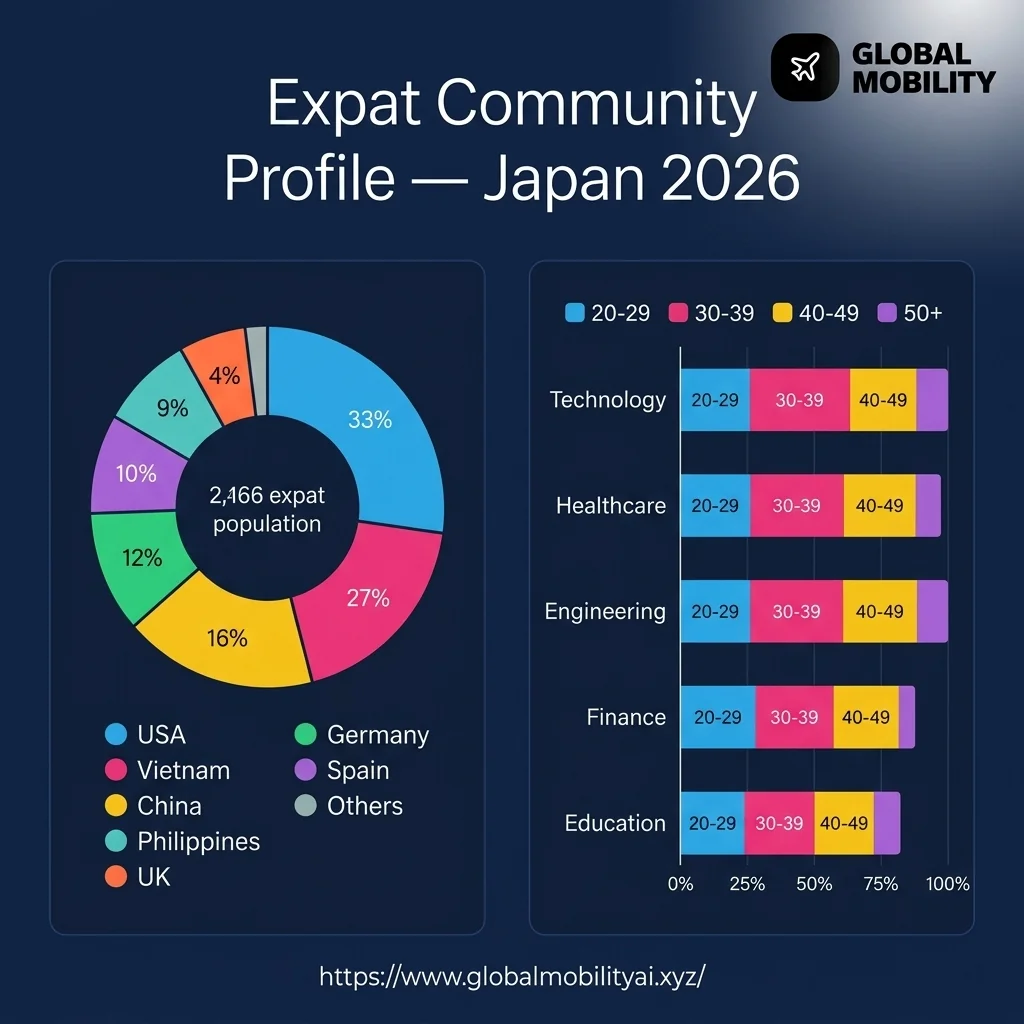
IMG-02: Japan Expat Community Profile
Analysis of the high-skilled expat demographic distribution and industry sectors in Japan in 2026.
(Source: OECD International Migration Outlook, 2025) [https://www.oecd-ilibrary.org/social-issues-migration-health/international-migration-outlook-2025_]
2. Deep-Dive Analysis: Legal & Financial Framework
The foundation of the Japan Highly Skilled Professional visa 2026 (commonly known as the Kodo Jinzai visa) is a rigid, mathematical evaluation system managed by the Immigration Services Agency of Japan (ISA). Unlike holistic immigration systems like those in the UK or Canada where subjective assessments might play a role, the Japanese system is purely objective and transparent. If your documented points reach the required threshold, your visa is mathematically guaranteed.
2.1 Comprehensive Legal Requirements & Visa Categories
The points-based visa is legally classified into three primary sub-categories. These categories are strictly delineated based on the fundamental nature of the applicant's professional activities and the type of corporate sponsor in Japan:
Unlike standard work permits (such as the Engineer/Specialist in Humanities/International Services visa), the HSP visa grants unparalleled statutory privileges that radically improve the expat experience:
This elite status contrasts heavily with the competitive pool system used in the Canada Express Entry strategy, as Japan awards visas immediately upon meeting the objective mathematical criteria without making you compete against other applicants in a draw.
2.2 Eligibility Criteria, Qualification Scoring & Point Optimization
To qualify for any HSP category, the applicant must score a minimum of 70 points on the official Immigration Services Agency point matrix. Crucially, the points are accumulated across four primary pillars: academic qualifications, professional work experience, age, and annual income.
The Core Points Matrix Breakdown
The 1-Year Permanent Residency Blueprint
The standard statutory residence requirement for Japanese Permanent Residency (Eijuken) is 10 consecutive years of tax-compliant living. The HSP framework fundamentally shatters this timeline:
This makes the 80-point threshold the most coveted target for global professionals. An applicant who is 29 years old (15 pts), holds a Master's from a top 300 university (20+10=30 pts), has 5 years of experience (10 pts), and earns 6 million JPY (20 pts) easily scores 75 points. By simply passing the N2 language exam (+10 pts), they cross the 80-point threshold and secure the 1-year PR pathway. Calculate your initial estimate on the Official ISA Point Calculation Sheet.

IMG-03: Japan Visa Points System
The four core pillars of the Japanese Highly Skilled Professional point matrix that unlocks the 1-year fast-track Permanent Residency.
2.3 Required Documentation & Official Checklists
To secure priority 10-day processing, you must submit a front-loaded, perfectly structured application package to the Tokyo or regional Immigration Bureau:
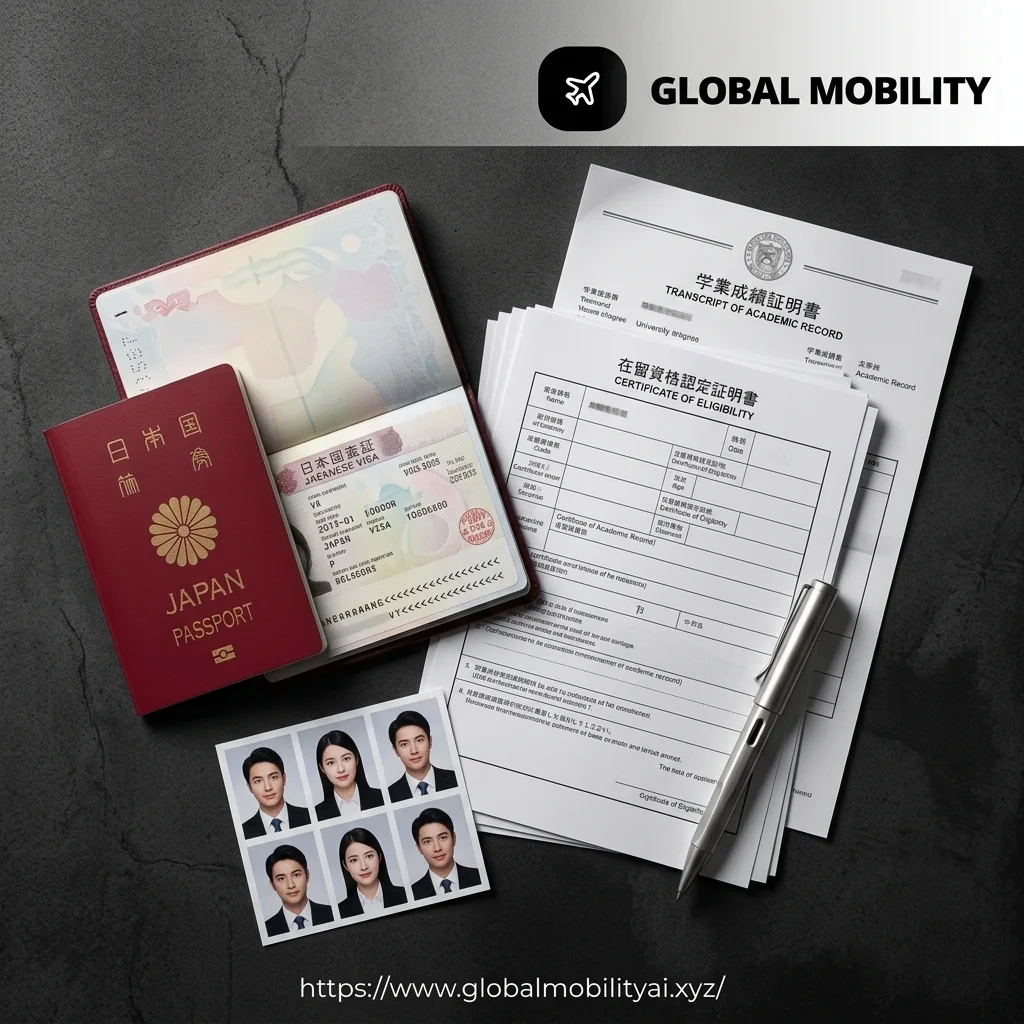
IMG-04: Japan Visa Document Checklist
A professional front-loaded document package, including certified degree transcripts, JLPT score sheets, and bank statements, prepared for official Certificate of Eligibility (COE) filing.
3. City Guide — Where to Live in Japan in 2026
Expats moving to Japan will find a high variance in living costs, localized tech demand, and international community density across different regions.
3.1 Top 5 Cities for Expats: Rankings & Analysis

IMG-05: Tokyo Expat Lifestyle
The high-tech city skyline and dynamic professional environment in Tokyo’s Shinjuku business district.
IMG-06: Osaka Expat Lifestyle
The vibrant commercial canals of Dotonbori, Osaka, representing the Kansai region's active career and cultural lifestyle.
3.2 City Comparison Table
The following comparative analysis uses current cost data to evaluate Japan's primary expat hubs:
| City | Avg Rent 1BR (City Centre) | Monthly Cost (Excl. Rent) | Job Market Density | Safety Index | Expat Rating |
|---|---|---|---|---|---|
| Tokyo | 145,000 JPY ($935 USD) | 120,000 JPY ($775 USD) | Critical / Extreme | 76.4 | 9.5/10 |
| Osaka | 85,000 JPY ($548 USD) | 95,000 JPY ($612 USD) | High / Growing | 73.1 | 8.8/10 |
| Yokohama | 100,000 JPY ($645 USD) | 105,000 JPY ($677 USD) | Medium / Steady | 79.5 | 9.0/10 |
| Kyoto | 75,000 JPY ($483 USD) | 90,000 JPY ($580 USD) | Research Focused | 81.2 | 8.5/10 |
| Fukuoka | 65,000 JPY ($419 USD) | 85,000 JPY ($548 USD) | Tech Startup Focus | 80.4 | 8.9/10 |
(Source: Numbeo Cost of Living Index Japan, 2026) [https://www.numbeo.com/cost-of-living/country_result.jsp?country=Japan]
4. Cost of Living & Comprehensive Tax Breakdown — 2026
Japan's cost of living in 2026 remains highly favorable for foreigners earning in USD or strong local currencies due to the stabilized, competitive yen. However, understanding Japan's complex tax and social security system is critical for accurately projecting your net savings.
4.1 Monthly Budget Calculator Breakdown
Earning as a high-skilled professional in Japan allows for a highly comfortable lifestyle. Below is an itemized monthly budget for a typical single expat residing in central Tokyo (e.g., Minato, Shinjuku, or Shibuya wards):
4.2 Cost of Living vs. Salary: The Real Impact of Japanese Taxes
High-skilled professionals in Japan are legally required to meet the 3 million JPY minimum salary, but actual HSP-eligible salaries are significantly higher. Japan employs a progressive tax system. To calculate your true net income, you must account for four mandatory deductions:
Below is the accurately recalculated monthly net savings trajectory using the GlobalMobilityAI Savings Calculator across three professional income tiers in Tokyo. (Tax baselines sourced from the National Tax Agency Japan) [https://www.nta.go.jp/english/taxes/individual/12006.htm]:
4.3 Cost of Living Index vs. Home Countries
The following comparison highlights the relative purchasing power index of Japan against major expat origins:
| Cost Category | Tokyo, Japan | Lahore, Pakistan | Mumbai, India | London, UK |
|---|---|---|---|---|
| Rent Index (City Centre) | 100.0 (Base) | 18.2 | 29.5 | 198.4 |
| Groceries Index | 100.0 (Base) | 24.5 | 28.1 | 92.6 |
| Restaurant Prices | 100.0 (Base) | 19.4 | 21.0 | 168.1 |
| Local Purchasing Power | 100.0 (Base) | 14.8 | 26.2 | 112.5 |
(Source: Numbeo Cost of Living Comparison, 2026) [https://www.numbeo.com/cost-of-living/compare_countries.jsp]
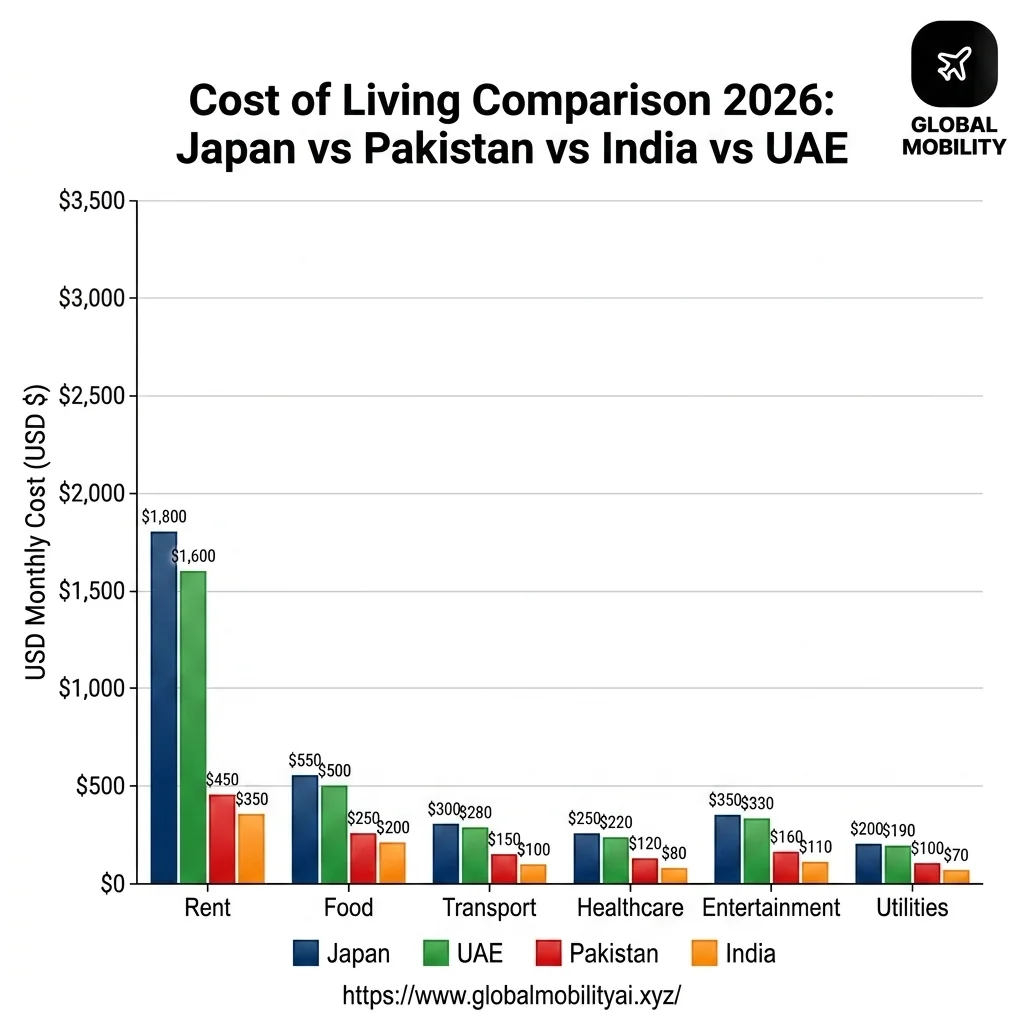
IMG-07 (CHART-1): Japan Cost of Living Comparison
Comparison of monthly cost of living averages including rent between Tokyo, Lahore, Mumbai, and London in 2026.
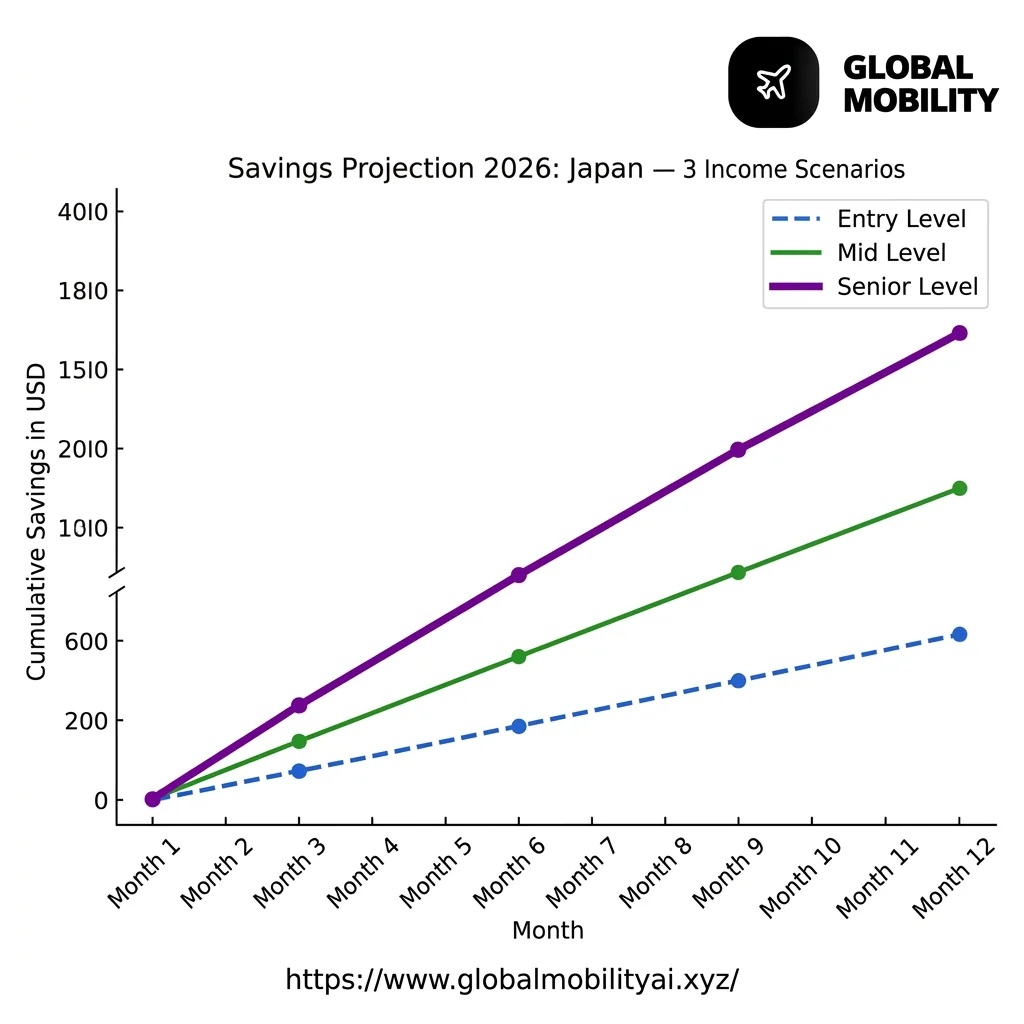
IMG-08 (CHART-2): Expat Savings Trajectory Japan
Projected monthly savings trajectories over 24 months across three expat income levels in Tokyo.
5. Salary Data & Job Market Intelligence
Earning benchmarks in Japan have risen significantly, with domestic tech firms matching global standards to secure premium talent.
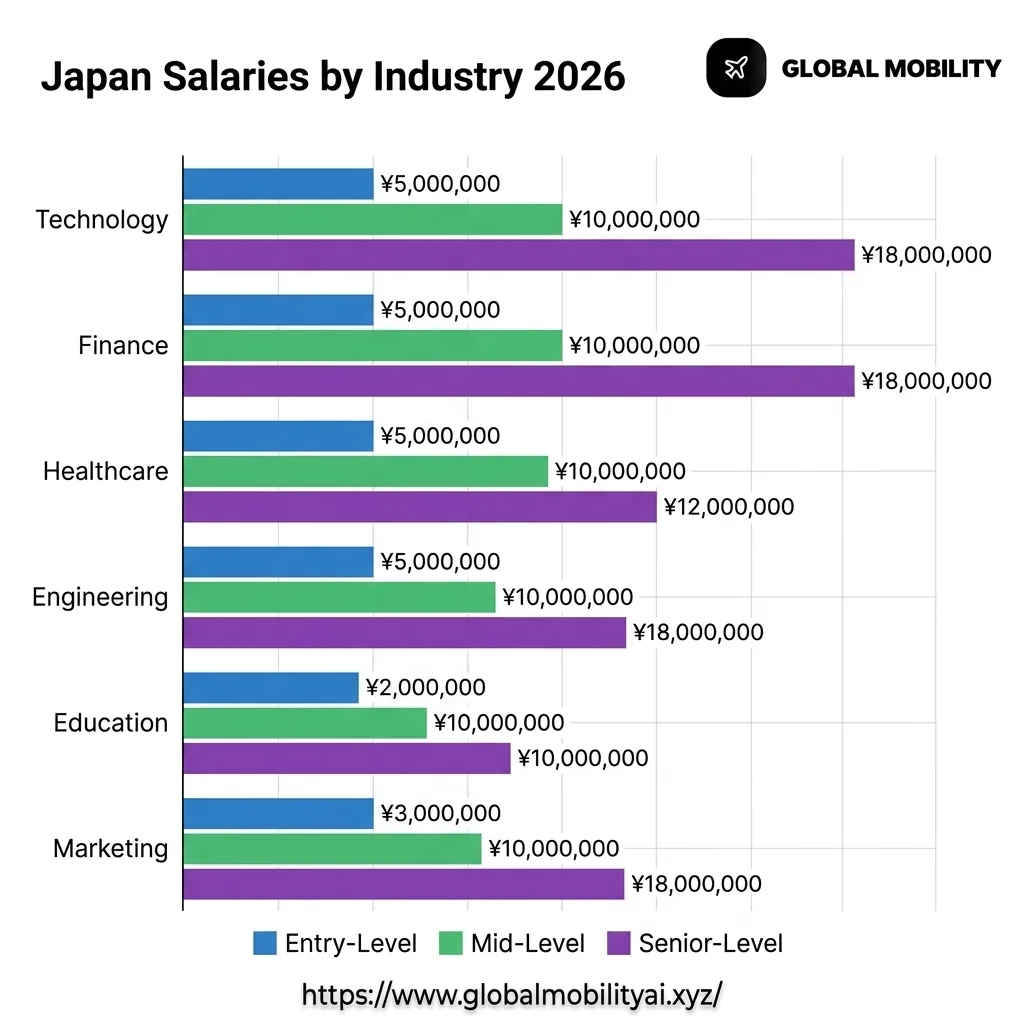
5.1 Average Salaries by Industry (2026 Data)
The Ministry of Health, Labour and Welfare's Basic Survey on Wage Structure provides the verified baseline salary structure for expat-dense industries in Japan:
| Industry Sector | Entry Level (Annual JPY) | Mid-Level (Annual JPY) | Senior Level (Annual JPY) | Local Currency |
|---|---|---|---|---|
| Software & IT | 4,500,000 JPY | 8,500,000 JPY | 14,000,000 JPY | Japanese Yen |
| Biotech & Pharma | 4,000,000 JPY | 7,800,000 JPY | 12,500,000 JPY | Japanese Yen |
| Academic Research | 3,800,000 JPY | 6,500,000 JPY | 10,500,000 JPY | Japanese Yen |
| Finance & VC | 5,500,000 JPY | 9,500,000 JPY | 18,000,000 JPY | Japanese Yen |
| Business Management | 6,000,000 JPY | 11,000,000 JPY | 22,000,000 JPY | Japanese Yen |
(Source: MHLW Basic Survey on Wage Structure Japan, 2025) [https://www.mhlw.go.jp/english/database/db-l/]
5.2 In-Demand Skills & Sectors in 2026
According to the 2026 Ministry of Economy, Trade and Industry (METI) industrial roadmap, Japan is facing a critical shortage of 450,000 IT professionals by 2030 (Source: METI Japan, 2025) [https://www.meti.go.jp/policy/it_policy/jinzai/index.html]. Highly sought-after tech stacks include cloud architecture (AWS, Azure), machine learning engineering, embedded systems for automotive robotics, and cybersecurity infrastructure. In the academic sector, quantum computing, renewable materials research, and genomics are highly prioritized. Corporate employers are actively leveraging the Japan Highly Skilled Professional visa 2026 points calculator as a recruitment tool, guaranteeing point-eligible salaries to expedite Certificate of Eligibility (COE) issuances.
IMG-09: Tech Career Tokyo
A bilingual technical software engineer in a modern Tokyo office, optimizing AI models and working within a global engineering team.
5.3 How to Use GlobalMobilityAI Salary Comparison Tool
To ensure your Japanese job offer complies with the HSP points requirement, use our GlobalMobilityAI Salary Comparison Tool to cross-examine local industry rates. You can compare your proposed JPY base salary against local tax brackets and calculate the exact points you will score for your age and income tier, protecting you from under-market offers.
6. CV Formatting — Japanese-Style Resume Guide
Applying for jobs in Japan requires a distinct, highly formalized CV structure that differs fundamentally from western standards.
6.1 Japanese CV Format Requirements
The Japanese job market operates on two separate documents: the Rirekisho (standard profile resume) and the Shokurekisho (detailed work history).
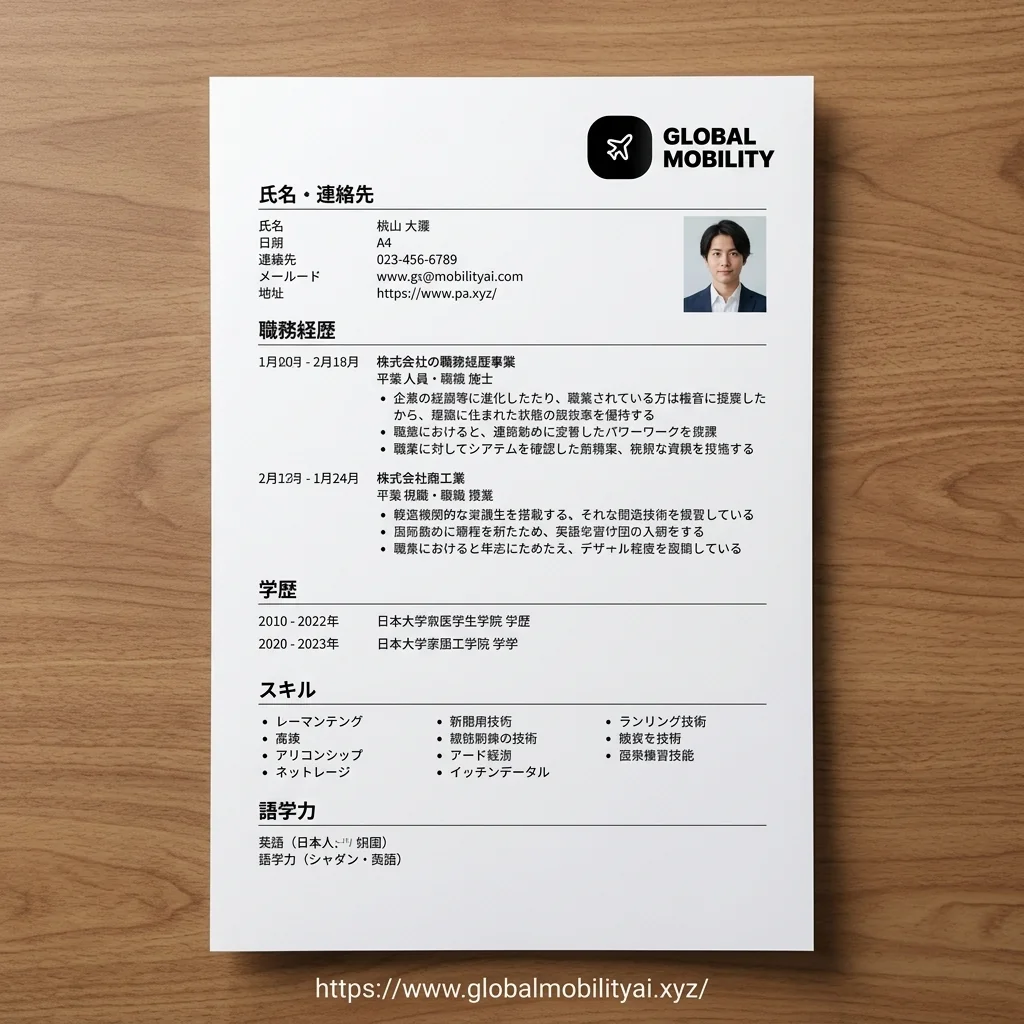
IMG-10: Japanese Resume Format
A properly structured Rirekisho and Shokurekisho, fully localized and ready for bilingual Japanese corporate ATS portal screening.
6.2 Common CV Mistakes That Get Applications Rejected
6.3 ATS Optimization for Japanese Job Portals
The dominant high-end and bilingual job portals in Japan—such as Daijob, CareerCross, and BizReach—utilize highly specific Applicant Tracking System (ATS) parsing models. To pass the automated screening:
7. Interview Tips for the Japanese Job Market
The interview process in Japan is highly behavioral, testing cultural alignment, hierarchical respect, and long-term organizational fit.
7.1 Cultural Interview Norms & Expectations
Japanese corporate interviews emphasize harmony (Wa), humility, and organizational commitment. High-skilled applicants are expected to show extreme respect for company hierarchy. Never interrupt the interviewer. Avoid overly boastful language; instead of using "I achieved X," frame successes as "Our team, under my technical guidance, successfully delivered X."
7.2 Common Interview Questions & Answer Frameworks
7.3 Dress Code, Punctuality & Professional Etiquette
The dress code is strictly "Recruit Suit" format: a dark black, navy, or charcoal suit, white collared shirt, and conservative tie. Join virtual interviews exactly 3 minutes early. If attending in person, arrive at the office reception exactly 10 minutes early. Master the formal business card exchange (Meishi Koukan) rules—always present and receive cards with both hands, and never write on a business card.

IMG-11: Corporate Etiquette Tokyo
A formal exchange of business cards (Meishi Koukan) between an expat professional and a Japanese executive in a Tokyo boardroom.
7.4 Post-Interview Follow-Up Etiquette
Send a highly polite, structured "Thank You" email within 24 hours of the interview. Address the primary interviewer by their formal title (e.g., Sato-部長 or Sato-san). Reiterate your enthusiasm for the specific technical challenges discussed and highlight how your transition will directly benefit their ongoing operations.
8. 2026 Policy Updates & Market Predictions
Japan's immigration architecture is undergoing rapid regulatory evolution as the government aggressively targets elite global talent. Driven by Prime Minister directives to establish Japan as the premier tech and finance hub of Asia, the Immigration Services Agency has unleashed unprecedented policy updates for 2026.
8.1 Key Policy Changes Effective 2026: The J-Skip and J-Find Frameworks
Effective early 2026, the Immigration Services Agency has heavily streamlined the points-based transition process to remove bureaucratic friction for elite earners. Crucially, two powerful new tracks have been fully integrated into the standard HSP framework (Source: ISA Japan, 2026) [https://www.isa.go.jp/en/applications/procedures/nyuukokukanri07_00016.html]:
Furthermore, Japan's robust digital nomad visa framework, introduced in late 2024, has been optimized. Freelancers earning over 10 million JPY annually from foreign clients can reside in Japan for 6 months. This has effectively become a scouting ground, allowing nomads to network locally in Tokyo and transition directly into a corporate-sponsored HSP status without flying home.
8.2 Immigration Trend Predictions (Data-Backed)
According to the OECD International Migration Outlook, the competition for STEM talent in East Asia is intensifying as nations race to secure AI engineers and semiconductor specialists. ISA Japan's published statistics confirm a sustained, aggressive upward trend in high-skilled COE issuances — (Source: ISA Japan, 2025) [https://www.isa.go.jp/en/publications/statistics/toukei_ichiran_coestatus.html].
[ISA Japan High-Skilled Visa Approvals Growth]
2023: ██████████████████ 26,000
2024: ██████████████████████ 32,200
2025: ██████████████████████████ 39,900
Processing times for highly skilled profiles are being ruthlessly prioritized. The average COE issuance time has dropped to under 7 calendar days for applicants whose sponsors are classified as "Category 1" corporations (listed public companies on the Tokyo Stock Exchange and highly capitalized entities).
8.3 How These Changes Affect Your Application in 2026
These policy updates mean that preparing a digitally verifiable, front-loaded points portfolio is your absolute priority. You must ensure your local employer is fully registered as a Category 1 or Category 2 sponsor to secure the fast-track 7-day priority processing. This approach mirrors strategies seen in the Netherlands Highly Skilled Migrant Visa 2026 guide, where utilizing pre-approved corporate sponsors is mandatory for expedited processing. Use our GlobalMobilityAI Immigration Probability Score tool to run a complete, independent simulation of your points portfolio against these newly integrated J-Skip and J-Find benchmarks before you submit your physical documents to the consular window.
9. Tactical Comparison Matrix
Securing the Japan Highly Skilled Professional visa 2026 requires a clear comparison against alternative high-skilled pathways:
| Visa Type | Primary Eligibility Focus | Min. JPY Salary Requirement | Average Processing Time | Local Bureaucratic Difficulty | Est. Approval Rate* | Consolidated Gov. Fee |
|---|---|---|---|---|---|---|
| HSP (i)(b) | Point Score ≥ 70 Pts | 3,000,000 JPY | 5–10 Business Days | Moderate / Structural | Platform Est.* | 4,000 JPY |
| Standard Engineer | Degree in STEM Field | 2,400,000 JPY | 1–3 Calendar Months | Low / Standard | Platform Est.* | 4,000 JPY |
| J-Skip (Specialist) | Income ≥ 20,000,000 JPY | 20,000,000 JPY | 5 Business Days | High / Financial Audit | Platform Est.* | 4,000 JPY |
| Business Manager | Corporate Investment | 5,000,000 JPY | 2–4 Calendar Months | Extreme / Business Plan | Platform Est.* | 4,000 JPY |
| J-Find (Job Search) | Top 100 University Grad | N/A (Show Savings) | 2–4 Calendar Weeks | Very Low | Platform Est.* | 4,000 JPY |
| Student Visa | Language/University Place | Bank Statements + Guarantor Letter | 2–3 Calendar Months | Low | Platform Est.* | 4,000 JPY |
*Internal platform estimate. Official approval rates by specific visa class are not publicly published by the Japanese Ministry of Justice. Monitor: Official ISA Statistics.
(Source: Immigration Services Agency of Japan official portal, 2026) [https://www.isa.go.jp/en/]
10. Execution Roadmap: Phase-by-Phase
Securing your HSP visa and successfully transitioning to Japanese permanent residency is a highly structured, 4-phase project. Every step must be executed with precision, as the Japanese immigration system penalizes missing documents with severe delays.
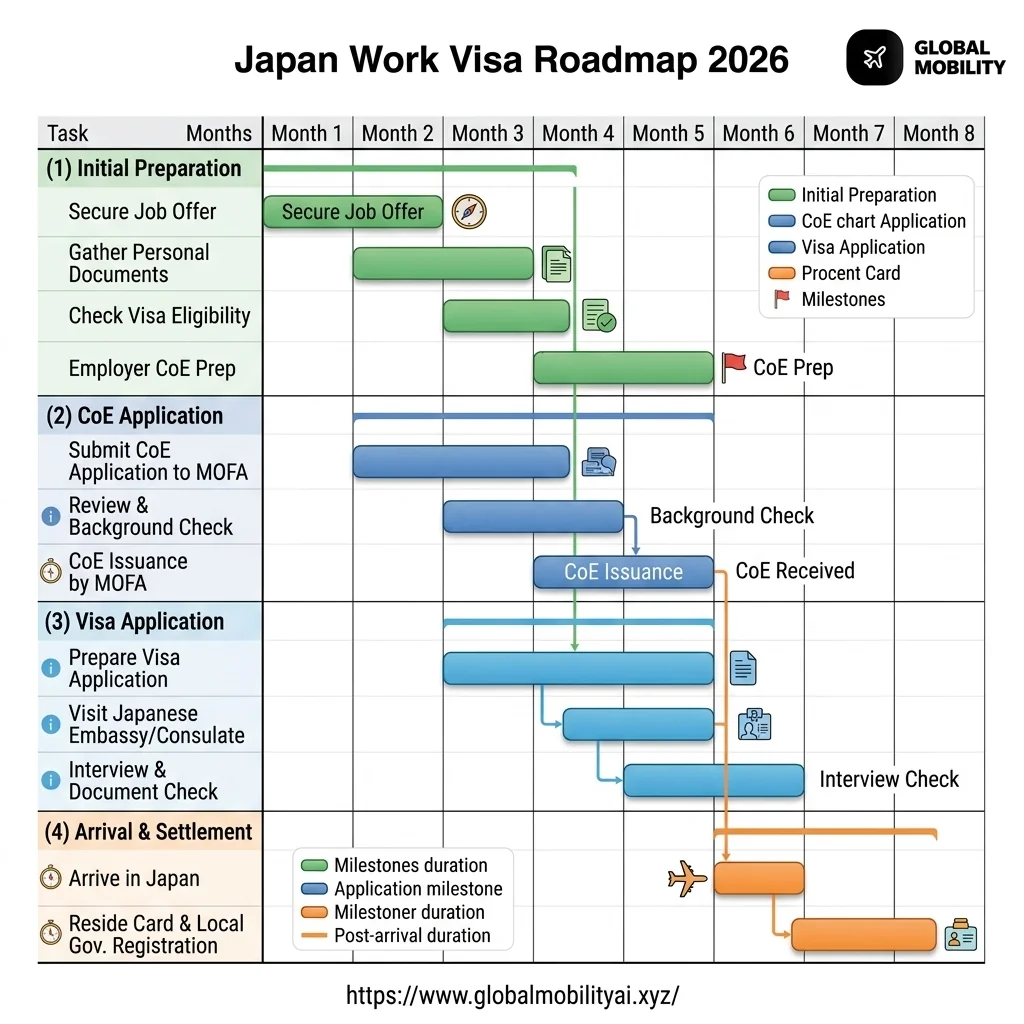
IMG-12 (CHART-3): Japan Visa Processing Timeline
The strategic 12-month timeline to secure the Certificate of Eligibility and transition to Permanent Residency.
Phase 1 — Preparation & Point Verification (Months 1–2):
Your priority is securing the foundational academic, language, and employment documents to calculate and definitively lock in your points portfolio. Unlike standard visa applications where you apply and hope for the best, the HSP requires absolute certainty of your score prior to submission.
Phase 2 — Application & Priority COE Issuance (Months 3–4):
With your documents prepared, you must secure your verified local employment contract and authorize your employer to submit the full package to the Immigration Bureau in Japan.
Phase 3 — Arrival, Local Registration & Spousal Work Setup (Month 5):
Your arrival in Japan involves critical bureaucratic registrations that legally activate your resident status and start your Permanent Residency countdown clock.
Phase 4 — Permanent Residency Transition (Month 12+ or Month 36+):
Once you have completed 1 year (if scoring ≥ 80 points) or 3 years (if scoring ≥ 70 points) of consecutive, tax-compliant residency, you file your fast-track Permanent Residency application.
11. Critical Risk Factors & Common Pitfalls
Navigating the high-skilled points framework in Japan carries significant operational risks that can trigger instant application rejection or cancel your PR fast-track.
12. FAQ — People Also Ask
Q: How long does it take to get PR under the Japan Highly Skilled Professional visa 2026?
A: Under the updated 2026 regulations, the residency requirement for permanent residency is based entirely on your objective point score, offering the fastest settlement route in the G7. If your points portfolio totals 80 points or more on the immigration matrix, you are legally entitled to apply for Permanent Residency after just 1 single year of consecutive, tax-compliant residence in Japan. If your score falls between 70 and 79 points, the residency requirement is reduced to 3 years. It is critical to maintain your point score throughout this period; if your salary drops and your score falls below 80 points during that first year, the 1-year timeline is invalidated. Use our Immigration Probability Score tool to accurately simulate your points profile, project your salary trajectory, and map your exact path to settlement.
Q: Can I count allowances, housing benefits, and overtime toward the minimum salary?
A: Absolutely not. The Japanese Immigration Bureau is incredibly strict regarding what constitutes "annual income" on the point calculation sheet. They strictly exclude all housing allowances, relocation benefits, commutation fees, transportation passes, and discretionary overtime pay from the calculated annual income. Only your base salary and legally guaranteed, contractually fixed bonuses are accepted. If these core base components fall below the 3 million JPY mandatory threshold, your points calculation sheet will be discarded automatically, regardless of how many academic or experience points you have. Furthermore, bonuses must be explicitly written as guaranteed amounts in your employment contract. You can verify local salary baselines against tax bracket deductions using our GlobalMobilityAI Salary Comparison Tool.
Q: What happens to my HSP visa if I lose my job or resign in Japan?
A: Because the HSP visa is legally tied to your specific corporate sponsor, losing your job or resigning invalidates your current status. You are legally required to formally notify the Immigration Services Agency within 14 days of leaving your employer. The government grants a standard 3-month grace period for you to secure a new HSP-compliant job offer. Once you secure new employment, you must submit a completely new point calculation sheet to prove you still meet the 70-point threshold, and file an application for a "Change of Status" or "Permission to Acquire Status of Residence." Failing to do so within the grace period will result in the revocation of your residence card and mandate your departure from Japan.
Q: Do I need to speak fluent Japanese to qualify for the HSP visa?
A: No, Japanese language fluency is not a mandatory requirement for the visa itself. You can easily score the minimum 70 points through a combination of academic degrees, professional work experience, a young age demographic, and a high annual salary. Many IT engineers in Tokyo work entirely in English. However, passing the Japanese Language Proficiency Test (JLPT) grants massive, often decisive bonus points. Achieving N1 JLPT yields 15 points, while N2 JLPT yields 10 points. Earning these language bonuses often represents the crucial difference needed to push an applicant from the 3-year PR track (70 points) across the 80-point threshold for the 1-year fast-track PR.
Q: Can my spouse work full-time under the HSP spousal visa?
A: Yes. One of the absolute greatest privileges of the Highly Skilled Professional visa is that your dependent spouse is legally permitted to work full-time in Japan, entirely bypassing the severe restrictions of standard spousal visas. Under a standard dependent visa, spouses are legally capped at working no more than 28 hours per week, mostly in part-time roles. Under the HSP "Designated Activities" framework, the spouse can engage in full-time professional employment. They do not need to secure their own independent work visa sponsor. They simply need to secure a job offer and complete a routine registration at the local Immigration Bureau to unlock their full working rights.
Q: Is there an age limit to apply for the Japan Highly Skilled Professional visa 2026?
A: There is no official upper age limit to apply, meaning professionals in their 50s and 60s are legally eligible. However, because the points matrix highly penalizes age to counteract Japan's aging demographic—applicants aged 40 or older receive 0 points for the age factor, while those under 30 receive 15 points—older applicants must compensate elsewhere. Typically, senior professionals overcome the 0-point age penalty by demonstrating exceptionally high annual salaries (often exceeding 10 million to 15 million JPY), holding a PhD, or bringing decades of executive experience. If you are an older applicant, maximizing salary and academic points is the only mathematical way to cross the mandatory 70-point threshold.
Q: Can I invite my parents to live with me in Japan under this visa?
A: Yes, this is a unique and incredibly valuable statutory privilege exclusive to the HSP visa. Standard Japanese work visas categorically do not allow for parent sponsorship, forcing families to remain separated. Under the HSP framework, you are permitted to sponsor long-term resident visas for your parents (or your spouse’s parents) to reside with you in Japan. To utilize this benefit, you must meet two strict conditions: first, your household annual income must exceed 8 million JPY; second, the purpose of the parents' stay must be to assist with raising a child under the age of 7, or to support your spouse who is currently pregnant.
Q: Does graduating from a university in Pakistan or India yield bonus points?
A: Yes, but only if your specific university falls within the top 300 of the global rankings recognized by the Japanese Ministry of Justice. Japan utilizes the QS World University Rankings, the Times Higher Education World University Rankings, and the Shanghai Academic Ranking of World Universities. Graduates from recognized premier institutions—such as the IITs or IISc in India, or NUST and Quaid-e-Azam University in Pakistan (depending on the year's ranking)—receive a massive 10-point bonus. To claim this, you must provide official proof of your graduation (sealed transcripts and degrees) alongside a printed copy of the corresponding global ranking list at the time of your COE submission. Use our Immigration Probability Score tool to easily verify if your specific university qualifies for the bonus.
13. Conclusion: The Bottom Line
If you are a high-skilled technical professional or corporate executive in 2026, the Japan Highly Skilled Professional visa 2026 is the most powerful and predictable pathway to secure a permanent future in a G7 nation. By shifting from temporary work permits to a mathematical points-based visa, you secure immediate relocation advantages, complete family settlement rights, and a direct path to permanent residency in as little as 12 months.
Do not leave your immigration trajectory to chance. Flawless document preparation and precise points targeting are the difference between an immediate visa grant and a painful rejection. We strongly recommend that you evaluate your exact score on the GlobalMobilityAI Immigration Probability Score tool to verify your odds before launching your application. Align your qualifications with Japan's urgent tech demands, and make the G7's fastest settlement corridor your reality.
Predict your mobility score.
Use our AI engine to get your personalized visa pathway, salary prediction, and relocation roadmap.
More Insights

Skilled Worker Shortage Countries 2026: Complete Fast-Track Guide

New Zealand Skilled Migrant Category 2026: Points Test, Expression of Interest & PR Pathway