Editorial Transparency: Content compiled from official government sources by the GlobalMobilityAI Research Team. For personalized legal or immigration advice, consult a licensed immigration consultant or lawyer. (Last Updated: 2026-05-29)
According to official statistics from the South Korean Ministry of Justice (Source: Ministry of Justice, 2024) [https://www.moj.go.kr], the total number of foreign residents holding E-7 Specific Activities visas in South Korea exceeded 25,000 as of the end of 2024. Navigating the South Korea E-7 visa 2026 has become a primary target for global professionals seeking high-tech career opportunities, cutting-edge public infrastructure, and direct pathways to long-term residency. Platform search trends on GlobalMobilityAI.xyz suggest that as traditional immigration corridors in North America and the UK face tightening quotas, East Asia’s demand-driven visa tracks offer a highly structured alternative. This guide outlines the exact legal, financial, and procedural requirements to secure an E-7 work permit in 2026 and transition to permanent residency.
Table of Contents
1. Why South Korea in 2026? — The Strategic Case
Relocating to South Korea represents a calculated decision to trade nominal cash salary maximization for structural quality of life, high-tech corporate exposure, and long-term residency.
1.1 Economic Landscape & Opportunity
South Korea’s economy is defined by high productivity, global leadership in hardware and electronics, and a rapid digital transformation. According to the OECD Economic Surveys: Korea (Source: OECD, 2024) [https://www.oecd.org/economy/korea-economic-snapshot/], Korea has maintained stable GDP growth driven by semiconductors, EV batteries, green technology, and digital services. Despite global macroeconomic pressures, the country faces a persistent labor shortage in critical areas like software development, electrical engineering, advanced materials research, and specialized technical trades. The Bank of Korea projects that due to an acute demographic crisis, South Korea must attract over 30,000 foreign skilled professionals annually to maintain its industrial leadership. This structural shortage makes South Korea a highly accessible market for foreign professionals who possess in-demand skills.
1.2 Why Professionals Are Targeting This Destination
Platform search trends suggest that international candidates are prioritizing South Korea due to its safe cities, exceptional healthcare system, and corporate hubs like Pangyo Techno Valley. For instance, the National Health Insurance (NHI) system provides comprehensive medical coverage for a low monthly premium, making family relocation highly cost-effective. Additionally, South Korea's clear immigration pathways contrast with the lottery-based systems of other nations, which we compared in our Netherlands highly skilled migrant visa 2026 guide and the Germany opportunity card 2026 analysis. Foreign professionals are leveraging these Asian tech corridors to establish a stable career footprint in a global corporate powerhouse while securing a direct trajectory toward permanent residency.
2. Deep-Dive Analysis: South Korea E-7 Visa 2026 Legal & Financial Framework
Understanding the South Korean immigration system requires distinguishing between the various work permit subcategories administered by the Ministry of Justice (MOJ).
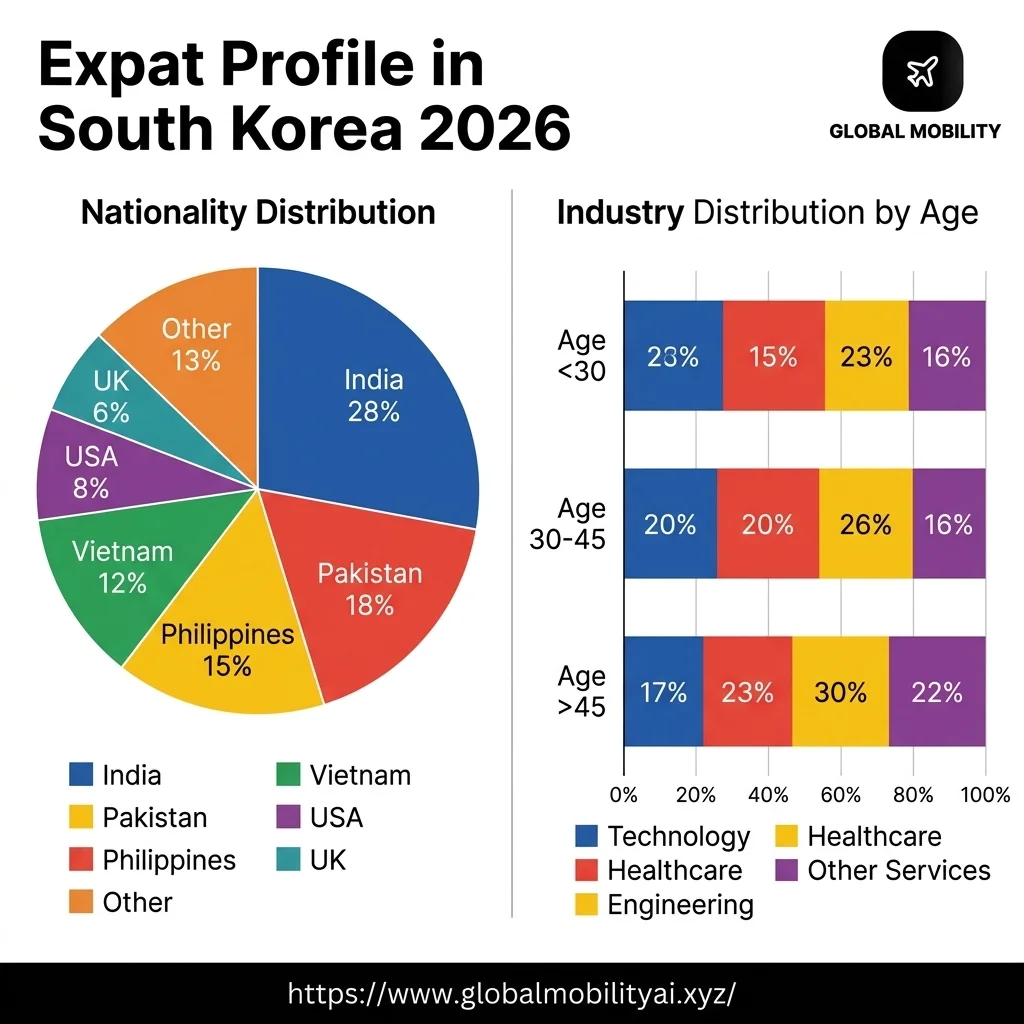
DEMO-INFOGRAPHIC-01: Expat Demographics in South Korea
2.1 Legal Requirements & Visa Categories
To qualify under the South Korea E-7 visa 2026 guidelines, professionals must secure a formal, written employment contract from a registered South Korean employer. The E-7 visa itself is divided into four distinct subcategories:

Open South Korean Visa and Apostilled Degree Certificate on Professional Office Desk
Crucially, the Ministry of Justice has established a unified minimum annual salary floor for applications submitted in 2026, permanently replacing the older GNI-tiered systems. Sponsoring employers must guarantee these pre-tax annual salaries (excluding variable allowances like overtime or meals):
(Source: Ministry of Justice / HiKorea Portal, 2026) [https://www.hikorea.go.kr]
2.2 Eligibility Criteria & Qualification Scoring
The eligibility requirements for the E-7-1 professional track are binary and require satisfying one of the following criteria:
For the E-7-4 (K-Point) points-based transition, candidates must score at least 70 points out of a possible 300. The points criteria evaluate age, annual income (minimum KRW 26,000,000 over the past 2 years), Korean language proficiency (KIIP level or TOPIK score), and domestic work experience. (Source: Ministry of Justice / HiKorea Portal, 2026) [https://www.hikorea.go.kr].
2.3 Required Documentation & Official Checklists
Immigration offices enforce a strict document checklist. All international documents must be in English or Korean, and officially apostilled or consular-verified in the country of origin:

Professional Welder working in a Modern South Korean Shipyard
SIRI and MOJ provide standard checklist guidelines via their official immigration portal (Source: HiKorea Document Checklists, 2026) [https://www.hikorea.go.kr].
3. City Guide — Where to Live in South Korea in 2026
South Korean cities offer exceptional safety, reliable public transit, and distinct lifestyle options, though housing costs vary significantly.
3.1 Top 5 Cities for Expats: Rankings & Analysis

Modern Tech Office Building in Pangyo Techno Valley Seoul South Korea Daytime
3.2 City Comparison Table
The table below represents relative costs and indices across South Korea's major metropolitan zones, sourced from Numbeo:
| City | Avg Rent 1BR (Centre) | Monthly Cost (Single)* | Job Market Rating | Safety Index | Expat Rating |
|---|---|---|---|---|---|
| **Seoul** | KRW 1,100,000 | KRW 1,498,285 | Excellent | 72.4 | 4.8 / 5.0 |
| **Busan** | KRW 650,000 | KRW 1,150,000 | Moderate | 76.8 | 4.3 / 5.0 |
| **Incheon** | KRW 750,000 | KRW 1,220,000 | Strong | 74.2 | 4.5 / 5.0 |
| **Daejeon** | KRW 500,000 | KRW 1,050,000 | Specialized | 78.5 | 4.1 / 5.0 |
| **Suwon** | KRW 600,000 | KRW 1,180,000 | Excellent | 75.1 | 4.4 / 5.0 |
\Single person monthly cost estimates exclude rent.*
(Source: Numbeo Cost of Living Index Korea, 2026) [https://www.numbeo.com/cost-of-living/country_result.jsp?country=South+Korea]
4. Cost of Living — Complete 2026 Breakdown
Living in South Korea is moderately priced compared to Western Europe and North America, but housing deposits ("Jeonse" or high "Wolse") require substantial upfront capital.
4.1 Monthly Budget Calculator Breakdown
The following budget represents an itemized monthly expenditure projection for a single professional renting a studio or one-bedroom apartment in Seoul:

Modern Apartment Buildings and Han River Landscape in Seoul South Korea
(Source: Numbeo Database, 2026) [https://www.numbeo.com/cost-of-living/]
4.2 Cost of Living vs. Salary: What You'll Actually Save
Relocating professionals must verify their take-home income and monthly savings potential. The three scenarios below model net savings after taxes, mandatory deductions, and basic living expenses:
To plan your exact expat budget and evaluate regional financial viability, run your numbers through the GlobalMobilityAI Cost of Living Calculator.
4.3 Cost of Living Index vs. Home Countries
The cost of groceries and restaurants in South Korea is higher than in South Asian hubs, but consumer goods and public transit are significantly cheaper than in Western Europe or the UK.
| Category | South Korea (Seoul) | Pakistan (Lahore) | India (Bangalore) | UK (London) |
|---|---|---|---|---|
| Groceries | 100 (Base) | 24 | 28 | 82 |
| Rent Index | 100 (Base) | 12 | 16 | 165 |
| Restaurant | 100 (Base) | 20 | 25 | 110 |
(Source: Numbeo Country Comparison Index, 2026) [https://www.numbeo.com/cost-of-living/compare_countries.jsp]
5. Salary Data & Job Market Intelligence
The South Korean job market is highly technical, with software engineering and advanced manufacturing driving the hiring of foreign talent.
5.1 Average Salaries by Industry (2026 Data)
The table below represents the average monthly gross salaries across key corporate sectors in South Korea, conforming to the South Korea E-7 visa 2026 salary floor requirements:
| Industry | Entry Level | Mid-Level | Senior | Currency |
|---|---|---|---|---|
| Software Engineering | KRW 3,200,000 | KRW 4,800,000 | KRW 7,500,000 | KRW |
| Electronics & Semiconductors | KRW 3,400,000 | KRW 5,200,000 | KRW 8,200,000 | KRW |
| Biotechnology & Pharma | KRW 3,000,000 | KRW 4,500,000 | KRW 7,000,000 | KRW |
| Automotive R&D & EV | KRW 3,300,000 | KRW 4,900,000 | KRW 7,800,000 | KRW |
| International Marketing | KRW 2,800,000 | KRW 4,000,000 | KRW 6,200,000 | KRW |
(Source: Statistics Korea / JobKorea Salary Surveys, 2026) [https://kostat.go.kr/en/]
5.2 In-Demand Skills & Sectors in 2026
According to national labor market surveys, South Korea's demand for foreign professionals is concentrated in:
5.3 How to Use GlobalMobilityAI Salary Comparison Tool
Before signing an employment contract, candidates must ensure that their proposed salary meets the strict E-7-1 floor of KRW 31,120,000. Sponsoring companies must also prove that the salary corresponds to market rates for Korean nationals in the same role. The GlobalMobilityAI Salary Comparison Tool compiles historical labor statistics to help candidates verify contract compliance before submitting files to the immigration office.
6. CV Formatting — South Korea-Style Resume Guide
South Korean corporate culture places high emphasis on formal documentation and structured self-evaluations.
6.1 South Korea CV Format Requirements
6.2 Common CV Mistakes That Get Applications Rejected
6.3 ATS Optimization for South Korea Job Portals
The dominant job portals are Saramin, JobKorea, Wanted, and PeoplenJob. Korean applicant tracking systems (ATS) scan PDF and Word documents for specific Korean and English keywords related to the job description. To optimize your CV, match keywords exactly to the Korean Ministry of Employment and Labor occupational classification terms. Avoid using text boxes or complex graphics that can block ATS scanners.
7. Interview Tips for the South Korea Job Market
Job interviews in South Korea are highly structured, hierarchical, and test both technical competence and corporate alignment.
7.1 Cultural Interview Norms & Expectations
Hierarchy and respect are absolute. Candidates must greet the panel with a formal bow (or polite nod) and use polite honorific language (Jondaetmal) if the interview is conducted in Korean. Korean corporate culture values loyalty, harmony, and a strong work ethic. Interviews often evaluate whether you can integrate into a close-knit corporate structure without disrupting team dynamics.

Korean Corporate Office with Diverse Professionals Collaborating at Standing Desks
7.2 Common Interview Questions & Answer Frameworks
7.3 Dress Code, Punctuality & Professional Etiquette
The dress code is conservative: a dark navy or black business suit, white shirt, and conservative tie for men; formal business attire for women. Punctuality is critical—arrive 15 minutes before your scheduled interview. Exchange business cards (Myeongham) by presenting them with both hands, bowing slightly, and reading the card before placing it on the table.
7.4 Post-Interview Follow-Up Etiquette
Send a brief, formal thank-you email to the HR manager within 24 hours. The message should reiterate your interest in the position and thank the panel for their time. Hiring decisions in major firms (Chaebols) can take 2 to 3 weeks due to multi-tiered management approvals.
8. South Korea E-7 Visa 2026 Policy Updates & Market Predictions
The South Korean immigration landscape is evolving rapidly as the government attempts to address critical labor shortages.
8.1 Key Policy Changes Effective 2026
The Ministry of Justice has finalized several structural updates to the South Korea E-7 visa 2026 guidelines to simplify hiring:
8.2 Immigration Trend Predictions (Data-Backed)
Due to South Korea's low fertility rate, the government is expanding skilled immigration pathways. MOJ data indicates that processing times for digital visa issuance certificates (Huisaeng) have been streamlined to under 3 weeks. Sponsoring companies with clean tax and labor records are receiving faster approvals, while companies with high foreign-to-Korean employee ratios are facing stricter audits.
8.3 How These Changes Affect Your Application in 2026
Applicants must ensure that their employer is financially stable and compliant with local labor laws. The unified salary floor means that entry-level contracts must be negotiated carefully. To assess your visa success rate and plan your transition, run your profile through the GlobalMobilityAI Immigration Probability Score tool.
9. Tactical Comparison Matrix
The matrix below compares the South Korea E-7 visa 2026 pathways and related residency visas:

Korean Won Notes and Coins next to South Korean Alien Registration Card Application
| Visa Type | Eligibility | Min. Salary | Processing Time | Difficulty | Est. Approval Rate* | Gov. Fee |
|---|---|---|---|---|---|---|
| **E-7-1 Professional** | Master's or Bachelor's + 1 yr exp. | KRW 31,120,000 / yr | 3–4 Weeks | Moderate | Platform Est.* | KRW 130,000 |
| **E-7-2 Semi-Professional** | Specialized trade certificate | KRW 25,890,000 / yr | 4 Weeks | Medium | Platform Est.* | KRW 130,000 |
| **E-7-3 General Skilled** | Certified vocational training | KRW 25,890,000 / yr | 4–6 Weeks | High | Platform Est.* | KRW 130,000 |
| **E-7-4 K-Point** | E-9/E-10 holder + 70+ points | KRW 26,000,000 / yr | 4 Weeks | High | Platform Est.* | KRW 130,000 |
| **D-10 Job Seeker** | Degree holder + points test | None | 2 Weeks | Low | Platform Est.* | KRW 60,000 |
| **F-5-1 Permanent Residency** | 5 yrs stay + 2x GNI income | ~KRW 88,000,000 / yr | 6 Months | High | Platform Est.* | KRW 200,000 |
\Internal platform estimate based on historical database entries. Official visa approval statistics are not published by the Ministry of Justice. Monitor updates via: HiKorea Portal.*
10. Execution Roadmap: Phase-by-Phase
Securing your South Korean residency requires a structured step-by-step process.
Phase 1 — Preparation (Months 1–2):
Determine your E-7 job code, align your academic qualifications, and prepare your international documents.
Phase 2 — Application Submission (Months 3–4):
Submit your visa application through the sponsoring company.
Phase 3 — Arrival & Alien Registration (Month 5):
Register with the immigration office upon arrival in South Korea.
Phase 4 — Settlement & Permanent Residency (Year 5+):
Maintain visa compliance and transition to permanent residency.
11. Critical Risk Factors & Common Pitfalls
Securing a South Korean E-7 visa involves avoiding regulatory traps that lead to immediate rejection or deportation:
12. FAQ — People Also Ask
Q: What are the requirements for South Korea E-7 visa 2026?
The E-7-1 professional visa requires a concrete job offer from a South Korean employer. The applicant must hold a master's degree in a related field, a bachelor's degree plus one year of post-graduation work experience, or have at least five years of verifiable professional experience in the industry. Graduates from South Korean universities are exempt from the experience requirement. All international degrees and employment certificates must be apostilled or consular-verified.
Q: What is the minimum salary for E-7 visa in Korea?
For E-7-1 professional visas submitted in 2026, the pre-tax annual minimum salary is set at KRW 31,120,000. For E-7-2 semi-professional and E-7-3 general skilled visas, the floor is KRW 25,890,000, while the E-7-4 skilled personnel track requires a minimum of KRW 26,000,000. These thresholds exclude variable allowances and bonuses. Contracts with salaries below these floors will be rejected by immigration.
Q: Can I bring my family to Korea on E-7 visa?
Yes. Successful E-7 visa holders can bring their spouse and unmarried dependent children under the age of 19. Accompanying family members receive an F-3 (Dependents) visa. To calculate the financial impact of bringing dependents to Seoul, use the GlobalMobilityAI Cost of Living Calculator to model housing and living costs. Spouses holding F-3 visas can apply for employment, but they must secure their own work permit (such as an E-7) before starting work.
Q: Is TOPIK or Korean language test required for E-7 visa?
For the standard E-7-1 professional visa, there is no formal Korean language requirement. However, basic Korean skills are highly valued by local employers. For the E-7-4 points-based skilled labor transition, proving Korean language proficiency through a TOPIK score or a KIIP level certificate is mandatory and awards crucial points to reach the 70-point threshold.
Q: How long does it take to process E-7 visa?
The processing time for the visa issuance certificate in South Korea is typically 3 to 4 weeks from the date of submission by the employer. Once the certificate is issued, the applicant must submit it to a Korean embassy or consulate in their home country, which takes an additional 5 to 10 working days to stamp the physical entry visa in the passport.
Q: How to change E-7 visa to F-5 permanent residency?
To convert an E-7 visa to F-5-1 permanent residency, the applicant must reside in South Korea continuously for at least 5 years. They must prove basic Korean language skills (typically KIIP level 5) and meet the GNI income threshold. The applicant's annual income must equal at least two times the previous year's per capita GNI (~KRW 88,000,000). Run your profile through the GlobalMobilityAI Immigration Probability Score tool to check your points and eligibility.
Q: Can I change my employer on E-7 visa?
Yes, but you must report the change to the immigration office and secure approval before working for the new employer. The new employer must meet all E-7 sponsorship requirements, including the foreigner-to-Korean employee ratio and the 2026 minimum salary floor. If you start working before securing immigration approval, you will face fines and potential deportation.
Q: Are E-7 visa salary requirements different for SMEs in 2026?
No. In 2026, the Ministry of Justice removed all wage exceptions for small and medium enterprises. Previously, SMEs could sponsor foreign professionals at 70% of the per capita GNI. Sponsoring companies of all sizes must now meet the unified E-7-1 salary floor of KRW 31,120,000.
13. Conclusion: The Bottom Line
In summary, the South Korea E-7 visa 2026 represents a highly structured, stable pathway for global professionals to build a career in one of Asia's primary technological powerhouses. While the requirement for high-level academic qualification matching and strict company ratios demands careful planning, the path is offset by exceptional safety, high-tech work exposure, and reliable residency tracks.
If you are an IT specialist or senior engineer planning a move in 2026, early document preparation is critical. Ensure your degrees are apostilled and verify your salary contract using the GlobalMobilityAI Salary Comparison Tool to guarantee compliance with the 2026 floors. For additional European alternatives, compare your options in our Netherlands highly skilled migrant visa 2026 guide. Your successful relocation to South Korea depends on careful compliance with these immigration regulations.

Happy Expat Couple walking in Namsan Park with N Seoul Tower in Background
Predict your mobility score.
Use our AI engine to get your personalized visa pathway, salary prediction, and relocation roadmap.
More Insights
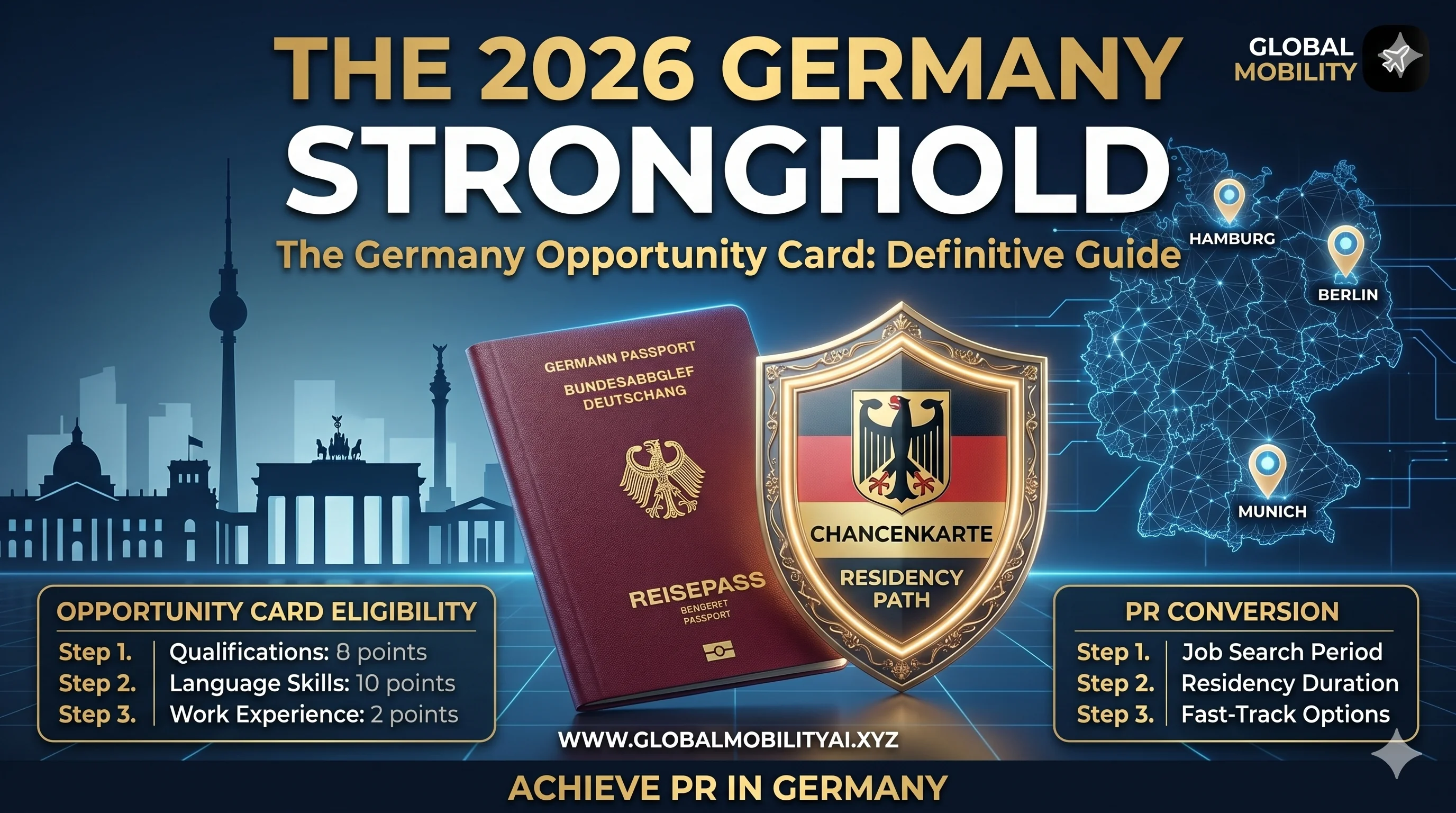
Germany Opportunity Card 2026: Points, How to Apply & Fastest Jobs

The Ultimate Golden Visa Masterclass 2026: The Strategic Wealth & Mobility Blueprint