Switzerland Work Permit 2026: B Permit Rules, Salary Reality & Realistic Expat Guide
Editorial Transparency: Content compiled from official government sources by the GlobalMobilityAI Research Team. For personalized legal or immigration advice, consult a licensed immigration consultant or lawyer. (Last Updated: 2026-05-27)
In 2026, relocating to the heart of Europe remains one of the most prestigious career moves a professional can make, but navigating the complexities of a Switzerland work permit 2026 is the baseline for success. According to the State Secretariat for Migration (SEM), Switzerland has maintained a strict quota system for third-country nationals (non-EU/EFTA citizens), allocating a total of 8,500 work permits for the 2026 calendar year Source: SEM, 2025. This allocation is split into 4,500 long-term B residence permits and 4,000 short-term L permits, creating a highly competitive gatekeeping mechanism for global talent. At GlobalMobilityAI.xyz, we have analyzed cantonal approval rates, salary structures, and labor-market trends to provide you with a tactical relocation roadmap. For non-European specialists, matching your qualifications with cantonal labor requirements is not just a strategy—it is the only legal pathway to securing residency in the Swiss Confederation.
A comprehensive guide to navigating Switzerland's quota-based work permit system for 2026.
Table of Contents
1. Why Switzerland in 2026? — The Strategic Case
Relocating to Switzerland represents the pinnacle of professional advancement, offering unmatched financial stability and lifestyle benefits.
1.1 Economic Landscape & Opportunity
The Swiss economy is projected to grow by approximately 1.3% in 2026, reflecting its signature resilience and insulation from broader Eurozone volatility Source: SECO, State Secretariat for Economic Affairs, 2025. This economic health is supported by high-performing sectors like biotechnology, pharmaceuticals, software engineering, and wealth management. Despite global corporate restructurings, Swiss enterprises face persistent shortages of highly qualified specialists. Securing a Switzerland work permit 2026 represents a unique professional challenge because of these economic drivers; the federal government deliberately limits permits to protect local wages, meaning only high-value, highly specialized positions can successfully clear Swiss border controls.
For professionals specializing in STEM fields or quantitative finance, Switzerland offers a concentration of research hubs and corporate headquarters (such as Roche, Novartis, Nestlé, and UBS) unmatched in continental Europe. The Swiss market's emphasis on high-margin industries ensures that capital remains available for research and development, providing professional security for incoming expats.
1.2 Why Professionals Are Targeting This Destination
Expats are drawn to Switzerland by the structural advantages of low taxation, high purchasing power, and premium public infrastructure. Unlike high-tax EU neighbors, Switzerland operates a decentralized cantonal tax system, resulting in significantly higher net take-home pay for skilled professionals. As we analyzed in our Netherlands Highly Skilled Migrant Visa 2026 guide, European destinations are becoming increasingly competitive. However, the Swiss combination of pristine natural safety, public school quality, and currency stability keeps it at the top of relocation objectives.
Platform search trends suggest that skilled professionals are increasingly prioritizing Switzerland over traditional destinations due to the long-term stability of the Swiss Franc (CHF). This currency hedge protects global savings against inflation, making Switzerland a prime wealth-preservation enclave for international professionals.
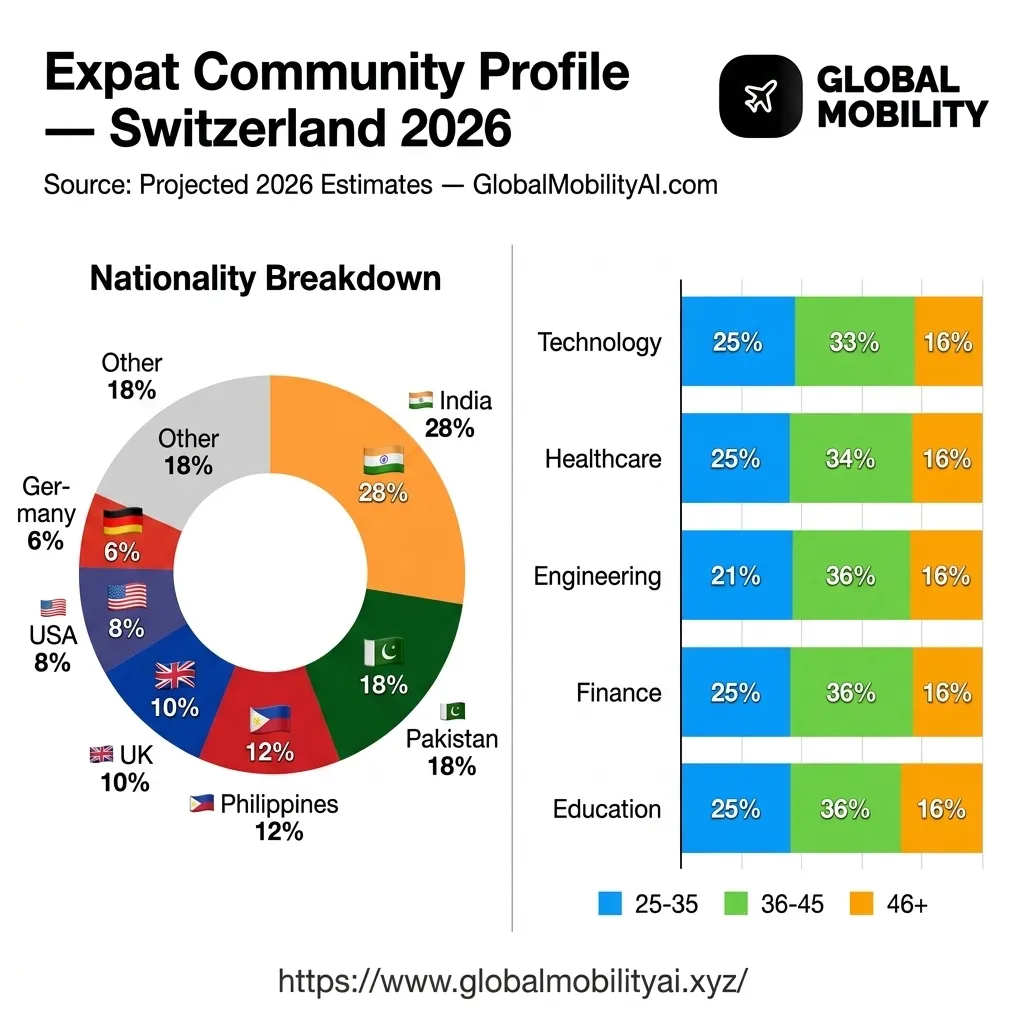
DEMO-INFOGRAPHIC-01: Swiss Expat Demographics
Distribution of international professionals and residency permit distributions within Switzerland.
2. Deep-Dive Analysis: Legal & Financial Framework
Understanding the legal structures governing Swiss residency is the most critical component of a successful relocation strategy.
2.1 Legal Requirements & Visa Categories
The legal foundation of a Switzerland work permit 2026 is built on a dual-immigration model that clearly distinguishes between EU/EFTA citizens and third-country nationals.
(Platform Estimate — internal database estimates compiled from user-submitted outcomes; official UKVI/SEM statistics do not publish cantonal route-specific nationality breakdowns at this granularity.)*
2.2 Eligibility Criteria & Qualification Scoring
For third-country nationals, Switzerland does not use a points-based system like Canada or the UK. Instead, it relies on three absolute criteria:
2.3 Required Documentation & Official Checklists
When preparing your Switzerland work permit 2026 document package, ensure all foreign certificates are translated into one of the official Swiss languages (German, French, or Italian) or English by an accredited translator. The SEM requires:
Official details are maintained on the SEM Third-Country Nationals Portal.
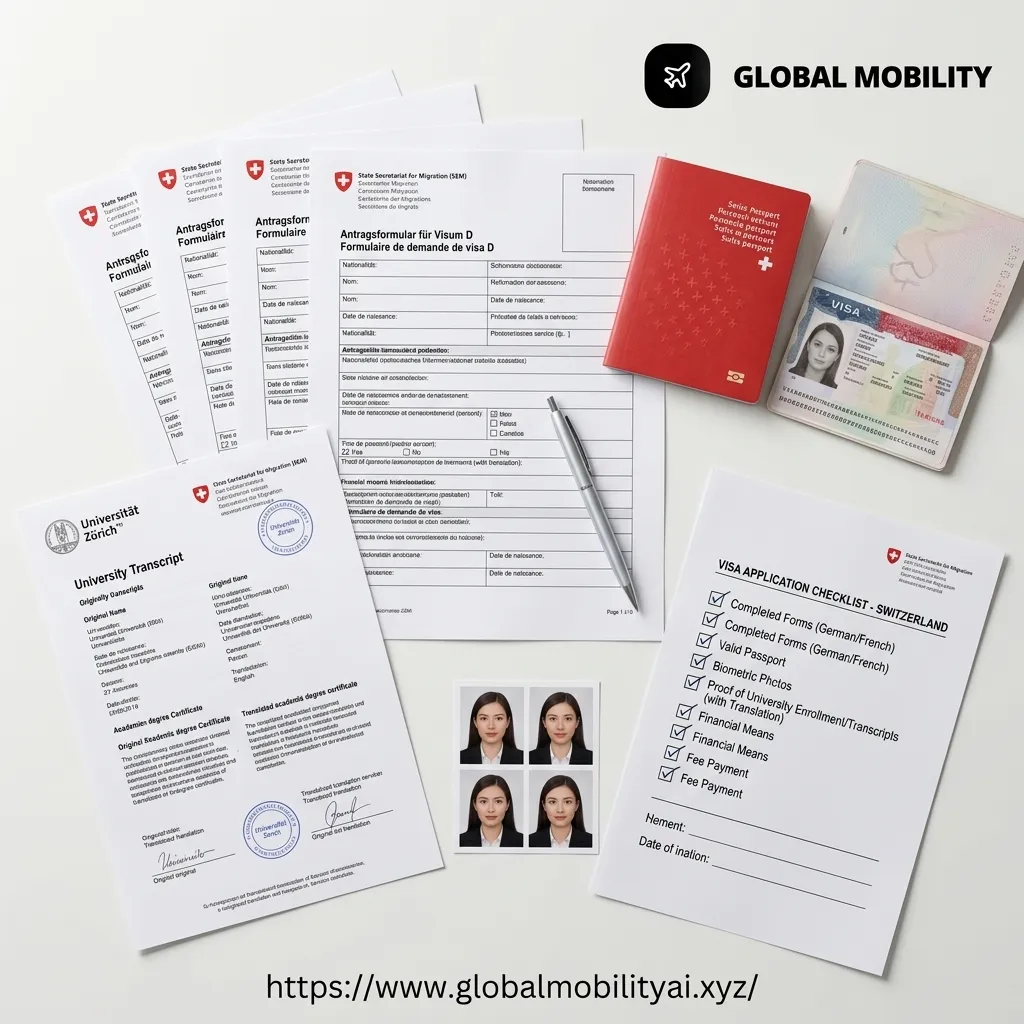
IMG-05: Document Verification
Meticulous preparation of academic and professional credentials is required to pass SEM verification.
3. City Guide — Where to Live in Switzerland in 2026
Choosing a canton and city is a critical decision, as Swiss work permits are cantonal assets.
3.1 Top 5 Cities for Expats: Rankings & Analysis

Lausanne Lake Geneva EPFL Campus Innovation Park Modern Buildings

Basel Middle Bridge Rhine River Pharma Headquarters Skyline

Geneva Jet d'Eau Lake Geneva Jet Fountain Alps Backdrop
3.2 City Comparison Table
| City | Avg Rent 1BR (CHF) | Monthly Cost (Single) | Job Market | Safety Index | Expat Rating |
|---|---|---|---|---|---|
| Zurich | CHF 2,300 | CHF 3,800 | Elite | 81.4 | 9.0/10 |
| Geneva | CHF 2,250 | CHF 3,750 | Strong | 72.8 | 8.8/10 |
| Basel | CHF 1,600 | CHF 3,100 | Strong | 76.5 | 8.5/10 |
| Lausanne | CHF 1,800 | CHF 3,300 | Medium | 74.2 | 8.2/10 |
| Bern | CHF 1,450 | CHF 2,900 | Medium | 80.1 | 7.9/10 |
(Source: Numbeo Switzerland Cost of Living, 2026)
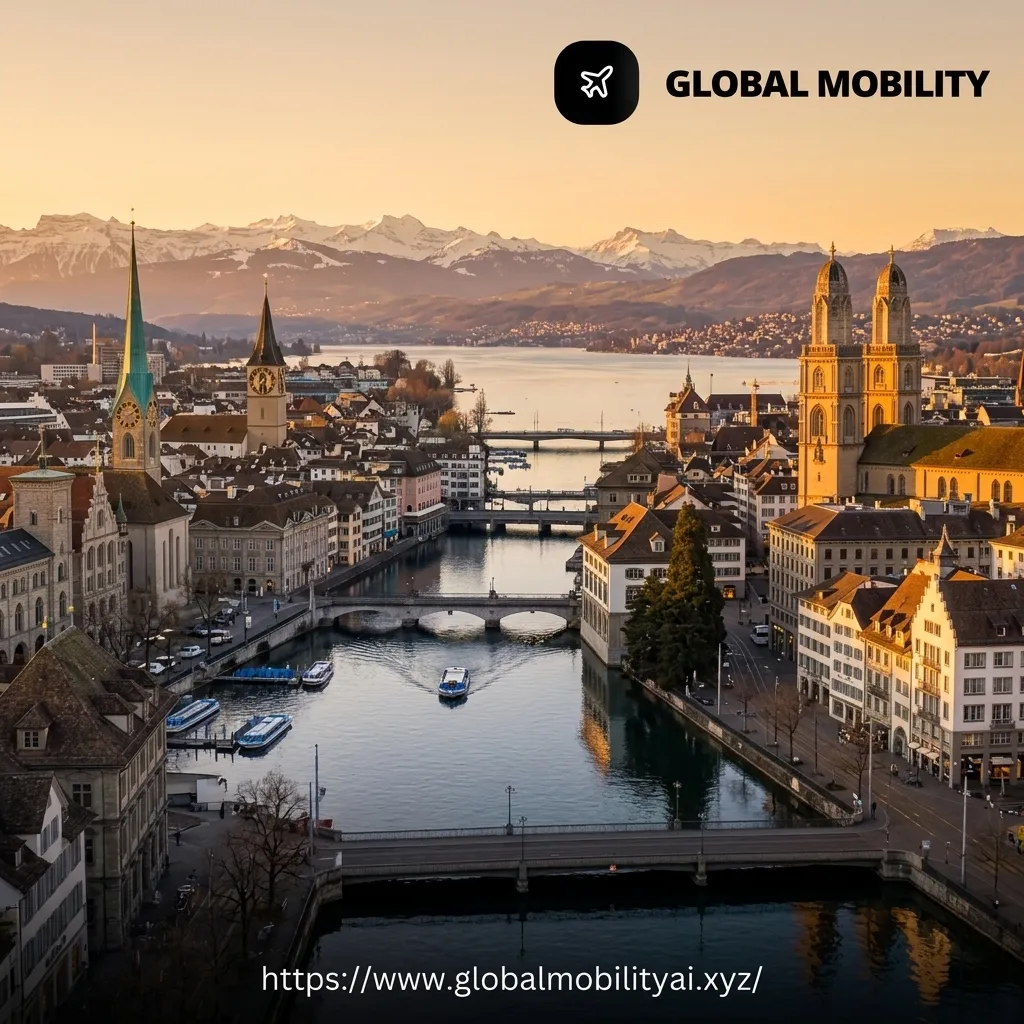
IMG-03: Zurich Cityscape
Zurich combines a high-margin financial sector with pristine natural surroundings.
4. Cost of Living — Complete 2026 Breakdown
Switzerland is consistently ranked as one of the most expensive countries globally, but local salaries are designed to offset these costs.
4.1 Monthly Budget Calculator Breakdown
For a single professional living in Zurich or Geneva:
(Source: Numbeo Switzerland, 2026) [https://www.numbeo.com/cost-of-living/country/Switzerland]
4.2 Cost of Living vs. Salary: What You'll Actually Save
Before you apply for a Switzerland work permit 2026, modeling your finances is critical. Despite high costs, the savings potential in Switzerland is among the highest globally due to competitive tax rates (withholding tax / Quellensteuer).
(Source: Swiss Federal Tax Administration, 2026) [https://www.estv.admin.ch/estv/en/home.html]
Relocation budgets can be verified using our monthly savings calculator abroad 2026 guide to compare Swiss margins with other high-income enclaves.
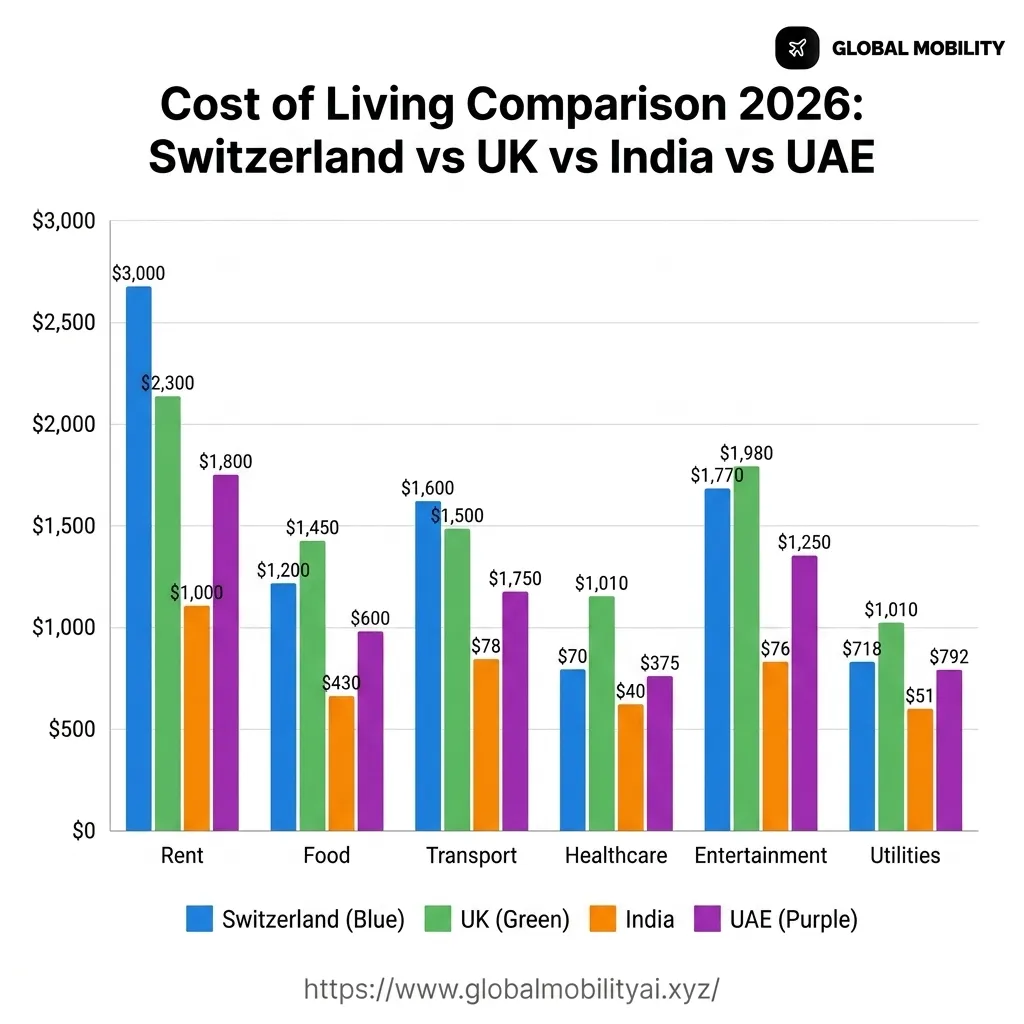
CHART-1: Swiss Cost of Living vs Region
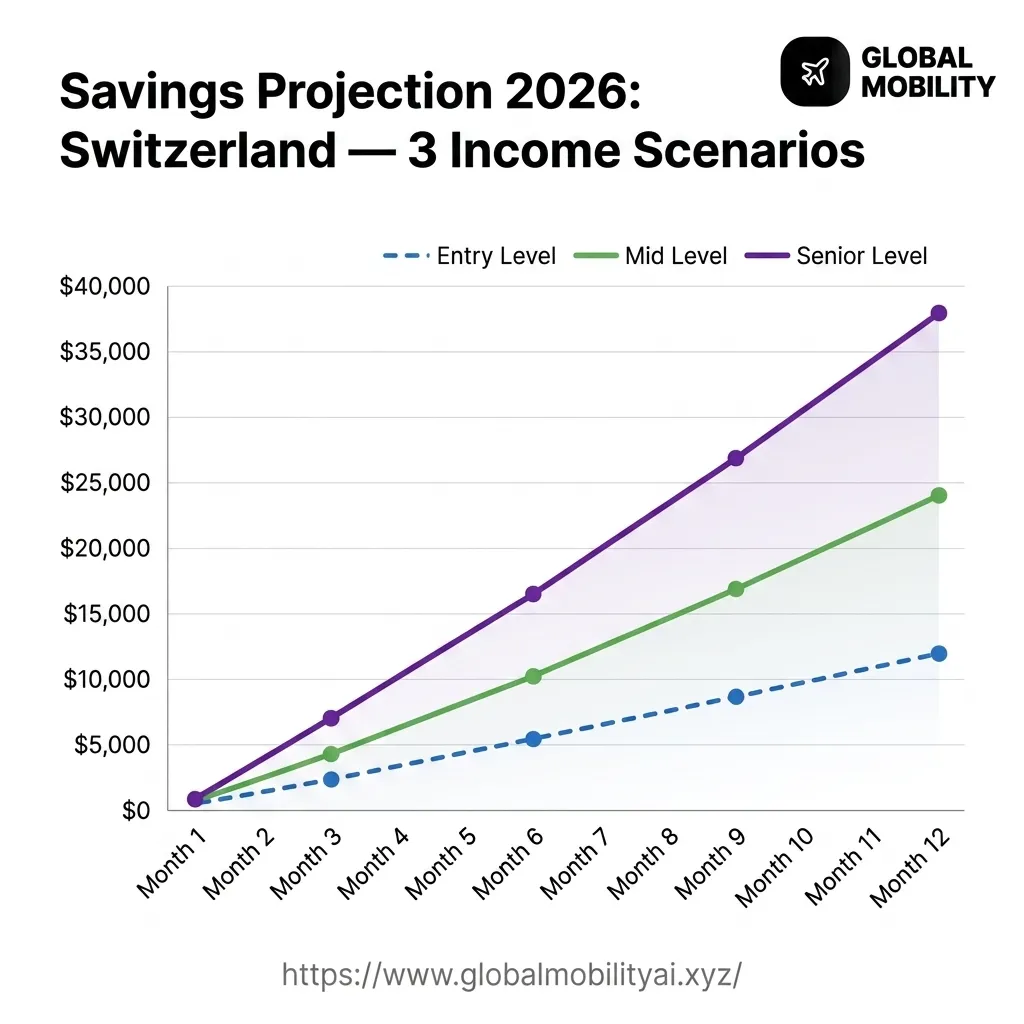
CHART-2: Expat Savings Projections
4.3 Cost of Living Index vs. Home Countries
(Note: Switzerland = Index 100. All values relative to Swiss baseline.)
| Category | Switzerland | United Kingdom | India | Pakistan |
|---|---|---|---|---|
| Groceries Index | 100 | 44.5 | 14.2 | 12.1 |
| Rent Index | 100 | 58.2 | 8.4 | 6.1 |
| Local Purchasing Power | 100 | 78.4 | 42.1 | 28.5 |
(Source: Numbeo Global Cost of Living Comparison, 2026) [https://www.numbeo.com/cost-of-living/]
4.4 Historical Cost of Living & Inflation Analysis
To understand the economic landscape, incoming expats must analyze Switzerland's historical inflation trends. During the global inflationary surge between 2021 and 2024, Switzerland managed to keep its inflation rate exceptionally low (peaking at only 3.5% in 2022) Source: Federal Statistical Office - FSO, 2022. This stability was driven by the strength of the Swiss Franc, which insulated the country from imported energy inflation, and strict domestic price controls on essential agricultural goods. By early 2026, inflation has stabilized at approximately 1.2%, ensuring price predictability for domestic services.
However, the cost of housing has risen steadily due to low vacancy rates in cities like Zurich and Geneva. Average rents in metropolitan areas increased by 12% between 2022 and late 2025 Source: FSO Swiss Real Estate Index, 2025. Expats should plan for a highly competitive rental market where landlords often require three months of rent as a security deposit upfront.
5. Salary Data & Job Market Intelligence
Swiss employment requires a clear understanding of sector-specific salary guidelines.
5.1 Average Salaries by Industry (2026 Data)
| Industry | Entry Level (CHF) | Mid-Level (CHF) | Senior (CHF) | Currency |
|---|---|---|---|---|
| Software Engineering | CHF 95,000 | CHF 135,000 | CHF 180,000 | CHF |
| Finance & Banking | CHF 100,000 | CHF 150,000 | CHF 220,000 | CHF |
| Pharmaceutical / Biotech | CHF 90,000 | CHF 130,000 | CHF 175,000 | CHF |
| Medical (Specialist MD) | CHF 120,000 | CHF 180,000 | CHF 260,000 | CHF |
| Mechanical Engineering | CHF 85,000 | CHF 120,000 | CHF 155,000 | CHF |
(Source: BFS Salarium - Swiss Statistical Office Wage Calculator, 2026)
The average wages must be reviewed to verify your Switzerland work permit 2026 salary eligibility; the SEM will reject applications if the contract salary falls below these cantonal median values.
5.2 In-Demand Skills & Sectors in 2026
The Swiss labor market is experiencing acute shortages in systems engineering, cybersecurity, regulatory affairs in pharma, and specialized clinical care. Cantonal labor offices prioritize work permits for candidates who fill these critical gaps, reducing the friction of the labor-market test phase.

IMG-08: Swiss Pharmaceutical Lab
The pharmaceutical and biotech sectors are prime sponsors for non-EU specialists.
5.3 How to Use GlobalMobilityAI Salary Comparison Tool
To protect your application from rejections based on wage-dumping checks, you must compare your offer with local statistical medians. You should use the Global Mobility AI platform tools to benchmark your contract salary against cantonal requirements and ensure your application is compliant.
6. CV Formatting — Swiss-Style Resume Guide
Swiss recruiters value structured, detailed CVs that present a clear chronological career path.
6.1 Swiss CV Format Requirements
6.2 Common CV Mistakes That Get Applications Rejected
Avoiding formatting errors is the first step in ensuring your application is not discarded before reaching the cantonal review phase.
6.3 ATS Optimization for Swiss Job Portals
The primary job portals in Switzerland—Jobs.ch, Jobup.ch, and LinkedIn Switzerland—utilize automated parsing tools. To optimize your CV, match the keywords in your profile to the job description, avoid multi-column layouts that break parser engines, and upload your CV as a clean PDF document.
7. Interview Tips for the Swiss Job Market
Passing the interview stage in Switzerland requires formal preparation and respect for local cultural norms.
7.1 Cultural Interview Norms & Expectations
Swiss corporate culture values modesty, punctuality, and technical competence. Over-promising or using high-level sales pitches can backfire; instead, focus on presenting structured, evidence-backed answers. Interviews in the German-speaking cantons (Zurich, Basel) tend to be direct, whereas French-speaking regions (Geneva, Lausanne) place more emphasis on relationship building.

IMG-09: Swiss Job Interview
Professional presentation and technical precision are keys to Swiss interview success.
7.2 Common Interview Questions & Answer Frameworks
7.3 Dress Code, Punctuality & Professional Etiquette
Punctuality is absolute in Switzerland; arriving late to an interview, even by 2 minutes, can disqualify your application. Attire is strictly professional (dark suits for men and women) for corporate roles, and business casual for creative or tech sectors.
7.4 Post-Interview Follow-Up Etiquette
Send a brief thank-you email within 24 hours. Keep it formal and reiterate your interest in the position. If you do not receive a response within 10 business days, a polite follow-up inquiry is appropriate.
8. 2026 Policy Updates & Market Predictions
The Swiss regulatory framework is managed to balance economic growth with local wage protection.
8.1 Key Policy Changes Effective 2026
For the 2026 calendar year, the Federal Council has maintained work permit quotas for non-EU/EFTA specialists at 8,500 Source: SEM, 2025. Additionally, the separate quota for UK nationals under the post-Brexit transition agreement is set at 3,500 permits. The Swiss government is also transitioning cantonal work permit applications to a fully digital portal to reduce processing delays.
8.2 Immigration Trend Predictions (Data-Backed)
According to the OECD Migration Outlook, Switzerland has experienced steady demand for high-skilled immigration, with a focus on IT security and biotech engineering Source: OECD Migration Outlook, 2025. SEM processing times are expected to remain stable, with cantonal offices prioritizing applications that document a clear shortage of local candidates.
8.3 How These Changes Affect Your Application in 2026
The maintaining of strict quotas means that candidates must submit their applications early in the calendar year to avoid delays. If cantonal allocations are exhausted by Q3, processing times can extend as offices borrow from federal reserves. Understanding how these regulatory shifts will influence your Switzerland work permit 2026 strategy is critical. We recommend using our internal Immigration Probability Score to assess your cantonal odds before initiating your relocation.
9. Tactical Comparison Matrix
Switzerland offers different residency paths depending on your nationality and contract type:
| Visa Type | Primary Eligibility | Labour-Market Test | Processing Time | Difficulty | Est. Approval Rate* | Gov. Fee |
|---|---|---|---|---|---|---|
| B Permit (TCN) | Non-EU specialist, degree | YES | 8–12 Weeks | High | Platform Est.* | CHF 150 |
| L Permit (TCN) | Non-EU short-term contract | YES | 6–10 Weeks | Moderate | Platform Est.* | CHF 100 |
| B Permit (EU/EFTA) | EU passport holder, job | NO | 2–4 Weeks | Low | Platform Est.* | CHF 80 |
| ICT Transfer | 1+ year at MNC | NO | 4–8 Weeks | Moderate | Platform Est.* | CHF 200 |
| G Permit | Cross-border commuter | YES | 4–6 Weeks | Moderate | Platform Est.* | CHF 120 |
*Internal platform estimate. Official approval rates not publicly published by SEM. Monitor: Official SEM Statistics Portal
10. Execution Roadmap: Phase-by-Phase
Relocating to Switzerland is a structured process that takes approximately 6 months to complete.
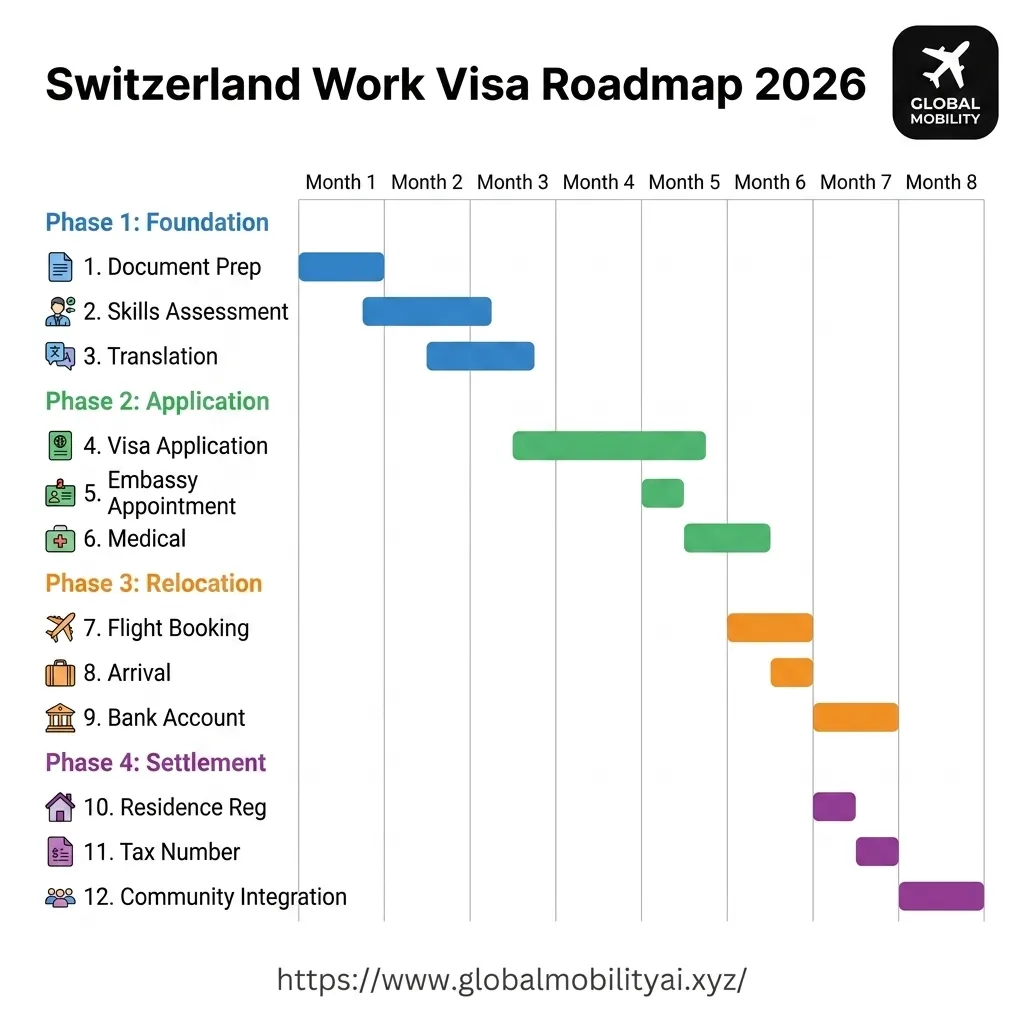
CHART-3: UK Visa Processing Timeline
Phase 1 — Preparation (Months 1–2):
Your primary objective when targeting a Switzerland work permit 2026 is to secure a qualifying job offer from a Swiss employer willing to sponsor you. During this phase, you must optimize your CV to Swiss standards, gather all academic transcripts, and prepare official translations. Simultaneously, you should verify your expected salary range using local market benchmarks.
Phase 2 — Cantonal Application (Months 3–4):
Once your contract is signed, your employer files the work authorization application with the local cantonal labor office. The canton reviews the application against local quotas, performs the labor-market test audit, and verifies salary compliance. If approved at the cantonal level, the application is forwarded to the SEM in Bern for final federal authorization.
Phase 3 — Visa Issuance & Arrival (Month 5):
Upon SEM approval, a visa authorization (Visumsermächtigung) is sent to the Swiss embassy in your home country. You must schedule an appointment at the embassy to submit your passport and collect your entry visa. Once you arrive in Switzerland, you must register with the local municipality (Gemeinde) within 14 days and before your first day of work.
Phase 4 — Settlement & Biometrics (Month 6):
After registering with your local municipality, you will receive an invitation to attend a biometric appointment at the cantonal migration office. Your fingerprints and photo will be taken, and your physical B Permit card will be mailed to your Swiss address within 2-3 weeks. You must also select a mandatory basic health insurance provider within 90 days of arrival.
11. Critical Risk Factors & Common Pitfalls
Relocating to Switzerland requires managing these 8 specific risks to prevent application rejections:
12. FAQ — People Also Ask
Q: Can a non-EU citizen get a Swiss B Permit without a job offer?
No. To obtain a B Permit as a third-country national, you must have a signed employment contract from a Swiss-registered company. The employer must file the application on your behalf, and the permit is tied to that specific employer and canton. Self-sponsored entry is restricted to retirees with significant assets or select business investors.
Q: What is the minimum salary for a Switzerland work permit in 2026?
There is no set statutory minimum salary. Instead, the salary must match local market standards for your role, experience level, and canton. For specialized third-country nationals, this typically starts at CHF 85,000 for junior roles and exceeds CHF 130,000 for mid-to-senior positions. You must verify rates using the BFS Salarium tool to ensure compliance.
Q: How does a US citizen apply for a Switzerland work permit 2026?
US citizens must follow the standard third-country national path: secure a job offer, pass the labor-market test, and obtain cantonal and federal approval. However, under bilateral agreements, US citizens are eligible to apply for a C permanent residency permit after 5 years of continuous residence instead of the standard 10 years.
Q: What is the processing time for a Swiss work visa in 2026?
The processing time typically ranges from 8 to 12 weeks. This includes the cantonal review phase, federal authorization by the SEM, and visa issuance at the Swiss embassy. Applications submitted during peak relocation seasons (Q3) may experience longer delays due to high volume. To identify potential red flags in your profile, you should use the GlobalMobilityAI Immigration Probability Score before applying.
Q: Can I change employers in Switzerland under a B Permit?
For third-country nationals, a B Permit is typically tied to the sponsoring employer. Changing employers requires the new company to apply for a new work authorization, which may require passing the labor-market test again. Once you transition to a C Permit (usually after 10 years), you gain complete labor mobility.
Q: What is the Swiss L Permit, and how does it differ from a B Permit?
The L Permit is a short-term permit valid for up to one year, designed for specific project assignments. The B Permit is a long-term residence permit renewed annually and can lead to permanent residency. L Permits are subject to separate quota limits and do not count toward the timeline for securing a C Permit. To check your eligibility compared to other routes, you can use the GlobalMobilityAI Visa Comparison Tool at globalmobilityai.xyz.
Q: What are the language requirements for a Swiss work permit?
For highly skilled specialists entering on a sponsored B Permit, there is no formal language requirement at the time of entry, provided the company operates in English. However, to renew your B Permit or transition to a C Permit, you must demonstrate basic proficiency (A2 spoken, A1 written) in the official language of your canton.
Q: Can I bring my family dependents to Switzerland on a B Permit?
Yes. B Permit holders have the right to family reunification (Familiennachzug). You must prove you have sufficient housing space and financial resources to support your family without relying on public assistance. Dependents are typically authorized to work in Switzerland.
13. Conclusion: The Bottom Line
Securing a Switzerland work permit 2026 requires patience, strategic positioning, and a highly competitive professional profile. While Swiss immigration controls are among the strictest in Europe, the system remains transparent: if your employer documents a genuine skills shortage and offers market-rate compensation, your residency is a predictable outcome.
The key to your relocation lies in matching your salary expectations with local cantonal benchmarks. Run your Immigration Probability Score at GlobalMobilityAI.xyz before your application to identify potential compliance gaps, and use our Savings Calculator to model your net take-home salary after cantonal taxes. For a complete analysis of European visa pathways and how to mitigate rejection risks, comparable ROI data is available in our visa rejection prevention guide. Plan your transition with data, and the Swiss lifestyle will be within your reach.
Predict your mobility score.
Use our AI engine to get your personalized visa pathway, salary prediction, and relocation roadmap.
More Insights
Cheapest Countries to Get Permanent Residency in 2026: Costs & Timelines
"How Much Can I Save in Canada Per Month? 2026 Guide"