
Canada Provincial Nominee Program 2026: Fastest PR Provinces
Editorial Transparency: Content compiled from official government sources by the GlobalMobilityAI Research Team. For personalized legal or immigration advice, consult a licensed immigration consultant or lawyer.
(Last Updated: 2026-05-21)
According to official administrative updates published by the Immigration, Refugees and Citizenship Canada IRCC Levels Plan, the federal government has indexed the target for provincial nominee programs to 91,500 nominations in 2026, establishing regional migration as the largest economic immigration pathway in the country. (Source: IRCC, 2024). Navigating the Canada Provincial Nominee Program 2026 requires understanding the updated provincial allocations and processing speeds. As the federal government increases quotas, these regional nominee programs have become the cornerstone of Canada's economic immigration strategy. By utilizing the GlobalMobilityAI.xyz platform tools, applicants can compare regional streams, analyze local living costs, and model their immigration probability score to secure permanent residency in the shortest possible timeframe.
Figure 1: Provincial nominee programs offer the fastest and most stable route to Canadian permanent residency in 2026.

Table of Contents
1. Why the Canada Provincial Nominee Program 2026 is Your Fastest PR Route
In the current landscape of Canadian immigration, relying solely on federal Express Entry general draws has become a high-risk strategy. With Comprehensive Ranking System (CRS) cut-offs consistently hovering above 500 points for general pools, provincial nomination offers the most reliable mechanism to bypass the federal backlog and secure permanent residency.
1.1 Economic Landscape & Opportunity
The macroeconomic landscape of Canada in 2026 is defined by regional labor market specialization. Rather than a monolithic national economy, Canada operates as a collection of distinct provincial job markets, each experiencing unique deficits in human capital. According to the OECD International Migration Outlook 2025, countries utilizing sub-national selection mechanisms report a 14% higher rate of immediate economic integration among economic newcomers (Source: OECD, 2025). The World Bank's economic prospects report for Canada indicates a GDP growth stabilization of 1.6% driven heavily by regional manufacturing expansions and green energy initiatives outside the traditional hubs (Source: World Bank Canada Economic Prospects 2026). As a result, provinces like Alberta and Saskatchewan are experiencing accelerated regional demand for specialized workforce allocations, far outpacing the nationwide average growth rates.
According to the latest federal targets, the provincial nominee framework targets 91,500 nominations, establishing it as the largest economic program in Canada. By decentralizing selection authority, provinces can bypass the broader federal queue to nominate individuals with targeted skill sets in healthcare, technology, construction, and agriculture. This regional autonomy allows smaller jurisdictions to offer fast-tracked immigration pathways directly tied to local employers' immediate operational needs, ensuring incoming professionals secure stable employment and contribute immediately to provincial GDP.
1.2 Why Professionals Are Targeting This Destination
Immigration candidates are increasingly shifting their focus from federal pools to provincial nomination streams. Platform search trends suggest that skilled workers are looking beyond Toronto and Vancouver, directing their profiles toward jurisdictions where their profession yields priority points.
For instance, tech workers are utilizing our resources to target the British Columbia Tech stream or Alberta’s Accelerated Tech Pathway. Receiving a provincial nomination awards a candidate 600 bonus points in the federal Express Entry system, which guarantees an invitation in the subsequent federal draw. This regional focus allows candidates to bypass the high general CRS score requirements, reducing their relocation timelines by up to 12 months. This path is analyzed in detail in our Canada Express Entry 2026 guide.
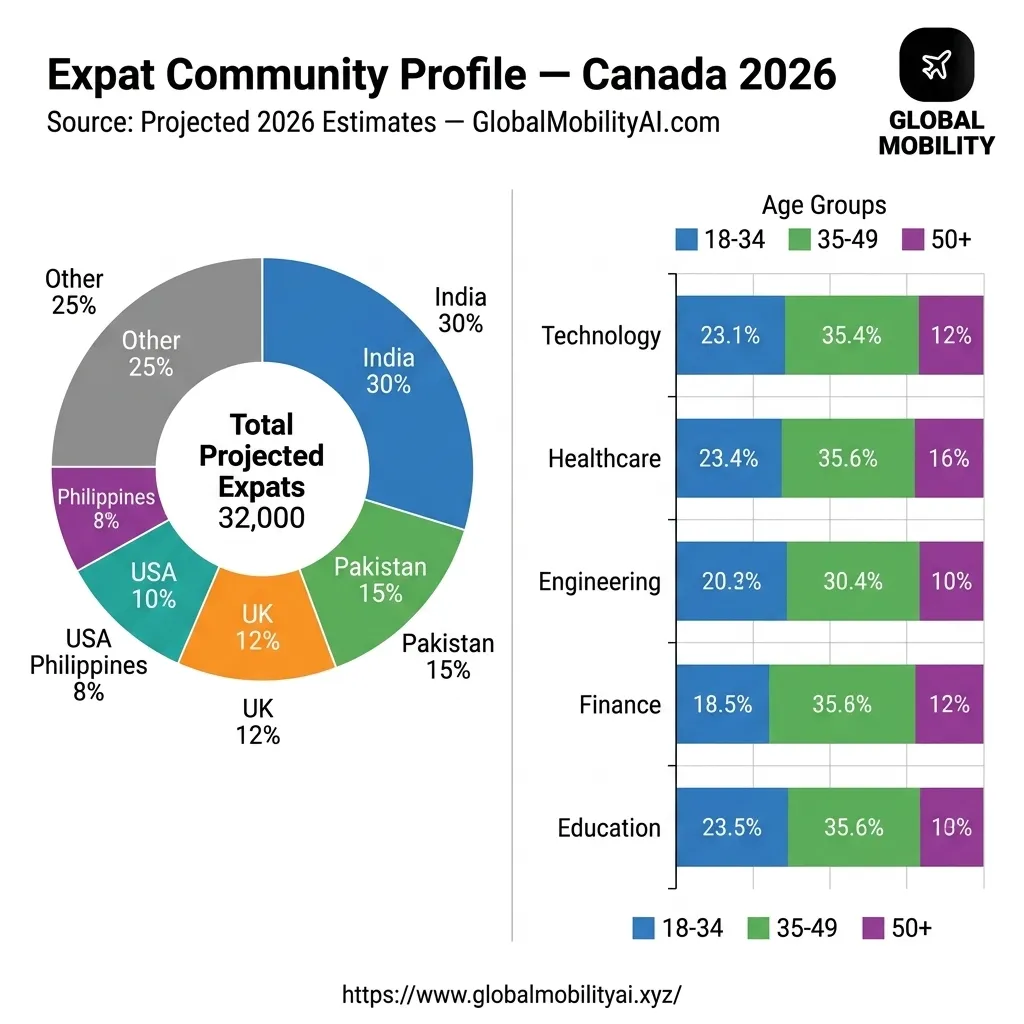
IMG-02: Canada Expat Community Profile 2026 Infographic
Figure 2: The 2026 provincial expat community profile indicates strong representation in technology, healthcare, and engineering.
2. Legal and Financial Requirements of the Canada Provincial Nominee Program 2026
The legal infrastructure governing provincial nomination is structured around two distinct operational pathways: Enhanced streams and Base streams. Understanding these pathways is critical to avoiding application delays.
2.1 Legal Requirements & Visa Categories
Each stream under the provincial nominee framework has unique qualifying criteria and financial requirements. The pathways are categorized as:
To qualify under the Canada Provincial Nominee Program 2026, candidates must prove their intent to reside in the nominating province, meet minimum education thresholds, and demonstrate language proficiency in English or French.
2.2 Eligibility Criteria & Qualification Scoring
Provinces use points-based grids or targeted occupational lists to evaluate candidates:
Candidates can evaluate their starting CRS profiles using the Official IRCC CRS Tool to determine if they need a provincial nomination to become competitive. Candidates interested in starting a business rather than skilled employment should consult our Canada Startup Visa Program 2026 guide.
2.3 Required Documentation & Official Checklists
Provincial applications require high-integrity documentation. The IRCC and provincial authorities enforce a zero-tolerance policy for missing records:

IMG-03: Canada PR Document Checklist 2026
Figure 3: Key legal documents required for provincial nomination and Express Entry alignment.
3. City Guide — Where to Live in Canada in 2026
Your choice of province determines not only your PR speed but also your long-term living expenses and career prospects.
3.1 Top 5 Cities for Expats: Rankings & Analysis
3.2 City Comparison Table
The following comparative table details the baseline metrics of the top five newcomer destinations:
| City | Avg Rent 1BR (Centre)* | Monthly Cost (Single)* | Job Market | Safety Index | Expat Rating |
|---|---|---|---|---|---|
| Calgary | $1,850 CAD | $1,250 CAD | High | 67.5 | 9.0/10 |
| Ottawa | $1,980 CAD | $1,280 CAD | Stable | 73.2 | 8.5/10 |
| Halifax | $1,680 CAD | $1,180 CAD | Competitive | 65.4 | 8.0/10 |
| Toronto | $2,580 CAD | $1,420 CAD | Elite | 58.4 | 8.5/10 |
| Vancouver | $2,720 CAD | $1,480 CAD | High | 61.2 | 8.0/10 |
\Data compiled from community indexes. Compare real-time cost variations using the Numbeo Cost of Living Index - Canada database (Source: Numbeo, 2026).*

IMG-04: Top Expat Cities in Canada Collage
Figure 4: Comparative snapshot of Canada's leading newcomer destination hubs.
4. Cost of Living — Complete 2026 Breakdown
Understanding the itemized expenses of a single professional is vital to optimizing your newcomer budget.
4.1 Monthly Budget Calculator Breakdown
Average monthly expenditures in Canada for a single professional in a major city center:
(Source: Numbeo Cost Database, 2026).
4.2 Cost of Living vs. Salary: What You'll Actually Save
To understand your true savings potential, you must evaluate net salaries after provincial and federal taxes. We model three scenarios in Calgary, Alberta, using data from the Canada Job Bank Occupations Database (Source: Job Bank Canada, 2025):
Using our platform's cost of living calculator, users can adjust these estimates based on family size and destination province to evaluate their savings potential under the Canada Provincial Nominee Program 2026.
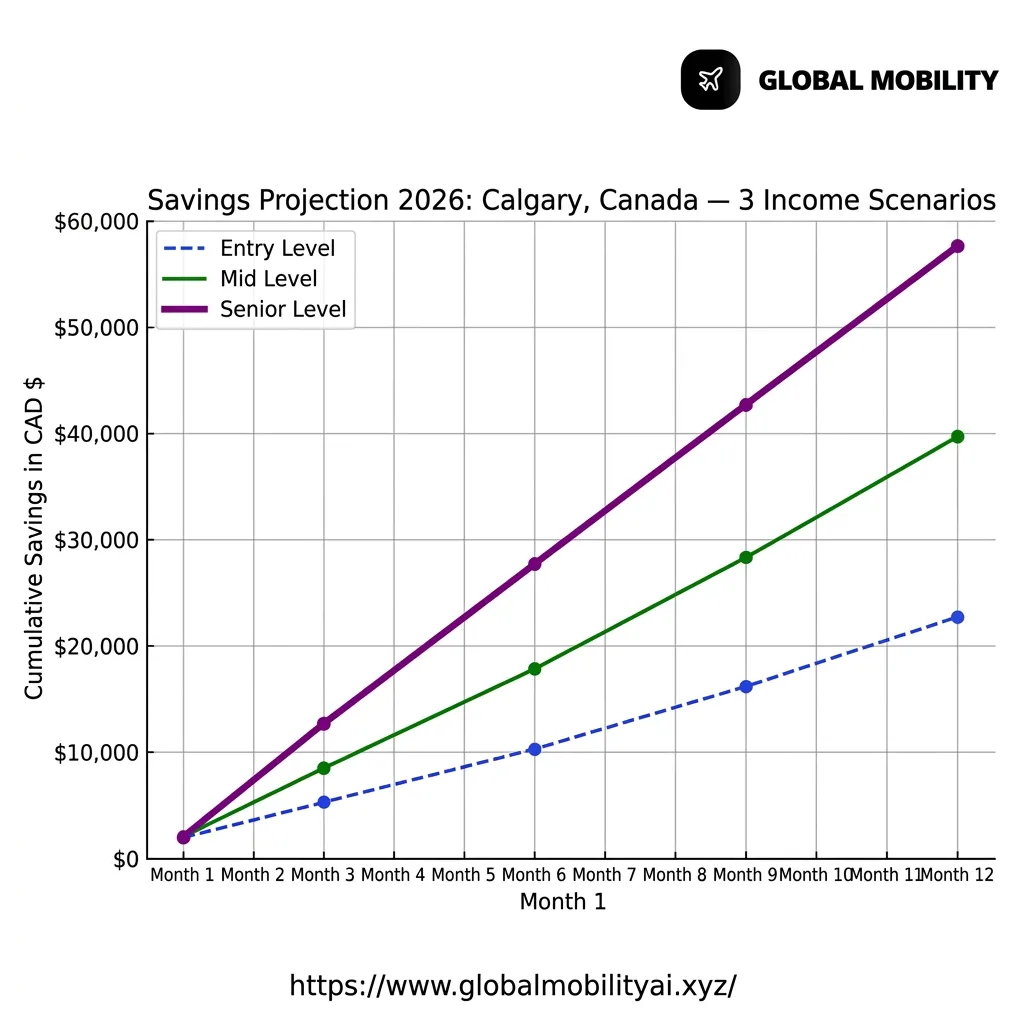
IMG-06: Canada Salary vs Savings Line Chart
Figure 6: Accumulating settlement savings in Canada requires budgeting for regional tax differences.
4.3 Cost of Living Index vs. Home Countries
The cost of living in Canada is significantly higher than in traditional source nations, particularly regarding shelter. For comparison with other major destinations, see our analysis of how much can I save in Australia per month 2026 to benchmark your monthly savings potential:
| Category | Canada (CAD) | Pakistan (PKR) | India (INR) | UK (GBP) |
|---|---|---|---|---|
| Rent (1BR) | $2,100 CAD | 80,000 PKR | 42,000 INR | £1,300 GBP |
| Groceries | $550 CAD | 38,000 PKR | 18,500 INR | £350 GBP |
| Utilities | $220 CAD | 22,000 PKR | 11,000 INR | £220 GBP |
(Sources: Numbeo Cost of Living Index - Canada and Numbeo Cost of Living Index - United Kingdom, 2026).
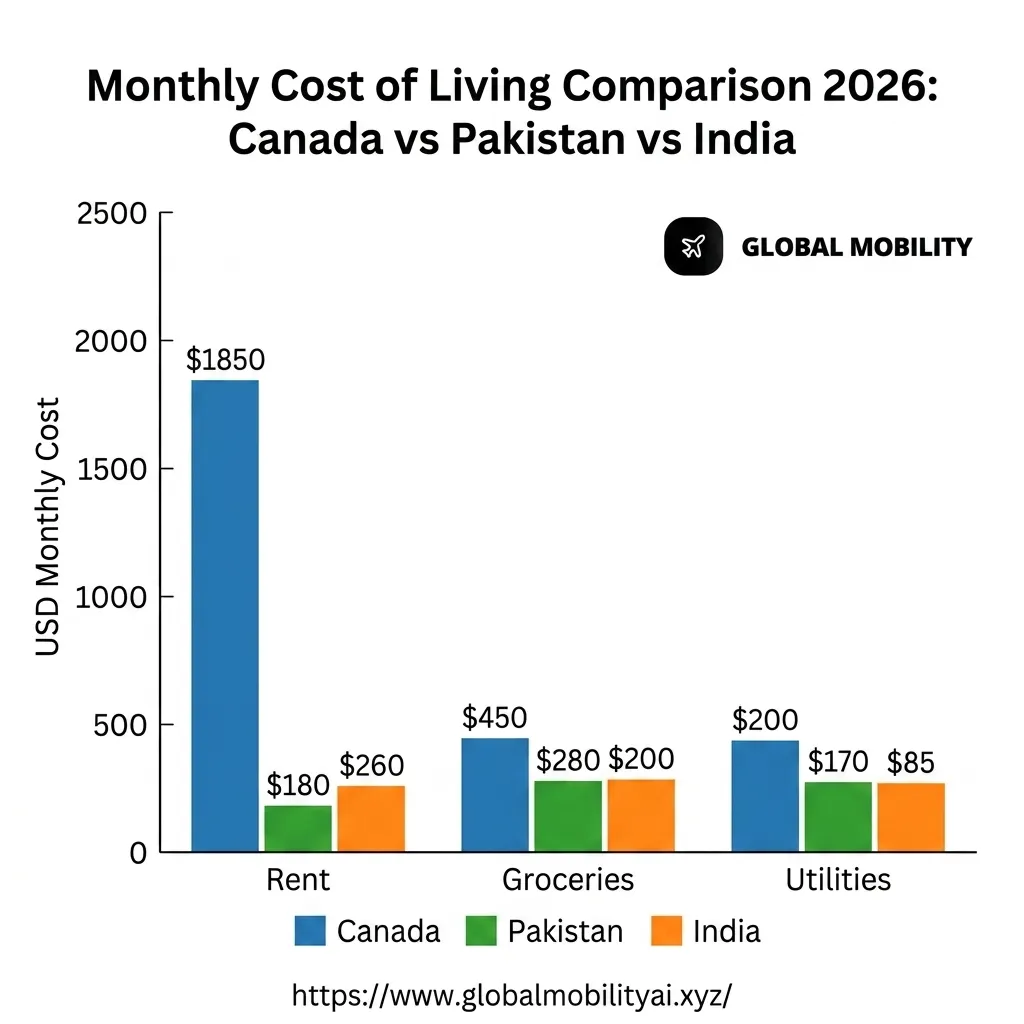
IMG-05: Canada Cost of Living Comparison Bar Chart
Figure 5: Baseline monthly expenses in Canada against traditional source countries.
5. Salary Data & Job Market Intelligence
Provincial salaries vary based on local economic strength and demand for specialized skills.
5.1 Average Salaries by Industry (2026 Data)
Annual gross salary rates by professional sector in Canada:
| Industry | Entry Level (CAD) | Mid-Level (CAD) | Senior (CAD) | Source Database |
|---|---|---|---|---|
| Technology | $78,000 CAD | $112,000 CAD | $165,000 CAD | Statistics Canada / Job Bank |
| Healthcare | $70,000 CAD | $98,000 CAD | $148,000 CAD | Statistics Canada / Job Bank |
| Engineering | $74,000 CAD | $108,000 CAD | $158,000 CAD | Statistics Canada / Job Bank |
| Finance | $68,000 CAD | $95,000 CAD | $145,000 CAD | Statistics Canada / Job Bank |
| Marketing | $62,000 CAD | $88,000 CAD | $130,000 CAD | Statistics Canada / Job Bank |
(Source: Canada Job Bank Wages Database, 2025).
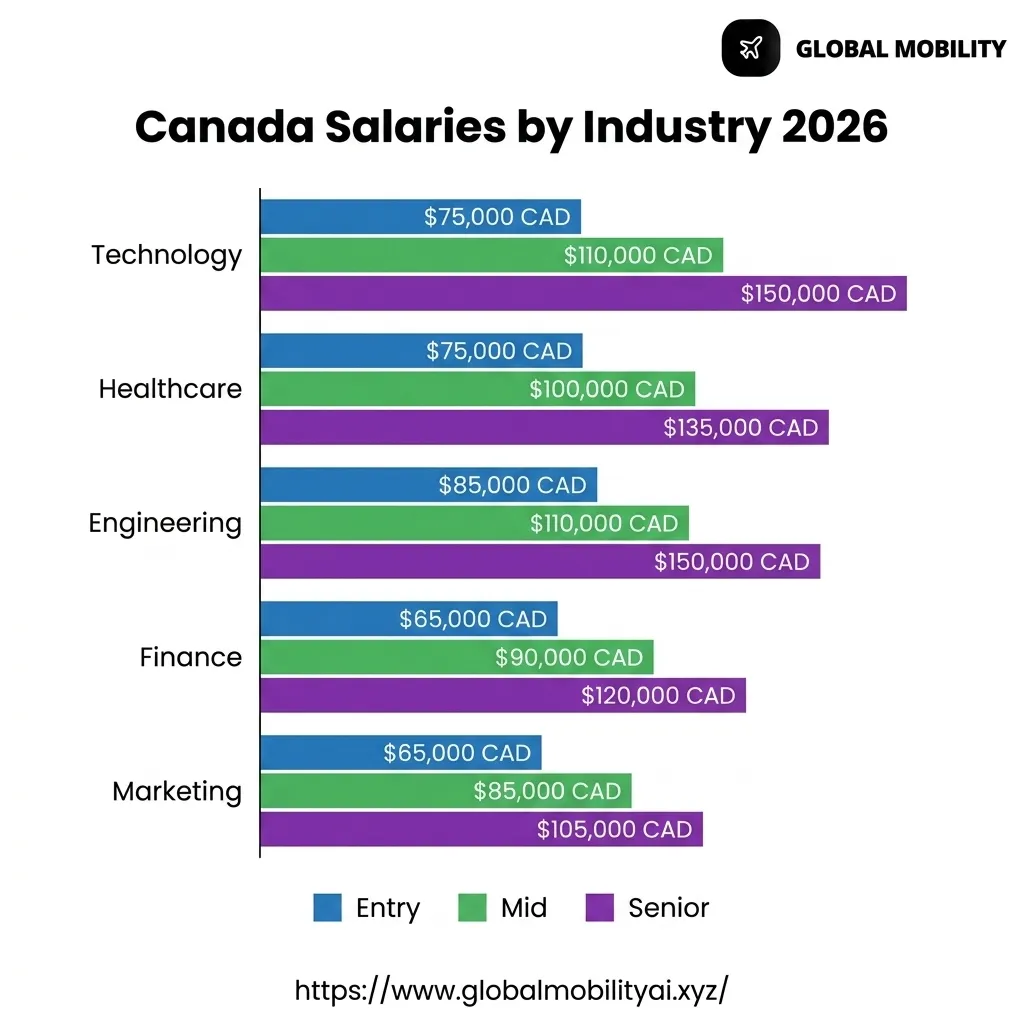
IMG-07: Canada Industry Salary Chart
Figure 7: Gross entry, mid-level, and senior annual salaries by key sector.
5.2 In-Demand Skills & Sectors in 2026
According to the Statistics Canada Labor Shortage Reports 2025, critical labor shortages persist in civil infrastructure engineering, nursing, early childhood education, and commercial electrical trades. (Source: Statistics Canada, 2025). Provinces use targeted PNP draws to prioritize these occupations, providing faster processing and lower CRS score requirements.
5.3 How to Evaluate Your Salary Potential Before Applying
Before negotiating employment offers in target provinces, applicants should evaluate their market value against local averages. Utilizing our platform's Canada salary comparison tool allows newcomers to model their prospective income after accounting for regional tax brackets, indexation rates, and provincial healthcare premiums, ensuring competitive compensation package alignment.
6. CV Formatting — Canada-Style Resume Guide
A resume that does not conform to Canadian formatting guidelines will be rejected by corporate applicant tracking systems (ATS).
6.1 Canada CV Format Requirements
6.2 Common CV Mistakes That Get Applications Rejected
6.3 ATS Optimization for Canada Job Portals
Most corporate portals in Canada—such as Indeed.ca, LinkedIn Canada, and Workopolis—rely on automated parsers. Optimize your resume by mirroring exact keywords from the job description, using standard headings (Experience, Education, Skills), avoiding tables or charts, and saving the file as a `.docx` document.

IMG-08: Canada CV Format Mockup
Figure 8: Compliant Canadian resume structure excluding personal photographs and biographical details.
7. Interview Tips for the Canada Job Market
Canadian employers prioritize soft skills, collaboration, and cultural alignment as much as technical expertise.
7.1 Cultural Interview Norms & Expectations
Canadian corporate interviews are predominantly behavioral. Recruiters believe that past performance is the best predictor of future behavior. Expect questions that test your emotional intelligence, ability to handle constructive feedback, and collaboration in diverse teams. Polite directness and team-first language are valued.
7.2 Common Interview Questions & Answer Frameworks
You must answer all situational questions using the STAR (Situation, Task, Action, Result) framework:
7.3 Dress Code, Punctuality & Professional Etiquette
7.4 Post-Interview Follow-Up Etiquette
Send a personalized thank-you email to each panel interviewer within 24 hours. Keep it under 150 words, reference a specific topic discussed during the interview, and state your continued interest in the position.

IMG-09: Corporate Interview Scene in Canada
Figure 9: Professional interviews in Canada heavily prioritize behavioral STAR-format answers.
8. Policy Updates & Market Predictions
Staying informed about regulatory adjustments is essential to maintain application compliance.
8.1 Key Policy Changes Effective 2026
8.2 Immigration Trend Predictions (Data-Backed)
According to the OECD International Migration Outlook 2025, Canada remains a leading destination for skilled human capital, but is shifting focus from general intakes to sector-specific allocations. (Source: OECD, 2025). Enhanced PNP pathways are projected to account for 65% of all provincial nominations in 2026, as provinces seek to minimize processing times and secure immediate labor matches.
8.3 How These Changes Affect Your Application in 2026
Applicants must ensure they possess the increased settlement funds before entering the provincial pools. Because provinces now hold sole authority over residence intent evaluations, applicants must document strong local ties, such as regional job searches, family connections, or past visits. Using our platform's immigration probability engine, candidates can evaluate their suitability for targeted streams under the Canada Provincial Nominee Program 2026.
9. Tactical Comparison Matrix
The following matrix compares the leading provincial nominee pathways available in 2026:
| Visa Type | Eligibility | Min. Salary | Processing Time | Difficulty | Est. Approval Rate* | Gov. Fee |
|---|---|---|---|---|---|---|
| **OINP Human Capital** | CRS 450+, Degree, Tech/Health | N/A | 3–5 Months | High | Platform Est.* | $1,500 CAD |
| **BC PNP Tech** | Job offer in 35 tech NOCs | Median Wage | 2–3 Months | Moderate | Platform Est.* | $1,475 CAD |
| **AAIP Tech Pathway** | Tech job offer in Alberta | Prevailing Wage | 1–2 Months | Moderate | Platform Est.* | $500 CAD |
| **SINP Skilled Worker** | EOI points grid, Skilled NOC | N/A | 3–6 Months | High | Platform Est.* | $350 CAD |
| **NSNP Market Priorities** | Express Entry profile, NOC match | N/A | 3–5 Months | Moderate | Platform Est.* | Free |
| **Manitoba PNP** | Close friend/family or job offer | N/A | 4–6 Months | High | Platform Est.* | $500 CAD |
\Internal platform estimate. Official program approval rates are not publicly published by provincial immigration authorities. Monitor updates via the IRCC Official Portal (Source: IRCC, 2026).*
10. Execution Roadmap: Phase-by-Phase
A successful application requires executing a series of precise administrative milestones.
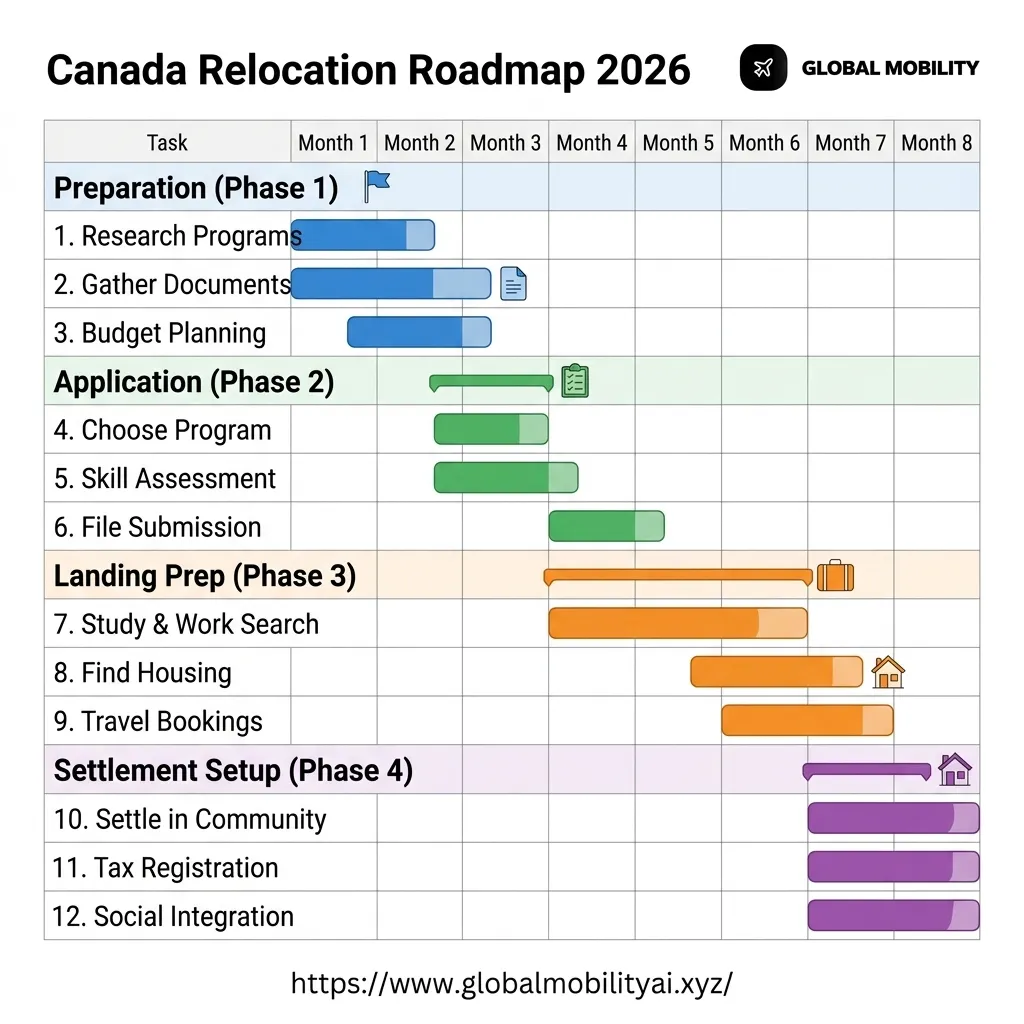
IMG-10: Canada PNP Processing Timeline Gantt Chart
Figure 10: Gantt chart mapping key administrative milestones from preparation to settlement landing.
Phase 1 — Preparation (Months 1–2): Credentials & Language
This phase establishes the eligibility baseline of your profile.
Phase 2 — Application (Months 3–4): Express Entry & EOI Submission
Phase 3 — Arrival & Administration (Months 5–6): Nomination & Federal Stage
Phase 4 — Settlement & Permanent Residency (Month 12+): Landing & Setup
11. Critical Risk Factors & Common Pitfalls

IMG-11: Canada Relocation Pitfalls and Warning Graphic
Figure 11: Warning infographic detailing critical relocation pitfalls and visa refusal vectors.
12. FAQ — People Also Ask
Q: What is the fastest stream under the Canada PNP in 2026?
Under the Canadian provincial nominee streams, the fastest option is BC's Tech stream or Alberta's Accelerated Tech Pathway, which nominate candidates within 4 to 8 weeks. Once nominated, applicants receive 600 points, allowing them to secure an Express Entry invitation in the next draw. Federal processing then takes approximately 7 months. (Source: IRCC, 2026). You can track processing times for these streams using official provincial tracking portals.
Q: Can I apply to the Provincial Nominee Program without a job offer?
Yes. Several provinces operate streams that do not require a job offer. The Ontario Immigrant Nominee Program (OINP) Human Capital Priorities stream draws directly from the Express Entry pool based on CRS scores and specific NOC codes. Saskatchewan's SINP International Skilled Worker stream also operates a points-based system that invites candidates without job offers, provided their occupation is on the provincial demand list.
Q: What happens if I move out of the nominating province after getting PR?
A provincial nomination is granted based on your commitment to reside in that province. Moving immediately to another province can be flagged as a violation of your declaration of intent. IRCC has the authority to investigate this under misrepresentation, which carries a maximum penalty of status revocation. It is recommended to reside and work in the nominating province for at least 24 months.
Q: How much does a Provincial Nominee Program application cost in 2026?
The total cost of applying under the Canada Provincial Nominee Program 2026 consists of provincial processing fees, which range from $350 CAD in Saskatchewan to $1,500 CAD in Ontario, plus the federal IRCC fee of $1,525 CAD (Source: IRCC Fee Structure 2026). This does not include secondary costs such as IELTS tests ($310 CAD), WES credential assessments ($250 CAD), or medical exams ($280 CAD).
Q: Do I need to enter the Express Entry pool to apply for a PNP?
No. You can apply directly to a province through a "Base" stream. If nominated, you receive a physical certificate and submit a paper-based PR application to IRCC. However, this process takes significantly longer, averaging 14 months for the federal stage alone. (Source: IRCC, 2026). Entering the Express Entry pool allows you to target "Enhanced" streams, reducing federal processing time to 7 months.
Q: Which province has the lowest CRS score requirement in 2026?
Saskatchewan and Manitoba often invite candidates with lower equivalent CRS scores through their provincial grids, sometimes inviting applicants who would score below 400 points in the general Express Entry pool. Additionally, Alberta's Accelerated Tech Pathway invites candidates with CRS scores as low as 300, provided they possess a valid tech job offer in the province.
Q: Can my spouse work in Canada under a PNP?
Yes. If you receive a provincial nomination and submit a PR application, your spouse is eligible to apply for an Open Work Permit, allowing them to work for any employer in Canada. This secondary income is crucial for building household savings. You can model your spouse's contribution to your relocation budget using our platform's salary comparison tool.
Q: What is the proof of funds requirement for a PNP in 2026?
If you apply through an Express Entry-aligned PNP stream, you must meet the federal proof of funds threshold, which is $14,690 CAD for a single applicant (Source: IRCC Proof of Funds Requirements 2026). If you apply through a provincial base stream with a job offer, this requirement is often waived, as your immediate employment satisfies the economic establishment criteria.
13. Conclusion: The Bottom Line
For skilled workers evaluating the 2026 landscape, the Canada Provincial Nominee Program 2026 represents a highly effective pathway to secure Canadian permanent residency. While federal Express Entry general draws demand high CRS scores, the 91,500 nominations allocated to provinces in 2026 provide a realistic alternative for skilled professionals. By aligning your application with regional labor demands, targeting tech-specific pathways, and preparing a compliant Canada-style resume, you can accelerate your relocation timeline.
If you are a skilled worker planning your move in 2026, the key to success is early preparation. Compare your provincial options, use our Canada Express Entry Points Calculator 2026 to assess your score under federal draws, and review our How Much Can You Save in Canada report to choose the most cost-effective region for your household.
Access the Full Platform at https://www.globalmobilityai.xyz/

IMG-12: GlobalMobilityAI Relocation Dashboard Mockup
Figure 12: Track settlement progress and PR probabilities in real-time on our relocation dashboard.
Predict your mobility score.
Use our AI engine to get your personalized visa pathway, salary prediction, and relocation roadmap.
More Insights