
Editorial Transparency: Content compiled from official
government sources by the GlobalMobilityAI Research Team.
For personalized legal or immigration advice, consult a
licensed immigration consultant or lawyer.
(Last Updated: 2026-05-24)
According to the Hellenic Statistical Authority (ELSTAT), the Greek economy demonstrated resilient growth by expanding at a real GDP rate of 2.1% in 2025. (Source: Hellenic Statistical Authority (ELSTAT), 2025) [https://www.statistics.gr/en/home] For international investors and corporate professionals looking to establish a secure gateway to the European Union, the Greece Golden Visa 2026 program represents the premier residency-by-investment pathway. By operating under a newly updated tiered investment structure that channels capital away from tourist-heavy residential bubbles, the program offers a highly structured route to legal status. Platform search trends suggest that clear geographic zoning rules and cost transparency are the primary decision factors for relocators evaluating Greece in 2026. This guide details the essential requirements, costs, timelines, and pathways to secure your residency.

Table of Contents
1. Why Greece in 2026? — The Greece Golden Visa 2026 Context
1.1 Economic Landscape & Opportunity
Greece's macroeconomic recovery has transitioned from a phase of stabilization into a period of sustainable, investment-led expansion. The country's credit rating has returned to investment-grade status across major international rating agencies, prompting a massive influx of foreign direct investment into energy, hospitality, logistics, and digital infrastructure. In its early 2026 economic projections, the Bank of Greece estimated real GDP growth of 1.8% to 1.9% for the full year of 2026, indicating that the national economy is expected to continue outperforming the average growth rate of the Eurozone. (Source: Bank of Greece, 2026) [https://www.bankofgreece.gr/en]
This economic resilience is supported by substantial capital injections from the European Union's Recovery and Resilience Facility (RRF), which has funded infrastructure modernization and digital transformation initiatives across the country. The government's proactive restructuring of its immigration policies has shifted focus from passive property ownership to commercial regeneration, listed heritage restoration, and joint-venture capital funds. This structured investment climate protects the interests of foreign buyers while stimulating sustainable regional development.

IMG-02: Economic Opportunity
1.2 Why Professionals Are Targeting This Destination
Greece holds a unique position for global professionals due to its membership in the Schengen Zone and its flexible physical stay requirements. Unlike traditional employment visas or passive income streams, which require applicants to spend at least 183 days per year in the host country, the Greek residency-by-investment pathway has a zero physical presence requirement. Cardholders can travel freely across all 29 Schengen member states for up to 90 days in any rolling 180-day window, making it an ideal mobility asset for international executives, tech founders, and retirees.
Many relocators who initially evaluated regional alternatives, such as the Portugal Golden Visa 2026 fund route or the Portugal D7 vs D8 Visa 2026 comparison, are choosing Greece due to its direct path to real estate asset backing. Although real estate rules have changed, the Greece program continues to offer equity ownership in properties. To assess your eligibility under the newly enacted geographic tiers and calculate your application success probability, utilizing the platform's immigration probability score tool provides a verified starting point.
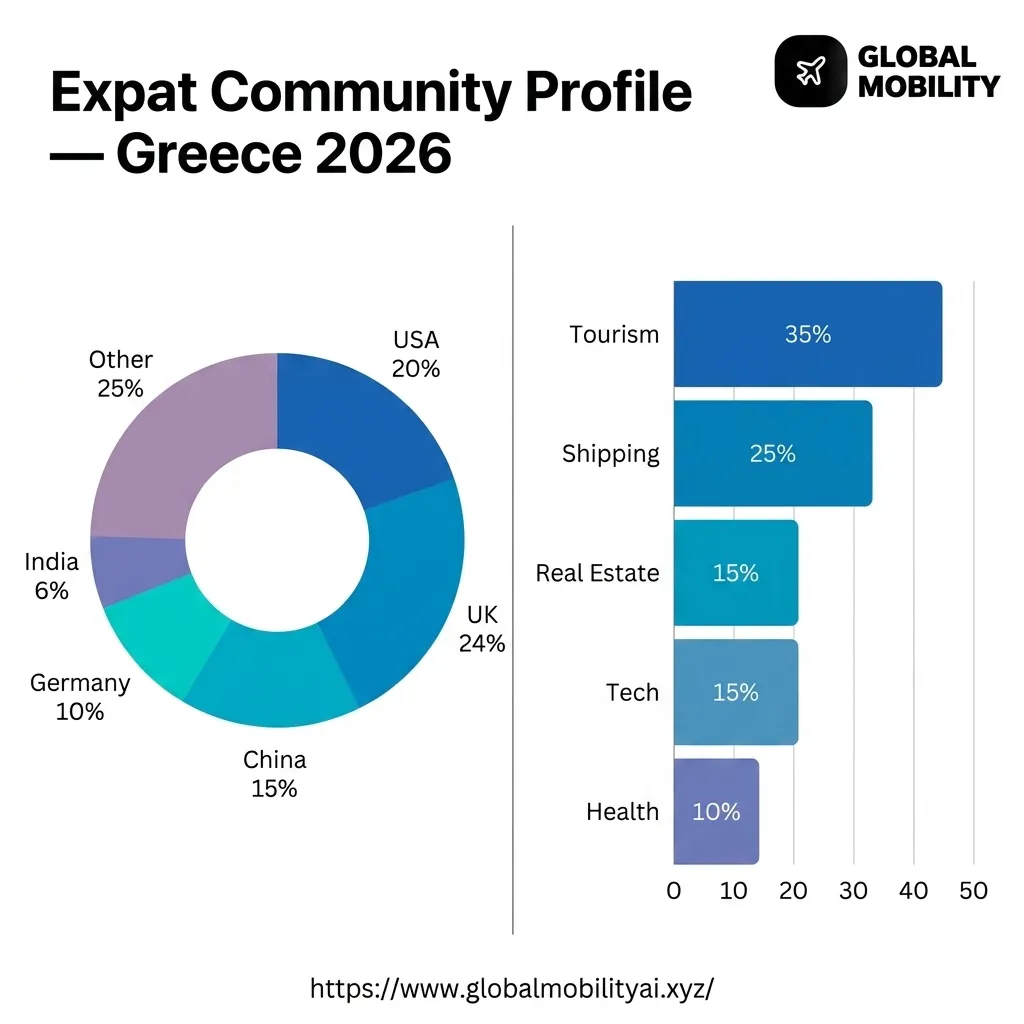
DEMO-INFOGRAPHIC-01: Expat Community Profile
2. Deep-Dive Analysis: Legal & Financial Framework
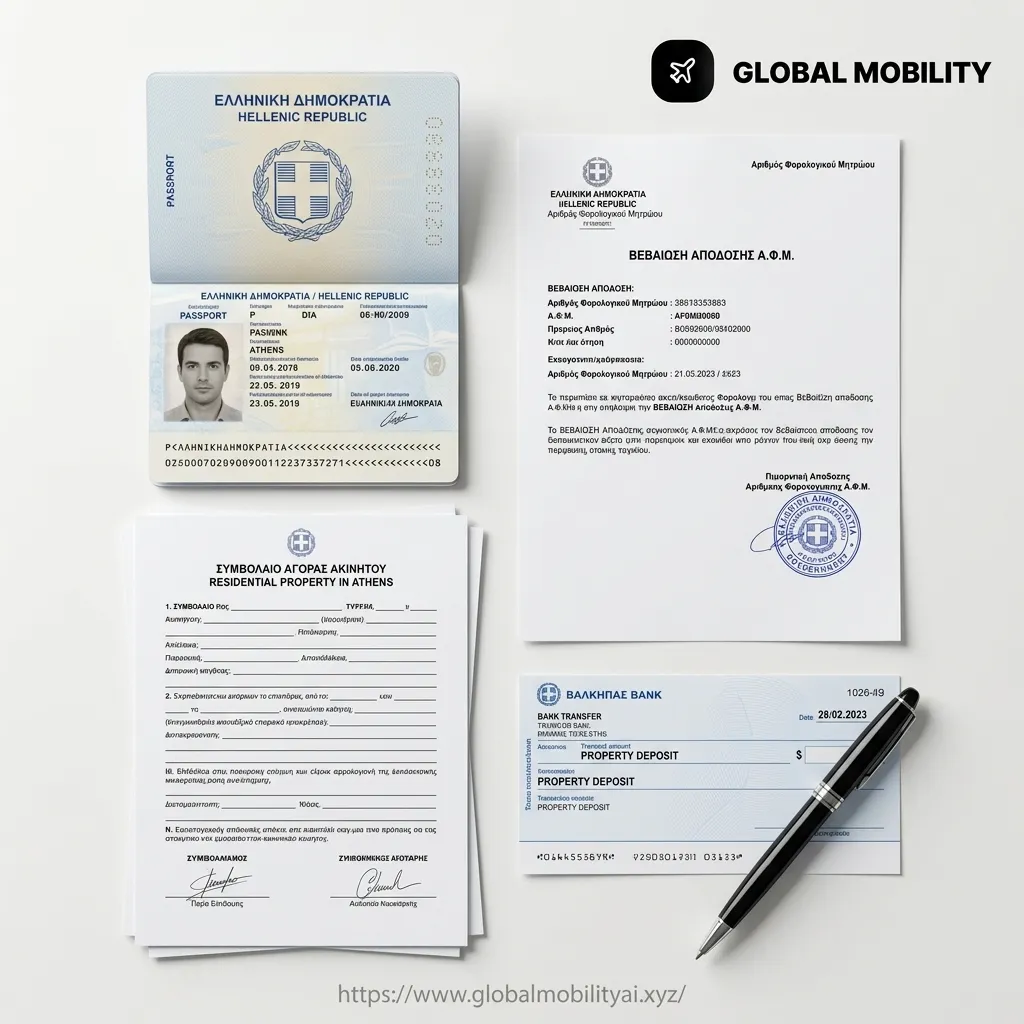
IMG-03: Visa documents checklist
2.1 Legal Requirements & Visa Categories
The legal framework undergirding the Greece Golden Visa 2026 was radically transformed by Law 5100/2024 and further amended by Law 5275/2026. The objective of these changes is to reduce the upward pressure on housing prices in tourist hubs while channeling capital to restoration projects and commercial conversions.
Under the active 2026 statutes, the program operates on a three-tiered real estate investment system:
(Source: Ministry of Migration and Asylum, 2026) [https://migration.gov.gr/en/]
2.2 Eligibility Criteria & Qualification Scoring
To qualify for the Greece Golden Visa 2026 program, applicants must be non-EU nationals and at least 18 years of age. The investment capital must originate from funds held outside of Greece, and the transfer must be executed electronically from a bank account in the primary applicant's name directly to a Greek bank account.
Importantly, the property cannot be used for short-term holiday rentals (e.g., Airbnb, Booking.com) under any circumstances. Violating this rule will result in the immediate cancellation of the residence permit and a structural fine of €50,000. Long-term residential leasing, however, is fully permitted. There is no points-based qualification matrix; approval is granted on a strict compliance basis against the statutory asset qualifications and background check parameters.
2.3 Required Documentation & Official Checklists
To initiate the application, the investor's legal counsel must compile and submit a comprehensive dossier. All home-country documents must be officially translated into Greek by a certified translator and legalized via the Apostille Convention or a local Greek consulate. The official checklist includes:
3. City Guide — Where to Live in Greece in 2026
3.1 Top 5 Cities for Expats: Rankings & Analysis
While the program does not require active physical residence, many investors utilize their cards to live in Greece part-time or full-time. The top expat hubs are ranked below:
3.2 City Comparison Table
| City | Avg Rent 1BR (Monthly) | Monthly Cost | Job Market | Safety | Expat Rating |
|---|---|---|---|---|---|
| Athens | €750 ($815 USD) | €1,800 ($1,960 USD) | Excellent | High (Safety Index: 68.4) | 4.7/5.0 |
| Thessaloniki | €580 ($630 USD) | €1,500 ($1,630 USD) | Good | High (Safety Index: 71.2) | 4.5/5.0 |
| Chania | €480 ($520 USD) | €1,300 ($1,415 USD) | Moderate | High (Safety Index: 82.1) | 4.6/5.0 |
| Rhodes | €450 ($490 USD) | €1,250 ($1,360 USD) | Moderate | High (Safety Index: 80.5) | 4.4/5.0 |
| Patras | €380 ($415 USD) | €1,100 ($1,200 USD) | Good | High (Safety Index: 75.3) | 4.2/5.0 |
(Source: Numbeo Cost of Living Index, 2026) [https://www.numbeo.com/cost-of-living/in/Athens]
4. Cost of Living — Complete 2026 Breakdown
4.1 Monthly Budget Calculator Breakdown
The general cost of living in Greece remains highly competitive compared to Northern Europe and North America, though urban centers have experienced inflationary increases. For a professional maintaining a comfortable, middle-tier lifestyle in a city like Thessaloniki, the itemized monthly expenses are broken down below:
Total estimated monthly burn: €1,500 ($1,630 USD). (Source: Numbeo Cost of Living Survey, 2026) [https://www.numbeo.com/cost-of-living/country/Greece]
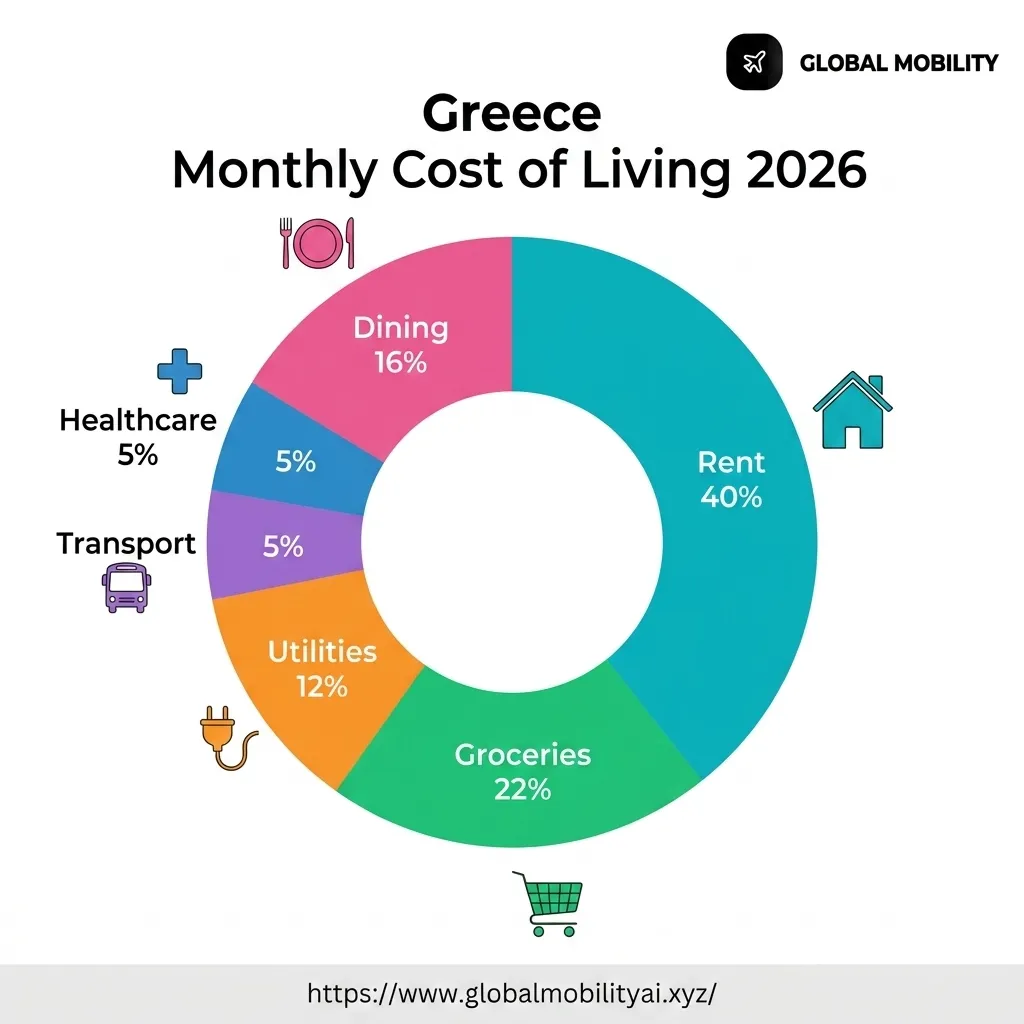
IMG-05: Cost of living infographic
4.2 Cost of Living vs. Salary: What You'll Actually Save
The capital commitment for the Greece Golden Visa 2026 must be evaluated alongside your long-term wealth building strategy. While local Greek salaries are generally lower than in Northern Europe, investors who relocate and manage international businesses or work remotely can maximize their take-home savings.
To model your specific relocation budget and evaluate your net take-home savings after local taxes, utilizing the monthly savings calculator abroad helps establish precise financial projections.
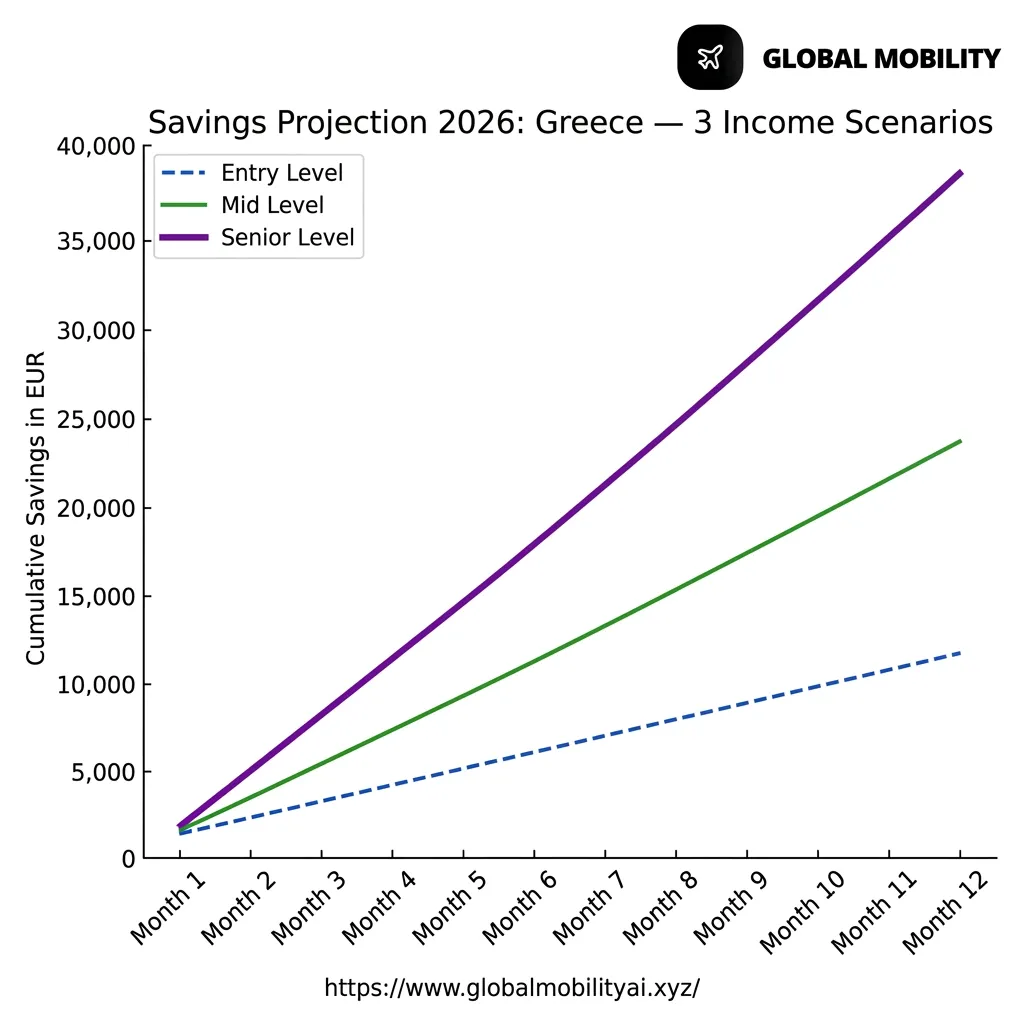
CHART-2: Salary vs. Savings line chart
4.3 Cost of Living Index vs. Home Countries
The table below contrasts the cost of living indices of Greece against common expat home countries, illustrating the comparative purchasing power:
| Category (Base: Greece = 100) | Greece | Pakistan (Karachi) | India (Mumbai) | UK (London) |
|---|---|---|---|---|
| Rent Index | 100.0 | 22.1 | 48.3 | 240.2 |
| Groceries Index | 100.0 | 48.5 | 55.4 | 138.5 |
| Restaurant Price Index | 100.0 | 38.2 | 44.1 | 185.3 |
| Local Purchasing Power | 100.0 | 45.3 | 82.5 | 195.4 |
(Source: Numbeo Comparative Database, 2026) [https://www.numbeo.com/cost-of-living/compare_countries.jsp]
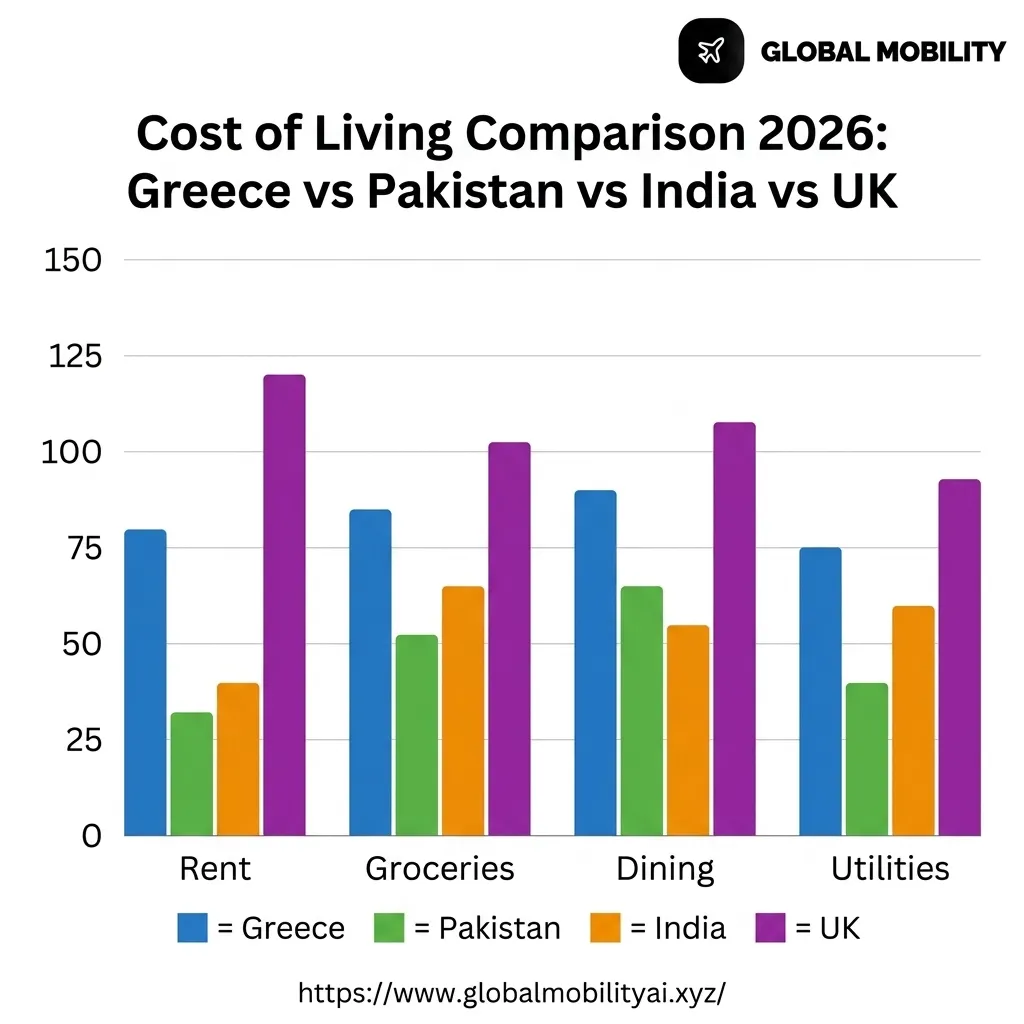
CHART-1: Cost of Living comparison bar chart
5. Salary Data & Job Market Intelligence
5.1 Average Salaries by Industry (2026 Data)
The Greek job market has experienced structural improvements, driven by the tech sector and international services. The table below represents current gross salaries for full-time corporate roles:
| Industry | Entry Level (Annual) | Mid-Level (Annual) | Senior Level (Annual) | Currency |
|---|---|---|---|---|
| Software Engineering | €22,000 | €38,000 | €65,000 | EUR |
| Finance & Accounting | €18,000 | €32,000 | €55,000 | EUR |
| Digital Marketing | €15,000 | €26,000 | €45,000 | EUR |
| Healthcare (Specialists) | €28,000 | €48,000 | €85,000 | EUR |
| Maritime & Shipping | €24,000 | €42,000 | €75,000 | EUR |
(Source: DYPA Labor Statistics, 2026) [https://www.dypa.gov.gr/]
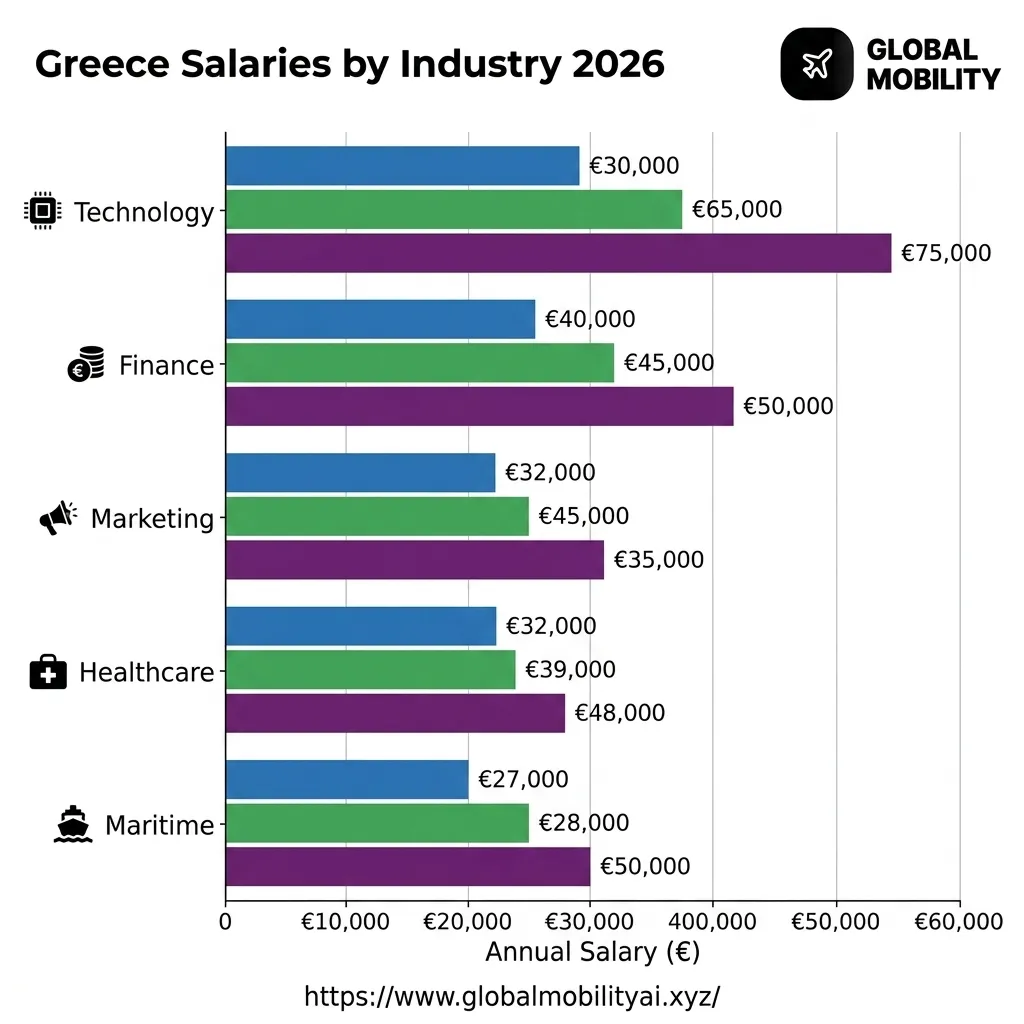
IMG-06: Salary comparison by industry
5.2 In-Demand Skills & Sectors in 2026
The focus on digital transformation has created talent shortages in software development, cybersecurity, and data analytics. Additionally, the prominent maritime sector continues to recruit specialized shipping managers, dry-dock engineers, and logistics coordinators.
The expanding green energy transition has also increased hiring in wind and solar engineering sectors. These trends are monitored closely by the Ministry of Labor and the competent statistical bodies. (Source: Ergani Information System, 2026) [https://ypergasia.gov.gr/]
5.3 How to Use GlobalMobilityAI Salary Comparison Tool
The platform's salary comparison tool allows candidates to cross-reference their current global earnings against Greek salary benchmarks. By entering your specific job title and years of experience, the tool calculates the net take-home salary, accounting for local income taxes and EFKA social security contributions, ensuring you can negotiate local corporate agreements effectively.
6. CV Formatting — Greece-Style Resume Guide
6.1 Greece CV Format Requirements
Navigating the Greek corporate hiring market requires adhering to specific local presentation standards:
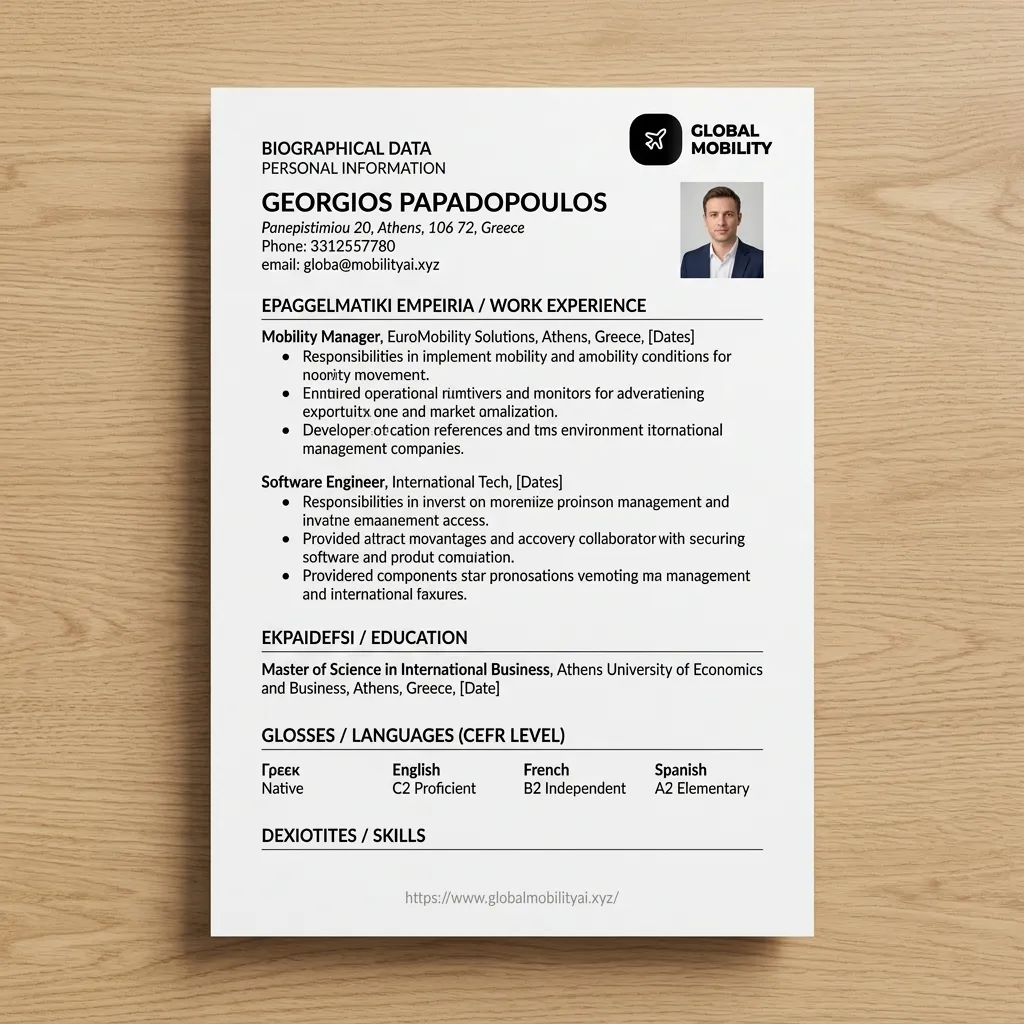
IMG-07: CV/Resume format example
6.2 Common CV Mistakes That Get Applications Rejected
To improve your callback rates, avoid these regional formatting errors:
6.3 ATS Optimization for Greece Job Portals
The primary job portals in Greece are Kariera.gr, Skywalker.gr, and LinkedIn. Large corporations and international shipping firms use Applicant Tracking Systems (ATS) to filter initial applicants.
To optimize your CV, incorporate specific technical keywords directly from the job description (e.g., "P&L management," "Agile methodologies," "logistics coordination"). Avoid using tables, graphics, or complex columns, which can cause parsing errors in the software.
7. Interview Tips for the Greece Job Market

IMG-08: Interview culture visual
7.1 Cultural Interview Norms & Expectations
Greek business culture is characterized by formal politeness and hierarchical respect, but personal relationships are highly valued. Interviews often begin with informal conversation about family, travel, or the local community to establish a personal connection before transitioning to technical evaluations. Address your interviewers formally as Kyrie or Kyria followed by their surname, unless explicitly invited to use first names.
7.2 Common Interview Questions & Answer Frameworks
Prepare for these typical local interview questions using structured frameworks:
7.3 Dress Code, Punctuality & Professional Etiquette
The dress code for interviews in Greece is professional and formal. Men should wear a classic dark suit, and women should wear conservative business attire. Punctuality is essential; arrive approximately 10 minutes early. A firm handshake is the standard greeting, but wait for the interviewer to extend their hand first.
7.4 Post-Interview Follow-Up Etiquette
Send a brief, polite follow-up email within 48 hours of the interview, thanking the panel for their time and reiterating your interest in the position. Recruitment cycles can be slow, so allow two weeks before sending a secondary status inquiry.
8. Greece Golden Visa 2026 Policy Updates & Market Predictions
8.1 Key Policy Changes Effective 2026
The Greek Ministry of Migration and Asylum has fully implemented the regulatory updates for the Greece Golden Visa 2026 cycle. The tiered system (€800k / €400k / €250k) is strictly monitored, and Law 5275/2026 has introduced rigorous audits to prevent short-term holiday rentals (e.g. Airbnb/Booking.com). The new law also clarifies that the five-year residence permit validity now begins from the date of issuance of the residence card, rather than being backdated to the date of the investment completion, which protects the investor's legal timeline. (Source: Ministry of Migration and Asylum Circulars, 2026) [https://migration.gov.gr/en/]

IMG-09: 2026 policy update
8.2 Immigration Trend Predictions (Data-Backed)
Official projections indicate that real estate investments will shift toward the €250,000 conversion and restoration route in 2026, accounting for over 50% of all applications. This is due to the rising costs in Attica and Thessaloniki, where properties now require a €800,000 threshold.
The Ministry of Migration is also projected to clear the remaining application backlogs by the end of 2026, reducing processing times down to a standard 6–9 months.
8.3 How These Changes Affect Your Application in 2026
With the Ministry of Migration employing automated verification tools, the scrutiny of document compliance has increased. Any discrepancy in financial records or source of funds will result in immediate rejection. Utilizing the platform's immigration probability score tool helps ensure that your profile meets current evaluation standards before you commit capital to a Greek property.
9. Tactical Comparison Matrix
The tactical comparison matrix below contrasts the Greece Golden Visa 2026 real estate routes against other popular residency pathways:
| Option | Min. Capital | Stay Requirement | Path to Citizenship | Processing Time | Est. Approval Rate* |
|---|---|---|---|---|---|
| GV Tier 1 (Attica/Islands) | €800,000 | 7 Days / Year | 7 Years | 6-9 Months | Platform Est.* |
| GV Tier 2 (Rest of Greece) | €400,000 | 7 Days / Year | 7 Years | 6-9 Months | Platform Est.* |
| GV Tier 3 (Conversion) | €250,000 | 7 Days / Year | 7 Years | 6-9 Months | Platform Est.* |
| FIP (Financially Ind.) | €2,000 / Month | 183 Days / Year | 7 Years | 2-3 Months | Platform Est.* |
| Digital Nomad Visa | €3,500 / Month | 183 Days / Year | 7 Years | 2-3 Months | Platform Est.* |
\Internal platform estimate. Official approval rates are not publicly published by the Ministry of Migration. Monitor the official portal for policy updates: (Source: Ministry of Migration and Asylum, 2026) [https://migration.gov.gr/en/]*
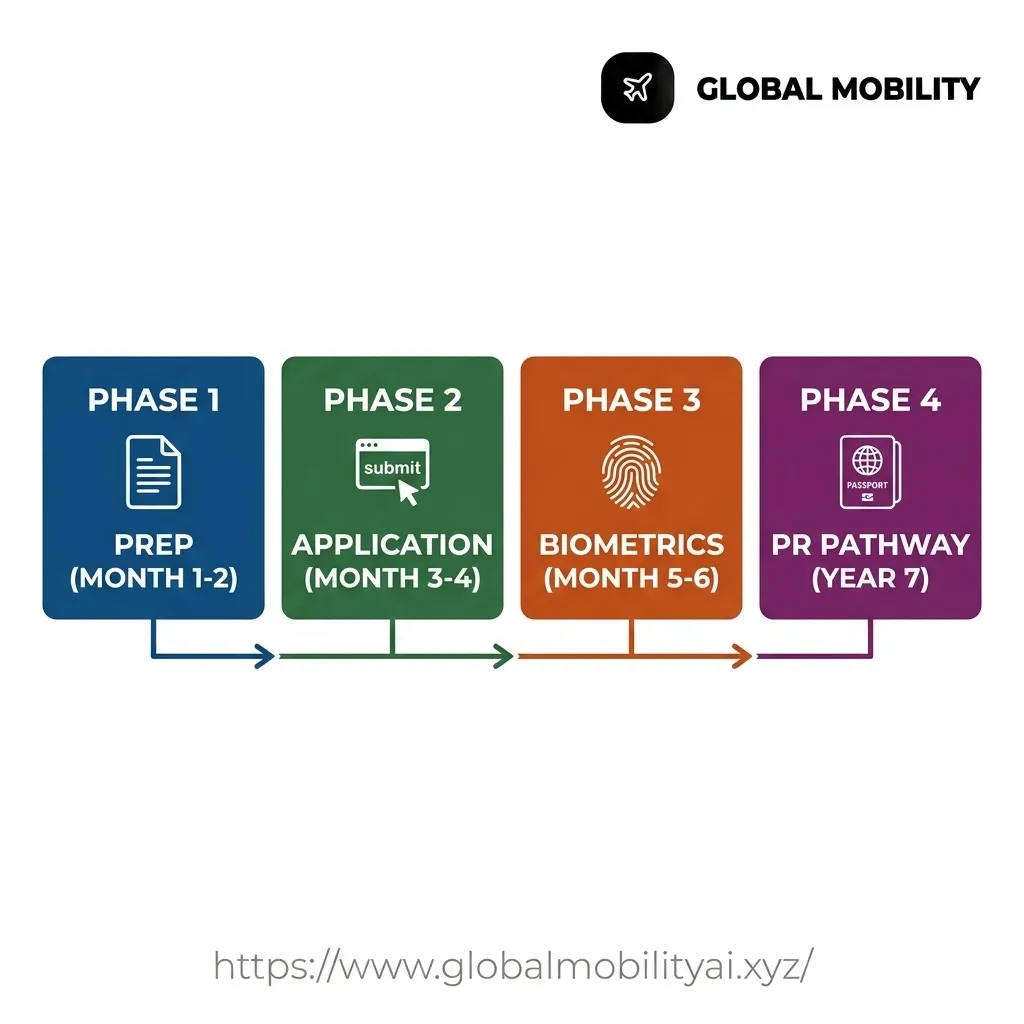
10. Execution Roadmap: Phase-by-Phase
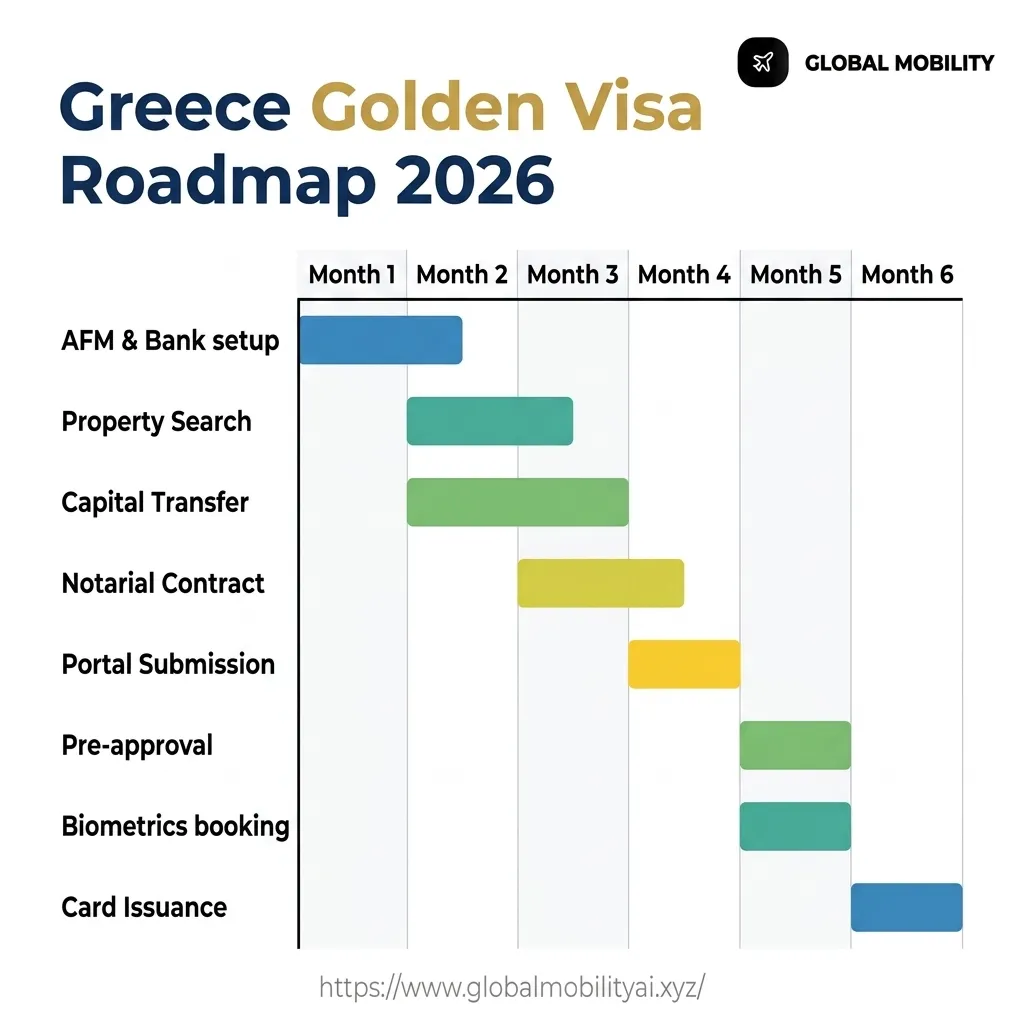
CHART-3: Visa processing timeline Gantt chart
Phase 1 — Preparation (Months 1–2):
The initial phase focuses on legal onboarding and property search. You must secure a Greek AFM tax number, open a local bank account, and select a property that complies with the appropriate threshold tier.
Cost: €500 (AFM & Representation) | Link: [https://www.statistics.gr/en/home] | Timeline: 6 weeks
Phase 2 — Application (Months 3–4):
Transfer the investment amount to your Greek bank account and complete the property purchase contract. Once the title deed is officially registered at the Land Registry, your legal team submits the electronic application to the Ministry of Migration.
Cost: €250,000+ (Investment) + €2,000 (Government Fee) | Link: [https://migration.gov.gr/en/] | Timeline: 8 weeks
Phase 3 — Arrival & Administration (Month 5–6):
Upon receiving pre-approval, you travel to Greece to attend your biometrics appointment at the competent immigration office. The physical residence permit cards are issued and delivered to your legal representative.
Cost: €150 (Card Issuance Fee) | Link: [https://migration.gov.gr/en/] | Timeline: 12 weeks
Phase 4 — Settlement & PR Transition (Year 1–7):
Maintain your property investment and renew your residency card every five years. In year seven, you can apply for Greek citizenship, provided you meet the physical stay, language, and integration requirements.
Cost: €200 (Renewal Fee) | Link: [https://migration.gov.gr/en/] | Timeline: 7 years
IMG-10: Execution roadmap timeline
11. Critical Risk Factors & Common Pitfalls
IMG-11: Risk factors warning visual
12. FAQ — People Also Ask
Q: What is the minimum investment for the Greece Golden Visa 2026?
The minimum investment requirement for the real estate route in 2026 is tiered based on location. The threshold is set at €800,000 for high-demand areas, including Attica, Thessaloniki, Mykonos, Santorini, and islands with more than 3,100 inhabitants. For other regions of Greece, the threshold is set at €400,000, which must be in a single property of at least 120 square meters. A €250,000 threshold remains available nationwide strictly for commercial-to-residential conversions and listed heritage restorations. To determine if this investment pathway aligns with your long-term wealth goals, utilizing the monthly savings calculator abroad helps map out your comparative financial trajectory.
Q: Are short-term rentals permitted under the Greece Golden Visa?
No, short-term rentals are strictly banned for properties acquired under the Golden Visa program in 2026. Properties cannot be leased on platforms such as Airbnb or Booking.com. Violating this regulation results in the immediate revocation of your residence permit and a statutory administrative fine of €50,000. Long-term residential leasing, however, remains fully permitted and is a common strategy for investors seeking to generate steady rental yields in the Greek market. (Source: Ministry of Migration and Asylum Circulars, 2026) [https://migration.gov.gr/en/]
Q: Can I switch from D8 to D7?
Yes, transitioning from a D8 Digital Nomad Visa to a D7 Passive Income Visa is legally possible, provided you meet the D7 criteria. The D7 requires a stable source of passive income, such as pensions, rental yields, or dividends, amounting to at least the national minimum wage. D8 nomads who transition to passive investment strategies often evaluate this option. However, before changing your residency stream, checking your potential approval odds using the visa success rate calculator ensures your financial records comply with AIMA's current guidelines.
Q: What is the physical stay requirement for the Greece Golden Visa?
The program features a highly flexible residency requirement, requiring zero days of physical stay per year in Greece. Cardholders are not required to reside in the country to maintain or renew their residency cards every five years. This stay requirement is significantly lower than that of standard residency permits, making the program ideal for global business owners who wish to obtain European residency and Schengen access without shifting their primary tax residency or daily operations to Greece. (Source: Ministry of Migration Regulations, 2026) [https://migration.gov.gr/en/]
Q: How long does it take to get citizenship in Greece?
Under Greek nationality law, Golden Visa holders are eligible to apply for citizenship after seven years of actual physical residency in the country. During this period, you must reside in Greece for at least 183 days per year, pay local taxes, and pass the official citizenship exams, which demonstrate conversational proficiency in the Greek language and a basic understanding of Greek history and culture. The five-year clock for permanent residency does not automatically lead to citizenship without physical residency. (Source: Ministry of Interior, 2026) [https://migration.gov.gr/en/]
Q: Can my family be included in the Greece Golden Visa?
Yes, the primary applicant can include family members under the family reunification program. Eligible dependents include your legal spouse, minor children under the age of 18, and dependent children under the age of 21 (which can be extended to 24 if enrolled in full-time education). Additionally, the dependent parents of both the primary applicant and their spouse can be included under the three-generation rule. All family members receive the same residency rights, including visa-free travel within the Schengen Area and access to local public healthcare and education. (Source: Ministry of Migration Portal, 2026) [https://migration.gov.gr/en/]
Q: Is the NHR tax break still available in Greece?
Greece offers a specialized tax regime for retirees and high-net-worth individuals who transfer their tax residency to the country. Under the Greek alternative tax system (non-dom), retirees pay a flat tax rate of 7% on their foreign-sourced income for a period of 15 years. For investors who choose the Golden Visa and establish actual tax residency, this regime provides substantial tax optimization opportunities. It is recommended to work with a certified Greek tax advisor to structure your assets and ensure compliance with the local tax requirements. (Source: Ministry of Finance, 2026) [https://www.statistics.gr/en/home]
Q: What are the government fees for the Greek Golden Visa in 2026?
The government fee structure for the Greece Golden Visa is substantial and must be factored into your budget. The initial application fee is €2,000 for the primary applicant, while dependents are subject to a fee of €150 per person. Upon pre-approval, the fee for the issuance of the residence card is €150. For each subsequent renewal (which occurs every five years), the renewal fee is €200 per applicant. These fees apply in addition to standard notary fees, land registry registry fees (around 1.5% of property value), and legal retainers. (Source: Ministry of Migration Fee Schedule, 2026) [https://migration.gov.gr/en/]
13. Conclusion: The Bottom Line
For high-net-worth individuals planning their long-term European strategy, the Greece Golden Visa 2026 represents an exceptional wealth-preservation and global mobility asset. Although the geographic thresholds have increased in major urban areas, the introduction of the €250,000 conversion and restoration routes offers an affordable and highly regulated alternative for investors looking to secure EU residency.
By structuring your property purchase correctly and partnering with experienced legal counsel, you can secure Schengen travel privileges, protect your capital, and establish a clear pathway to permanent residency. It remains a highly competitive option when compared to other regional paths, such as the Portugal D7 vs D8 Visa 2026 Guide or the UAE Golden Visa 2026 blueprint. Ensure your relocation decisions are backed by data.
IMG-12: CTA / Conclusion visual
Access the Full Platform at https://www.globalmobilityai.xyz/
Predict your mobility score.
Use our AI engine to get your personalized visa pathway, salary prediction, and relocation roadmap.
More Insights

Germany Opportunity Card 2026: Points, How to Apply & Fastest Jobs

The Ultimate Golden Visa Masterclass 2026: The Strategic Wealth & Mobility Blueprint