Editorial Transparency: Content compiled from official
government sources by the GlobalMobilityAI Research Team.
For personalized legal or immigration advice, consult a
licensed immigration consultant or lawyer.
(Last Updated: 2026-05-23)
According to official economic forecasts published in the Q1 2026 bulletin of the Central Bank of Ireland, the nation's domestic economy remains remarkably resilient, with Modified Domestic Demand (MDD) projected to grow by 2.7% in 2026 despite global export volatility. (Source: Central Bank of Ireland, 2026) [https://www.centralbank.ie/] For highly skilled international professionals seeking a gateway to Europe, the Ireland Critical Skills Employment Permit 2026 represents the premier pathway to long-term residency, offering immediate family reunification rights, exemption from the labor market needs test, and a direct fast-track route to a Stamp 4 residency permit. Data from the GlobalMobilityAI.xyz platform suggests that keeping pace with the updated salary thresholds implemented by the Department of Enterprise, Trade and Employment (DETE) is the single most critical factor for application approval. By understanding the updated €40,904 and €68,911 remuneration bands, the standardized Standard Occupational Classification (SOC) codes, and the streamlined online application workflow, prospective migrants can execute their relocation strategy with complete regulatory confidence. This comprehensive guide outlines every stage of the process to secure your professional future in one of Europe's most dynamic economic and tech hubs.
Table of Contents
1. Why Ireland in 2026? — The Strategic Case
1.1 Economic Landscape & Opportunity
The Republic of Ireland occupies a unique position in the global economic landscape of 2026. According to the Central Bank of Ireland’s Q1 2026 Quarterly Bulletin, the headline GDP growth is projected to grow by a modest 0.9%, which reflects a normalization of the pharmaceutical and semiconductor export sectors after the historic highs of 2025. (Source: Central Bank of Ireland, 2026) [https://www.centralbank.ie/] However, economists place greater emphasis on Modified Domestic Demand (MDD), which measures the underlying domestic economy by excluding volatile multinational trade elements. Ireland’s MDD is projected to expand by a stable 2.7% in 2026, indicating strong consumer spending, high employment rates, and robust domestic capital investments. This economic stability is anchored by Ireland's status as the sole English-speaking member of the European Union with a highly integrated corporate framework. The country remains the European headquarters for over 1,000 multinational corporations, including Google, Apple, Meta, Intel, and Pfizer. The corporate tax structure has fully integrated the OECD Pillar Two minimum rate of 15% for large multinational entities, preserving fiscal stability while ensuring that personal tax credits and standard bands remain competitive for high-earning individuals. (Source: Revenue Commissioners Ireland, 2026) [https://www.revenue.ie/]
1.2 Why Professionals Are Targeting the Ireland Critical Skills Employment Permit 2026
For international professionals seeking global mobility, Ireland represents an exceptional career and lifestyle destination. Platform search trends suggest that interest in European relocation pathways has concentrated on destinations offering fast-tracked routes to permanent status without complex points-based criteria. Unlike points-based systems such as the one described in our Germany Opportunity Card 2026 guide, Ireland’s employer-led system offers absolute clarity: landing a qualifying job contract translates directly into a visa outcome. Expatriates are drawn to Ireland's high human development index, top-tier safety rankings, and an educational system that consistently ranks among the best in Europe. Furthermore, the Critical Skills route enables immediate family sponsorship, allowing spouses to access the labor market without requiring a separate employment permit. This makes Ireland a highly competitive option for families evaluating long-term relocation corridors.
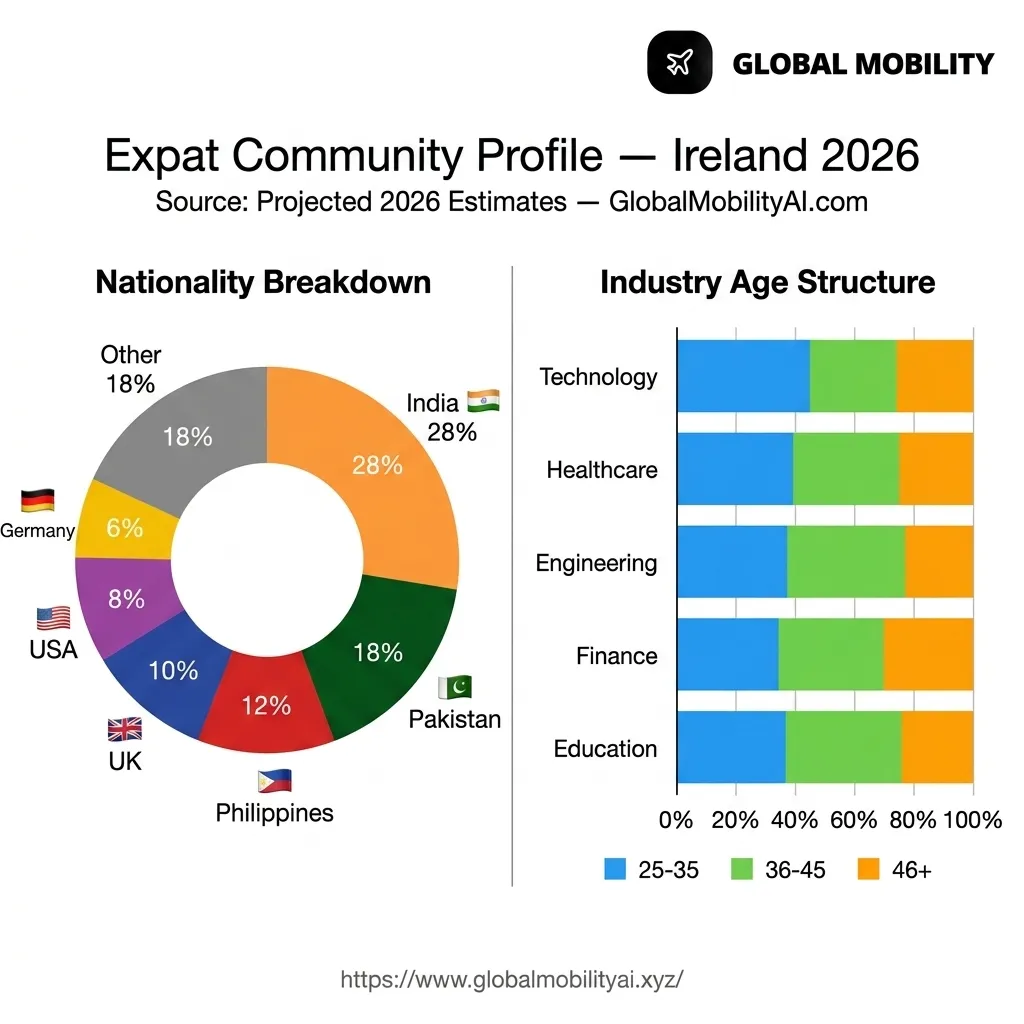
IMG-06: Expat Community Profile
2. Deep-Dive Analysis: Legal & Financial Framework
2.1 Legal Requirements & Visa Categories
The employment permit regime in Ireland is managed by the Department of Enterprise, Trade and Employment (DETE). The central pillar of this framework is the Ireland Critical Skills Employment Permit 2026, which targets highly skilled occupations experiencing persistent labor shortages. (Source: Department of Enterprise, Trade and Employment, 2026) [https://enterprise.gov.ie/] To qualify, an applicant must have a job offer that meets one of two distinct categories:
It is crucial to note that the remuneration calculations exclude bonuses, shift premiums, overtime, and cost-of-living allowances. Only the basic salary specified in the employment contract counts toward the threshold.
2.2 Eligibility Criteria & Qualification Scoring
Unlike Canada's Express Entry or Australia's subclass 189 points pools, Ireland does not use a competitive points grid. Eligibility is binary. If the candidate matches the following three criteria, the visa is systematically approved:
The official application portal is the Employment Permits Online System (EPOS) operated directly by DETE. (Source: DETE EPOS Portal, 2026) [https://epos.enterprise.gov.ie/]
2.3 Required Documentation & Official Checklists
To initiate the online application, the applicant or the employer must compile a detailed digital document package. The official DETE guidelines mandate the following documents:
The official document checklist and submission guidelines are maintained on the DETE portal. (Source: DETE Document Checklists, 2026) [https://enterprise.gov.ie/en/what-we-do/workplace-and-skills/employment-permits/permit-types/critical-skills-employment-permit/]
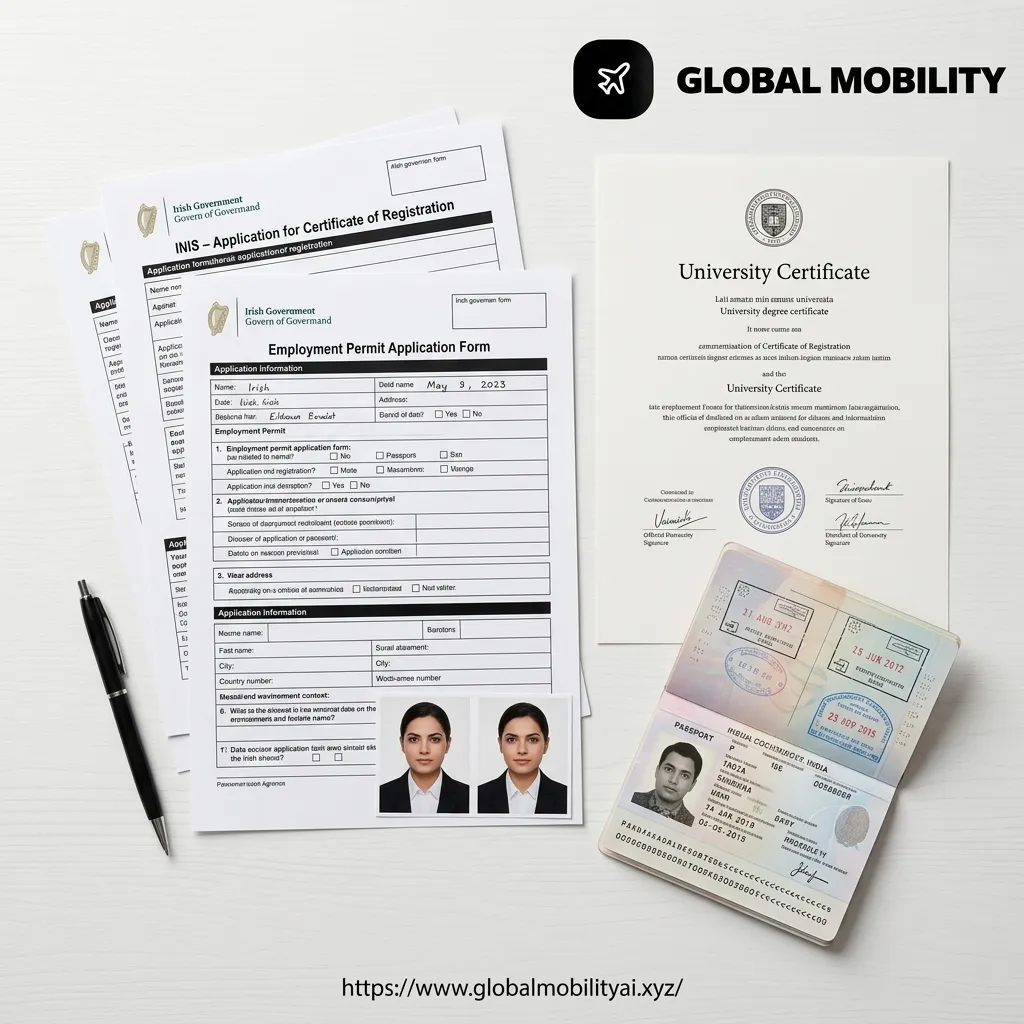
IMG-08: Degree Attestation Process
3. City Guide — Where to Live in Ireland in 2026
3.1 Top 5 Cities for Expats: Rankings & Analysis
Expatriates relocating to Ireland under the employment permit framework typically concentrate in five urban centers, each offering distinct industrial alignments and lifestyles:
3.2 City Comparison Table
The table below compares the key liveability metrics for a single professional in Ireland in 2026:
| City | Avg Rent 1BR (City Centre) | Monthly Cost (Excl. Rent) | Primary Job Sectors | Safety Index | Expat Rating |
|---|---|---|---|---|---|
| Dublin | €2,520 | €1,050 | Tech, Finance, Legal | Moderate | 4.5 / 5.0 |
| Cork | €2,250 | €980 | Bio-Pharma, MedTech | High | 4.3 / 5.0 |
| Galway | €2,210 | €960 | Medical Devices, Tourism | High | 4.2 / 5.0 |
| Limerick | €1,375 | €880 | ICT, Engineering | Moderate | 4.0 / 5.0 |
| Waterford | €1,250 | €820 | Tech, Advanced Mfg | High | 3.8 / 5.0 |
(Source: Numbeo Ireland Cost of Living Database, 2026) [https://www.numbeo.com/cost-of-living/]

IMG-07: Dublin City Living
4. Cost of Living — Complete 2026 Breakdown
4.1 Monthly Budget Calculator Breakdown
Living in Ireland requires careful financial planning, particularly given the high cost of accommodation. For a single professional maintaining a comfortable, private lifestyle in a central apartment, the monthly budget breakdown is structured as follows:
(Source: Numbeo Cost of Living Survey, 2026) [https://www.numbeo.com/cost-of-living/]
4.2 Cost of Living vs. Salary: What You'll Actually Save
Calculating your net monthly savings under the Ireland Critical Skills Employment Permit 2026 requires factoring in Ireland's progressive taxation system. PAYE income is subject to Income Tax (20% standard band up to €44,000, 40% on the balance), Universal Social Charge (USC) ranging from 0.5% to 8%, and PRSI (social insurance) at 4.2% (rising to 4.35% in October 2026). (Source: Revenue Commissioners, 2026) [https://www.revenue.ie/]
We analyze three distinct annual salary scenarios for a single tax-resident employee in 2026:
To generate personalized wealth-building projections based on your exact family size, location, and lifestyle choices, candidates can utilize the GlobalMobilityAI monthly savings calculator to analyze real take-home savings potential before signing an employment offer.
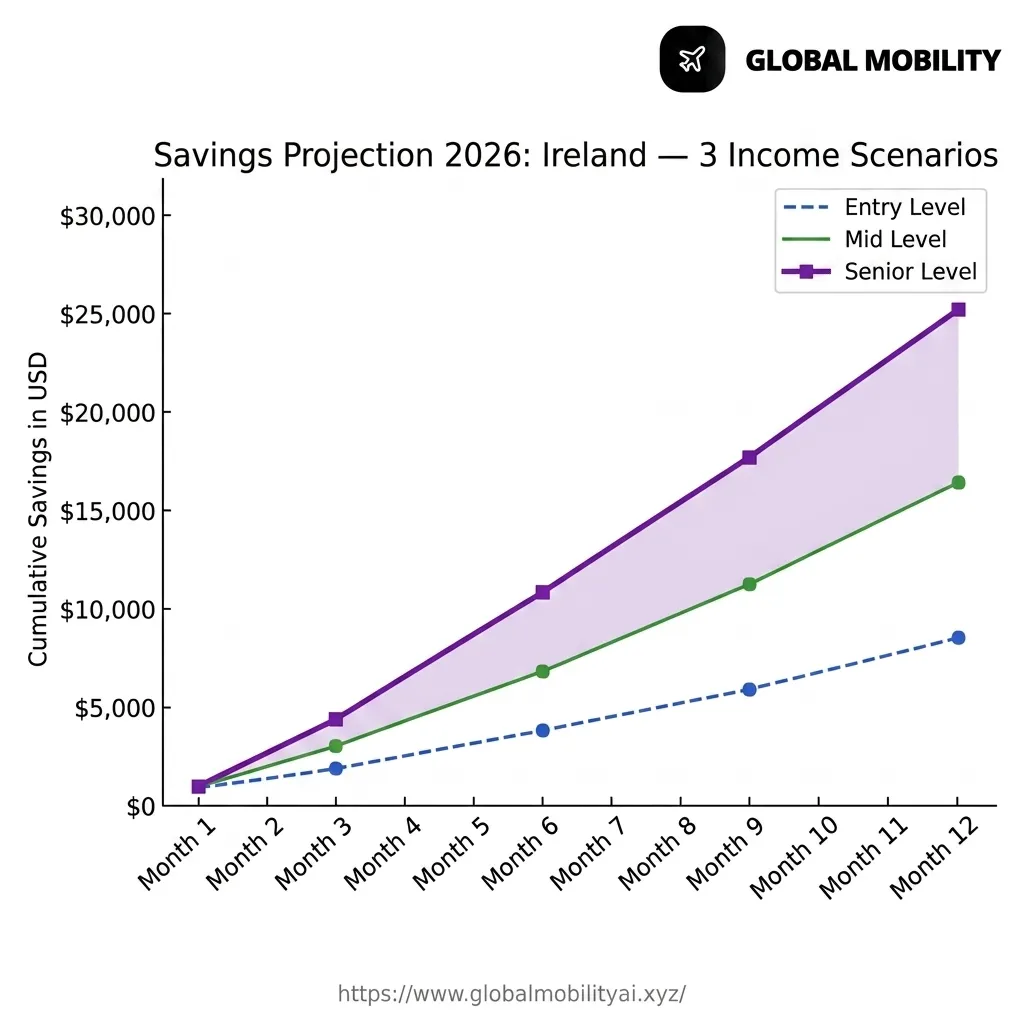
IMG-04: Salary vs. Savings Trajectory
4.3 Cost of Living Index vs. Home Countries
The table below benchmarks Ireland's cost of living index against major expat-sending countries and regional hubs:
| Category | Ireland (Dublin) | Pakistan (Karachi) | India (Mumbai) | United Kingdom (London) |
|---|---|---|---|---|
| Cost of Living Index | 74.7 | 19.8 | 25.6 | 78.4 |
| Rent Index | 65.4 | 4.8 | 15.2 | 70.8 |
| Local Purchasing Power | 84.5 | 16.5 | 39.8 | 86.2 |
(Source: Numbeo Comparative Cost Database, 2026) [https://www.numbeo.com/cost-of-living/compare_countries.jsp]
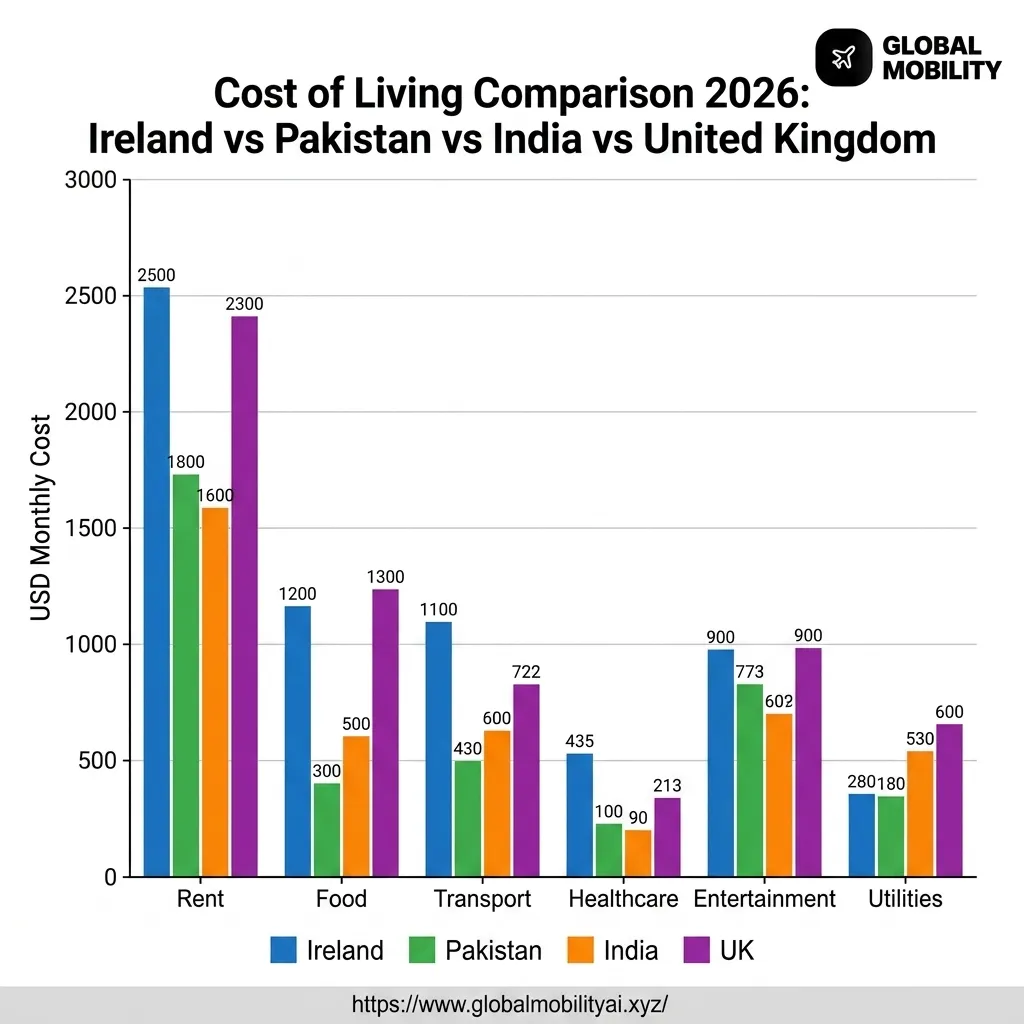
IMG-03: Cost of Living Comparison
5. Salary Data & Job Market Intelligence
5.1 Average Salaries by Industry (2026 Data)
To qualify for the Ireland Critical Skills Employment Permit 2026, candidates must land a contract that satisfies the statutory salary floors. The table below represents the average annual salaries across primary growth sectors in Ireland for the 2026 recruiting cycle:
| Industry Sector | Entry Level (0-2 Yrs) | Mid-Level (3-6 Yrs) | Senior (7+ Yrs) | Currency |
|---|---|---|---|---|
| IT & Software Development | €45,000 | €65,000 | €95,000 | EUR / year |
| Investment Banking & Finance | €48,000 | €75,000 | €110,000 | EUR / year |
| Corporate Law & Compliance | €50,000 | €80,000 | €120,000 | EUR / year |
| Medical & Specialist Healthcare | €60,000 | €110,000 | €180,000 | EUR / year |
| Civil & Mechanical Engineering | €42,000 | €60,000 | €85,000 | EUR / year |
(Source: Morgan McKinley Ireland Salary Guide, 2026) [https://www.morganmckinley.com/ie/salary-guide]
5.2 In-Demand Skills & Sectors in 2026
The Irish job market in 2026 is heavily oriented toward advanced technologies and infrastructure. The Expert Group on Future Skills Needs (EGFSN) has identified persistent skills gaps in cloud computing, devops, software architecture, data engineering, and automation. In the construction and engineering sectors, there is a severe shortage of civil engineers, quantity surveyors, and project managers, driven by national housing initiatives and the expansion of data center infrastructures. The biotechnology and pharmaceutical sectors in Cork and Dublin continue to recruit globally for quality assurance specialists, regulatory affairs managers, and process engineers. These shortages are reflected directly on the DETE Critical Skills Occupations List, ensuring that qualified applicants in these fields experience high visa approval rates. (Source: DETE Skills Shortages Report, 2026) [https://enterprise.gov.ie/]
5.3 How to Use GlobalMobilityAI Salary Comparison Tool
Negotiating an employment contract that meets or exceeds the DETE salary thresholds can be complex. The GlobalMobilityAI salary comparison tool enables candidates to compare their offered Irish salary against anonymized salary database points. By filtering by sector, city, and experience level, candidates can ensure their basic salary meets the statutory requirements of €40,904 or €68,911, protecting their application from rejection due to insufficient remuneration.

IMG-06: Salaries by Industry
6. CV Formatting — Ireland-Style Resume Guide
6.1 Ireland CV Format Requirements
Irish recruiters maintain specific formatting expectations that differ significantly from Anglo-American standards:
6.2 Common CV Mistakes That Get Applications Rejected
Navigating the Irish hiring landscape requires avoiding common layout and content pitfalls:
6.3 ATS Optimization for Irish Job Portals
The primary job boards in Ireland are IrishJobs.ie, LinkedIn, and Indeed Ireland. Multinational corporations in Dublin utilize Applicant Tracking Systems (ATS) such as Workday, Taleo, and Lever. To ensure your CV passes these automated parsers, avoid using text boxes, columns, tables, headers, footers, or graphic elements that disrupt standard text scanners. Ensure your job titles align with standard industry classifications. Keyword optimization is vital; integrate the exact technical skills and certifications mentioned in the job posting (e.g., "AWS Certified Developer", "Agile Methodology", "SQL"). Always save and upload the document in a standard PDF format to preserve formatting integrity.
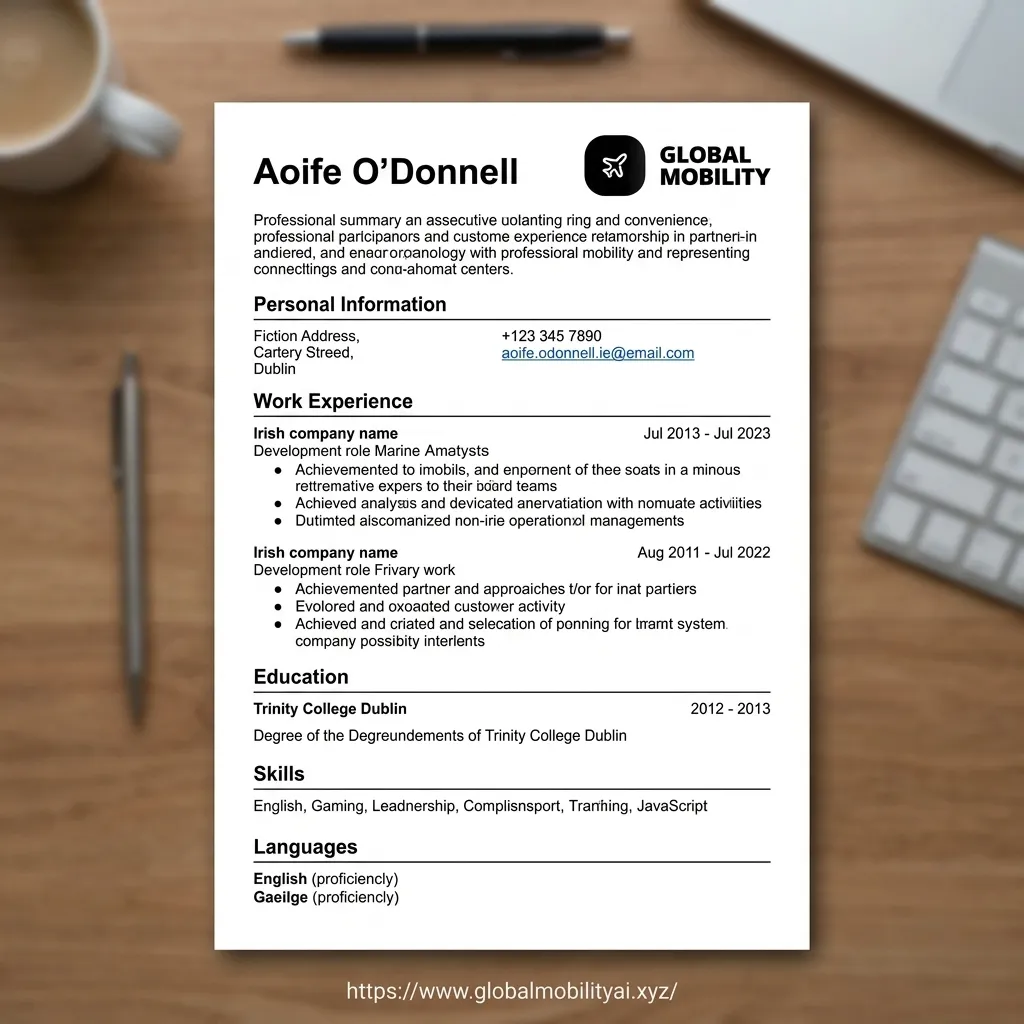
IMG-09: Ireland CV Formatting
7. Interview Tips for the Ireland Job Market
7.1 Cultural Interview Norms & Expectations
Interviews in Ireland are characterized by a balance of conversational tone and structured technical assessment. Irish workplace culture values modesty, team cohesion, and a lack of pretension. While demonstrating technical competence is vital, over-promoting oneself or appearing arrogant can be viewed negatively. Recruiters place high emphasis on cultural fit and your ability to operate effectively within highly multicultural teams, which are common in Dublin's tech sector. Expect a brief period of informal "small talk" at the beginning of the interview; this is a standard cultural mechanism used to build rapport and assess interpersonal style.
7.2 Common Interview Questions & Answer Frameworks
7.3 Dress Code, Punctuality & Professional Etiquette
The dress code for professional interviews in Ireland remains formal business attire, even for technology companies that maintain a casual dress code in the office. Men should wear a structured suit and tie, while women should wear professional business suits or formal corporate dresses. Punctuality is critical; arrive at the office or log into the virtual platform exactly 5 to 10 minutes prior to the scheduled time. When interviewing in person, a firm handshake and sustained eye contact are standard greetings.
7.4 Post-Interview Follow-Up Etiquette
Send a brief, professional thank-you email within 24 hours of the interview. Reiterate your interest in the position and express appreciation for the panel's time. Hiring timelines in Ireland can take 3 to 6 weeks due to HR approvals, reference checks, and compliance clearances. It is appropriate to send a polite follow-up inquiry if you have not received an update within two weeks.

IMG-10: Ireland Interview Etiquette
8. 2026 Policy Updates & Market Predictions
8.1 Key Policy Changes Effective 2026
The legislative amendments to the Ireland Critical Skills Employment Permit 2026 introduced new salary thresholds that took effect on March 1, 2026. The minimum annual salary floor for roles on the Critical Skills Occupations List was raised to €40,904. (Source: Department of Enterprise, Trade and Employment, 2026) [https://enterprise.gov.ie/] Additionally, DETE has fully launched the Employment Permits Online System (EPOS 2.0), which integrates real-time verification of employer tax clearance certificates and automates the 50:50 rule check. This system update has significantly reduced administrative errors and shortened processing timelines for compliant applications.
8.2 Immigration Trend Predictions (Data-Backed)
Official data suggests that Ireland is prioritizing the retention of highly skilled professionals to support its growing domestic services sector. Processing times for Critical Skills applications have stabilized, with digital approvals through EPOS 2.0 averaging 4 to 6 weeks. The government's focus remains on attracting technology, engineering, and healthcare talents, which is expected to support strong employment rates in major cities like Dublin and Cork. For comparison, candidates evaluating alternative regional pathways can review processing time metrics in our Canada Express Entry 2026 master guide to assess comparative timeline options.
8.3 How These Changes Affect Your Application in 2026
Understanding these administrative updates ensures that your transition under the Ireland Critical Skills Employment Permit 2026 is seamless. The increase in the salary floor to €40,904 means that employers must adjust their compensation packages to meet the new legal minimums. Furthermore, the strict enforcement of degree verifications means that any discrepancy in document translation or attestation will lead to immediate rejection by the EPOS portal. Candidates should utilize the GlobalMobilityAI immigration probability calculator to verify that their job offer and credentials align with DETE requirements before starting the application.
9. Tactical Comparison Matrix
The table below benchmarks the Ireland Critical Skills Employment Permit 2026 against other primary Irish employment visa pathways available to international professionals in 2026:
| Visa Type | Primary Eligibility Criteria | Min. Salary | Average Processing Time | Administrative Difficulty | Est. Approval Rate* | Government Application Fee |
|---|---|---|---|---|---|---|
| Critical Skills Permit (CSOL) | Job on CSOL + degree / experience | €40,904 | 4 – 6 Weeks | Medium | Platform Est.* | €1,000 (usually paid by employer) |
| Critical Skills (Non-CSOL) | Non-ineligible job + Bachelor's degree | €68,911 | 4 – 6 Weeks | Medium | Platform Est.* | €1,000 |
| General Employment Permit | Job not ineligible + Labour Market Test | €34,000 | 6 – 8 Weeks | High | Platform Est.* | €1,000 |
| Intra-Company Transfer (ICT) | Existing employee transfer (1+ years) | €46,000 | 4 – 6 Weeks | Low | Platform Est.* | €1,000 |
| Stamp 4 Upgrade | Completed 21 months on CSOL | N/A | 2 – 4 Weeks | Low | Platform Est.* | €300 (IRP Card Fee) |
| Working Holiday Visa | Bilateral agreements (under 30/35) | N/A | 4 – 8 Weeks | Low | Platform Est.* | €300 |
*Internal platform estimate. Official approval rates are not publicly published by DETE. Monitor the official portals for policy updates: [https://enterprise.gov.ie/]
(Source: Department of Enterprise, Trade and Employment, 2026) [https://enterprise.gov.ie/en/what-we-do/workplace-and-skills/employment-permits/]
10. Execution Roadmap: Phase-by-Phase
Embarking on the pathway to the Ireland Critical Skills Employment Permit 2026 requires a structured, phase-by-phase execution timeline from contract negotiation to long-term settlement.
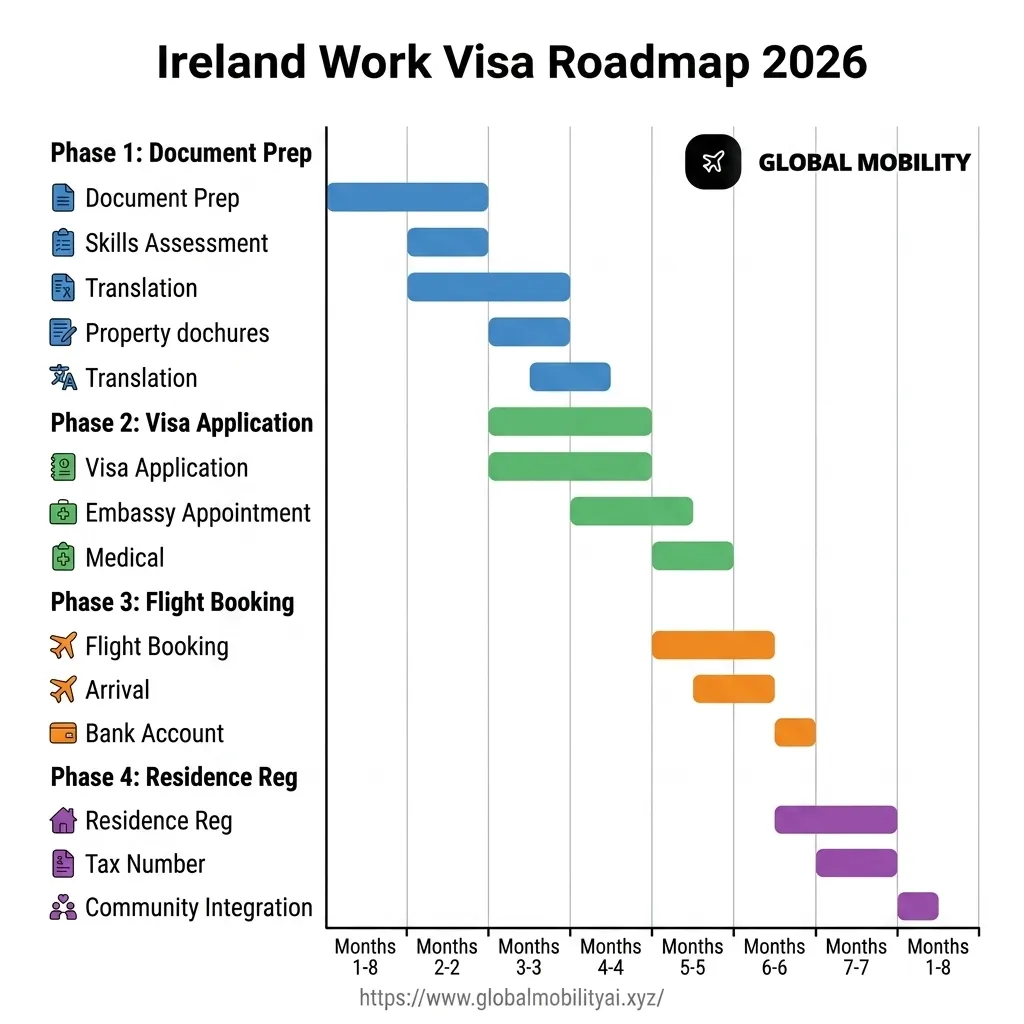
IMG-05: Visa Processing Timeline
Phase 1 — Preparation (Months 1–2)
This initial phase focuses on contract negotiation and document collection before initiating the official application portal.
Phase 2 — Application (Months 3–4)
Once the documents are prepared, the official application is submitted via the digital portal.
Phase 3 — Arrival & Administration (Month 5–6)
This phase covers the entry visa process, entry into Ireland, and initial local registration.
Phase 4 — Settlement & Permanent Residency (Month 12+)
Long-term settlement processes and transition to permanent status.
11. Critical Risk Factors & Common Pitfalls

IMG-11: Visa Rejection Risks
12. FAQ — People Also Ask
Q: What is the processing time for the Ireland Critical Skills Employment Permit 2026?
As of 2026, the Department of Enterprise, Trade and Employment (DETE) processes compliant applications within 4 to 6 weeks. This streamlined timeline is made possible by the updated Employment Permits Online System (EPOS 2.0), which automates employer tax clearance checks and workforce ratio verifications. To ensure your application is processed within this timeline, check your profile alignment beforehand using the GlobalMobilityAI immigration probability calculator to avoid requests for additional information (RFIs) that can delay approval.
Q: Can my spouse work in Ireland if I hold a Critical Skills permit?
Yes. One of the primary benefits of the Critical Skills pathway is that spouses and de facto partners of permit holders are granted immediate access to the Irish labor market. Upon arrival, your spouse can register for a Stamp 1G residency permit, which allows them to work for any employer without needing a separate employment permit. This makes Ireland an exceptionally attractive destination for dual-income households looking to relocate.
Q: What happens if I lose my job while on a Critical Skills permit?
If your employment is terminated or you are made redundant, you must notify DETE within 14 days. You will be granted a 6-month grace period during which you can remain in Ireland to find another qualifying job. During this period, you can apply for a new Critical Skills Employment Permit without having to leave the country.
Q: Do I need to undergo a Labour Market Needs Test for this permit?
No. Because the roles qualifying for the Critical Skills Employment Permit are recognized as experiencing severe labor shortages, DETE waives the requirement for a Labour Market Needs Test. This means your employer does not need to advertise the role locally or within the EEA before offering it to you, significantly speeding up the hiring process.
Q: Can I apply for permanent residency in Ireland after getting this visa?
Yes. After completing 21 months of employment under your Critical Skills permit (Stamp 1), you are eligible to apply to Immigration Service Delivery (ISD) for a Stamp 4 residency upgrade. This status allows you to live and work in Ireland without needing an employment permit. To benchmark your take-home pay and living costs before transitioning to permanent residency, utilize the GlobalMobilityAI monthly savings calculator to manage your long-term financial planning.
Q: What is the minimum salary requirement for a Critical Skills visa in 2026?
Effective March 1, 2026, the minimum annual basic salary is €40,904 for roles listed on the Critical Skills Occupations List (CSOL), and €68,911 for occupations not on the CSOL but not ineligible. A reduced threshold of €36,848 applies to recent graduates of Irish higher education institutions who are applying for roles on the CSOL.
Q: Can I change employers while holding a Critical Skills permit?
You are generally expected to remain with your initial employer for at least 12 months. After this period, you can change employers, provided you secure a new job offer that meets the Critical Skills criteria and submit a new permit application to DETE. Changing employers before the 12-month mark is permitted only in cases of redundancy or contract breach.
Q: Does time spent on a Critical Skills permit count toward citizenship?
Yes. The time you spend in Ireland on your Critical Skills Employment Permit (Stamp 1) and your subsequent Stamp 4 residency counts fully as reckonable residence toward naturalization. Once you accumulate a total of 5 years (60 months) of reckonable residence in Ireland, you are eligible to apply for Irish citizenship.
13. Conclusion: The Bottom Line
Ultimately, the Ireland Critical Skills Employment Permit 2026 represents one of the most structured and direct pathways to permanent residency in Europe. By providing exemption from the labor market needs test and offering a clear, 21-month transition to Stamp 4 status, the Irish framework allows highly skilled professionals to establish a secure, long-term base in a highly resilient economy. However, achieving approval requires strict compliance with document translations, correct Standard Occupational Classification (SOC) coding, and meeting the updated €40,904 and €68,911 salary thresholds. Candidates who manage their documentation meticulously and verify their qualifications beforehand routinely secure their permits with minimal administrative friction.
To evaluate your readiness and verify your visa odds, check your profile alignment using the GlobalMobilityAI immigration probability calculator. Before signing an employment offer, project your net retention and living costs across different Irish cities using our monthly savings calculator to ensure the transition matches your wealth preservation goals. For professionals considering other regions, reviewing our Netherlands Highly Skilled Migrant Visa 2026 guide offers essential comparative insights on European pathways. By taking a structured, data-driven approach, you can transform your relocation into an accelerator for your financial independence.

IMG-12: Digital PR System
Predict your mobility score.
Use our AI engine to get your personalized visa pathway, salary prediction, and relocation roadmap.
More Insights

UK Innovator Founder Visa 2026: Business Plan Requirements, Endorsers & Settlement Path
Fastest Countries to Get Permanent Residency in 2026: Ranked by Timeline & Cost